
This page does not publish a CPC table for commercial loan keywords, because no sourced 2026 figure set exists in our data and an invented one would cost you real ad budget. It gives you the cluster structure, the break-even math and the decision rules that hold regardless of what Google Keyword Planner shows this quarter.
- Commercial loan keyword CPC benchmarks vary by loan type, deal size and match type, so one blended average misleads.
- Pull CPC from your own Google Ads account and Keyword Planner for 2026, then price each cluster against loan size.
- Bid ceiling equals loan revenue per funded deal times close rate times lead-to-deal rate. Never bid from a published average.
- Loans from $500K to $20M+ can absorb high CPCs; sub-$500K keywords rarely can.
Why this matters in 2026
Commercial lending keywords are among the most contested in paid search. Bridge loan, hard money, DSCR, SBA, CMBS and Fannie Mae queries all attract lenders, brokers and lead aggregators bidding against each other. A borrower searching for a $2M bridge loan and a borrower searching for a $15M CMBS loan are different auctions with different economics.
A blended industry CPC hides that. The only CPC that matters is the one tied to your revenue per funded loan. A lender closing $500K to $20M+ deals can pay for clicks that would bankrupt a lender funding small-ticket products.
The benchmark table: fill it from your own account
Use this structure for your 2026 benchmark. Every cell in the data columns comes from your Google Ads account (Search terms and Keywords reports, last 90 days) or Keyword Planner top-of-page bid ranges. Do not copy numbers from a third-party blog that does not state its date and scope.
| Keyword cluster | Example head term | Avg CPC (your data) | Conv. rate (your data) | Cost per lead | Best for |
|---|---|---|---|---|---|
| Overall commercial loans | commercial real estate loan | yardstick row | yardstick row | yardstick row | Brand baseline |
| Bridge loans | commercial bridge loan | fill | fill | CPC / conv. rate | Time-sensitive acquisitions |
| Hard money | hard money lender commercial | fill | fill | CPC / conv. rate | Fix-and-flip, distressed assets |
| DSCR loans | DSCR loan investment property | fill | fill | CPC / conv. rate | Rental investors qualifying on cash flow |
| SBA loans | SBA 7(a) loan | fill | fill | CPC / conv. rate | Owner-occupied business purchases |
| CMBS | CMBS loan lender | fill | fill | CPC / conv. rate | Large stabilized assets |
| Fannie Mae multifamily | Fannie Mae multifamily loan | fill | fill | CPC / conv. rate | Apartment owners |
Keep the Overall row. Every cluster is judged against it, and a cluster that costs more per click only matters if it also costs more per funded deal.
What the cluster comparison tells you
Expect the spread between clusters to follow deal size and urgency, not search volume. Urgent, high-ticket clusters such as bridge and hard money attract the most aggressive bidding because one funded loan pays for hundreds of clicks. Product-education clusters such as DSCR and SBA usually carry longer research phases and lower conversion on the first click.
Read your own table this way:
- Highest CPC, highest loan size: keep bidding if cost per funded deal sits under your revenue ceiling.
- Low CPC, low conversion: usually broad-match leakage. Check the search terms report before raising bids.
- Mid CPC, high conversion: this is where most budget should go.
Methodology and limits
The table above is built from first-party account data over a 90-day window, split by match type and device. Its limit: a new account with under a few hundred clicks per cluster produces noisy conversion rates, so merge adjacent clusters until each has enough volume to trust. Keyword Planner ranges are estimates of auction bids, not what you will actually pay.
Break-even math for commercial loan clicks
Use four inputs and nothing else:
- Revenue per funded loan (origination fee plus any spread you keep).
- Lead-to-funded rate across your pipeline.
- Click-to-lead rate from the landing page.
- Target margin on ad spend.
Maximum CPC = revenue per funded loan x lead-to-funded rate x click-to-lead rate x (1 minus target margin).
A lender with 48-hour pre-approvals can lift click-to-lead by promising the speed in the ad itself. Speed is a message borrowers on bridge and hard money searches respond to, and it raises the CPC you can afford without raising your cost per funded deal.
How to use these benchmarks
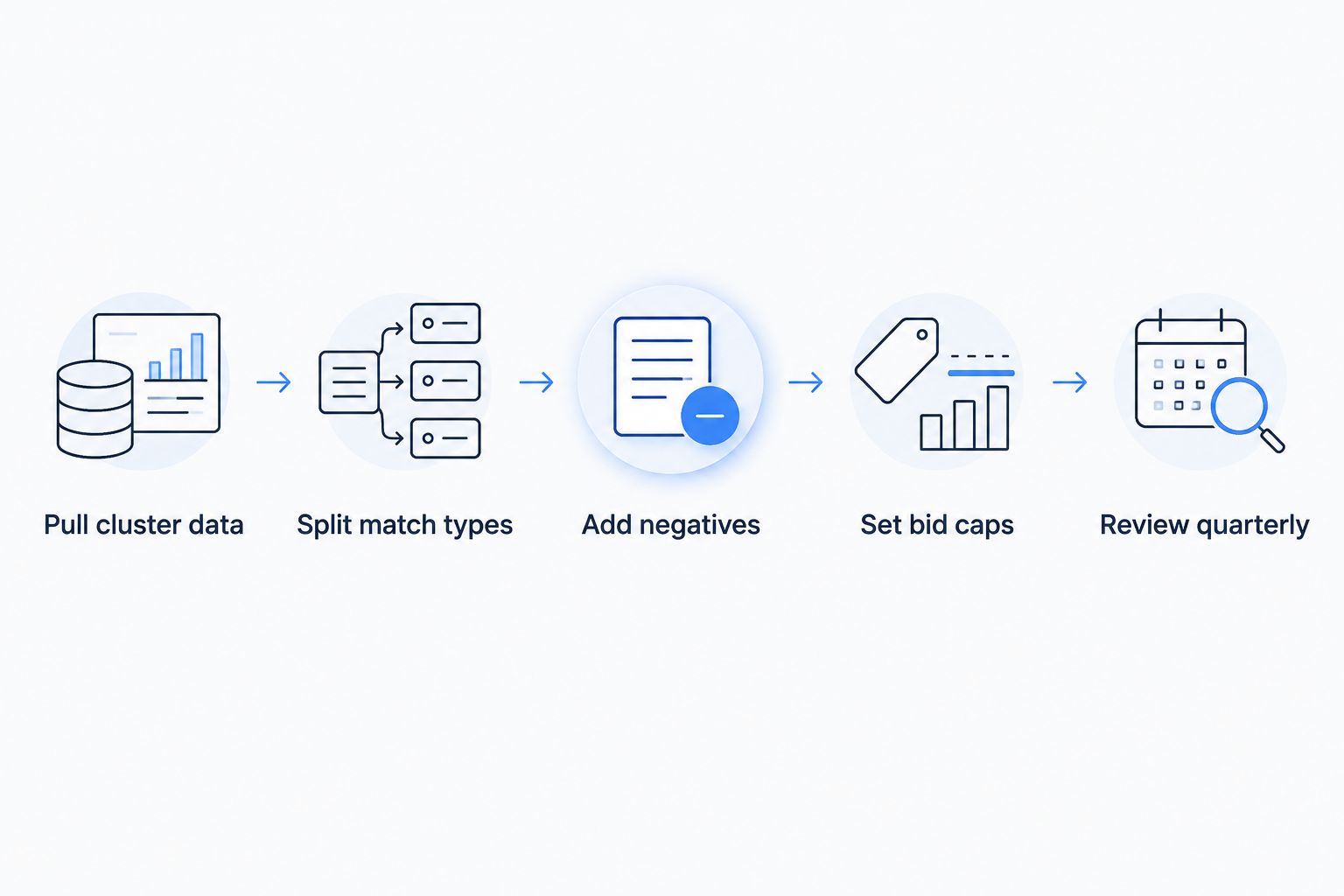
- Set bid caps per cluster, not per account. A $500K bridge loan and a $20M CMBS loan cannot share a ceiling.
- Split exact and phrase match from broad. Broad match in lending pulls in consumer mortgage and personal loan searches that never convert.
- Add negatives early. Residential, personal loan, payday, credit card and student loan terms burn spend on commercial campaigns.
- Match landing page to cluster. Send DSCR queries to a DSCR page, not a generic lending homepage.
- Review quarterly. Auction pricing shifts, so refresh the table at the start of each quarter in 2026.
Where commercial loan clusters differ
The lender you compete against changes by cluster, and so does your angle.
- Bridge loans: competitors win on closing speed. See bridge loan lenders ranked by closing speed to see which promises ad copy is up against.
- DSCR loans: competitors win on qualification terms. Compare against DSCR loan lenders before writing headlines.
- Hard money: the auction mixes local private lenders with national brokers. The hard money lenders for commercial property investors comparison shows how the field positions itself.
- SBA: longer cycles mean you pay for clicks months before revenue. The SBA loan lenders comparison covers the field.
- CMBS: low click volume, high loan size. Track cost per funded deal, not cost per click. See CMBS loan lenders.
Pros and cons of paid search for commercial lending
Pros: intent is explicit, spend is controllable per cluster, and a single funded loan in the $500K to $20M+ range can cover a large block of clicks.
Cons: CPCs rise with competition, lead quality varies by match type, and long closing cycles delay proof that a keyword pays back. Paid search works best next to organic pages that capture the same borrowers without a per-click fee.
Talk to a direct commercial lender
Bridge, DSCR, hard money, SBA, CMBS and Fannie Mae from $500K to $20M+.
FAQ
What is the average CPC for commercial loan keywords in 2026?
No single average holds across clusters. CPC differs by loan type, deal size and match type, so pull your own 2026 figures from Google Ads and Keyword Planner rather than relying on a blended number.
Which commercial loan keywords cost the most per click?
Urgent, high-ticket clusters such as bridge loan and hard money queries typically draw the heaviest bidding, because one funded loan covers many clicks. Confirm against your own account data.
How do I calculate a maximum CPC for loan keywords?
Multiply revenue per funded loan by lead-to-funded rate, click-to-lead rate and one minus your target margin. Bid at or below the result.
Is a high CPC bad for commercial lending?
No. A high CPC is fine when cost per funded deal stays under revenue per loan. On deals between $500K and $20M+, higher CPCs are often profitable.
Should I use broad match for commercial loan keywords?
Start with exact and phrase match. Broad match pulls in consumer mortgage and personal loan searches that rarely convert for commercial lenders.
How often should I refresh CPC benchmarks?
Quarterly. Auction pricing moves with competition and season, so rebuild the cluster table at the start of each quarter in 2026.
Do faster closings justify higher CPCs?
Yes. Speed claims such as 48-hour pre-approvals can lift click-to-lead rates, which raises the CPC you can afford.
One last thing
Benchmarks tell you where the auction sits. Your funded-deal data tells you whether to play. Two lenders paying the same CPC in 2026 can have cost per funded loan that differs several times over, purely from landing page match and follow-up speed. Fix the follow-up first, then bid.