
Instead of repeatedly sending incomplete payoff and property files, organize your SBA 7a to SBA 504 refinance around an eligibility review, a documented use-of-proceeds schedule, and coordinated lender and Certified Development Company underwriting. An existing SBA 7(a) loan is not automatically eligible for a 504 refinance; confirm the applicable refinancing rules before ordering reports or committing to closing expenses.
- Start your SBA 7a to SBA 504 refinance with eligibility, not a rate quote.
- Flexvcapital offers SBA financing; confirm transaction-specific 504 participation before submitting a full application.
- A Certified Development Company must assess qualified debt, borrower benefit, and the applicable refinancing structure.
- Owner-occupied commercial real estate and eligible fixed assets fit 504 financing; ordinary working capital does not.
Why this matters
A 7(a) loan can finance several business purposes within one transaction. A 504 refinance has a narrower fixed-asset purpose and a different financing structure. Moving between them requires more than replacing one loan number with another.
Flexvcapital is a direct commercial lender for commercial real estate investors and business borrowers seeking SBA financing. Review Flexvcapital for the stated lending categories, then ask specifically about the proposed 504 refinance structure. An SBA financing offering does not establish eligibility for your particular transaction.
For a 2026 application, separate three decisions: whether the debt qualifies, whether the replacement financing improves the borrower’s position, and whether the closing can satisfy both lender and SBA requirements. A favorable answer to one does not settle the others.
Before you start
- Assemble the original loan record. Obtain the signed 7(a) note, authorization or approval documents, settlement statement, disbursement records, payment history, amendments, collateral schedule, and current payoff information. Identify the existing lender and SBA loan number.
- Establish access and authority. Assign an authorized borrower representative, accountant, proposed third-party lender, and Certified Development Company, or CDC. Prepare ownership records, financial statements, tax returns, property documents, and existing leases.
- Check the mixed-purpose debt problem first. A 7(a) balance that includes acquisition goodwill, inventory, working capital, and real estate cannot simply be labeled a building loan. Ask the CDC how the original proceeds and remaining debt must be documented under the applicable refinancing rules.
Do not assume that an ordinary refinance checklist covers federally guaranteed debt. Your 2026 eligibility review must identify the rules that apply to refinancing an existing SBA-backed obligation, including any restrictions involving the existing lender.
Choose the refinancing route
Best for a fixed-asset refinance: evaluate SBA 504 only after the CDC confirms the debt and project qualify. Keeping the existing 7(a) loan remains a valid comparison, not a failed outcome.
| Route | Best for | Advantage | Limitation |
|---|---|---|---|
| Keep the existing SBA 7(a) loan | Borrowers whose current financing still meets business needs | Avoids replacing a loan solely to change programs | Leaves the existing repayment structure in place |
| SBA 504 refinance without expansion | Borrowers refinancing qualifying fixed-asset debt | Aligns eligible debt with the 504 fixed-asset structure | Requires the applicable debt, benefit, collateral, and closing tests |
| SBA 504 project with expansion | Borrowers combining an eligible expansion with qualifying debt refinancing | Evaluates the expansion and related refinancing together | Uses different project and refinancing requirements |
For eligible 504 projects, SBA publishes debenture maturities of 10 years, 20 years, and 25 years. These are program terms, not a promise that every component of your financing receives the same maturity or repayment conditions.
Compare the complete transaction. A lower scheduled payment alone does not establish that refinancing is the better decision.
Loan eligibility file
Establish the debt and property facts
- Trace original proceeds. Build a schedule connecting each disbursement to its purpose and supporting document. Separate land, building, improvements, equipment, acquisition costs, and operating uses without assuming that your allocation determines eligibility.
- Reconcile the balance. Match the latest statement to the accounting ledger and payment record. Explain modifications, additional advances, deferred payments, and any difference between principal outstanding and the requested payoff.
- Confirm the property’s use. Document the operating business, property-owning entity, tenant roster, and occupied area. For an existing building, the SBA owner-occupancy baseline is generally at least 51%; the lender and CDC must apply the relevant occupancy and entity rules to the actual project.
- Request a written eligibility screen. Ask the CDC to identify the applicable refinance route, treatment of existing government-guaranteed debt, required payment history, debt-age requirements, and any lender-related restrictions.
Expected result: You have a documented eligibility position and an unresolved-items list before paying for third-party reports. A list of documents received is not an eligibility decision.
Passive investment real estate is not the same as an eligible owner-occupied business property. If your borrower is a property-holding entity, have the CDC review the proposed entity and lease structure rather than assuming that ownership alone satisfies SBA requirements.
Refinance economics file
Compare complete repayment obligations
- Request a dated payoff statement. Include principal, accrued interest, applicable prepayment charges, release requirements, and the date through which the payoff is valid. Obtain an updated statement when the closing date changes.
- Build a sources-and-uses schedule. Show the existing debt to be retired, eligible transaction expenses, proposed financing components, and required borrower contribution. Keep unapproved uses separate from the eligible project.
- Compare both financing components. Review the proposed third-party loan and CDC/SBA debenture together. Record maturity, amortization, payment structure, lien position, and prepayment provisions for each component.
- Have the CDC document borrower benefit. Ask which benefit test applies in 2026 and how the calculation treats the existing obligation, replacement debt, and transaction expenses. Use the required methodology rather than a sales illustration.
Expected result: You can explain why the refinance meets the applicable requirements and whether the economics justify proceeding. The comparison includes every replacement obligation, not only the debenture payment.
Keep a separate liquidity check. A transaction can improve scheduled debt service while still requiring cash at closing or leaving less operating flexibility. Ask your accountant to reconcile the proposed closing contribution with the business’s cash needs.
For application preparation, use the QuickBooks financials to SBA loan approval workflow to organize the financial reporting side of the file.
Underwriting and closing file
Coordinate lender and CDC requirements
- Assign document ownership. Designate who supplies borrower financials, orders the appraisal, coordinates environmental review, obtains title information, and answers underwriting conditions. Confirm report-ordering instructions before commissioning work independently.
- Submit matching financial information. Give the lender and CDC the same financial statements, debt schedule, ownership information, and explanations. Reconcile material changes instead of sending different versions to different parties.
- Resolve collateral and entity conditions. Confirm proposed lien positions, guarantees, insurance, entity authority, and any required agreements involving the operating business and property owner. Identify existing liens that must be released or addressed.
- Approve the funding sequence. Obtain a written closing plan identifying any interim financing, final debenture funding, payoff delivery, recording requirements, and responsibility for completing outstanding conditions.
Expected result: Every party understands which conditions precede closing, which precede debenture funding, and who is responsible for each item. Do not treat a conditional approval as authorization to stop paying the existing loan.
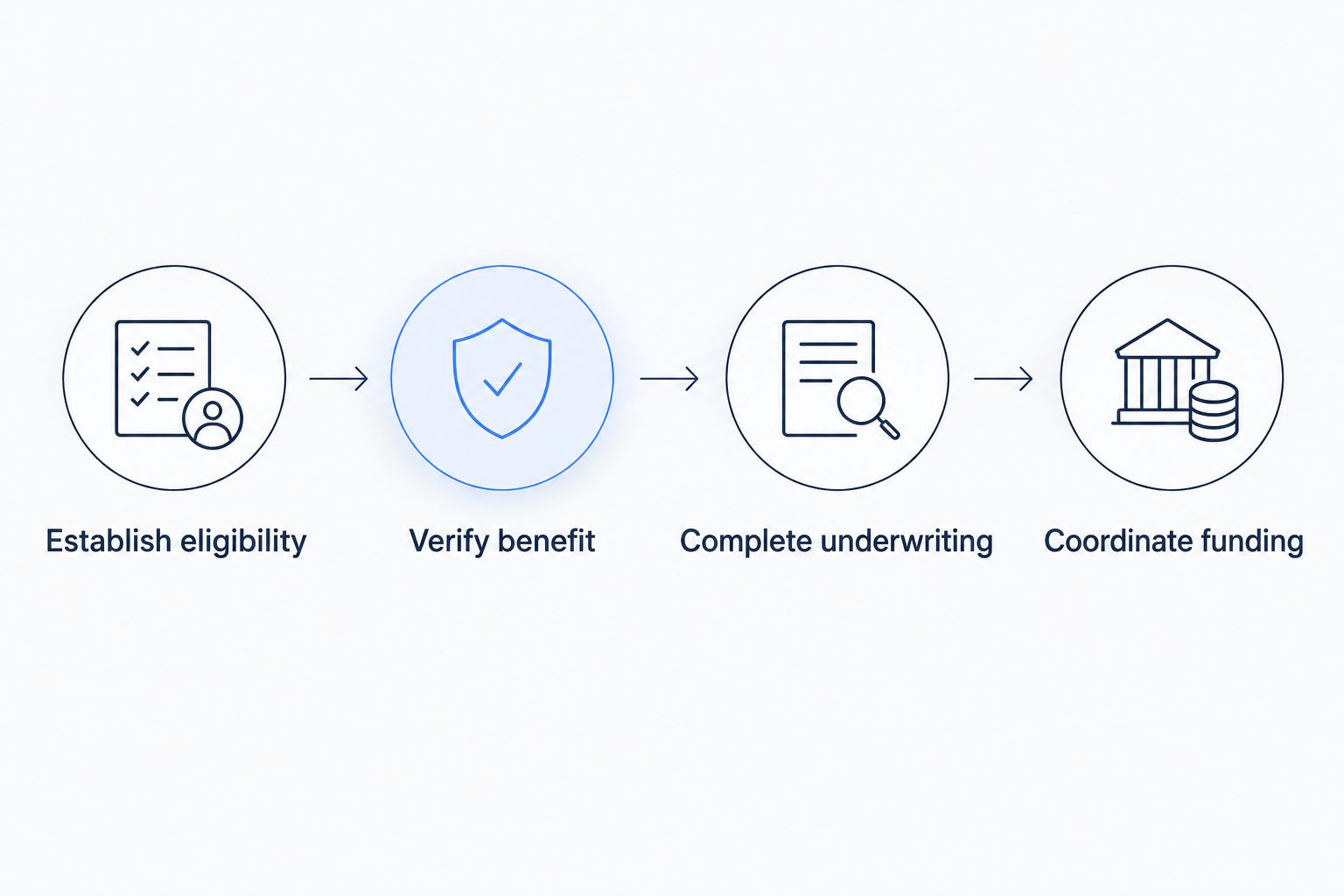
The core process is sequential: establish eligibility, verify benefit, complete underwriting, and coordinate funding. Advancing a file with unresolved eligibility does not remove the underlying problem.
Verify payoff and final records
- Refresh closing-sensitive documents. Update the payoff, financial information, insurance evidence, and authorizations as required. Check that the borrower names and property descriptions match throughout the closing package.
- Confirm actual disbursement. Obtain confirmation that the existing obligation received the required payoff. Follow up on releases, satisfactions, and any remaining document conditions through the responsible closing professional.
- Retain the permanent file. Keep executed notes, closing statements, funding confirmations, payment instructions, insurance requirements, and ongoing reporting obligations together.
Expected result: Your records establish what was paid, what remains outstanding, and which obligations continue after closing.
For your 2026 closing calendar, distinguish the expected closing date from any later debenture funding event. Ask the lender and CDC which obligations remain active between those events and how payments must be handled.
Second variant: refinance alongside an expansion
A refinance tied to an eligible expansion is a different workflow from refinancing without expansion. Best for an expansion project: start with the proposed project scope, then have the CDC determine how existing debt fits. Do not add a construction estimate merely to reclassify the transaction.
Prepare an expansion budget showing the property work, equipment, professional expenses, and other proposed uses. Separate those amounts from the existing debt payoff. The lender and CDC need to evaluate both the new project and the requested refinancing.
Next, document how the business will use the expanded property. Include plans, contracts, occupancy information, and completion requirements requested by the financing parties. A scope change can affect the financing structure, so circulate revisions before signing amended construction commitments.
The advantage is one coordinated review of the expansion and related refinancing. The trade-off is a larger set of project conditions: construction documentation, completion requirements, and funding coordination can become part of the transaction.
Expected result: The approval documents identify the expansion project, eligible refinancing, financing sources, and conditions for each disbursement. Neither work already started nor debt already incurred establishes eligibility by itself.
Troubleshooting
The original loan financed several business purposes
Fix: Reconstruct the original disbursement trail using settlement records, invoices, bank records, and the authorization. Ask the CDC to determine the treatment of the obligation under the applicable rules. Do not substitute your own percentage allocation for that determination.
The payment comparison excludes part of the new debt
Fix: Combine the proposed third-party loan and debenture obligations in the comparison. Include required payments on any debt that remains after closing, and have the CDC apply the prescribed borrower-benefit calculation.
The property is leased to the operating business
Fix: Provide ownership charts, the lease, occupancy calculations, and entity documents at the initial screen. Ask whether the structure satisfies SBA requirements; common ownership does not eliminate the need for review.
Reports were ordered before lender instructions
Fix: Send the existing report to the lender and CDC before commissioning a replacement. Ask whether it satisfies their scope, reliance, and timing requirements. Do not assume that an appraisal prepared for another purpose is acceptable.
The payoff changes before closing
Fix: Obtain a revised payoff and update the sources-and-uses schedule. Confirm that the financing amount, borrower contribution, and closing instructions still reconcile. Continue required payments until the existing lender confirms payoff.
Customize your workflow
Use one shared document register with columns for the requirement, responsible party, status, document date, and unresolved question. Keep sensitive borrower information in the secure delivery method specified by the financing parties, not an unrestricted shared folder.
Add a decision log for eligibility findings and structural changes. Record who confirmed each item and which documents support it. This prevents an early assumption from becoming an undocumented closing instruction.
When approaching Flexvcapital about SBA financing in 2026, state the current loan type, original use of proceeds, property occupancy, outstanding balance, and whether the project includes expansion. Request confirmation of the proposed lender and CDC roles before treating the conversation as a 504 application.
FAQ
Can I refinance an SBA 7(a) loan into an SBA 504 loan?
An SBA 7(a) loan can be considered for 504 refinancing only when the transaction satisfies the applicable SBA requirements. Have the CDC assess the existing government-guaranteed debt, original use of proceeds, borrower benefit, and proposed structure before committing to the refinance.
Is SBA 504 better than keeping my SBA 7(a) loan?
SBA 504 is not automatically better than keeping an SBA 7(a) loan. Compare all replacement obligations, transaction expenses, prepayment provisions, closing contributions, and the business’s need for flexibility.
Can I include working capital in an SBA 504 refinance?
SBA 504 is not a general working-capital loan program. Ask the CDC whether any proposed operating-expense component is permitted under the specific refinancing provisions; do not assume the full balance of a mixed-purpose 7(a) loan qualifies.
Do I need a Certified Development Company for a 504 refinance?
Yes, a Certified Development Company participates in the SBA 504 financing structure. Coordinate the CDC’s requirements with those of the proposed third-party lender rather than treating them as interchangeable approvals.
How much of an existing building must my business occupy?
The SBA owner-occupancy baseline for an existing building is generally at least 51%. The lender and CDC must review the actual occupied area, leases, borrower entities, and applicable project requirements.
How long does an SBA 7(a) to 504 refinance take?
There is no single closing timeline for every SBA 7(a) to 504 refinance. Eligibility review, document completeness, appraisal, environmental review, title conditions, and funding coordination determine the transaction’s schedule.
Does Flexvcapital offer SBA financing?
Flexvcapital lists SBA financing among its commercial lending offerings. Ask specifically about participation in your proposed SBA 7(a) to 504 refinance and the lender and CDC responsibilities for that transaction.
One last thing
Your original disbursement records can matter more than your current mortgage statement. A statement establishes what remains owed; it does not establish what the loan originally financed. Retrieve those records before requesting a refinance proposal, and require the eligibility review to address them directly.