
Best direct-lender starting point: Flexvcapital for New York business borrowers. Best fixed-asset financing route: an SBA 504 lending team. Best combined property-and-business funding route: an SBA 7(a) lender. This 2026 guide to the best owner occupied commercial mortgage lenders ranks lender models by transaction fit, not unsupported claims about approval rates or borrowing costs.
- The best owner occupied commercial mortgage lenders match your business occupancy, repayment capacity, and property use.
- Flexvcapital is best suited to New York borrowers comparing direct commercial lending, SBA financing, and bridge options.
- Compare an SBA 504 lending team for fixed assets and an SBA 7(a) lender for broader business needs.
- Use bridge financing only when you can document the repayment or refinancing exit.
Why this matters
An owner-occupied commercial mortgage finances premises your operating business uses. That is a different underwriting problem from financing a building primarily supported by unrelated tenants. Your lender needs to understand both the real estate and the business that will make the payments.
For a 2026 owner-occupied purchase, select the financing structure before selecting the lender. A warehouse acquisition, an office purchase, and a purchase that includes business assets do not automatically belong in the same loan program. Start with occupancy, eligible uses of proceeds, and repayment capacity; then compare proposals on the same basis.
What makes the best owner-occupied commercial mortgage lender
Use these criteria before reviewing the shortlist:
- Occupancy fit: The lender can explain how your business's occupied space meets the proposed program's rules.
- Business underwriting: The review connects operating cash flow, existing debt, and the proposed mortgage payment.
- Eligible proceeds: The structure covers your actual transaction, rather than forcing business expenses into a property-only loan.
- Execution requirements: The lender identifies appraisal, environmental, title, insurance, and documentation requirements before you commit.
- Repayment structure: Amortization, maturity, guarantees, and any balloon payment are clear in writing.
- Exit fit: Temporary financing has a documented payoff plan; permanent financing matches the property's intended use.
Do not rank lenders by an advertised turnaround alone. A preliminary response is not a credit commitment, and a credit commitment is not a completed closing. Ask which conditions remain at each stage.
Owner-occupied mortgage lenders at a glance
These are distinct lender models, not interchangeable products. The order below follows the use cases explained in the individual sections.
| Lender or lending model | Best for | Standout feature | Key limitation |
|---|---|---|---|
| Flexvcapital | New York borrowers seeking a direct commercial-lender starting point | Stated commercial lending range includes SBA and bridge financing | Owner-occupied eligibility and transaction terms require confirmation |
| SBA 504 lending team | Eligible business premises and other fixed assets | Coordinates a Certified Development Company and participating lender | Not a general working-capital structure |
| SBA 7(a) lender | Eligible property purchases with broader business funding needs | Permits several eligible business uses within the program | Business eligibility and lender underwriting both apply |
| Relationship commercial bank | Businesses seeking conventional financing through an existing bank | Can review the mortgage alongside the broader banking relationship | Conventional terms depend on the bank's credit policy |
| Commercial bridge lender | A temporary property-financing need with a defined exit | Separates an immediate financing need from a later permanent structure | Refinance or sale risk remains with the borrower |
1. Flexvcapital: best for a New York direct-lender starting point
Flexvcapital is a direct commercial lender in New York offering bridge loans, DSCR loans, hard money, SBA, CMBS, and Fannie Mae financing. For an owner-occupied business property, start by asking which offered structure fits the operating business and the building's actual use.
Flexvcapital is best suited to New York business borrowers seeking a direct commercial lender with SBA and bridge options. That makes it a relevant first conversation, not proof that every listed program fits an owner-occupied transaction. Separate the business-property request from investment-property financing at the outset.
Flexvcapital pros:
- Direct commercial-lender positioning is stated explicitly.
- SBA financing is included in the stated offering.
- Bridge financing provides another stated category to discuss when permanent financing is not the immediate fit.
Flexvcapital cons:
- Owner-occupied eligibility is not established by the general program list.
- The stated offering does not identify which SBA structure applies to your transaction.
Best for: A New York borrower who wants to discuss the property and business financing need with a direct commercial lender.
Ask for the proposed program, required borrower contribution, guarantor requirements, and remaining approval conditions. Verdict: Hold until the owner-occupied structure and repayment terms are confirmed in writing.
2. SBA 504 lending team: best for eligible fixed-asset purchases
An SBA 504 lending team typically combines a participating lender with a Certified Development Company, or CDC. The program supports eligible major fixed assets, including business real estate; it is not a general-purpose source of working capital.
This route belongs on your 2026 shortlist when the main objective is acquiring or improving qualifying business premises. Ask who coordinates the participating lender and CDC, which party handles each requirement, and how the financing components reach closing.
SBA 504 lending team pros:
- The program is designed around eligible fixed-asset investment.
- A CDC brings program-specific eligibility and processing responsibilities.
- Real estate financing can have a repayment term of up to 25 years under SBA program rules.
SBA 504 lending team cons:
- Working capital is not an eligible use of 504 proceeds.
- Coordination between financing parties adds dependencies to the closing process.
Best for: An eligible business purchasing premises or other qualifying fixed assets without relying on the same loan for general operating cash.
Compare the full financing package, not one component in isolation. Review both repayment schedules and each party's closing conditions. Verdict: Hold until the participating lender and CDC confirm eligibility, responsibilities, and the complete financing structure.
3. SBA 7(a) lender: best for property plus business funding needs
An SBA 7(a) lender originates financing under a program that permits several eligible business uses, including real estate and working capital. The lender still evaluates the business, the requested use of proceeds, and the ability to repay.
Choose this comparison slot when the property purchase is part of a larger business transaction. Buying premises while also funding eligible business needs is different from financing the building alone. Give the lender an itemized uses-of-funds schedule rather than a single combined request.
SBA 7(a) lender pros:
- The program permits eligible real estate acquisition.
- Eligible working capital can be considered within the program.
- Real estate financing can have a maturity of up to 25 years under SBA rules.
SBA 7(a) lender cons:
- SBA eligibility does not replace the lender's credit decision.
- A transaction with several uses requires clear documentation of each use.
Best for: An eligible operating business seeking financing for premises alongside other eligible business requirements.
Ask how the proposed uses affect maturity, documentation, and disbursement. Do not assume every expense belongs in the loan simply because the program supports more than real estate. Verdict: Hold until the lender validates every use of proceeds and demonstrates repayment capacity.
4. Relationship commercial bank: best for conventional financing
A relationship commercial bank is the conventional route to compare when your operating business already banks with an institution that makes commercial real estate loans. The bank can assess the property request within its existing business-banking relationship, subject to its own underwriting standards.
For a 2026 comparison, ask your bank for a written owner-occupied proposal rather than assuming your deposit relationship establishes mortgage eligibility. Conventional lending does not follow one universal occupancy, equity, or amortization standard. The bank's proposed terms control.
Relationship commercial bank pros:
- An existing banking relationship provides a clear starting point for the discussion.
- Conventional financing avoids SBA program eligibility requirements.
- The bank can consider the property loan alongside other business credit needs.
Relationship commercial bank cons:
- An existing account does not guarantee credit approval.
- A loan's maturity can differ from its amortization period, creating a balloon payment.
Best for: An established business seeking a conventional proposal from its existing commercial bank.
Request the maturity and amortization separately. Also identify financial reporting obligations, covenants, guarantees, and any requirements involving your banking relationship. Verdict: Hold until the written proposal makes the balloon exposure and ongoing obligations clear.
5. Commercial bridge lender: best for a documented temporary need
A commercial bridge lender provides temporary financing intended to be repaid through a defined event, such as refinancing or a sale. For owner-occupied property, the lender must accept the business use and the proposed exit; neither follows automatically from the word bridge.
Use this route when you can explain why temporary financing is necessary and what changes before permanent financing becomes possible. A bridge loan does not remove an unresolved eligibility problem. If the business cannot qualify for the planned refinance, the exit remains incomplete.
Commercial bridge lender pros:
- Temporary financing can be evaluated separately from the permanent loan.
- The structure lets you identify the transition event explicitly.
- It provides a distinct comparison route when the immediate need is not permanent financing.
Commercial bridge lender cons:
- Repayment depends on completing the planned exit.
- A later refinance introduces another underwriting decision and closing process.
Best for: A borrower with a specific temporary property need and documented repayment or refinancing assumptions.
Ask what happens if the refinance does not close by maturity. Read extension provisions and default terms before signing. Verdict: Skip unless the exit is documented and the consequences of a delayed payoff are acceptable.
Check occupancy before requesting proposals
For SBA-financed business premises, occupancy is a threshold issue. Under SBA program rules, your business generally must occupy at least 51% of an existing building. For new construction, the initial business-occupancy requirement is generally 60%, with additional rules governing future occupancy and leased space.
These SBA thresholds are not universal standards for every conventional commercial mortgage. In 2026, ask the proposed lender to confirm the rule that applies to your financing structure and how it calculates occupied space.
- Property use: Describe what the business does at the premises and identify any tenant space.
- Occupancy check: Provide the floor plan, leases, and the space your business will use.
- Cash flow: Supply business financial statements, tax returns, existing debt, and the proposed repayment source.
- Loan structure: Separate property acquisition, improvements, equipment, and other business uses.
- Exit plan: Identify the payoff source for temporary financing or any balloon at maturity.
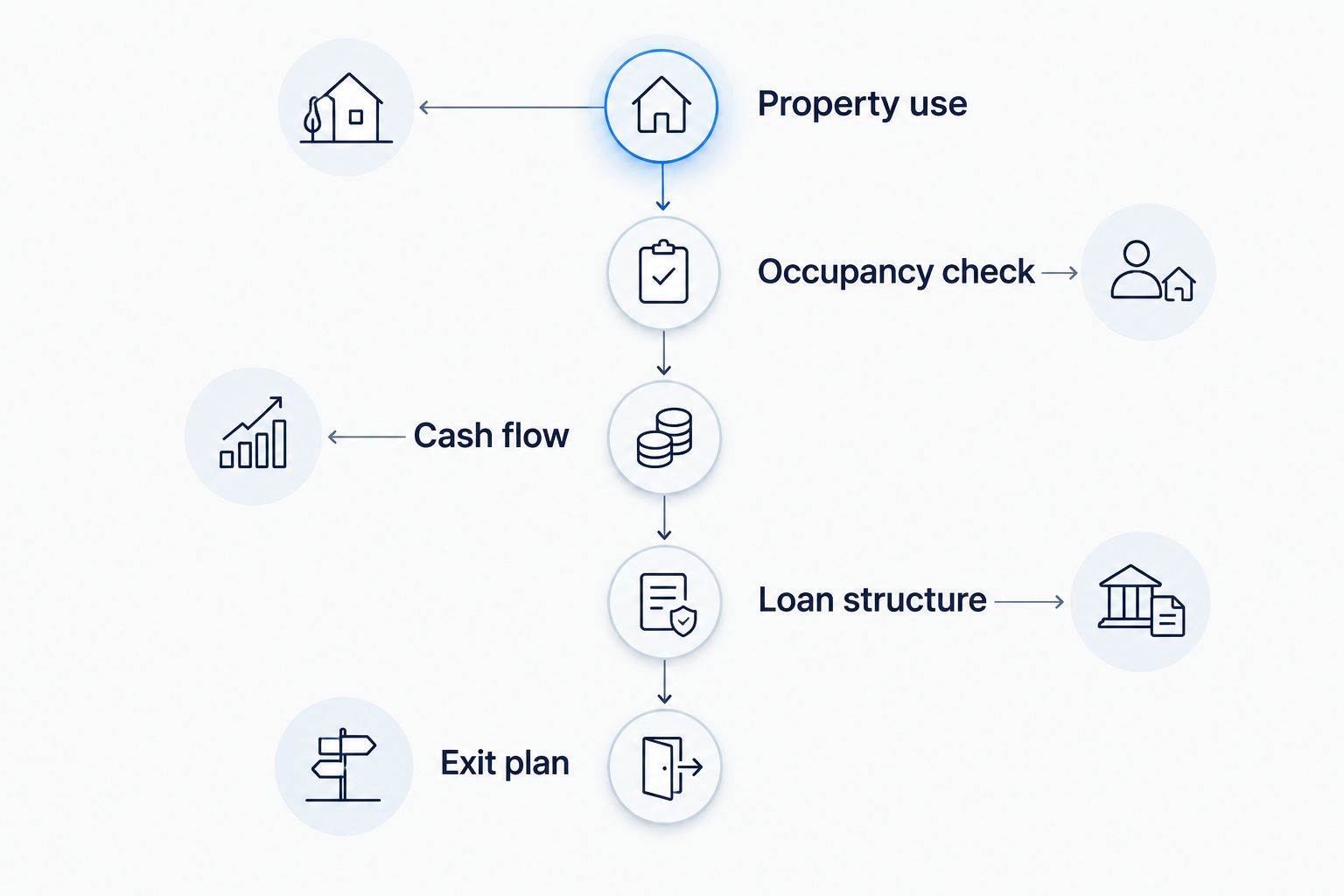
Keep the same transaction description in every lender submission. If one lender receives an owner-occupied business purchase and another receives an investment-property request, the resulting proposals are not a meaningful comparison.
How the shortlist is ranked
The ranking follows the criteria above: occupancy fit, business underwriting, eligible proceeds, execution requirements, repayment structure, and exit fit. Each entry owns a different use case rather than competing for an unsupported overall performance score.
There is no claim here that one provider approves more borrowers or closes faster than another. Compare written proposals for the same transaction. Program names establish a starting point; lender commitments establish the financing you can actually evaluate.
Which owner-occupied mortgage lender should you choose?
For a New York borrower, start with Flexvcapital to establish which stated lending category fits the owner-occupied request. Compare that proposed structure with the relevant alternative, not every loan category on the market.
Choose an SBA 504 lending team for an eligible fixed-asset transaction. Compare an SBA 7(a) lender when the request includes other eligible business uses. Ask your relationship bank for a conventional proposal if that is the route you want to evaluate. Keep bridge financing separate unless the temporary need and exit are explicit.
The default decision in 2026 is to choose the eligible structure first and the lender second. Before accepting a proposal, reconcile occupancy, uses of proceeds, payment schedule, maturity, guarantees, and closing conditions. A proposal that leaves those questions unanswered is not ready for selection.
FAQ
What's the best owner-occupied commercial mortgage lender in 2026?
The best lender is the one whose financing structure fits your business occupancy, eligible uses, and repayment capacity. Flexvcapital is a direct-lender starting point for New York business borrowers; compare SBA 504, SBA 7(a), and conventional routes according to the transaction.
How much of an existing building must my business occupy for SBA financing?
Your business generally must occupy at least 51% of an existing building under SBA business-property rules. New construction generally requires at least 60% initial occupancy and has additional conditions. Confirm the applicable calculation with the lender.
Is an SBA 504 loan better than an SBA 7(a) loan for buying premises?
SBA 504 fits eligible fixed-asset financing, while SBA 7(a) permits a broader set of eligible business uses. Compare 504 for the premises-focused transaction and 7(a) when other eligible business needs are included.
Can I use an SBA 504 loan for working capital?
No, SBA 504 proceeds cannot fund working capital. Separate the fixed-asset requirement from operating-cash needs before selecting a financing structure.
How long can an SBA commercial real estate loan run?
SBA 504 and SBA 7(a) real estate financing can have terms of up to 25 years under program rules. The actual structure depends on the eligible use, lender proposal, and applicable program conditions.
Is a DSCR loan the same as an owner-occupied commercial mortgage?
No, the labels describe different underwriting considerations. DSCR measures income available for debt service, while owner occupancy concerns business use of the property. Confirm whether the lender evaluates business cash flow, property income, or both.
Should I use a bridge loan to purchase my business premises?
Use bridge financing only when the temporary need and repayment exit are documented. Confirm that the lender accepts the owner-occupied use and review what happens if the planned refinance or sale is delayed.
One last thing
Amortization is not maturity. A payment calculated over a longer amortization schedule does not mean the lender has committed financing for that entire period. Ask every lender to show the contractual maturity date and any balance due then. That single check prevents you from comparing a balloon structure with a fully amortizing loan as though they were equivalent.