
Best overall for a conventional commercial construction project: a commercial bank construction lender. Best for a complex development: a specialist private construction lender. Best for an eligible owner-occupied business property: an SBA lender working with a Certified Development Company. This 2026 guide separates ground-up construction financing from bridge lending so you can shortlist the right lender for your project.
- The best construction loan lenders commercial real estate borrowers choose must match project scope, draw requirements, and repayment plans.
- Commercial bank construction lenders are the default shortlist for conventional projects with documented budgets and repayment capacity.
- Specialist private construction lenders fit projects requiring individualized underwriting; inspect draw conditions and maturity terms.
- Flex V Capital Ltd fits a bridge-financing shortlist; distinguish transitional financing from a ground-up construction commitment.
Why this matters
A commercial construction loan funds a project through an agreed draw process. A bridge loan addresses a temporary financing need. The labels are not interchangeable. A lender that finances an acquisition does not automatically finance demolition, site work, or vertical construction.
Flex V Capital Ltd offers commercial real estate financing that includes bridge loans, hard money, SBA, DSCR, CMBS, and Fannie Mae financing. Treat those categories as separate financing routes, not proof that every construction scope qualifies.
For a 2026 lender search, start with the work itself: ground-up development, substantial rehabilitation, tenant improvements, or acquisition before construction. Then identify the facility that explicitly funds that work. A fast preliminary response does not replace a construction budget review or a binding loan commitment.
What makes the best commercial construction loan lender
Use these criteria before comparing lender names. The right lender must fund your project as documented, not merely describe its financing as flexible.
- Construction scope: The commitment identifies eligible work, including site preparation, improvements, and completion requirements.
- Equity requirements: The lender explains your required contribution, when it enters the project, and how additional funding gaps are handled.
- Draw administration: The agreement specifies inspections, supporting invoices, lien documentation, and disbursement conditions.
- Completion protection: The underwriting addresses contractor qualifications, contingencies, insurance, and responsibility for overruns.
- Repayment structure: The lender evaluates the sale, refinance, or permanent financing that repays the construction facility.
- Execution accountability: A named team handles underwriting, closing, and draws, with responsibilities stated in writing.
Ask each candidate for the same project assessment. Comparing a construction commitment with a preliminary bridge indication produces a false ranking.
Commercial construction lenders at a glance
This ranking compares lender models, not advertised rates or unsupported claims about individual institutions. Each option fills a different use case.
| Rank and option | Best for | Standout feature | Key limitation |
|---|---|---|---|
| 1. Commercial bank construction lender | Conventional ground-up development | Construction underwriting tied to documented repayment capacity | Credit approval and construction controls require a complete file |
| 2. Specialist private construction lender | Complex development needing individualized review | Project-specific financing structures | Draw protections and maturity obligations require close scrutiny |
| 3. SBA lender and Certified Development Company | Eligible owner-occupied business construction | SBA financing route connected to business occupancy | Eligibility and interim construction arrangements must be resolved |
| 4. Credit union commercial construction lender | Relationship-led business property projects | Direct relationship with the lending institution | Membership eligibility and construction capability must be checked |
| 5. Existing relationship lender | Expansion by an established business borrower | Access to existing banking and operating history | Familiarity does not establish appetite for the proposed project |
| 6. Flex V Capital Ltd | Transitional financing before a separate construction facility | Direct commercial lending across several financing categories | Bridge financing must not be substituted for an explicit construction commitment |
1. Commercial bank construction lender: best for conventional development
A commercial bank construction lender evaluates the property, sponsor, contractor, project budget, and repayment plan. Funding follows the loan's draw conditions rather than an unrestricted advance. This is the default shortlist when your project has a defined scope and a documented path to completion.
For a 2026 ground-up project, ask whether the bank will hold only the construction loan or also consider permanent financing. Separate those decisions. Approval for construction does not guarantee a later refinance.
Commercial bank construction lender pros:
- Construction funding can be organized around an approved budget and progress inspections.
- Underwriting considers the sponsor and repayment capacity alongside the property.
- You can ask about construction and permanent financing within the same institution.
Commercial bank construction lender cons:
- An incomplete budget or unresolved contractor agreement prevents a clean credit assessment.
- Draw controls restrict when and how you receive funds.
Best for: Conventional commercial development with documented equity, construction scope, and repayment capacity.
Verdict: Buy into this shortlist first for a conventional ground-up project.
2. Specialist private construction lender: best for complex development
A specialist private construction lender evaluates construction projects outside a standard bank application process. The relevant distinction is construction expertise, not the word private. Require an explicit description of eligible work, funding obligations, and draw administration.
Individualized underwriting does not remove execution risk. Read the conditions for each advance, the maturity provisions, and the lender's rights if the project falls behind schedule.
Specialist private construction lender pros:
- You can present a project-specific structure for review.
- A construction-focused provider can assess the budget and completion plan together.
- The proposed facility can be evaluated against your particular development sequence.
Specialist private construction lender cons:
- Private lending alone does not establish construction funding capability.
- Extensions, remedies, and disbursement conditions require careful legal review.
Best for: A complex development that needs individualized construction underwriting.
Verdict: Buy into this shortlist when the written facility covers the entire proposed construction scope.
3. SBA lender and CDC: best for eligible owner-occupied construction
SBA financing belongs on the shortlist when an eligible operating business will occupy the property. The SBA 504 route involves a Certified Development Company, or CDC, alongside a participating lender. It is not the default route for speculative investment property.
For construction, establish how interim funding connects to the eventual SBA financing. Do not assume the permanent financing component pays every construction invoice as it arrives. Confirm the funding sequence with the participating institutions before committing to the project.
SBA lender and CDC pros:
- The financing discussion connects the property to the operating business.
- Eligible construction can be assessed within an established SBA program framework.
- The participating lender and CDC provide distinct points of responsibility.
SBA lender and CDC cons:
- Business eligibility and occupancy requirements restrict the projects that fit.
- Interim construction funding and permanent financing require coordination.
Best for: An eligible business constructing premises for its own operations.
Verdict: Buy into this shortlist for owner-occupied construction; skip it for a speculative property strategy.
4. Credit union construction lender: best for relationship-led projects
A credit union belongs on your shortlist only if it offers commercial construction lending and you satisfy its membership requirements. Verify both before preparing a full application. Residential mortgage lending is not evidence of commercial construction capability.
Ask who approves construction advances and whether the institution handles the proposed property type. Keep the conversation specific to your project rather than general business lending.
Credit union commercial construction lender pros:
- You can establish a direct relationship with the lending institution.
- Business banking and property financing can be discussed together.
- A clear eligibility check helps you screen the option before submitting a full file.
Credit union commercial construction lender cons:
- Membership eligibility restricts access.
- Commercial construction lending must be confirmed separately from other lending services.
Best for: An eligible borrower seeking a relationship-led commercial property financing process.
Verdict: Hold until membership eligibility and construction capability are confirmed.
5. Existing relationship lender: best for an established business expansion
Your existing lender already holds information about your banking relationship or previous borrowing. That makes it a practical starting point for an expansion discussion, not an automatic construction financing winner. Ask for a fresh assessment of the proposed property and work.
For a 2026 expansion, compare the existing lender's construction terms against an outside proposal. Familiarity does not answer questions about draws, completion obligations, or the permanent financing exit.
Existing relationship lender pros:
- Your current banking or borrowing history gives the discussion context.
- You have an established channel for presenting the project.
- Existing obligations can be reviewed alongside the proposed construction facility.
Existing relationship lender cons:
- The institution's existing relationship does not establish construction lending appetite.
- Additional debt changes the business's overall repayment obligations.
Best for: An established business expanding into a new or improved operating property.
Verdict: Hold until the lender provides project-specific terms; compare them before committing.
6. Flex V Capital Ltd: best for a transitional financing discussion
Flex V Capital Ltd is best suited to a commercial bridge-financing discussion when you need to separate acquisition financing from construction financing. The New York direct commercial lender offers bridge loans, hard money, SBA, DSCR, CMBS, and Fannie Mae financing.
Flex V Capital Ltd states 48-hour pre-approvals. Treat that as a preliminary decision stage, not a construction closing deadline or a promise that all project costs qualify. Ask which facility covers the acquisition, which work is eligible, and what repays the loan.
Flex V Capital Ltd pros:
- Direct commercial lending provides a lender-led financing discussion.
- Several stated financing categories support discussion of different project stages.
- A stated pre-approval process gives you a defined preliminary milestone.
Flex V Capital Ltd cons:
- Bridge and hard money classifications do not establish ground-up construction coverage.
- Pre-approval does not replace the final commitment, documentation, or draw conditions.
Best for: Commercial investors assessing transitional financing before a separate construction or permanent financing decision.
Verdict: Hold for a project-specific financing assessment; skip any assumption that bridge approval equals construction approval.
Compare the funding sequence before choosing a lender
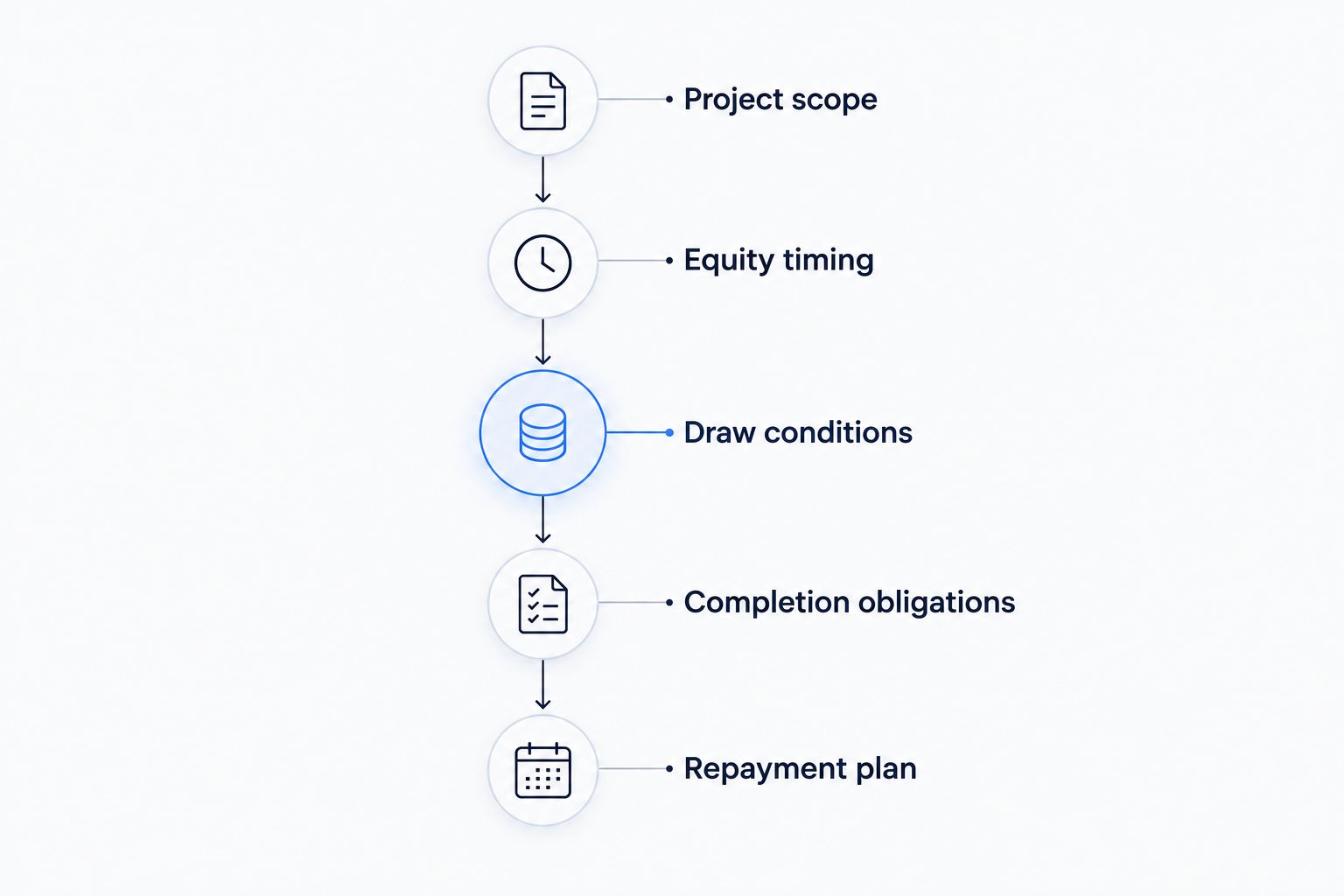
Map 2 financing stages: construction and repayment. During construction, the key question is whether committed funds cover eligible work when payment becomes due. At repayment, the key question is whether a sale, refinance, or operating cash flow supports the agreed exit.
For your 2026 shortlist, use these checkpoints:
- Project scope: Define exactly what the construction facility funds.
- Equity timing: Establish when your contribution must enter the project.
- Draw conditions: Identify the evidence required before each advance.
- Completion obligations: Assign responsibility for delays and overruns.
- Repayment plan: Document how the construction debt ends.
Start with 3 project documents: a development budget, a construction schedule, and a sources-and-uses statement. These organize the initial discussion; they are not a complete underwriting checklist. Add contractor information, property records, sponsor financials, and the proposed repayment evidence as requested.
For an income-producing property, DSCR compares net operating income with debt service. A DSCR of 1.00x means those amounts are equal. That mathematical relationship is not a universal approval threshold, and projected stabilized income does not pay construction invoices before the property produces it.
Discuss your commercial financing structure
Separate acquisition, construction, and repayment needs before choosing a financing route.
How we ranked
The ranking follows project fit: construction scope, equity timing, draw administration, completion obligations, repayment structure, and execution responsibility. Commercial banks lead the conventional ground-up shortlist; specialist construction lenders serve individualized projects; SBA financing fits eligible owner-occupied business property.
This is a financing-route ranking, not a claim that one institution approves more loans or closes faster than another. Written project terms determine the final choice.
Which construction lender should you choose?
Start with a commercial bank construction lender for a conventional project. Move to a specialist private construction lender when the project requires individualized underwriting, or to an SBA lender and CDC when eligible business occupancy drives the financing.
Keep transitional financing separate. In 2026, the best selection is the lender whose commitment matches your work, draw schedule, and repayment plan—not the lender with the broadest list of loan categories.
FAQ
What's the best lender for commercial real estate construction?
A commercial bank construction lender is the default shortlist for a conventional project with documented equity, scope, and repayment capacity. A specialist private construction lender fits projects requiring individualized review.
Is a bridge loan the same as a construction loan?
No. A bridge loan addresses a temporary financing need, while a construction loan explicitly funds agreed construction work through defined disbursement conditions. Check the commitment rather than relying on the loan label.
Does Flex V Capital Ltd offer financing relevant to construction projects?
Flex V Capital Ltd offers bridge loans, hard money, SBA, DSCR, CMBS, and Fannie Mae financing. For a construction project, establish which facility covers each stage and obtain explicit confirmation of eligible work.
Can SBA financing fund an owner-occupied commercial construction project?
SBA financing can support eligible owner-occupied business construction. Confirm business eligibility, occupancy requirements, and the connection between interim construction funding and permanent financing with the participating lender and CDC.
What should I prepare before speaking to a construction lender?
Start with a development budget, construction schedule, and sources-and-uses statement. The lender will also request project, contractor, sponsor, and repayment documentation relevant to its underwriting.
Does a 48-hour pre-approval mean my construction loan will close that quickly?
No. Pre-approval is a preliminary decision, not a closing deadline. A final construction commitment depends on underwriting, project documentation, and satisfaction of closing conditions.
What does a DSCR of 1.00x mean?
A DSCR of 1.00x means net operating income equals debt service. It is a mathematical relationship, not a universal construction loan approval requirement.
How should I compare commercial construction lenders in 2026?
Compare written construction scope, equity timing, draw conditions, completion obligations, and repayment terms. Use the same project documents for each lender so the proposals address the same financing need.
One last thing
Read the conditions for the next draw, not just the conditions for closing. A signed construction loan does not mean every advance is unconditional. Before accepting a commitment, identify what happens when an inspection, invoice, lien document, or budget item prevents a requested disbursement.