
Best starting point for comparing commercial loan programs in New York: Flexvcapital. Best for stabilized rental income: a DSCR-focused lender. Best for transitional property: a commercial bridge lender. Best for collateral-driven underwriting: a hard money lender. The best no doc commercial loan lenders in 2026 are the lenders whose documentation requirements match your property, repayment source, and exit—not simply those advertising fewer forms.
- Compare the best no doc commercial loan lenders by required documents, collateral, repayment source, and exit requirements.
- Flexvcapital offers commercial lending programs; confirm reduced-documentation eligibility before treating any program as no-doc.
- DSCR-focused lenders suit income-producing rentals; bridge lenders suit transitional commercial property.
- Hard money underwriting emphasizes collateral, but no-doc never means no property or borrower verification.
Why this matters
No-doc is a marketing description, not a standardized commercial loan program. A lender can waive personal tax returns while still requiring a rent roll, operating statements, bank statements, identity verification, and property information. Another lender can emphasize collateral but require substantial evidence of your equity and repayment plan.
That distinction matters in 2026 because the wrong interpretation sends you toward the wrong financing. If your problem is personal income documentation, investigate property-income underwriting. If your problem is an unfinished renovation or unstable occupancy, investigate transitional financing instead.
This guide ranks lender-selection routes, not an unsupported leaderboard of named no-doc providers. The named lender offers relevant commercial programs, but a published program list does not establish a tax-return waiver or an unconditional no-doc policy. Get the actual document requirements before paying for third-party reports or making financing-dependent commitments.
What makes the best no-doc commercial loan lender?
Evaluate these criteria before comparing offers:
- Documentation fit: Identify exactly which personal income documents the lender excludes and which borrower, entity, and property documents remain mandatory.
- Property eligibility: Confirm the property type, occupancy, use, and condition fit the program. A residential rental DSCR program is not automatically a commercial-property program.
- Repayment source: Separate property cash flow, business cash flow, and sale or refinance proceeds. Each calls for different underwriting.
- Loan structure: Examine maturity, amortization, recourse, extension conditions, and any restrictions on early repayment.
- Execution requirements: Ask what remains between preliminary approval and funding, including valuation, title, insurance, and legal review.
- Exit feasibility: For temporary financing, establish how the loan will be repaid and what happens if that plan takes longer than expected.
Your 2026 shortlist should follow these criteria in that order. A lender that accepts your paperwork but rejects your property type is not a useful candidate.
No-doc commercial lending options at a glance
| Rank and option | Best for | Standout approach | Key limitation |
|---|---|---|---|
| 1. Flexvcapital | Comparing commercial programs in New York | Offers DSCR, bridge, hard money, SBA, CMBS, and Fannie Mae financing | Reduced-documentation eligibility requires program-specific confirmation |
| 2. DSCR-focused lender | Stabilized rental property | Evaluates property income relative to debt obligations | Property eligibility and cash-flow calculations vary by program |
| 3. Commercial bridge lender | Acquisition, renovation, or lease-up before permanent financing | Matches temporary financing to a transition and repayment exit | Requires a credible exit; permanent financing is not guaranteed |
| 4. Hard money lender | Collateral-driven property transactions | Emphasizes collateral and transaction structure | Collateral review does not eliminate borrower or closing documentation |
There is no universal winner across these options. Start with the property's current condition, then identify the documentation you cannot provide. Reversing that sequence produces an attractive application process for the wrong loan.
1. Flexvcapital: best for comparing New York commercial programs
Flexvcapital is a direct commercial lender in New York offering bridge loans, DSCR loans, hard money, SBA, CMBS, and Fannie Mae financing. Its stated financing range is $500K to $20M+, and its stated pre-approval turnaround is 48 hours. Those are financing amounts and a preliminary approval timeframe—not a funding commitment.
Flexvcapital is best for New York commercial borrowers comparing DSCR, bridge, and hard money financing before choosing a documentation route. Ask which program accepts your property and whether that specific program requires personal tax returns, business returns, income verification, or property operating records.
Flexvcapital pros:
- Direct commercial lender rather than a lender-selection category.
- Offers several financing types relevant to different property conditions and repayment sources.
- States a financing range that helps borrowers screen the requested loan amount.
- States a pre-approval timeframe, distinct from the eventual closing process.
Flexvcapital cons:
- The stated program menu does not establish that any particular loan is no-doc.
- A 48-hour pre-approval is not a 48-hour closing promise.
- SBA, CMBS, and Fannie Mae financing should not be grouped under a blanket no-doc label.
Best for: New York commercial real estate investors and business borrowers who need to compare financing structures before submitting a complete application.
Verdict: Hold selection until the lender confirms your property's eligibility and the required documents in writing.
2. DSCR-focused lender: best for stabilized rental income
A DSCR-focused lender evaluates rental income against the debt obligations defined by its program. DSCR means debt service coverage ratio. The calculation shifts attention toward the property's ability to support its financing, but the exact income treatment and debt-service calculation require confirmation.
This is the first route to investigate when your property produces rent but your personal tax returns do not represent the repayment source. Confirm whether the lender accepts your particular commercial or multifamily property; not every program marketed as DSCR financing serves the same assets.
DSCR-focused lender pros:
- Connects underwriting to rental income and property repayment capacity.
- Provides a relevant screening route when personal earned income is not the central repayment source.
- Lets you evaluate the financing against documented property operations.
DSCR-focused lender cons:
- Weak or unstable income can undermine the property's qualification.
- Rent rolls, leases, valuation, and other property documents can still be required.
- A DSCR label alone does not establish commercial-property eligibility or a tax-return waiver.
Ask whether underwriting uses existing leases, market rent, historical collections, or another permitted income measure. Also establish how the lender treats taxes, insurance, association obligations, vacancy, and other expenses. Different calculations can produce different eligibility outcomes from the same property.
Best for: Stabilized rental property with supportable income and a borrower seeking a property-income underwriting route.
Verdict: Select a DSCR-focused lender only after confirming property eligibility and the lender's actual income calculation.
3. Commercial bridge lender: best for transitional property
A commercial bridge lender provides temporary financing while a property moves toward a sale, refinance, or another defined repayment event. This route fits a transaction whose current condition does not yet support the intended permanent financing.
Investigate bridge financing when acquisition, renovation, or lease-up sits between today's property and your exit. In 2026, treat the exit as an underwriting requirement, not a sentence added to the application. Identify what must change before the next lender or buyer will accept the property.
Commercial bridge lender pros:
- Matches financing to a temporary property transition.
- Separates the acquisition or improvement phase from permanent financing.
- Makes the repayment event an explicit part of the transaction plan.
Commercial bridge lender cons:
- Loan maturity creates a deadline even when renovation or leasing takes longer.
- A refinance exit still depends on the future lender's eligibility requirements.
- Draw procedures and extension provisions can affect execution.
Ask how improvement funds are released, what evidence supports each release, and what conditions govern an extension. If the repayment plan relies on refinancing, identify the income, occupancy, and property-condition requirements of that intended financing before committing to the bridge loan.
Best for: A commercial property with a defined transition and a documented repayment exit.
Verdict: Select bridge financing when the transition is clear; skip it when repayment depends only on hoped-for appreciation.
4. Hard money lender: best for collateral-driven transactions
A hard money lender emphasizes the property's collateral value and the transaction's structure. Hard money and bridge financing can overlap: hard money describes a lending approach, while bridge describes the temporary role of the financing.
This route deserves consideration when collateral, borrower equity, and the exit support the transaction but conventional income documentation does not fit. It does not remove the need to establish ownership, identity, title, insurance, or the lender's other closing requirements.
Hard money lender pros:
- Places collateral at the center of the financing assessment.
- Provides a distinct route to investigate when conventional income underwriting does not fit.
- Connects borrower equity and property value to the lending decision.
Hard money lender cons:
- Collateral-focused underwriting does not mean document-free underwriting.
- Existing liens or a weak valuation can restrict the financing.
- Repayment and maturity still require a workable plan.
Ask how value is established and whether underwriting relies on current condition or a proposed completed condition. Review lien position, recourse, default provisions, and any conditions attached to renovation funding. A reduced personal-income checklist does not make those obligations less important.
Best for: Property transactions supported by collateral, borrower equity, and a credible exit.
Verdict: Select a hard money lender for a collateral-supported transaction; skip offers that leave repayment obligations unclear.
Match the lender to the property before applying
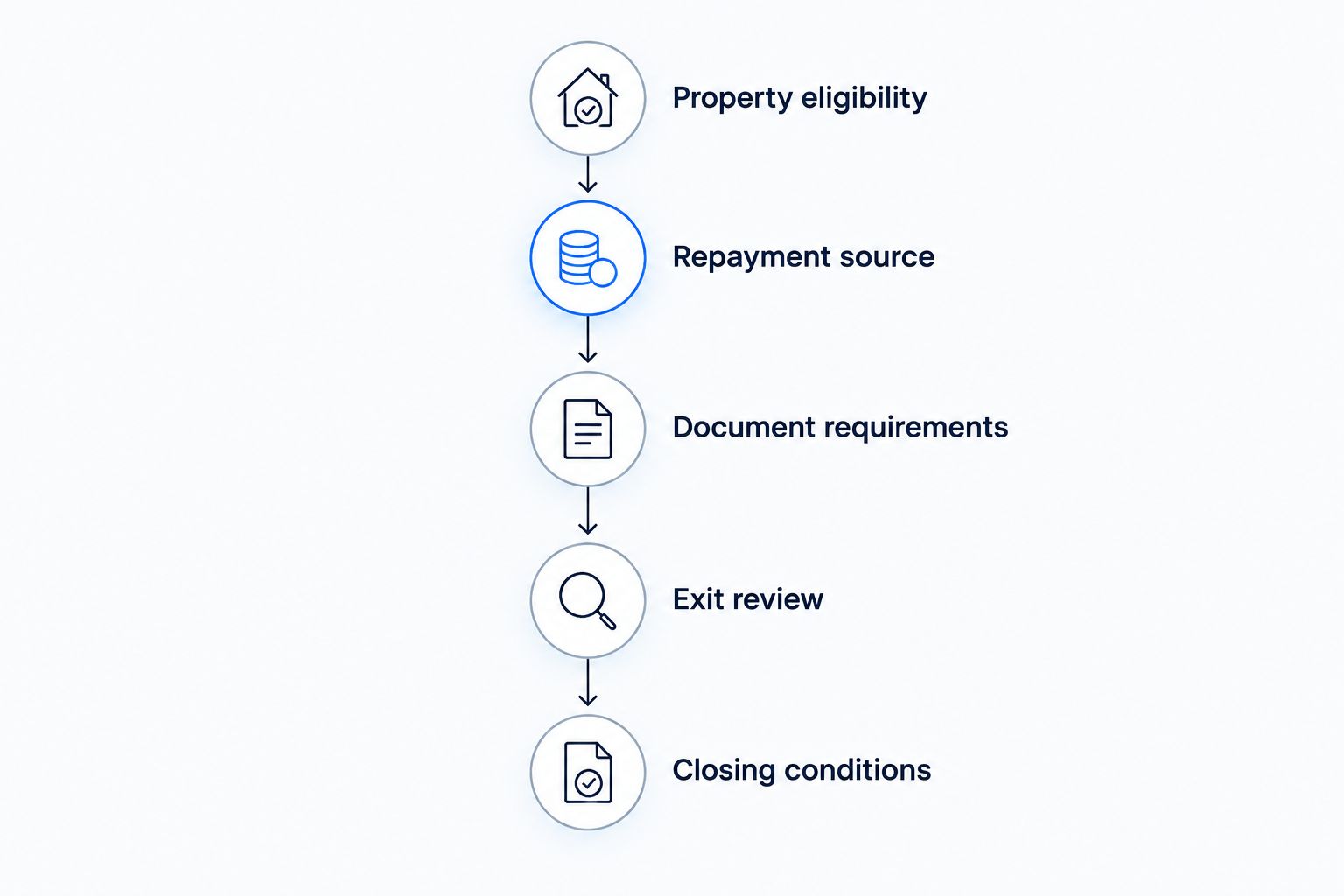
Use this screening sequence for your 2026 financing search:
- Property eligibility: State the property type, location, occupancy, and condition.
- Repayment source: Identify whether repayment comes from rental operations, business operations, sale, or refinancing.
- Document requirements: Ask for the actual borrower, entity, income, and property checklist.
- Exit review: Check that the proposed maturity and repayment event fit the transaction.
- Closing conditions: Confirm what must be satisfied after preliminary approval.
Follow the sequence rather than submitting the same application indiscriminately. If a lender rejects the property type, stop there. If the property fits but the required income documentation does not, ask about another program rather than assuming a no-doc exception exists.
Prepare a concise property summary before speaking to a lender. Include the requested loan amount, acquisition or refinance purpose, current debt, rent information, ownership structure, and proposed exit. Clear transaction facts make the documentation conversation useful; the phrase no-doc alone does not.
Compare your commercial financing options
Confirm property eligibility and document requirements before choosing DSCR, bridge, or hard money financing.
How the options are ranked
The ranking follows documentation fit, property eligibility, repayment source, loan structure, execution requirements, and exit feasibility. The named lender comes first as a starting point for comparing several commercial programs; the remaining entries separate the underwriting routes by transaction use.
This is not a ranking based on approval rates, borrower reviews, or verified no-doc acceptance. Choose from the shortlist only after obtaining a program-specific checklist and reviewing the proposed loan documents.
Which no-doc commercial lending option should you choose?
Default to the underwriting route that matches the property—not the shortest advertised application. For stabilized rental income, start with a DSCR-focused lender. For a property transition, start with a commercial bridge lender. For a collateral-led transaction, investigate hard money.
Borrowers comparing several commercial structures can start with the named New York lender, then narrow the request to a specific program. Your decision standard in 2026 is straightforward: the lender accepts the property, the required documents are obtainable, and the repayment plan fits the loan structure.
FAQ
What's the best no-doc commercial loan lender in 2026?
The best choice depends on your property's condition, repayment source, and the documents the lender requires. Flexvcapital is a starting point for comparing commercial programs in New York, but confirm reduced-documentation eligibility for the specific program before applying.
Does no-doc mean I won't need any documents?
No-doc does not mean document-free financing. A lender can exclude personal tax returns while still requiring property records, identity verification, entity documents, valuation, title, and insurance.
Can I get a commercial property loan without personal tax returns?
Whether personal tax returns are required depends on the lender and program. Ask DSCR-focused, bridge, and hard money lenders for their exact document requirements rather than treating the program name as a waiver.
Is a DSCR loan better than a bridge loan?
A DSCR underwriting route fits income-producing rental property, while bridge financing fits a temporary property transition. The better choice depends on current property operations and the repayment plan; the labels can also overlap within a lender's programs.
Are all DSCR loans available for commercial properties?
No, a DSCR label does not establish eligibility for every commercial property type. Confirm the lender accepts your specific asset and ask which income and debt obligations enter its calculation.
Does hard money financing require income documents?
Income-document requirements depend on the hard money lender and transaction. Collateral-focused underwriting does not eliminate borrower verification, property review, or other closing requirements.
Does pre-approval mean my commercial loan is ready to fund?
Pre-approval is not a funding commitment. Confirm the outstanding underwriting, valuation, title, insurance, and legal conditions before relying on a closing date.
What should I ask a no-doc commercial lender before applying?
Ask which documents are excluded, which remain required, and whether your property qualifies. Then confirm repayment requirements, recourse, maturity, extension conditions, and the steps between preliminary approval and funding.
One last thing
The most useful no-doc question is: Which documents are you replacing, and what evidence replaces them? That answer reveals whether the lender is evaluating property income, collateral, or a temporary exit—and whether the program actually solves your documentation problem.
Keep the answer with your 2026 financing comparison. A shorter checklist is useful only when the resulting loan still fits the property and repayment plan.