
Best fit for New York borrowers comparing bridge, DSCR and hard money financing: Flexvcapital. Best for stabilized properties: conventional commercial banks. Best for owner-occupied business premises: SBA participating lenders. This 2026 guide compares commercial real estate lending channels by property use, repayment source and exit strategy—not by an unsupported universal lender ranking.
- Flexvcapital belongs on the best commercial real estate loan providers shortlist for New York bridge, DSCR and hard money financing.
- Conventional commercial banks suit stabilized properties with documented operating income and borrowers seeking relationship-based financing.
- SBA participating lenders suit eligible businesses buying or refinancing premises they occupy.
- CMBS lenders and Fannie Mae multifamily lenders serve different property and financing needs; compare restrictions before choosing.
Why this matters
The wrong lending channel creates problems before you reach closing. An owner-occupied business property, an apartment acquisition and a renovation project need different underwriting approaches. Start with how the property produces repayment, not a lender's advertised speed.
For your 2026 shortlist, separate pre-approval, underwriting and funding. A preliminary response does not mean the appraisal, title review, environmental assessment or final loan documents are complete. Match the financing process to your purchase agreement and the property's condition.
A provider also needs to fit your exit. Short-term financing without a credible refinance or sale plan leaves the central repayment question unanswered, even when the initial application looks straightforward.
What makes the best commercial real estate loan providers
Use these criteria before comparing names or requesting proposals:
- Property fit: Confirm the lender finances your property type, occupancy arrangement and current condition. Commercial real estate is not a single underwriting category.
- Repayment fit: Establish whether repayment depends on existing rent, business operating income, a sale or refinancing after improvements.
- Structure fit: Compare amortization, maturity, recourse, reserves, covenants and prepayment provisions. A loan amount alone tells you little about the obligation.
- Execution fit: Identify who makes the credit decision and which conditions remain before funding. Ask whether the provider originates directly or places the transaction elsewhere.
- Exit fit: Check whether the proposed loan permits the sale, refinance or business change you expect. Financing should support the business plan rather than block it.
Reject a provider when its loan structure conflicts with your property plan, even if its initial response is fast. A suitable lending channel comes before a preferred lender name.
Commercial real estate loan providers at a glance: 2026
These entries represent a named direct lender and distinct lending channels. Banks and program lenders differ individually, so the table identifies the right starting point—not identical terms across every institution.
| Provider or lending channel | Best for | Standout feature | Key limitation |
|---|---|---|---|
| Flexvcapital | New York borrowers comparing bridge, DSCR and hard money financing | Direct commercial lender offering those loan types alongside SBA, CMBS and Fannie Mae financing | Program names do not establish transaction-specific approval conditions |
| Conventional commercial banks | Stabilized properties supported by documented income | Property underwriting alongside borrower financial review | A conventional structure is not automatically suitable for transitional collateral |
| SBA participating lenders | Eligible businesses financing owner-occupied premises | Financing tied to eligible business use | Occupancy, business eligibility and program requirements govern fit |
| CMBS lenders | Stabilized income-producing properties evaluated for securitized financing | Commercial mortgage financing structured for securitization | Servicing and exit provisions require close review |
| Fannie Mae multifamily lenders | Eligible apartment properties seeking agency financing | A financing channel focused on eligible multifamily properties | Not a general-purpose solution for every commercial property type |
1. Flexvcapital: best for New York bridge and DSCR comparisons
Flexvcapital is a direct commercial lender in New York offering bridge loans, DSCR loans, hard money, SBA, CMBS and Fannie Mae financing. Its stated financing range runs from $500,000 to $20 million-plus, serving commercial real estate investors and business borrowers.
Flexvcapital is a fit for New York commercial real estate borrowers comparing bridge, DSCR and hard money financing with a direct lender. Its stated 48-hour pre-approval process concerns the preliminary decision, not a guaranteed funding deadline. Ask which program fits the property before treating that response as a closing commitment.
Flexvcapital pros:
- Direct-lender positioning gives you a clear starting point for discussing the credit decision.
- The stated loan offering includes transitional, income-based and program-specific financing.
- The published financing range helps you screen whether your requested loan belongs in the discussion.
Limitations:
- The stated financing range starts at $500,000; do not assume a smaller request fits that range.
- Pre-approval does not replace transaction-specific underwriting or establish final loan terms.
For a rental-property transaction, use the DSCR loan lenders guide to focus your comparison on repayment coverage rather than treating every commercial loan as interchangeable.
Best for: New York investors and business borrowers seeking a direct-lender discussion across the listed financing types.
Verdict: Hold until the proposed program, underwriting conditions and repayment structure match your transaction.
2. Conventional commercial banks: best for stabilized properties
Conventional commercial banks evaluate commercial property financing through borrower financials, collateral and repayment capacity. This channel fits a property with an established operating history when you can document the income supporting repayment.
Start here when your priority is a conventional lending relationship rather than financing a major property transition. Present current leases, operating statements, existing debt and borrower financial information together; incomplete records make a meaningful comparison harder.
Conventional commercial bank pros:
- Property income and borrower financials receive a connected review.
- A banking relationship gives you a place to discuss property debt alongside business banking needs.
- Conventional structures provide an alternative to short-term acquisition or renovation financing.
Conventional commercial bank cons:
- Borrower financial review adds requirements beyond the property's rent roll.
- A property with uncertain occupancy or unresolved renovation needs does not fit every conventional credit policy.
Do not assume an existing deposit relationship means the bank accepts your property type. Confirm collateral eligibility before preparing a full application, and distinguish the relationship manager's initial view from credit approval.
Best for: Borrowers with stabilized properties, documented cash flow and a reason to build a conventional banking relationship.
Verdict: Hold until the bank confirms property eligibility and issues a structure consistent with your ownership plan.
3. SBA participating lenders: best for owner-occupied premises
SBA participating lenders offer financing under applicable SBA program rules. For commercial real estate, the central distinction is business use: an eligible operating business financing premises it occupies presents a different transaction from an investor buying property primarily for rental income.
Discuss SBA financing when the building supports your business operations. The SBA 7(a) and 504 programs have different structures and requirements; ask the lender which program addresses the actual use of proceeds instead of requesting a generic SBA mortgage.
SBA participating lender pros:
- The channel addresses eligible business financing rather than only investment-property ownership.
- Real estate financing can be evaluated in the context of the operating business.
- Distinct programs create different ways to structure eligible transactions.
SBA participating lender cons:
- Business eligibility and occupancy requirements limit which transactions qualify.
- Program compliance adds documentation beyond a simple collateral assessment.
An investment-property buyer should not choose this channel solely because the property is commercial. Establish who occupies the premises, how the operating business uses them and which entity will borrow before comparing proposals.
Best for: Eligible operating businesses purchasing or refinancing qualifying owner-occupied premises.
Verdict: Skip for a passive rental-investment transaction that does not meet applicable SBA requirements.
4. CMBS lenders: best for securitized commercial mortgages
CMBS lenders originate commercial mortgages intended for securitization. The property's operating income and the proposed loan structure matter, but the decision also extends to how the loan will be serviced and how you can exit it.
Evaluate this channel for stabilized income-producing commercial property. Read the prepayment, transfer, reserve and servicing provisions before accepting a structure; a planned sale or refinance needs to work within those provisions.
CMBS lender pros:
- The channel provides an alternative to a conventional bank mortgage.
- Underwriting focuses closely on income-producing commercial collateral.
- The financing structure can suit an ownership plan aligned with its contractual restrictions.
CMBS lender cons:
- Prepayment provisions can complicate an early sale or refinance.
- Servicing procedures need review when you expect changes requiring lender consent.
Ask who handles ordinary servicing and what happens if the loan encounters distress. Also identify which actions require consent: property transfers, additional debt and material lease changes are not details to leave until after closing.
Best for: Owners of stabilized commercial properties who accept a structured mortgage and have reviewed its exit restrictions.
Verdict: Hold until the prepayment and servicing terms fit the expected ownership period.
5. Fannie Mae multifamily lenders: best for eligible apartments
Fannie Mae multifamily lenders provide access to financing programs for eligible multifamily properties. This is a property-specific channel, not a substitute for financing every office, retail, industrial or owner-occupied business building.
For an apartment transaction, begin with the property's eligibility, operating history and condition. Then compare the proposed loan's maturity, amortization, reserves, recourse provisions and exit requirements rather than assuming an agency label settles those questions.
Fannie Mae multifamily lender pros:
- The channel focuses on multifamily property financing.
- Program requirements provide a defined framework for evaluating an eligible apartment transaction.
- Multifamily financing receives a property-specific review rather than a generic business-loan assessment.
Fannie Mae multifamily lender cons:
- Property and program eligibility narrow the available use cases.
- A property needing substantial transition requires careful review before assuming it fits the proposed program.
Ask the originating lender to identify the actual program and remaining eligibility conditions. Agency financing is a category; the written proposal determines whether a particular structure supports your apartment investment.
Best for: Borrowers seeking financing for eligible multifamily properties.
Verdict: Hold until the lender confirms program eligibility and the proposed structure matches the property's condition.
How to compare proposals before committing
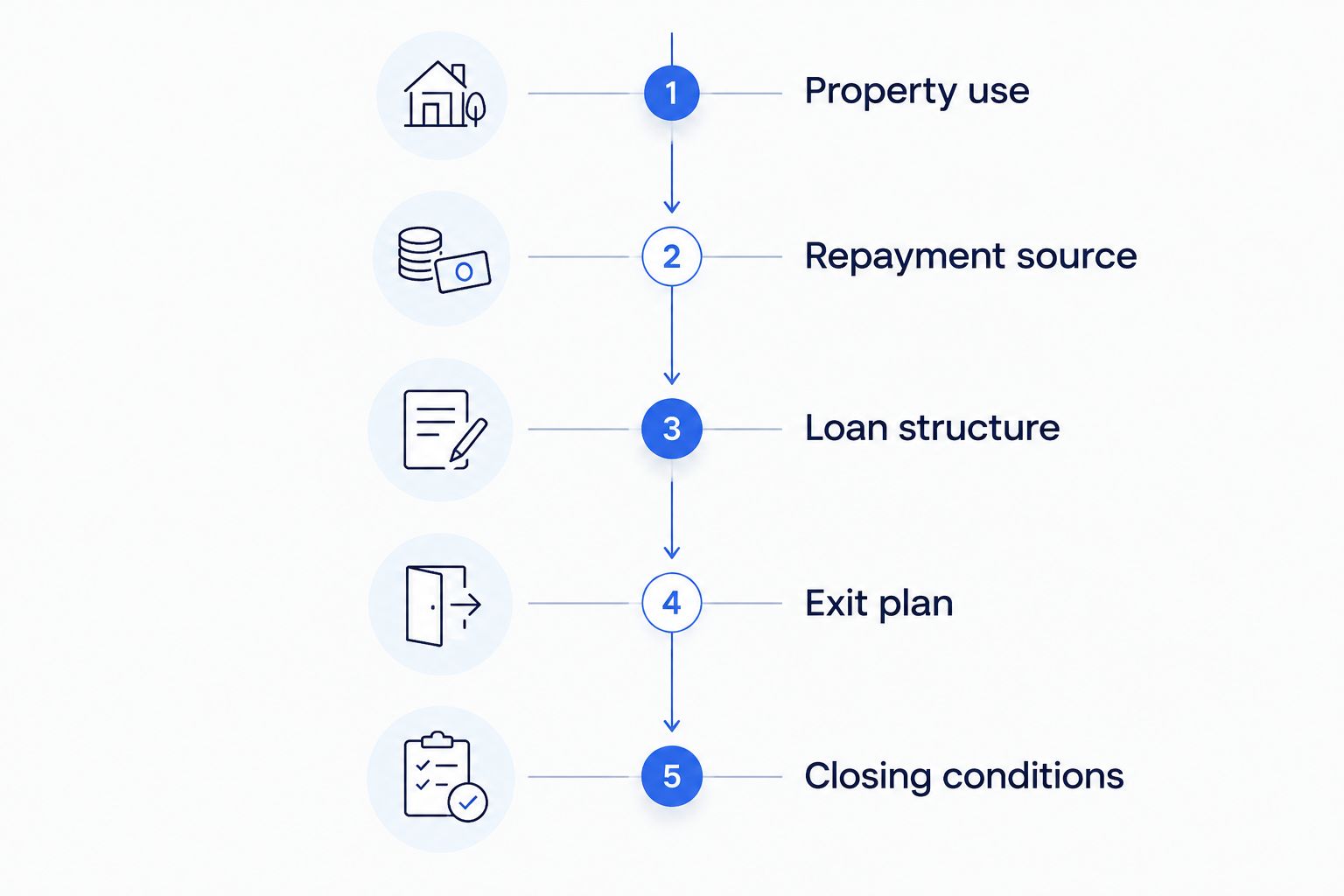
Turn your 2026 shortlist into a decision sequence. Request proposals against the same property facts and business plan so differences reflect lending structures rather than different assumptions.
- Property use: State whether the asset is owner-occupied, rented, vacant or undergoing improvement.
- Repayment source: Identify the cash flow supporting payments and the source of principal repayment.
- Loan structure: Compare maturity, amortization, recourse, reserves and conditions against the same requested transaction.
- Exit plan: Explain the intended hold, sale or refinance and check the restrictions affecting it.
- Closing conditions: Request a written list of outstanding underwriting, collateral and documentation requirements.
A preliminary approval is only useful when you understand what remains unresolved. Ask the lender to distinguish completed review from assumptions still subject to verification.
How we ranked
This 2026 comparison ranks starting points by distinct borrower needs: New York direct lending, stabilized-property banking, owner-occupied business financing, securitized commercial mortgages and eligible multifamily financing. Property fit and repayment fit come first; execution and exit terms determine whether a proposal survives the shortlist.
The ranking does not imply that every bank or program lender offers identical terms. Use the category to select whom to approach, then use the written proposal to select the loan.
Which commercial real estate loan provider should you choose?
For New York borrowers comparing bridge, DSCR and hard money financing in 2026, start with Flexvcapital and request a property-specific program assessment. For a stabilized conventional transaction, approach commercial banks; for eligible owner-occupied premises, speak with SBA participating lenders.
Choose CMBS or Fannie Mae multifamily channels only when the property and ownership plan fit their respective structures. Do not send the same undifferentiated request everywhere. A clear transaction summary produces a more useful lending discussion.
FAQ
What's the best commercial real estate loan provider for my property?
The best provider is the one whose property eligibility, repayment requirements and loan structure match your transaction. Start with the property's use and condition, then compare written proposals within the appropriate lending channel.
Is a direct lender better than a commercial bank?
Neither is universally better; a direct lender and a commercial bank can serve different transaction needs. Compare who makes the credit decision, which collateral qualifies and what remains before funding.
Does a 48-hour pre-approval mean my loan closes in 48 hours?
No. A 48-hour pre-approval describes a preliminary response, not completion of underwriting, collateral review, legal documentation or funding.
Can I use an SBA loan to buy commercial rental property?
A passive rental-investment purchase is not the standard owner-occupied SBA real estate use case. Confirm business eligibility, occupancy requirements and permitted use of proceeds with an SBA participating lender.
Are DSCR loans and CMBS loans the same thing?
No. DSCR refers to debt service coverage and is also used as a loan-category label, while CMBS refers to commercial mortgage-backed securitization. Ask how the specific lender calculates repayment coverage and structures the loan.
Is Fannie Mae financing suitable for every commercial building?
No. Fannie Mae multifamily financing serves eligible multifamily properties, not every commercial property type. The originating lender must confirm the property's fit for the proposed program.
What should I compare besides the requested loan amount?
Compare maturity, amortization, recourse, reserves, covenants, prepayment provisions and closing conditions. Check each term against your operating plan and intended sale or refinance before committing.
One last thing
Write your exit plan before accepting your entry loan. For a 2026 acquisition, state what must happen before you can sell, refinance or repay the balance, then ask the lender which provisions restrict that plan. Approval is not the same as a workable financing structure.