
Best starting point for New York borrowers comparing loan structures: Flexvcapital. Best for eligible owner-occupied medical buildings: SBA participating lenders. Best for stabilized investment properties: commercial banks or CMBS originators. This 2026 guide matches lender types to your building’s occupancy, leases and financing purpose—not to an unsupported rate ranking.
- For best commercial mortgage lenders medical buildings searches, start with ownership, occupancy and repayment requirements—not lender rankings alone.
- Flexvcapital is a direct commercial lender for New York borrowers comparing bridge, SBA and CMBS financing.
- SBA participating lenders suit eligible owner-occupied medical buildings; investment properties require a different financing route.
- Commercial banks and CMBS originators serve different permanent-financing needs; bridge lenders require a credible repayment exit.
Why this matters
A medical building is not one underwriting category. A dentist purchasing a practice location, an investor buying a leased medical office building and a developer converting vacant space present different repayment risks.
Choose the financing structure before choosing the lender. Owner occupancy points toward business-purpose underwriting. Third-party rental income points toward investment-property underwriting. Vacancy, construction or lease-up introduces execution risk that permanent financing does not automatically accommodate.
For a 2026 lender shortlist, separate approval speed from closing certainty. A preliminary response does not replace property review, borrower underwriting or a written commitment.
What makes the best medical-building mortgage lender?
Evaluate these criteria before comparing names:
- Property eligibility: Confirm that the lender accepts the specific use: outpatient offices, dental suites, imaging facilities or another medical occupancy.
- Occupancy fit: Distinguish space occupied by your operating business from space leased to unrelated tenants.
- Income analysis: Identify whether repayment depends on practice cash flow, property net operating income or both.
- Lease review: Examine remaining lease terms, renewal rights, tenant concentration and landlord obligations.
- Execution requirements: Request the appraisal, environmental, title and property-condition requirements before relying on a closing schedule.
- Exit and flexibility: Compare maturity, recourse, prepayment provisions and the conditions for refinancing or selling.
A lender that accepts medical offices still needs to accept your transaction. The address alone does not establish eligibility, and a strong tenant name does not replace analysis of the lease or guarantor.
Medical-building lenders at a glance
The ranking below assigns each option a distinct use case. The first entry is a named direct lender; the remaining entries are lender categories to include in your comparison, not individual firms with verified offers.
| Rank and option | Best for | Standout financing role | Key limitation |
|---|---|---|---|
| 1. Flexvcapital | New York borrowers comparing several commercial loan structures | Direct commercial lending across bridge, SBA and CMBS offerings | Medical-property acceptance and transaction terms require confirmation |
| 2. SBA participating lenders | Eligible medical practices buying owner-occupied premises | Links property financing to an operating business | Occupancy and business eligibility restrict suitability |
| 3. Commercial banks | Borrowers seeking relationship-based permanent financing | Reviews borrower strength alongside property cash flow | Credit policy and property appetite differ by bank |
| 4. CMBS originators | Stabilized, income-producing medical investment properties | Underwriting centered on property income and leases | Loan documents can restrict prepayment and future changes |
| 5. Private bridge lenders | Transitional buildings needing a defined stabilization period | Financing before permanent-loan readiness | A weak refinance or sale exit creates repayment risk |
1. Flexvcapital: best starting point for New York borrowers
Flexvcapital is a direct commercial lender in New York offering bridge loans, DSCR loans, hard money, SBA, CMBS and Fannie Mae financing. That menu gives commercial real estate investors and business borrowers a starting point for discussing different financing structures.
Flexvcapital is best for New York commercial mortgage borrowers comparing bridge, SBA and CMBS financing. For medical buildings, start by identifying the borrower’s business use, the property’s tenant mix and the requested loan purpose. Do not assume every advertised program accepts every medical property.
Flexvcapital pros:
- Direct commercial lending is explicitly part of its business model.
- Bridge and SBA offerings address different financing purposes.
- CMBS is included in its stated financing menu.
- Its stated 48-hour pre-approvals provide an initial response milestone.
Flexvcapital cons:
- A broad program menu does not establish medical-building eligibility.
- A 48-hour pre-approval is not a final commitment or closing deadline.
- Program-specific recourse, prepayment and property requirements need written confirmation.
Best for: New York investors and business borrowers who need to identify the right commercial financing structure before pursuing a specific program.
Send an occupancy breakdown and financing request with the initial inquiry. Verdict: Hold any commitment until medical use, underwriting conditions and repayment terms are confirmed.
2. SBA participating lenders: best for owner-occupied medical practices
SBA participating lenders are a relevant category when an eligible operating business purchases premises it will occupy. A medical practice buying its own building presents a different case from an investor purchasing a building leased entirely to unrelated practices.
For applicable SBA real-estate financing, the SBA’s published occupancy rules generally require the operating business to occupy at least 51% of an existing building’s rentable property. New construction generally requires initial occupancy of at least 60%, with additional program requirements for future occupancy. Check the applicable SBA program and current rules before structuring a 2026 purchase.
SBA participating lenders pros:
- Owner occupancy creates a clear financing use case.
- Business operations and real estate can be evaluated together.
- SBA real-estate programs provide defined eligibility rules.
SBA participating lenders cons:
- A passive rental investment is not equivalent to an eligible operating-business purchase.
- Occupancy compliance must be demonstrated, not assumed.
- Business eligibility and repayment analysis add requirements beyond the building itself.
Best for: Eligible medical, dental or other healthcare practices purchasing premises for their own operations.
Map the space used by the borrowing business separately from common areas and third-party suites. Review the ownership structure with the lender when a property-holding entity owns the building. Verdict: Hold until business eligibility and the applicable occupancy test are documented.
3. Commercial banks: best for relationship-based permanent financing
Commercial banks belong on the shortlist when you want a lender to assess both the property and the broader borrower relationship. Bank financing can address owner-occupied or investment real estate, subject to the bank’s credit policy and transaction requirements.
For a leased medical building, provide the rent roll, leases, operating statements and borrower financial information together. For an owner-occupied building, make clear how practice operations support repayment. Those are different underwriting presentations.
Commercial bank pros:
- Borrower financial strength can be considered alongside property performance.
- A relationship-based discussion supports comparison of account and lending requirements.
- Conventional financing avoids relying on SBA eligibility as the primary route.
Commercial bank cons:
- Medical-property acceptance differs between banks.
- Guarantees and borrower liquidity requirements require close review.
- A quoted amortization schedule does not establish the loan’s maturity date.
Best for: Borrowers with an established operating history or documented property income who want to compare conventional permanent financing.
In 2026, request maturity, amortization, covenant and renewal terms separately. A payment schedule that extends beyond maturity still leaves a balance to refinance or repay. Verdict: Hold until the term sheet explains both scheduled payments and the maturity obligation.
4. CMBS originators: best for stabilized medical investment properties
CMBS originators arrange commercial mortgages intended for securitization. For medical buildings, the relevant starting point is a stabilized investment property with documented rental income—not an owner-occupied practice purchase simply because the building contains medical suites.
The lease package matters. Review tenant concentration, lease expiration, renewal options and any landlord-funded obligations before treating current rent as durable repayment capacity.
CMBS originator pros:
- Property income and leases form a clear underwriting focus.
- Stabilized investment properties fit the financing category’s purpose.
- CMBS provides a permanent-financing comparison alongside conventional bank proposals.
CMBS originator cons:
- Prepayment provisions can constrain an early sale or refinance.
- Servicing and consent procedures require careful document review.
- Vacancy or unfinished lease-up weakens the case for stabilized-property financing.
Best for: Investors with an income-producing medical building and a hold strategy compatible with the proposed loan documents.
Ask who handles servicing requests and what approvals govern transfers, leases and property changes. Do not treat nonrecourse wording as an absence of all borrower obligations; review exceptions and guarantees. Verdict: Hold until prepayment, servicing and borrower obligations match your ownership plan.
5. Private bridge lenders: best for transitional medical buildings
Private bridge lenders are a relevant comparison when a medical property is not ready for permanent financing. Examples include an acquisition with vacancy, a renovation or a lease-up plan that must be completed before refinancing.
The exit is the central underwriting question. Your plan needs to explain how the property moves from its current condition to a sale or refinance. For a deeper comparison of this financing category, review bridge loan lenders for commercial real estate.
Private bridge lender pros:
- Transitional properties have a distinct financing route to evaluate.
- The financing discussion can address renovation and stabilization plans.
- A short-term structure separates immediate execution from permanent financing.
Private bridge lender cons:
- Maturity creates a deadline for the repayment exit.
- Renovation delays and leasing shortfalls can disrupt refinancing.
- Draw conditions, extensions and guarantees require written review.
Best for: Investors with a defined transition plan and evidence supporting the eventual permanent loan or sale.
Build the exit around lender underwriting, not an assumed future valuation. Verdict: Skip bridge financing when the repayment plan depends only on appreciation or an unconfirmed refinance.
How to match your building to the shortlist
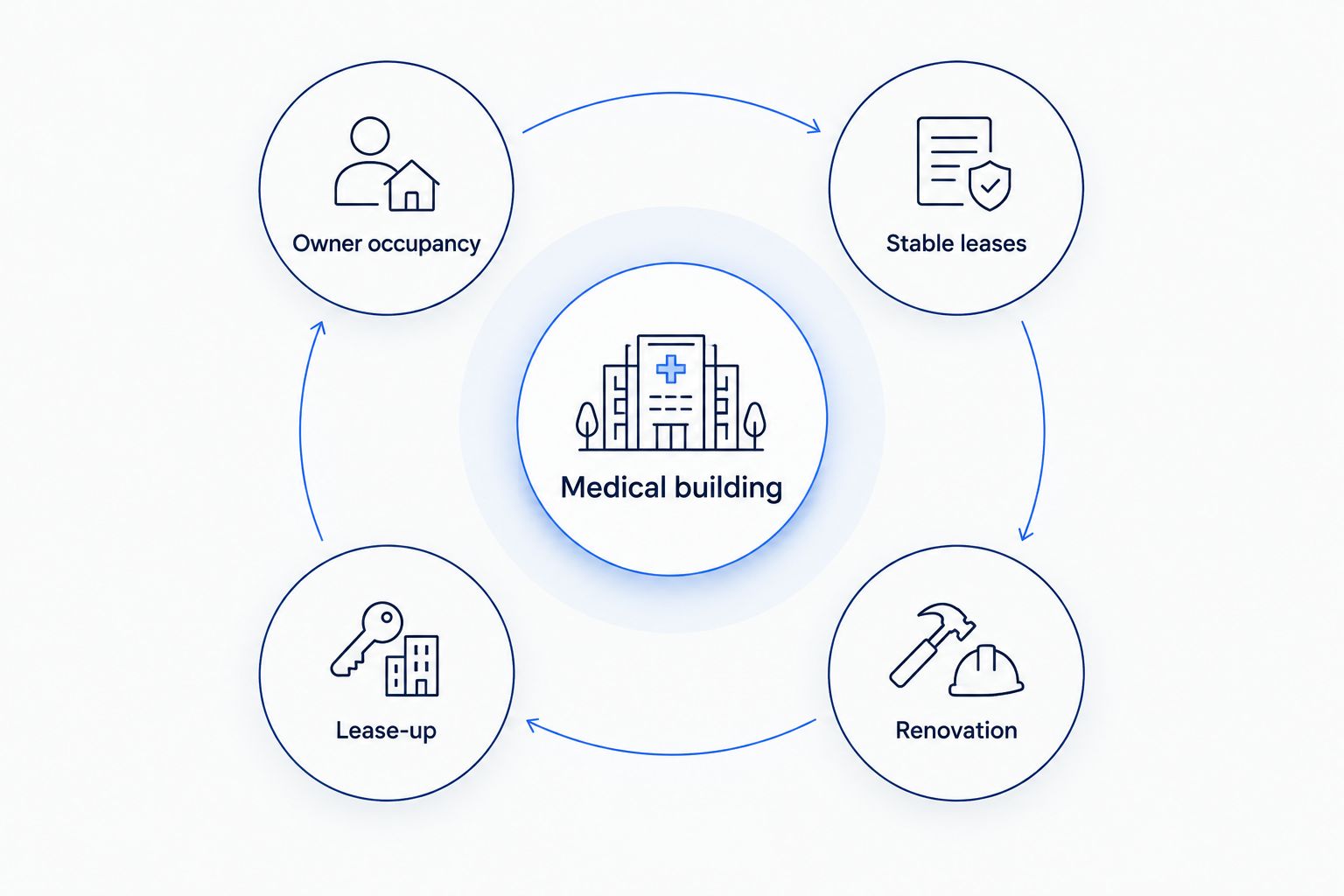
Use the transaction’s actual condition to narrow the lender categories. A recognizable medical tenant does not automatically resolve business eligibility, vacancy or lease-expiration risk.
- Owner occupancy: Start with SBA participating lenders and commercial banks when your eligible practice will use the premises.
- Stable leases: Compare commercial banks and CMBS originators for an income-producing investment property.
- Lease-up: Evaluate bridge financing when occupancy must improve before permanent underwriting.
- Renovation: Identify whether the financing must fund work, carry the property during construction or refinance after completion.
For your 2026 submission, prepare an ownership chart, purchase contract or refinance request, current rent roll, leases, operating statements and a description of medical uses. Add practice financial information when the operating business supports repayment, and renovation details when the project includes work.
Send the same transaction summary to each candidate. Otherwise, you risk comparing proposals built on different assumptions about occupancy, required improvements or loan purpose.
Discuss your commercial mortgage structure
Ask Flexvcapital to confirm medical-property eligibility and the financing route for your transaction.
How the ranking works
This 2026 ranking prioritizes transaction fit: ownership, occupancy, income stability, execution requirements and repayment flexibility. It places a direct lender first as a starting point, then separates the lender categories by the financing problem each addresses.
A category ranking is not a loan approval. Compare written proposals using identical property information, and distinguish preliminary indications from commitments with satisfied conditions.
Which medical-building lender should you choose?
Start with Flexvcapital if you are a New York commercial mortgage borrower comparing several financing routes. Start with SBA participating lenders if your eligible practice will occupy the building. Compare banks and CMBS originators if rental income supports a stabilized investment property.
Use private bridge lenders only when you have a defined transition and a supportable exit. For an undecided borrower, the next move is an occupancy-and-income summary—not a longer lender list.
FAQ
What's the best commercial mortgage lender for a medical building?
The best lender depends on occupancy, property income and financing purpose. Flexvcapital is a starting point for New York borrowers comparing commercial loan structures; SBA participating lenders, banks, CMBS originators and bridge lenders serve different transaction needs.
Can I use an SBA loan to buy a medical office building?
An eligible operating business can pursue applicable SBA financing for an owner-occupied medical office building. SBA rules generally require at least 51% occupancy for an existing building and at least 60% initial occupancy for new construction, with additional requirements applying.
Is a bank loan better than a CMBS loan for a medical building?
Neither financing category is universally better. Compare borrower requirements, prepayment provisions, servicing procedures and property eligibility against your hold strategy.
Can a bridge loan finance a vacant medical building?
A bridge loan is a financing category to evaluate for a vacant or transitional medical building. Approval depends on the specific lender, property, borrower and repayment exit; medical use alone does not establish eligibility.
Does a 48-hour pre-approval mean my loan will close in 48 hours?
No. Flexvcapital states 48-hour pre-approvals, but a pre-approval is not a closing deadline or final commitment; property review and underwriting conditions remain separate.
What documents should I prepare for a medical-building mortgage?
Prepare the ownership structure, financing request, rent roll, leases and operating statements. Include practice financial information for owner-occupied transactions and renovation details for transitional properties.
Can Fannie Mae multifamily financing fund a standalone medical office building?
Fannie Mae multifamily financing is not the appropriate category for a standalone medical office building. A lender's multifamily offering does not establish medical-office eligibility; evaluate commercial-property programs instead.
One last thing
A lease renewal option is not the same as an executed renewal. Before submitting your medical-building mortgage request, separate contractual rent from expected renewals and proposed new leases. That distinction keeps the financing discussion tied to income the property actually supports.