
Instead of manually rebuilding each draw package and waiting until construction ends to arrange refinancing, connect construction draws to permanent loan takeout through one controlled document register, draw reconciliation, and closing checklist. For a 2026 project, start with the permanent lender’s completion and income requirements, then work backward to the remaining construction milestones.
- Construction draws to permanent loan takeout requires separate checks for construction funding, property completion, and refinance eligibility.
- Flexvcapital is best for commercial real estate borrowers seeking a direct lender for takeout financing discussions.
- Reconcile every draw against the budget, supporting invoices, inspection findings, and lender-approved disbursements.
- Start permanent underwriting before construction ends; completion alone does not establish repayment capacity.
Why this matters
A construction draw pays for eligible project costs under the construction loan documents. A permanent takeout replaces that debt with longer-term financing after the property satisfies the new lender’s requirements. A funded final draw is not a permanent loan approval.
Your construction lender and takeout lender evaluate different risks. The construction lender tracks completion, collateral, and remaining costs; the permanent lender also evaluates sustainable repayment capacity, property eligibility, and its own closing conditions.
Flexvcapital is a direct commercial lender in New York offering bridge, DSCR, hard money, SBA, CMBS, and Fannie Mae financing. Flexvcapital is best for commercial real estate borrowers seeking a direct lender for takeout financing discussions. Match the financing to the property and borrower rather than treating those programs as interchangeable.
Before you start
- Collect the controlling documents: executed construction loan agreement, approved budget, draw procedures, construction contract, change orders, maturity provisions, and any existing takeout commitment. Use signed documents rather than an outdated financing summary.
- Assign access and responsibility: identify the borrower’s document owner, contractor contact, construction lender’s draw administrator, permanent lender’s underwriting contact, and closing counsel or settlement agent. Obtain access to the required submission channels and current document checklists.
- Resolve the hidden timing conflict: determine whether the permanent lender requires completed construction, occupancy authorization, actual collections, or stabilization before closing. A construction loan can mature before those conditions are satisfied; physical completion does not eliminate that gap.
For your 2026 project file, separate construction maturity, expected completion, and expected permanent closing. Record each date’s source and the person responsible for changes. An extension request is not an approved extension.
Project register
Create a shared register before submitting another draw. The bold labels below are suggested document fields you create, not proprietary lender portal controls; use the lender’s actual form wherever one is required.
- Record the financing baseline. Add Construction Maturity, Extension Conditions, Approved Budget, Funded Balance, Undisbursed Commitment, and Takeout Conditions. Copy contractual terms directly and distinguish committed financing from a preliminary proposal.
- Assign document ownership. For every required item, enter Document Owner, Required Version, Status, and Submission Evidence. Keep the signed contract and approved changes separate from drafts.
- Connect the schedules. Enter the contractor’s completion milestones beside the permanent lender’s requirements. Identify which inspections, permits, leases, operating statements, or other documents depend on work still underway.
Expected result: you have one source for the current financing terms, outstanding documents, and dependencies between construction completion and permanent closing.
Make the register operational
Use distinct statuses such as Not Requested, Requested, Received, Under Review, and Accepted. Receipt is not acceptance. Preserve the lender’s written acceptance or request for corrections rather than marking a document complete because someone uploaded it.
Keep a change log when the budget, ownership structure, construction scope, or closing assumptions change. Send material changes to both lenders where required; a construction lender’s approval does not establish the permanent lender’s acceptance.
Draw package
The draw package should prove what work supports the request, what the lender has already funded, and what remains. Build it around the construction lender’s checklist, not a generic list of documents.
- Reconcile the requested work. Match each requested amount to the approved budget line, contractor payment application, supporting invoice, and prior funding history. Identify stored materials separately when applicable and confirm the lender’s evidence requirements before requesting reimbursement.
- Resolve exceptions before submission. Flag unapproved change orders, disputed invoices, inspection differences, and missing lien documentation. Follow lender requirements and applicable law for conditional or unconditional waivers; do not request an unconditional release that misstates payment status.
- Record the funding decision. Save the submitted package, inspection findings, lender adjustments, approved disbursement, and evidence of receipt. Update the funded balance only after reconciling the lender’s disbursement record.
Expected result: every funded draw traces to approved costs and supporting evidence, while unresolved items remain visible for the next submission and eventual payoff.
Run 3 reconciliation checks
- Budget reconciliation: approved budget, approved changes, funded costs, and remaining costs agree.
- Payment reconciliation: contractor applications, invoices, lender disbursements, and payment evidence agree.
- Debt reconciliation: the borrower’s loan register agrees with lender statements, subject to separately identified interest, charges, and pending transactions.
These checks serve different purposes. A balanced construction budget does not prove every contractor has been paid, and a payment ledger does not establish the construction loan’s final payoff.
Carry this discipline through every 2026 draw cycle. Do not overwrite previous submissions; retain the history needed to explain adjustments and resolve discrepancies.
Takeout underwriting
Start the permanent financing file while construction remains active. The objective is to identify conditions that construction completion alone will not satisfy.
- Request the eligibility checklist. Confirm property type, borrower structure, permitted use, completion requirements, income documentation, and the proposed loan’s underwriting basis. Ask which conditions must be met before approval and which must be met before funding.
- Build the operating file. Provide the documents the lender requests, such as leases, rent roll, collections, operating statements, insurance information, tax information, and borrower financials. Separate projected income from executed leases and actual receipts.
- Test proceeds against the exit. Compare the lender’s supported loan proceeds with the construction payoff, closing requirements, required reserves, and borrower contribution. Identify a shortfall before scheduling closing; an indicated loan amount is not a final funding commitment.
Expected result: the permanent lender has a reviewable file, and you have a documented list of remaining eligibility, proceeds, and closing conditions.
Keep completion and repayment separate
For income-producing property, net operating income and debt service coverage answer a different question from construction completion. DSCR compares qualifying income with debt service, but lenders and loan programs define eligible income and expenses differently. Use the proposed lender’s calculation rather than applying an assumed universal threshold.
For an owner-occupied property, underwriting also depends on the business and program requirements. Do not substitute a rental-property checklist for an operating-business credit review.
The hard money loan to permanent DSCR refinance workflow addresses the adjacent exit process when rental-property financing is the intended destination. Confirm eligibility before treating DSCR financing as the answer for a commercial project.
Closing control
Treat closing as a separate configuration unit, not the final item in the contractor’s schedule. Construction completion, title clearance, underwriting approval, and funding authorization have separate owners.
- Obtain completion evidence. Collect the inspections, occupancy documentation, contractor closeout records, and other evidence required for this property and loan. Resolve remaining work and retainage under the applicable agreements rather than assuming permanent financing will fund them.
- Reconcile the payoff. Request a current payoff statement through verified channels. Confirm the intended funding date, payoff validity, applicable interest treatment, release requirements, and handling of undisbursed construction proceeds with the lender and settlement agent.
- Authorize closing only after conditions clear. Confirm final loan documents, title requirements, insurance, borrower funds, funding instructions, and release arrangements. Independently verify wire instructions using a known contact method before sending funds.
Expected result: the settlement agent can account for the money needed to close, satisfy the construction debt, and document the new lender’s position.
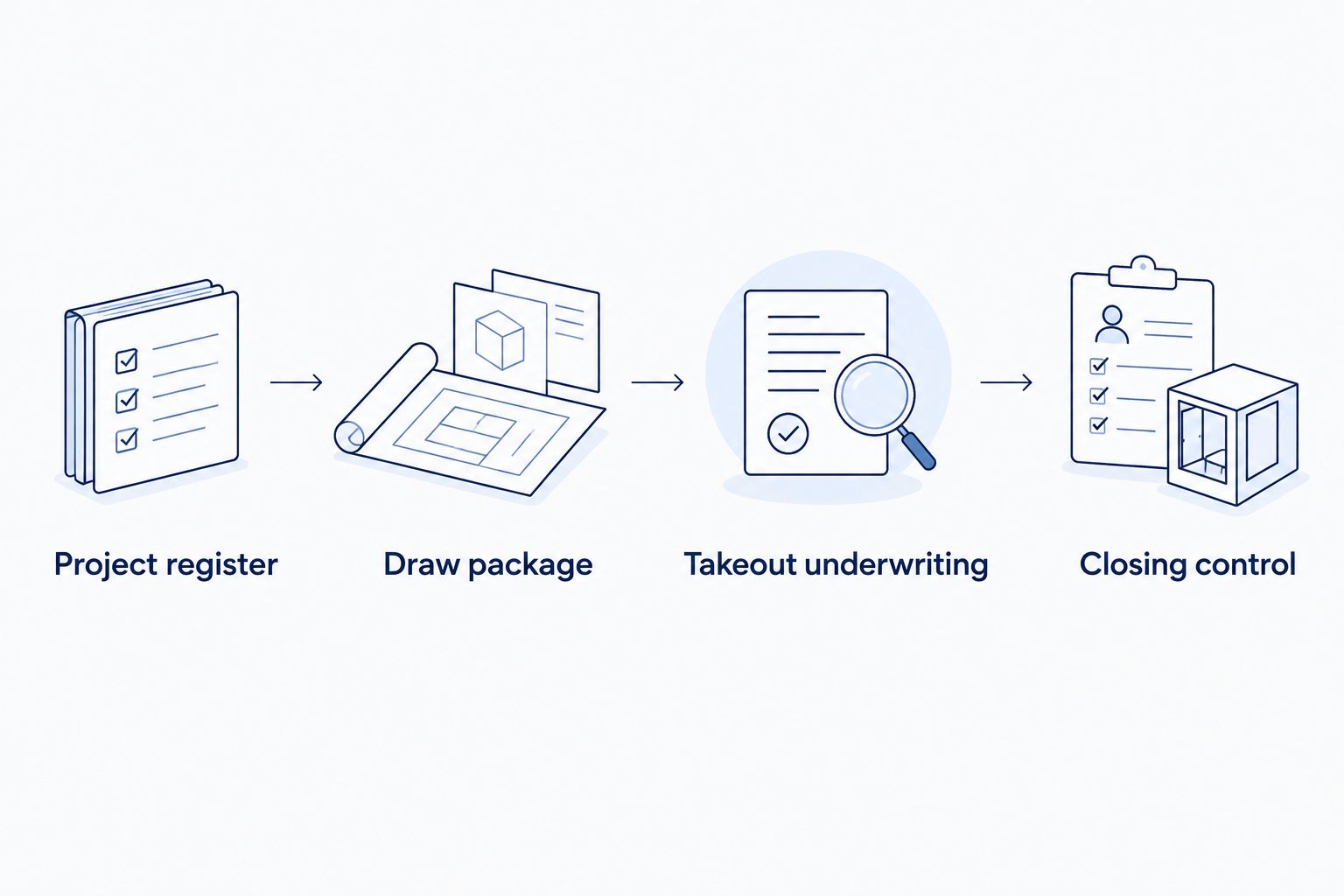
The sequence is Project register, Draw package, Takeout underwriting, and Closing control. Underwriting overlaps construction; the closing gate remains separate.
When completion precedes stabilization
A completed building does not necessarily have the income history required by the intended permanent lender. If lease-up or operating performance remains unfinished, compare a direct takeout with an interim financing stage instead of assuming the original exit still fits.
| Financing path | Best for | Advantage | Limitation |
|---|---|---|---|
| Direct permanent takeout | Completed properties satisfying the permanent lender’s conditions | Replaces construction debt without a separate interim loan | Depends on meeting completion, income, and other closing requirements |
| Interim bridge financing | Properties needing an eligible transition period before permanent financing | Separates construction payoff from the later permanent exit | Adds another maturity, underwriting process, and eventual refinance |
Choose direct permanent takeout when the property qualifies; evaluate bridge financing when a documented transition remains. Neither route removes the need to demonstrate repayment and an achievable exit.
For this second workflow, keep the same draw records and completion evidence. Replace the immediate permanent-closing checklist with the interim lender’s requirements, then create a separate permanent-exit register. Record the remaining leasing or operating milestones and the supporting documents each requires.
Recheck the plan against your 2026 construction maturity. Do not assume an interim lender will accept unfinished work, unresolved liens, or the proceeds gap declined by another lender.
Troubleshooting
The draw is reduced after inspection
Compare the inspection findings with the contractor’s payment application and approved scope. Correct the disputed completion items or documentation, then resubmit under the lender’s process. Do not record the requested amount as funded.
The final draw is funded but takeout remains blocked
Ask the permanent lender for the outstanding conditions in writing. Separate completion evidence from occupancy, title, insurance, income, and borrower conditions; satisfying the construction lender’s draw standard does not satisfy another lender’s closing standard.
Permanent proceeds do not cover the payoff
Reconcile the current payoff with the permanent lender’s supported proceeds and the complete closing uses. Identify the required borrower contribution or revise the financing structure before committing to a closing date. Do not fill the gap with an assumed appraisal increase.
Construction maturity arrives before income qualifies
Review the executed extension provisions and discuss the timing conflict with the construction lender. Evaluate interim financing in parallel where appropriate, but continue tracking maturity until an extension or replacement loan is executed.
A last-minute wire change arrives
Stop the transfer and verify instructions through a previously established contact channel. Do not rely on the telephone number or reply address contained in the change request. Ask the settlement agent to confirm the approved instructions through its verification procedure.
Customize your workflow
Add fields that reflect the property’s actual exit conditions: tenant improvements, lease commencement, business occupancy, insurance changes, or ownership documentation. Remove irrelevant fields, but preserve the evidence supporting every accepted condition.
Flexvcapital offers 48-hour pre-approvals. Treat a pre-approval as an early financing milestone, not a construction draw authorization or a permanent funding commitment; final underwriting and closing remain separate steps.
For a 2026 financing discussion, bring the current budget reconciliation, debt statement, completion schedule, property operating documents, and identified proceeds gap. A specific file supports a specific discussion.
FAQ
How do construction draws to permanent loan takeout work?
Construction draws fund eligible project costs, while permanent takeout replaces the construction debt after the new lender’s requirements are satisfied. Connect the processes through reconciled draw records, completion evidence, underwriting documents, and a verified payoff.
When should I start arranging permanent financing?
Start arranging permanent financing before construction ends. Identify the intended lender’s completion, occupancy, income, and closing requirements early enough to address dependencies before construction maturity.
Does the final construction draw mean my permanent loan is approved?
No. The final construction draw concerns funding under the construction loan, while permanent approval requires a separate underwriting and closing decision.
Can a completed property need bridge financing before permanent takeout?
Yes, a completed property can need interim financing when it does not yet satisfy the permanent lender’s requirements. Bridge financing requires its own approval and a documented exit; completion does not guarantee eligibility.
What happens if permanent loan proceeds are below the construction payoff?
You must resolve the funding gap before closing. Reconcile the payoff and closing requirements, then document an acceptable borrower contribution or revised financing structure.
Which records should I keep from each construction draw?
Keep the submitted payment application, supporting invoices, required inspection and lien documents, lender decision, disbursement record, and payment evidence. Retain approved changes and prior versions so adjustments remain traceable.
Does Flexvcapital’s 48-hour pre-approval guarantee a takeout closing?
No, a pre-approval is not a guarantee of permanent loan funding. Flexvcapital’s pre-approval milestone remains separate from final underwriting, property conditions, loan documentation, and closing authorization.
One last thing
Undisbursed construction proceeds are not borrower cash. Ask the construction lender and settlement agent how unused commitments, reserves, retainage, and pending disbursements affect the final payoff and closing statement. Counting the same funds toward both unfinished work and the refinance contribution creates a closing gap on paper before money moves.