
Instead of repeatedly sending rent records and payoff updates while a hard money loan approaches maturity, organize your hard money to DSCR refinance around eligibility, verified rental income, underwriting, and closing. The workflow replaces short-term debt with longer-term rental-property financing only when the property and borrower meet the receiving lender’s requirements.
- A hard money to DSCR refinance requires an eligible rental property, documented income, acceptable valuation, and a coordinated payoff.
- Flexvcapital offers hard money and DSCR loans; confirm property eligibility before ordering third-party reports.
- DSCR calculations differ between residential rental programs and commercial-property underwriting.
- Choose rate-and-term refinancing for debt replacement; evaluate cash-out separately against seasoning and equity requirements.
Why this matters
A completed renovation does not automatically create a financeable rental property. Your refinance depends on the lender’s accepted income, property condition, valuation, title position, and borrower qualifications—not simply the amount spent on repairs.
Flexvcapital is best for real estate investors seeking hard money and DSCR financing from a direct commercial lender. Start with Flexvcapital to discuss the property and existing debt; confirm the receiving program’s requirements before treating it as your exit.
For your 2026 refinance, distinguish preliminary feedback from final approval. Flexvcapital advertises 48-hour pre-approvals, but a pre-approval is not a commitment to fund or a guaranteed closing date.
Before you start
- Property and borrowing records: Gather the purchase closing statement, existing note, maturity date, renovation records, current leases, rent collection evidence, insurance, tax information, and ownership documents. Identify who can authorize a payoff request and sign for the borrowing entity.
- Lender and settlement access: Establish contacts with the proposed lender, current loan servicer, insurance agent, and title or settlement provider. Use the lender’s designated submission method for sensitive financial documents.
- The gotcha: seasoning and valuation basis: Ask how the lender measures ownership seasoning and whether proceeds depend on acquisition cost, documented improvements, current appraised value, or another permitted basis. A strong appraisal alone does not establish eligibility for your requested proceeds.
Keep the loan’s maturity date visible throughout the process. A pending application does not change your existing payment obligations or extend the hard money loan.
Exit criteria
Begin your 2026 exit plan by defining the transaction before assembling a full application. A clear request lets the lender identify property or program mismatches early.
- State the property use. Identify whether the collateral is a residential rental, multifamily building, mixed-use property, or another commercial asset. Disclose owner occupancy, short-term rental use, unfinished construction, and vacant units.
- Define the refinance purpose. Separate paying off existing debt from receiving additional proceeds. Ask how the lender classifies reimbursement of renovation expenses rather than assuming it qualifies as debt replacement.
- Confirm the borrowing structure. Provide the entity name, ownership structure, authorized signers, and any guarantors the lender requests. Confirm that the proposed borrower and current title holder satisfy the program’s requirements.
- Request written eligibility criteria. Cover property condition, occupancy, seasoning, credit, reserves, loan-to-value limits, DSCR methodology, and documentation. Ask which conditions must exist at application and which must be satisfied before closing.
Expected result: You have a defined transaction and a written list of eligibility conditions, rather than an informal assurance that rental income looks sufficient.
The benefit of a DSCR refinance is its focus on property cash flow. The limitation is equally important: cash flow does not override title defects, ineligible collateral, insufficient equity, or other underwriting conditions. Use the DSCR lender comparison to organize lender questions, not as a substitute for transaction-specific approval.
Income file
Build your 2026 income file around the lender’s actual calculation. Do not apply a residential rental formula to a commercial building without confirming the methodology.
- Confirm the numerator. Ask whether the program uses qualifying rent or net operating income. For qualifying rent, confirm how the lender treats the lease and appraiser’s market-rent estimate. For net operating income, confirm operating expenses, vacancy, and other adjustments.
- Confirm the denominator. Ask which debt obligations and property charges enter the calculation. Residential rental programs can use principal, interest, taxes, insurance, and applicable association dues; commercial underwriting generally compares net operating income with debt service.
- Match the periods. Compare monthly income with monthly obligations or annual income with annual obligations. Annual figures cover 12 months; mixing annual income with monthly payments produces a meaningless ratio.
- Reconcile supporting records. Match leases, rent rolls, deposits, concessions, and occupancy dates. Explain discrepancies directly and provide the supporting documents the lender requests.
Expected result: The lender can reproduce the income calculation from your documents and explain which rental income qualifies.
A DSCR of 1.00x means qualifying income equals the obligations included in that calculation. It does not establish an approval threshold, and it does not mean the property has sufficient cash left for repairs or unexpected vacancy.
Use a separate operating budget for your ownership decision. Include expenses that matter to the property even when a particular loan formula excludes them. A loan can satisfy its underwriting calculation without meeting your investment requirements.
Underwriting package
Your submission should follow the same sequence as the refinance decision: eligibility first, income second, underwriting third, and closing last. Keep these checkpoints distinct so a conditional approval does not get mistaken for cleared-to-close status.
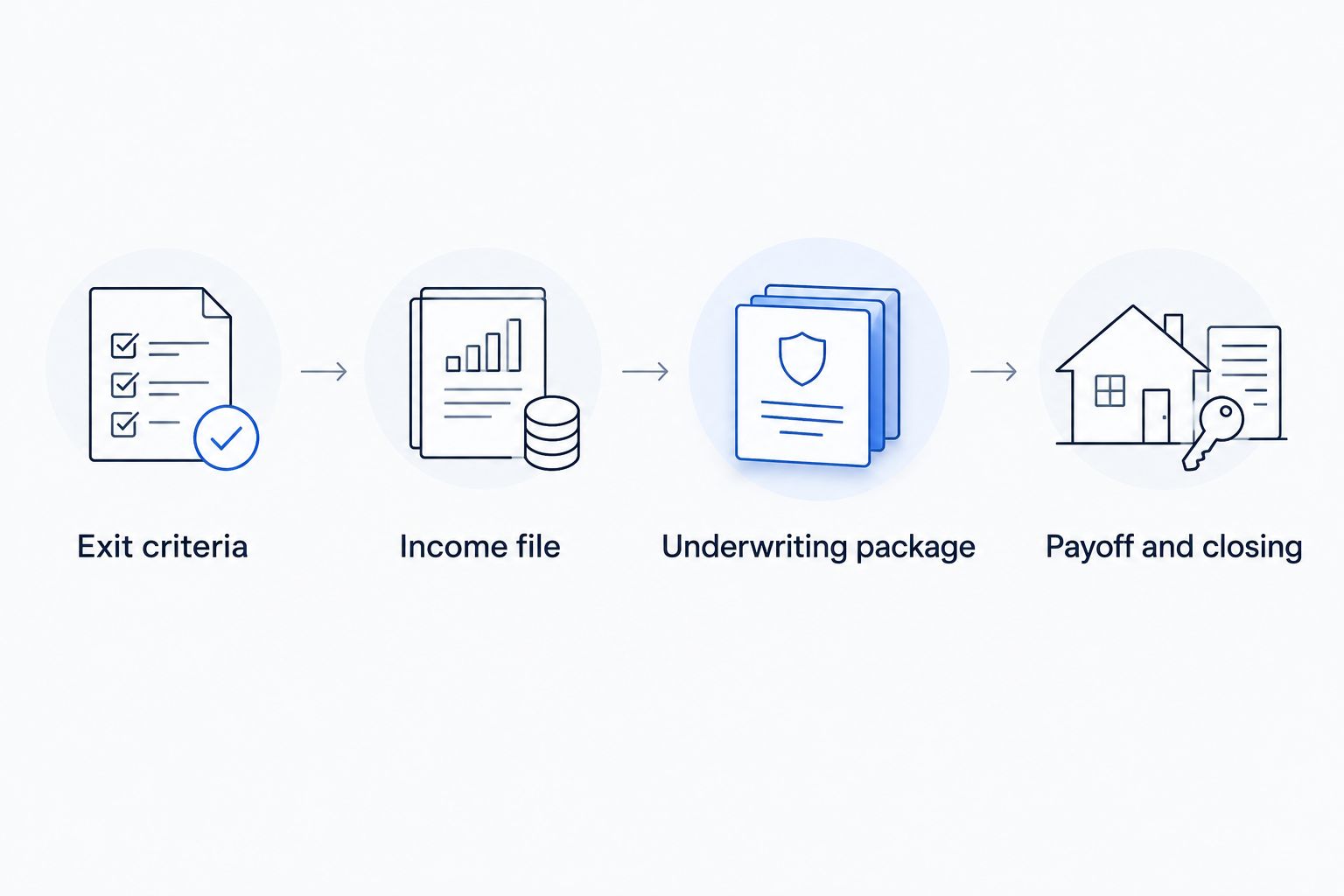
- Submit a consistent file. Use the same property address, borrowing entity, ownership details, and requested transaction purpose throughout. Include renovation completion evidence and explanations for unusual deposits or lease arrangements when requested.
- Follow the lender’s appraisal process. Confirm who orders the appraisal and which reports the program accepts. Do not commission a separate report and assume the receiving lender will use it.
- Track conditions by owner. Assign each outstanding item to the borrower, lender, appraiser, insurer, current servicer, or settlement provider. Distinguish a missing document from an underwriting issue that requires a changed transaction.
- Review the proposed structure. Check amortization, maturity, payment structure, prepayment provisions, reserves, escrows, recourse, and any balloon obligation. Ask what remains conditional and what can change before closing.
Expected result: You have an actionable condition list and understand the proposed obligations, including restrictions that affect a later sale or refinance.
Keep your 2026 underwriting file current as the application progresses. Report changes in occupancy, property condition, ownership, insurance, or existing debt instead of allowing the lender to discover conflicting information later.
Longer-term financing does not necessarily mean fully amortizing financing. Review the actual maturity and repayment schedule. The word permanent describes the intended financing role; the signed documents establish when the debt becomes due.
Payoff and closing
A refinance succeeds only when the new loan funds, the existing debt is paid as required, and settlement handles the lien release process. Approval alone does not accomplish those steps.
- Obtain an authorized payoff statement. Have the designated party request the statement from the current servicer. Check its expiration date, interest treatment, extension status, and any other amounts due under the existing documents.
- Reconcile proceeds and cash required. Compare the approved new loan with the payoff, settlement charges, required escrows, reserves, and other closing obligations. Confirm the final borrower contribution rather than relying on the initial estimate.
- Clear title and insurance conditions. Resolve ownership discrepancies, recorded liens, and required coverage changes through the lender and settlement provider. Renovation-related liens require attention even when the physical work is complete.
- Verify payment instructions independently. Confirm wiring instructions through a known, independently verified contact. Do not rely on an unexpected email changing the destination account.
- Confirm completion after funding. Obtain settlement records, verify the existing loan’s payoff status, and retain documentation of the lien release process. Record the new servicer, payment instructions, and reserve or escrow obligations.
Expected result: The new financing is funded, the old obligation is reconciled, and you know who receives the next payment.
For a 2026 closing, ask the current lender about extension procedures before maturity becomes an immediate problem. An extension is a separate agreement; neither a refinance application nor a scheduled closing obligates the existing lender to grant one.
Discuss your refinance exit
Review the property, existing hard money debt, and intended DSCR refinance with a direct commercial lender.
Refinance after stabilization: rate-and-term or cash-out?
An adjacent workflow applies when you want to recover invested capital after completing work and establishing rental income. Keep the same eligibility, income, underwriting, and closing checkpoints, but add a separate review of cash-out eligibility.
| Refinance structure | Best for | Advantage | Limitation |
|---|---|---|---|
| Rate-and-term refinance | Investors replacing existing hard money debt | Focuses the request on debt replacement | Additional proceeds depend on program classification and permitted uses |
| Cash-out refinance | Investors seeking equity proceeds after stabilization | Can release eligible equity while replacing debt | Adds seasoning, valuation, proceeds, and cash-flow considerations |
Choose the refinance structure before requesting the final loan amount. Neither structure is automatically better; the correct fit depends on the use of proceeds and the lender’s rules.
For cash-out, document the acquisition, improvement spending, completed condition, current rent, and intended use of funds. Ask whether the lender recognizes the requested amount as cash-out and which valuation basis applies.
Then recalculate coverage using the proposed debt obligation. More proceeds increase borrowing; they do not increase rental income. Keep an acceptable debt-replacement request available if the cash-out structure fails underwriting, but obtain approval for any revised terms.
Troubleshooting
The lease supports the request, but accepted rent is lower
Ask the lender to identify the accepted income source and reconcile it against the lease, concessions, collection history, and appraisal. Correct factual errors with evidence; do not assume contracted rent overrides the program’s income rules.
The appraisal supports value, but proceeds fall short
Separate the constraints. Loan-to-value, DSCR, seasoning, eligible cost basis, and transaction classification can each limit proceeds independently. Ask which constraint controls, then assess a smaller request, additional borrower funds, or a different eligible structure.
Renovations are complete, but condition remains unresolved
Confirm what evidence clears the specific condition. The lender can require an inspection, completed repairs, permits, or other documentation appropriate to the property and program. Contractor completion and underwriting acceptance are separate checkpoints.
Closing moves beyond the payoff statement’s validity
Request an updated statement through the authorized process and reconcile the revised amount with settlement. Separately confirm whether the hard money loan remains within its term; refreshing a payoff statement does not extend maturity.
Entity documents do not match title
Have the lender and settlement provider identify the discrepancy before signing. Supply current organizational and authority documents, and obtain legal advice before changing ownership. A last-minute title transfer can change the underwriting review.
Customize your workflow
Expand the file around the property’s actual operating model. Short-term rental income, mixed-use occupancy, and multifamily operations require different evidence; a generic rent spreadsheet does not resolve those differences.
If you approach Flexvcapital for a DSCR refinance, state the property type, existing debt, maturity, renovation status, occupancy, and intended proceeds together. That makes the first discussion about transaction fit rather than an isolated loan amount.
Maintain a condition tracker with the requested item, responsible party, submission date, and resolution status. Update it whenever a material fact changes. Repeatedly resending an unchanged document does not resolve a substantive underwriting objection.
FAQ
Can I refinance a hard money loan into a DSCR loan?
Yes, when the property, borrower, existing debt, and proposed transaction satisfy the receiving DSCR lender’s requirements. Confirm occupancy, condition, seasoning, valuation, and accepted rental income before relying on the refinance as your exit.
How long do I have to own the property before a DSCR refinance?
The required ownership period depends on the lender, program, and transaction type. Ask how seasoning affects both eligibility and the valuation basis used to calculate proceeds.
What DSCR do I need to refinance hard money?
The required DSCR depends on the program and its calculation method. A ratio of 1.00x means accepted income equals the included obligations; it is not a universal approval threshold.
Can I refinance before the rental property is leased?
Only if the receiving program accepts the property’s occupancy status and income documentation. Confirm whether market rent is acceptable and whether a lease or rental collection evidence is required before closing.
Can I get cash out after renovating with hard money?
Cash-out is possible when the lender permits it and the transaction meets its equity, seasoning, valuation, and coverage requirements. Renovation spending alone does not establish the amount you can withdraw.
Does permanent DSCR financing eliminate a balloon payment?
No, the permanent-financing label does not establish the repayment schedule. Review the note’s maturity, amortization, and balloon provisions before accepting the structure.
Does a pre-approval mean my hard money payoff is guaranteed?
No, a pre-approval does not guarantee funding or payoff of the existing loan. Appraisal, underwriting, title, insurance, and closing conditions still determine whether the refinance closes.
One last thing
The payoff balance is not necessarily the cash required to close. Required escrows, reserves, settlement obligations, and approved proceeds also affect the final reconciliation. Review that reconciliation before signing, and confirm where each required payment is going.