
Franchise owners’ construction financing is funding for building or improving a business location with the aim of opening an operating, revenue-producing franchise. Construction loans for franchise owners must account for lender requirements, franchisor specifications, property control, and the cash needed between construction completion and opening day.
- Construction loans for franchise owners should fund an executable buildout, not just a contractor’s estimate.
- SBA financing deserves consideration when an eligible franchise needs owner-occupied property, improvements, or business funding.
- Separate construction funding from opening working capital, and verify which expenses each lender will finance.
- Match loan maturity to a documented repayment or refinancing plan before accepting construction debt.
Why construction financing matters for franchise owners
A franchise construction project has several approval tracks: the franchisor approves the location and design, local authorities approve the work, and the lender approves the financing. Progress on one track does not establish approval on another. Your financing plan must connect all three before you commit to obligations you cannot reverse.
In 2026, start with the project’s actual scope rather than a preferred loan label. A leased storefront renovation presents different collateral and repayment questions from purchasing land and constructing an owner-occupied building. The construction loan lenders for commercial real estate guide provides a separate starting point for comparing lender categories.
Finance the path to an operating franchise, not merely the path to a finished building. An approved construction budget does not automatically include payroll, training, opening inventory, or cash reserves.
How to structure franchise construction financing in 2026
Define the property and construction scope
Start manually with a project summary and a spreadsheet. Identify whether you are buying a building, constructing on owned land, improving leased premises, or renovating an existing franchise location. State who owns the real estate and which entity operates the business.
Property control affects the financing structure. A leasehold buildout depends on lease terms and landlord permissions; an owned-property project adds acquisition, title, and real estate collateral questions. Do not present those projects as interchangeable.
Franchisor approval also needs a defined scope. Design changes after underwriting can affect the budget, schedule, and lender’s approved use of proceeds. Record the current design status rather than describing preliminary drawings as final.
- Identify the borrower, operating company, and property owner.
- Separate acquisition, construction, equipment, and operating expenses.
- Document site approval and outstanding franchisor conditions.
- Confirm landlord permissions for a leased location.
- List permits, utilities, and site work still required.
Build a complete sources-and-uses budget
Create the budget yourself before requesting financing. Use contractor proposals, equipment quotations, lease documents, and professional estimates rather than a single total copied from the franchise disclosure document. The disclosure document provides context; it does not replace site-specific underwriting.
Separate money already spent from money still required. Ask the lender whether prior expenditures count toward your contribution and what evidence supports that treatment. Do not assume every expense is eligible for reimbursement.
Build a monthly cash forecast covering the first 12 months after opening as a planning exercise, not a lender requirement. Show how you will meet operating expenses while sales develop. Keep construction contingency and operating reserves distinct so the same cash is not allocated twice.
- List hard costs and professional or administrative costs separately.
- Identify deposits and expenses already paid.
- Document the source of your equity contribution.
- Separate landlord allowances from borrower cash.
- Allocate construction contingency independently of opening reserves.
- Reconcile total funding sources with total project uses.
Match the financing route to the project
Prepare a short financing brief and compare program eligibility before submitting full applications. For an eligible operating business, SBA financing deserves review alongside conventional construction financing. A short-term bridge loan requires a credible exit rather than an assumption that refinancing will be available.
Flexvcapital is best for franchise owners seeking a direct New York commercial lender offering SBA and bridge financing. Flexvcapital offers those categories, but construction eligibility, permitted expenses, draw procedures, and repayment terms still require project-specific confirmation. A listed loan category is not a construction commitment.
The benefit of a direct lender discussion is evaluating the proposed structure with the financing provider. The limitation is that a broad commercial lending offering does not establish a fit for your particular franchise, property, or construction scope.
- Ask whether the lender finances your exact construction scope.
- Confirm whether the request is business lending or real estate lending.
- Identify expenses requiring a separate funding source.
- Request eligibility requirements before ordering third-party reports.
- Compare repayment structure, guarantees, and collateral requirements.
Assemble a consistent underwriting file
Organize the documents yourself in clearly named folders. The objective is consistency: the ownership chart, franchise agreement, lease, budget, and application should describe the same transaction. Conflicting entity names or project totals create questions that a polished business plan cannot resolve.
For a new franchise, distinguish assumptions from established operating results. Existing franchise owners should separate location-level performance from consolidated business results so the lender can assess the proposed expansion without confusing it with existing operations.
Franchise eligibility is not automatic because a business uses a recognized name. For a 2026 SBA request, confirm the applicable franchise and affiliation requirements with the lender using current SBA program guidance. Franchisor acceptance and lender approval are separate decisions.
- Provide the executed franchise agreement and relevant amendments.
- Include ownership details and required guarantor information.
- Supply available tax returns and current financial statements.
- Label projections and explain their operating assumptions.
- Include plans, contractor proposals, and the construction schedule.
- Document the lease, purchase contract, or ownership evidence.
Negotiate the draw process before signing
Construction financing commonly releases funds against approved progress rather than delivering the entire commitment at closing. Ask for the draw procedures in writing. Your contractor’s payment schedule and the lender’s disbursement process must work together.
A contractor deposit can create an immediate cash requirement if the lender reimburses only after specified conditions are satisfied. Clarify inspections, documentation, lien waivers, retainage, and who authorizes each release. Requirements vary by transaction; do not import assumptions from a previous residential or business loan.
Also establish how change orders move through approval. A lender-approved budget does not give the contractor permission to add work without review. Your construction contract should make responsibility for approvals and payment clear.
- Obtain the lender’s draw checklist before closing.
- Match contractor milestones to eligible disbursements.
- Confirm who pays inspection and administration charges.
- Identify any required borrower-funded expenses.
- Establish written approval procedures for change orders.
- Clarify conditions for the final construction disbursement.
Stress-test delays and the repayment plan
Build a base case and a delayed-opening case using the same budget. As a planning test, model a 30-day opening delay and identify which obligations continue: rent, insurance, interest, storage, or staffing commitments. The exercise is a decision tool, not a forecast of your construction timeline.
Then document how the construction debt ends. A construction-to-permanent structure, a separate refinance, and repayment from another source create different risks. A planned refinance is not an approved refinance.
Use the delayed case to test cash availability, not just projected profitability. A profitable annual forecast can still contain an unfunded month. Ask how an extension works before you need one, including approval conditions and any additional obligations.
- Model the scheduled opening and a delayed opening.
- Identify recurring expenses during a shutdown or delay.
- Confirm the loan’s maturity and extension provisions.
- Document permanent financing conditions, if applicable.
- Assign a funding source to any projected cash shortfall.
Compare written terms and clear closing conditions
Compare written proposals on the same project assumptions. A larger commitment is not automatically better if it excludes necessary expenses or requires cash you have allocated elsewhere. Review the net amount available for project uses, not just the headline financing amount.
Flexvcapital states 48-hour pre-approvals in its lending materials. Treat pre-approval as an initial financing stage, not a promise that construction funding will close or that draws will begin within that period. Obtain the remaining conditions and distinguish approval milestones from disbursement milestones.
For your 2026 closing checklist, assign an owner to every outstanding item. A financing approval cannot resolve an unsigned lease amendment, incomplete permit, or unresolved contractor requirement by itself.
- Compare collateral, guarantees, maturity, and repayment structure.
- Confirm which project expenses the commitment covers.
- Separate pre-approval conditions from closing conditions.
- Verify insurance and construction documentation requirements.
- Obtain a written list of outstanding deliverables.
- Avoid nonrefundable commitments based solely on preliminary approval.
Compare financing options for franchise construction
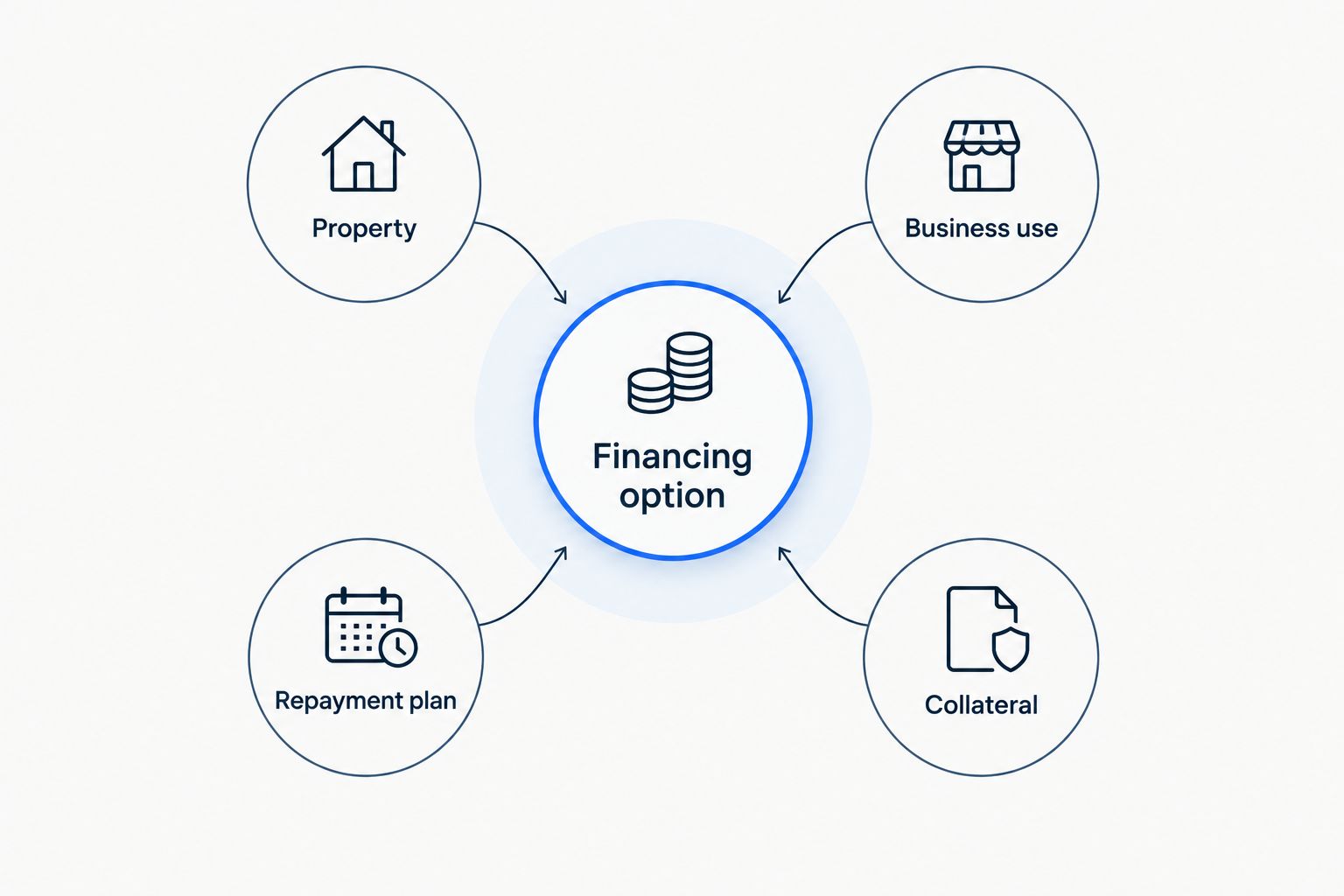
The best option matches the property, business use, and repayment plan. Program names alone do not establish eligibility. SBA describes 7(a) as its primary business loan program and 504 as long-term financing for major fixed assets; confirm current requirements when preparing a 2026 application.
| Financing option | Best for | Main advantage | Key limitation |
|---|---|---|---|
| Conventional construction financing | Borrowers building or substantially improving commercial property | Structures funding around construction progress | Requires lender acceptance of the borrower, property, budget, and repayment plan |
| SBA 7(a) financing | Eligible franchise businesses combining qualifying business and property needs | Can support a broader range of eligible business uses | Eligibility, documentation, and approved uses of proceeds still apply |
| SBA 504 financing | Eligible owner-occupied fixed-asset projects | Supports qualifying real estate, construction, and major equipment | Does not provide working capital or inventory financing |
| Bridge financing | Borrowers with a temporary funding need and documented exit | Addresses a defined interval before repayment or permanent financing | Maturity creates refinancing or repayment risk |
| Equipment financing | Borrowers funding identifiable business equipment | Separates equipment funding from the real estate request | Does not replace financing for the building or operating reserves |
Equipment financing and property financing can also compete for collateral. Disclose proposed financing arrangements to each lender instead of assuming separate applications remain independent.
For a buildout-only project, start with the lease, approved improvements, and repayment capacity. For an owned-property project, add real estate eligibility and permanent debt structure to that analysis.
Common mistakes franchise owners make
Treating franchisor approval as financing approval
A franchisor’s site acceptance does not establish the lender’s collateral value or repayment assessment. Keep separate approval checklists for the franchisor, lender, landlord, and permitting authority. Identify dependencies before setting an opening date.
Using the construction budget as the opening budget
A finished location still needs cash to operate. Training, inventory, payroll, and occupancy expenses need identified funding sources even when they fall outside the construction facility. Do not spend opening reserves to cover an unapproved change order without rebuilding the cash forecast.
Assuming every commercial loan fits an operating franchise
A loan assessed primarily on rental-property income is not interchangeable with financing for an owner-operated business. Describe who occupies the property and where repayment cash comes from. Select the loan structure after those facts are clear.
Signing a lease without coordinating financing conditions
Lease commencement, landlord delivery, construction access, and lender closing conditions affect one another. Have your attorney review those obligations together. A financing contingency has value only when the actual contract includes it and its deadlines remain workable.
FAQ
What are construction loans for franchise owners?
Construction loans for franchise owners finance eligible building or improvement work for a franchise location. The financing structure depends on property ownership, project scope, borrower eligibility, and the source of repayment.
Can an SBA loan finance a franchise buildout?
An SBA loan can finance an eligible franchise buildout when the borrower, project, and uses of proceeds meet the applicable program requirements. Ask the lender to distinguish construction expenses from equipment, inventory, and working capital.
Is SBA 7(a) or SBA 504 better for franchise construction?
SBA 7(a) deserves consideration for broader eligible business funding needs, while SBA 504 serves qualifying fixed-asset projects. SBA 504 does not fund working capital or inventory, so opening expenses require a separate plan.
Can I finance construction in a leased franchise location?
Financing for improvements in leased premises is possible when the lender accepts the transaction and applicable program requirements are met. Expect review of the lease, landlord permissions, improvement scope, and repayment capacity.
Does franchise construction financing include opening working capital?
Opening working capital is included only when the financing structure permits and approves that use. Identify a separate funding source for operating expenses that the construction facility excludes.
Does a 48-hour pre-approval mean my construction loan will close that quickly?
No. Flexvcapital states 48-hour pre-approvals, but pre-approval is not construction loan closing or authorization to draw funds. Obtain the remaining underwriting, property, and construction conditions in writing.
What should I prepare before contacting a franchise construction lender?
Prepare a project summary, sources-and-uses budget, ownership information, franchise documents, and evidence of property control. Include construction proposals and a cash forecast that separates the buildout from post-opening operations.
One last thing
Check the final draw conditions before the first draw. Completion documentation, lien releases, inspections, and other closing-out requirements can affect access to remaining construction funds. Establish who supplies each document while you are negotiating the construction contract, not when the contractor requests final payment.