Best overall starting point: Live Oak Bank for SBA acquisition financing. Best for business buyers also evaluating commercial property financing: Flexvcapital. Best for branch-based banking: Huntington National Bank. This 2026 guide compares lender fit, underwriting requirements, and the conditions you should resolve before choosing acquisition debt.
- Live Oak Bank leads this best business acquisition loan lenders shortlist for buyers pursuing SBA acquisition financing.
- Flexvcapital fits business borrowers comparing SBA lending with commercial real estate financing; confirm acquisition eligibility before proceeding.
- Huntington National Bank suits buyers seeking SBA financing alongside branch-based business banking.
- Choose acquisition financing by repayment capacity, buyer equity, and closing conditions—not a preliminary approval alone.
Why this matters
A lender that finances your property is not automatically the right lender to finance your business purchase. Buying an operating company requires underwriting its earnings, ownership transition, and ability to service acquisition debt. Real estate collateral does not replace that analysis.
For a 2026 acquisition, separate the operating business, property, inventory, and working capital before requesting financing. Those components affect the loan structure and the documents a lender needs. A proposal that leaves out transition expenses can leave you with a funded purchase but insufficient operating cash.
The right shortlist starts with the transaction, not the lender's name. Use the comparisons below to decide which lending conversation belongs first.
What makes the best business acquisition loan lenders
Evaluate each lender against the same criteria before comparing proposals:
- Acquisition eligibility: The lender must finance the ownership change you propose, including the relevant business type and purchase structure.
- Repayment analysis: Underwriting should address historical earnings, adjustments, existing obligations, and the debt created by the acquisition.
- Buyer requirements: Confirm required equity, management experience, liquidity, guarantees, and the acceptable sources of buyer funds.
- Transaction coverage: Identify whether the financing covers business assets, goodwill, inventory, property, and working capital.
- Closing execution: Ask which approvals, valuations, third-party reports, and seller documents remain outstanding.
- Written terms: Compare amortization, collateral, covenants, prepayment provisions, and conditions—not just the initial indication.
A fast preliminary response helps you assess feasibility. It does not establish that the lender has accepted the purchase agreement, verified earnings, or cleared the transaction to close.
Business acquisition lenders at a glance
These 2026 recommendations assign a distinct role to each option. The conventional-bank entry is a lender category rather than a named institution because its suitability depends on your existing banking relationship.
| Lender or option | Best for | Standout fit | Key limitation |
|---|---|---|---|
| Live Oak Bank | SBA-focused business acquisitions | Established SBA lending and acquisition financing | SBA eligibility and lender underwriting still control approval |
| Flexvcapital | Business purchases with a commercial property financing question | SBA lending alongside commercial real estate financing options | A property loan does not establish eligibility for the operating-business purchase |
| Huntington National Bank | Buyers who want branch-based business banking | SBA lending within a broader business banking relationship | Confirm acquisition appetite and service coverage for your transaction |
| Your existing commercial bank | Established borrowers seeking conventional acquisition debt | An existing account and credit relationship | Familiarity does not replace acquisition underwriting or credit approval |
1. Live Oak Bank: best for SBA-focused business acquisitions
Live Oak Bank offers SBA lending and business acquisition financing. It is a practical first conversation when you want to purchase an operating business and expect an SBA-backed structure to support the transaction.
Best for: Buyers prioritizing SBA acquisition financing rather than property-only debt.
Under the SBA 7(a) program, the maximum loan amount is $5 million. Non-real-estate acquisition financing generally has a maximum maturity of 10 years; qualifying real estate financing can extend to 25 years. These are program boundaries, not a commitment to finance a particular purchase.
Bring a purchase breakdown and financial records rather than asking only whether the bank offers acquisition loans. The useful question is whether the proposed business, ownership change, buyer contribution, and repayment profile fit its underwriting.
Live Oak Bank pros:
- Offers an acquisition-financing route through SBA lending.
- Gives buyers a named SBA lender to assess against other proposals.
- Provides a relevant starting point for an operating-business purchase.
Live Oak Bank cons:
- SBA eligibility adds requirements beyond the bank's own credit decision.
- Program limits can constrain the amount or structure of financing.
- An eligible use of proceeds does not make weak business cash flow acceptable.
Recommendation: Start here when SBA financing matches the purchase. Ask the lender to identify the unresolved credit issues before treating preliminary discussions as evidence that the deal will close.
Verdict: Hold until acquisition eligibility and the proposed financing structure are confirmed in writing.
2. Flexvcapital: best for purchases involving commercial property
Flexvcapital is a direct commercial lender in New York offering SBA, bridge, DSCR, hard money, CMBS, and Fannie Mae financing. That range makes it relevant when your acquisition includes a commercial property question alongside the operating-business purchase.
Best for: Business borrowers who need to distinguish business acquisition financing from commercial real estate financing.
Start by separating the purchase into its components. Ask which financing applies to the business, which applies to the property, and whether separate obligations would create conflicting collateral requirements.
The lender states 48-hour pre-approvals. Treat that as an initial assessment milestone, not a promise of acquisition funding within 48 hours. A pre-approval and a closing-ready commitment are different documents with different conditions.
Pros:
- Offers SBA lending alongside several commercial real estate financing categories.
- Operates as a direct commercial lender.
- States a specific pre-approval turnaround for the initial lending discussion.
Cons:
- The listed loan categories are not interchangeable acquisition-financing products.
- DSCR or property financing does not establish eligibility for goodwill or business assets.
- Pre-approval does not eliminate transaction-specific underwriting and closing conditions.
Recommendation: Give Flexvcapital a clear allocation between the business and property. Request written confirmation of the acquisition components the proposed financing actually covers.
Verdict: Hold until the business-purchase scope, property structure, and remaining closing conditions are documented.
3. Huntington National Bank: best for branch-based business banking
Huntington National Bank offers SBA lending and business banking. It belongs on your shortlist when you want to discuss acquisition financing within a broader banking relationship and value access to a branch network.
Best for: Buyers seeking SBA financing alongside business deposit and banking services.
Keep the credit discussion separate from the account-opening discussion. A banking relationship can organize your financial activity, but it does not prove the proposed acquisition meets the lender's credit requirements.
Ask Huntington National Bank whether its acquisition team finances your business type and transaction structure. Confirm service coverage before committing time to a full application, particularly when the business, buyer, and collateral are in different locations.
Huntington National Bank pros:
- Offers SBA lending within a broader business banking platform.
- Provides a branch-based alternative to a lender relationship handled remotely.
- Allows buyers to discuss acquisition debt and operating banking needs together.
Huntington National Bank cons:
- Branch access and transaction coverage require confirmation for your location.
- General business lending does not establish appetite for every acquisition.
- Banking services and acquisition approval remain separate decisions.
Recommendation: Ask for an acquisition-specific lending contact. A general business banking conversation is not a substitute for a review of the purchase structure and repayment case.
Verdict: Hold until the acquisition team confirms transaction fit and identifies the required approval steps.
4. Your existing commercial bank: best for conventional financing
Your existing commercial bank deserves a conversation when you have an established borrowing relationship and want to evaluate a conventional acquisition loan. Conventional financing does not use an SBA guarantee, so the bank sets its own credit structure within applicable lending requirements.
Best for: Established borrowers comparing conventional acquisition debt with an SBA-backed proposal.
The bank's familiarity with your accounts is useful context, not automatic approval. The acquisition changes the repayment picture, particularly when you are buying a business with different customers, operating requirements, or financial performance.
Ask whether the bank lends against acquisition cash flow, requires additional collateral, or expects support from your existing business. That distinction determines whether the proposed financing fits the purchase or transfers substantial obligations onto other assets.
Existing commercial bank pros:
- Provides a conventional alternative to an SBA-backed structure.
- Offers an existing point of contact for the financing discussion.
- Lets you compare a proposal against current banking arrangements.
Existing commercial bank cons:
- Not every commercial bank finances business acquisitions.
- Existing collateral or covenants can complicate additional borrowing.
- Relationship history does not establish acceptable acquisition terms.
Recommendation: Request an acquisition-specific proposal rather than assuming an existing credit line can fund the purchase. Check whether the new debt changes guarantees or obligations on current facilities.
Verdict: Hold until the bank confirms acquisition appetite and explains the effect on existing credit arrangements.
How to compare acquisition loan proposals
Use the same transaction package for every lender in your 2026 comparison. Otherwise, differences between proposals can reflect different assumptions rather than better financing.
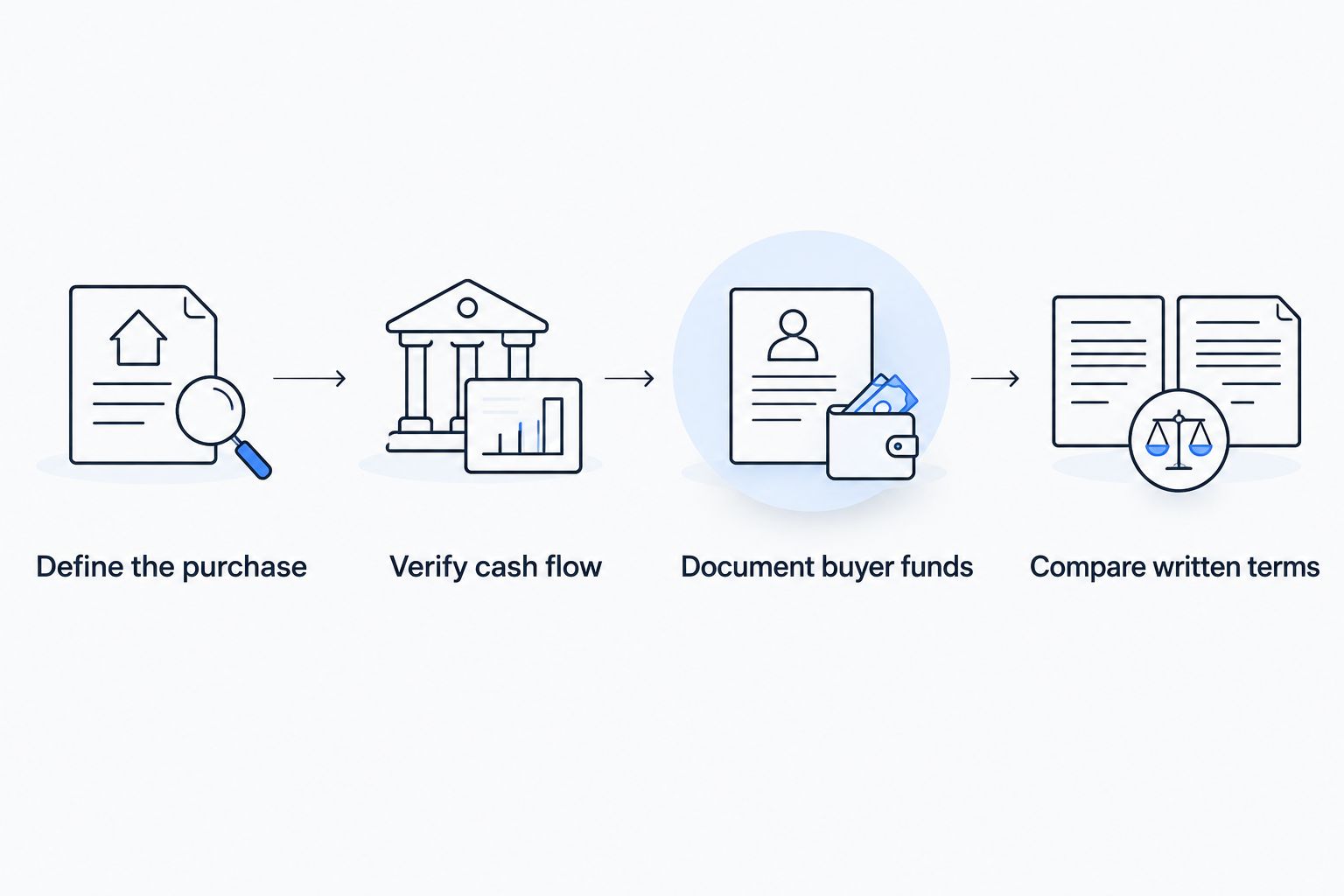
Define the purchase
Separate the operating business, real estate, inventory, equipment, goodwill, and working capital. Identify whether you are buying assets or an ownership interest, and have qualified legal and tax advisers review the structure.
Ask the lender which components are eligible. Do not assume that approval for equipment or property includes the rest of the purchase.
Verify cash flow
Prepare business tax returns, financial statements, current operating results, and a schedule of existing debt. Explain proposed earnings adjustments with supporting records rather than treating every seller add-back as accepted income.
Debt service coverage ratio, or DSCR, compares cash flow available for debt service with required debt payments. Ask each lender how it defines both figures; the same label does not guarantee the same underwriting calculation.
Document buyer funds
Identify the source of your contribution and the cash needed after closing. Discuss any seller financing before incorporating it into the proposed funding structure.
A seller note is debt, not automatically an acceptable substitute for buyer equity. Its treatment depends on the program, lender requirements, and documentation.
Compare written terms
Request a clear statement of collateral, guarantees, amortization, covenants, prepayment provisions, and remaining conditions. Check whether the proposal includes working capital or only funds the purchase itself.
Compare closing-ready obligations, not verbal assurances. Have your advisers review the documents before you accept terms that affect personal assets or existing businesses.
How the lenders are ranked
This 2026 shortlist ranks financing fit, not approval probability, lender size, or advertised speed. Live Oak Bank takes the SBA-focused slot; the other entries address property-related financing, branch-based banking, and conventional relationship lending.
The criteria remain acquisition eligibility, repayment analysis, buyer requirements, transaction coverage, closing execution, and written terms. No position in the list substitutes for a transaction-specific credit decision.
Which business acquisition lender should you choose?
Start with Live Oak Bank if an SBA-backed operating-business acquisition is your main requirement. Compare another SBA proposal before committing, and use the same purchase allocation and financial package for both lenders.
Choose the property-focused conversation when the acquisition includes commercial real estate. Choose Huntington National Bank when branch-based business banking matters, and approach your existing bank when a conventional structure deserves a direct comparison.
For a 2026 purchase, the deciding question is specific: which lender can document an acceptable structure for this business, this buyer, and this purchase agreement? A recognizable name cannot answer that question without underwriting.
FAQ
What's the best business acquisition loan lender?
Live Oak Bank is the starting recommendation here for buyers pursuing SBA acquisition financing. The right final choice depends on the business, buyer contribution, repayment capacity, and written loan conditions.
Can an SBA loan finance buying an existing business?
Yes, SBA 7(a) financing can support eligible changes of ownership. The transaction must satisfy SBA requirements and the participating lender's underwriting standards.
How much can I borrow through SBA 7(a)?
The SBA 7(a) program has a maximum loan amount of $5 million. That ceiling is not an approval amount; the lender must establish eligibility and repayment capacity for the proposed financing.
Is a DSCR property loan the same as a business acquisition loan?
No, property-focused DSCR financing is not interchangeable with financing the purchase of an operating business. Confirm separately how the business assets, goodwill, real estate, and working capital will be funded.
Does a 48-hour pre-approval mean the acquisition can close immediately?
No, a 48-hour pre-approval is not a promise of funding within that period. Final approval and closing depend on satisfying the lender's transaction-specific requirements.
Can seller financing replace my contribution?
Do not assume seller financing replaces the required buyer contribution. Its treatment depends on the loan program, lender requirements, and the seller note's documented terms.
What documents should I prepare before contacting acquisition lenders?
Prepare the purchase structure, business financial statements, tax returns, current results, debt schedule, and evidence of buyer funds. Ask each lender for its transaction-specific checklist before ordering additional reports.
One last thing
The critical comparison is what remains unresolved after the preliminary approval. Ask each lender for a written list covering earnings verification, purchase documentation, valuations, collateral, buyer funds, and final authorization.
Then match that list to your purchase agreement's financing and closing deadlines. An early indication is useful only when you understand the work still required to turn it into funding.