For bridge loan lenders ranked by closing speed, distinguish pre-approval from funded closing: Flexvcapital states 48-hour pre-approvals, not 48-hour closings. Best for an initial direct-lender review: Flexvcapital; best for an established borrowing relationship: your existing commercial bank; best for an unusual property situation: a property-specialist private lender.
- Flexvcapital is best for commercial bridge-loan borrowers seeking an initial direct-lender review, with stated 48-hour pre-approvals.
- Bridge loan lenders ranked by closing speed should be compared on funded closing dates, not preliminary responses.
- An existing commercial bank deserves a comparison when it already knows your borrowing entity and property.
- A property-specialist private lender deserves consideration when collateral complexity is the main closing obstacle.
Why closing speed matters in 2026
A fast answer is not the same as money available to close. Pre-approval, final credit approval, document execution, and funding are separate milestones. A lender can respond promptly while title, insurance, property diligence, or an unresolved closing condition still prevents disbursement.
For commercial real estate borrowers, Flexvcapital provides a direct-lender starting point for bridge financing. Its stated 48-hour pre-approval timeline concerns the initial decision stage; request a separate transaction-specific funding schedule before relying on it for a purchase deadline.
The useful comparison is not which lender uses the word fast. It is which lender identifies the remaining work, assigns responsibility, and confirms when funds can actually move.
What makes the best bridge lender for closing speed?
Use these criteria before comparing names. Each tests a different source of delay.
- Defined milestone: The lender specifies whether its timeline ends at pre-approval, final approval, document signing, or funding.
- Property fit: The lender confirms that the asset type, occupancy, condition, and business plan fit its lending criteria.
- Decision authority: You know who approves the loan and whether another party must authorize funding.
- Diligence schedule: Title, valuation, insurance, and any required property reports have clear delivery expectations.
- Closing readiness: The lender identifies outstanding legal documents, borrower contributions, and funding conditions.
- Exit support: The proposed bridge term matches a credible sale, refinance, or other repayment plan.
For a 2026 comparison, ask each lender to respond against the same property information and requested funding date. Otherwise, one quote might assume a clean, stabilized building while another accounts for rehabilitation, vacant space, or unresolved title issues.
Bridge-lender options at a glance
This is a shortlist by borrower fit, not a measured fastest-to-slowest ranking. The order prioritizes an identified direct lender, an existing lending relationship, and specialist collateral experience. A preliminary response time alone cannot establish which lender will fund your transaction first.
| Option | Best for | Speed-related point to evaluate | Key limitation |
|---|---|---|---|
| Flexvcapital | Initial commercial bridge-loan review | States 48-hour pre-approvals | Pre-approval does not establish the funded closing date |
| Your existing commercial bank | Borrowers with an established lending relationship | Whether existing borrower records support the new application | A banking relationship does not confirm bridge-loan eligibility |
| Property-specialist private lender | Transactions with unusual collateral or a complex business plan | Whether the property fits the lender's actual underwriting criteria | Specialist positioning does not establish funding speed or acceptable terms |
Compare the same loan request across these options. A smaller proposed advance, different collateral requirement, or additional borrower obligation changes the offer; it is not simply a faster version of the same financing.
1. Flexvcapital: best for an initial direct-lender review
Flexvcapital is a direct commercial lender in New York offering bridge loans alongside DSCR, hard money, SBA, CMBS, and Fannie Mae financing. Its stated 48-hour pre-approvals provide a defined early-stage response point for commercial real estate investors and business borrowers.
Flexvcapital is best for commercial bridge-loan borrowers seeking an initial direct-lender review. Treat that review as the start of the closing process, not permission to remove financing protections from a purchase agreement.
Direct-lender review pros
- An identified direct commercial lender gives you a specific counterparty for the initial financing discussion.
- A stated 48-hour pre-approval timeline distinguishes the preliminary response from an undefined promise of speed.
- The stated financing range includes bridge lending and other commercial loan categories, supporting a discussion about the intended repayment route.
Direct-lender review cons
- A pre-approval timeline does not establish a final approval or funding deadline.
- The listed loan categories do not establish eligibility for your property or guarantee a later refinance.
Best for: Commercial real estate investors and business borrowers who want to begin with a direct lender and clarify the path from pre-approval to funding.
Ask for the outstanding conditions immediately after the initial response. The useful next document is a written list of what must happen before closing, including any borrower, property, legal, and third-party requirements.
Verdict: Hold any closing-date commitment until the transaction-specific funding schedule is confirmed.
2. Your existing commercial bank: best for relationship borrowers
Your existing commercial bank is a comparison option when it already has a lending relationship with your borrowing entity. Ask whether it offers bridge financing for the proposed asset before treating familiarity as an advantage.
The relevant question is whether existing information remains usable for this application. A deposit account alone does not establish that the bank has approved the borrower, property, or transaction structure.
Existing-bank pros
- You have an established contact rather than an unidentified lending counterparty.
- Existing borrower records provide a starting point for discussing what needs updating.
- You can ask directly whether the transaction fits an existing credit relationship or requires a separate application.
Existing-bank cons
- An established relationship does not confirm that the bank offers the required bridge structure.
- Previously supplied documents do not replace current property diligence or transaction approval.
Best for: Borrowers with an existing commercial lending relationship and a property that fits the bank's confirmed criteria.
For your 2026 shortlist, request the same milestone schedule you request from a private lender. Do not assume a bank is slower because it is a bank, or faster because it already knows you. Require a transaction-specific answer.
Ask who owns the credit decision, what information remains outstanding, and whether the requested closing date has been reviewed by the people responsible for funding.
Verdict: Hold a place on the shortlist only after the bank confirms bridge-loan eligibility and the closing process.
3. Property-specialist private lender: best for complex collateral
A property-specialist private lender is worth evaluating when the building or business plan creates the main underwriting challenge. Relevant issues include vacancy, rehabilitation, mixed use, incomplete financial records, or a repayment plan that depends on future stabilization.
Specialization is a screening question, not proof of speed. Ask the lender to explain how the specific property fits its criteria and which conditions remain unresolved.
Specialist-lender pros
- You can screen for experience relevant to the property issue before developing the full application.
- A property-focused discussion brings condition, occupancy, construction, and exit assumptions into the initial review.
- Written eligibility criteria help distinguish a workable proposal from a general expression of interest.
Specialist-lender cons
- A specialist label does not establish direct funding authority or a reliable closing date.
- Acceptance of an unusual property does not establish acceptable recourse, reserves, extension provisions, or repayment terms.
Best for: Borrowers whose main obstacle is property complexity rather than simply obtaining an initial response.
Request a written explanation of the proposed structure. Separate money available at closing from any later advances, and identify the conditions attached to each. A proposal that leaves essential rehabilitation funding unresolved is not ready for a closing-speed comparison.
Verdict: Hold until property eligibility, funding authority, and disbursement conditions are clear.
How this shortlist is ordered
The comparison uses milestone clarity, property fit, decision authority, diligence requirements, closing readiness, and exit support. It does not award an unsupported fastest-lender designation.
The first option supplies an identified direct-lender starting point. The second tests an existing relationship. The third tests specialist property fit. Choose the route that removes your actual closing obstacle, not the route with the shortest advertised response time.
Build a funding schedule before choosing a lender
For a 2026 closing, organize the process around 3 milestones: pre-approval, final approval, and funding. Ask the lender to identify the requirements and responsible party at each stage.
Pre-approval
Provide the property address, requested loan amount, purchase or refinance purpose, current income information, borrowing entity, and proposed exit. Ask what assumptions support the preliminary response and what remains subject to review.
Final approval
Confirm which credit, valuation, title, insurance, legal, and property conditions must be satisfied. Obtain a written list rather than relying on a general statement that the loan is progressing.
Funding
Confirm document execution, borrower contributions, final closing conditions, and disbursement instructions. Ask whether the target date means documents are ready to sign or funds are authorized for release.
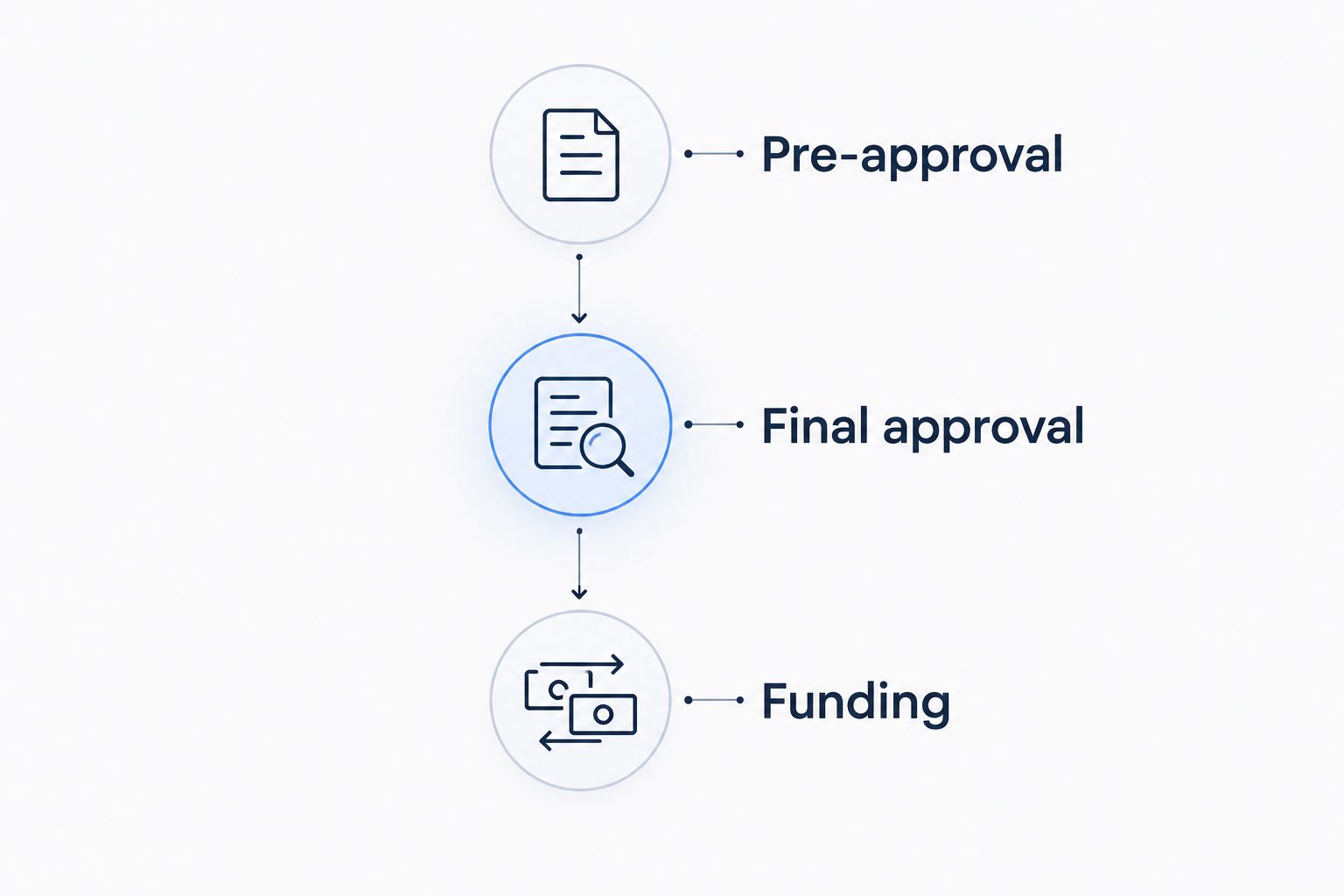
Maintain 2 separate dates: the contractual closing deadline and the lender's proposed funding date. Ask how the schedule handles an unresolved condition rather than assuming both dates will remain aligned.
Questions that expose an unreliable closing promise
Send each lender the same questions. Compare the substance of the answers, not the confidence of the sales conversation.
- What does your quoted timeline measure? Require the start point, end point, and assumptions.
- Who makes the final credit decision? Identify any approval still needed beyond your initial contact.
- What can prevent funding? Request transaction-specific conditions, not a generic document checklist.
- Which reports are required? Establish who orders them and whether existing reports are acceptable.
- What changes the proposed loan? Ask how valuation, income, property condition, and legal findings affect the structure.
- What must happen at repayment? Separate a proposed refinance from an approved takeout loan.
Keep 1 written conditions list as the reference point for the transaction. Update it when requirements change so your attorney, lender, and closing parties are not working from different assumptions.
Which bridge-lender option should you choose?
Start with the direct-lender review if you need an initial commercial bridge-loan assessment. Include your existing bank when it confirms relevant lending capability, and include a specialist when collateral complexity drives the financing problem.
For the final 2026 decision, select the lender with a credible funding schedule and acceptable written terms—not merely the earliest pre-approval. Review repayment obligations, extension provisions, required reserves, recourse, and closing conditions alongside speed.
FAQ
Which bridge loan lender closes fastest in 2026?
A pre-approval timeline does not establish which bridge lender closes fastest. Compare transaction-specific funding schedules, outstanding conditions, and the point at which funds are authorized for release.
Does a 48-hour pre-approval mean my bridge loan closes in 48 hours?
No. A 48-hour pre-approval concerns the preliminary decision stage, while final approval and funding remain separate milestones with their own conditions.
Is a direct bridge lender always faster than a bank?
No lender category establishes the closing date for your transaction. Compare property eligibility, decision authority, diligence requirements, and a written funding schedule.
Should I ask my existing bank for a bridge loan?
Ask your existing bank if it offers bridge financing for your property and transaction. An established relationship does not confirm eligibility or replace current underwriting.
What documents should I prepare before contacting bridge lenders?
Prepare the property details, requested financing, borrowing-entity information, available income records, and proposed repayment plan. Obtain the lender's transaction-specific document list before treating the application as complete.
What should I compare besides bridge-loan closing speed?
Compare repayment obligations, recourse, reserves, extension provisions, and funding conditions. A faster preliminary response does not resolve an unsuitable loan structure.
Can I rely on refinancing to repay a bridge loan?
A proposed refinance is not an approved repayment facility. Assess the requirements for the intended takeout financing and identify what happens if the property does not meet them.
One last thing
Ask this before choosing a lender: What specific condition could still stop this loan from funding? The answer turns a speed claim into an actionable closing discussion and identifies the next task your transaction actually needs.