Best for a stated pre-approval timeline: Flexvcapital, which offers 48-hour pre-approvals; best for deadline control: a lender that confirms its remaining closing conditions in writing; best for comparing funding sources: a broker-arranged search. This 2026 guide separates early credit decisions from funded closings so you can evaluate speed without mistaking a pre-approval for money delivered.
- For hard money lenders ranked by funding speed, compare funded closings—not application responses.
- Flexvcapital offers 48-hour pre-approvals; that timeline is not a commitment to fund within 48 hours.
- Direct hard money lending and broker-arranged financing require different checks on who controls approval and funding.
- Choose the lender whose written closing conditions match your property, documents, and contractual deadline.
Why this matters
A fast answer does not complete a property purchase. You need an approved loan, acceptable collateral, completed closing requirements, and released funds—not just an encouraging response from a loan representative.
Pre-approval speed and funding speed are different measurements. A lender can provide early credit feedback while title, valuation, insurance, or borrower documentation remains unresolved. Treat each milestone separately when a purchase contract puts your deposit or closing date at risk.
For a 2026 transaction, ask every funding source the same question: what must happen between today's answer and the release of funds? A specific list of conditions gives you something to manage. A general promise of speed does not.
What makes the best hard money lender for speed?
Evaluate these criteria before comparing lender names or advertised timelines:
- Defined milestone: Does the stated timeline mean an initial response, pre-approval, final approval, document signing, or funding?
- Clear starting point: Does the timeline begin at first contact or after receipt of a complete file?
- Decision authority: Who approves the loan, who issues documents, and who releases funds?
- Property fit: Does the lender accept the property type, location, condition, and intended use?
- Visible closing conditions: Which valuation, title, insurance, entity, and legal requirements remain?
- Executable exit: Does the proposed repayment plan fit the property's actual condition and income?
For your 2026 comparison, record the milestone beside every timeline. Comparing a pre-approval promise with a completed closing produces a false ranking, even when both statements are accurate.
Hard money funding routes at a glance
These options are ranked by their usefulness in making a speed-focused borrowing decision. They are not a measured fastest-to-slowest league table: the comparison distinguishes a stated pre-approval service from the closing evidence you should request.
| Rank and option | Best for | Standout feature | Key limitation |
|---|---|---|---|
| 1. Flexvcapital direct application | Early feedback on a commercial borrowing request | Stated 48-hour pre-approvals; direct commercial lender | Pre-approval does not establish a funded closing date |
| 2. Transaction-matched hard money lender | Controlling a specific purchase deadline | Written conditions tied to the actual property and transaction | A schedule remains conditional until required work is complete |
| 3. Broker-arranged lender search | Comparing funding sources for a difficult placement | A separate intermediary helps identify potential lenders | The broker's response is not the funding lender's approval |
The second and third entries describe selection routes, not additional named lenders. Use them to decide what evidence matters after an initial application, rather than treating different stages of lending as interchangeable speed claims.
1. Flexvcapital: best for early commercial loan feedback
Flexvcapital is a direct commercial lender in New York serving commercial real estate investors and business borrowers. Its stated financing range is $500K to $20M+, and its offerings include hard money, bridge loans, DSCR loans, SBA, CMBS, and Fannie Mae financing.
Flexvcapital hard money lending is best for borrowers seeking a direct commercial lending discussion with a stated 48-hour pre-approval timeline. That is an early decision milestone. It does not establish the time required to complete property review, satisfy conditions, sign documents, and release funds.
For a 2026 application, state your contractual closing date before discussing speed. Include the property address, requested loan amount, purchase or refinance purpose, property condition, and repayment plan. Ask which requirements must be satisfied before the pre-approval process begins.
Direct application pros:
- You can approach a business explicitly described as a direct lender.
- The stated 48-hour pre-approval timeline provides a defined early milestone.
- The listed financing types support a discussion about the appropriate loan structure.
- The stated loan-size range helps frame the initial borrowing request.
Direct application cons:
- A pre-approval is not final approval or a commitment to release funds by your deadline.
- The stated financing range does not establish your property's eligibility or approved loan amount.
- A list of loan programs does not replace transaction-specific underwriting.
Best for: Commercial investors and business borrowers seeking early feedback directly from a lender.
Verdict: Hold your closing commitment until the lender confirms the remaining conditions and proposed funding schedule in writing.
2. Transaction-matched lender: best for deadline control
A transaction-matched hard money lender is a funding source evaluated against your actual deal, rather than an advertised speed claim. The selection starts with property eligibility and ends with a written path to closing.
Ask the lender to review the purchase deadline, property condition, borrowing entity, intended work, and exit strategy together. A proposed closing date has little decision value if the lender has not addressed a known obstacle, such as unresolved ownership documentation or a property outside its lending criteria.
For a renovation purchase, separate the acquisition closing from later construction or rehabilitation disbursements. Funding the purchase and releasing money for completed work are different events. The hard money lender guide for fix-and-flip investors addresses the related lender-selection question.
Transaction-matched lender pros:
- You compare the proposed schedule against a specific contractual deadline.
- Written conditions identify work that the borrower, lender, and closing parties must complete.
- Reviewing the exit strategy early exposes a repayment dependency before closing.
Transaction-matched lender cons:
- A written schedule remains conditional on the requirements it lists.
- Property and closing issues still require resolution; lender responsiveness alone cannot resolve them.
- A funding date does not explain rehabilitation draw requirements or extension terms.
Best for: A borrower with a specific property under contract who needs to determine whether the proposed closing is executable.
Verdict: Hold until each open condition has an owner and the lender confirms how it affects funding.
3. Broker-arranged search: best for comparing funding sources
A broker-arranged search introduces an intermediary between you and potential funding sources. Its purpose is lender selection and transaction placement; the broker's initial response is not the same event as the funding lender's underwriting decision.
This route belongs in a speed comparison because you need to know where the file stands. Ask whether a lender has reviewed the property, whether the terms come from that lender, and who has authority to approve changes. Do not describe a file as approved merely because an intermediary has accepted it for submission.
When comparing proposals in 2026, keep the borrower and property information consistent. Otherwise, differences in proposed timing can reflect different assumptions rather than different execution capabilities.
Broker-arranged search pros:
- You have a route for seeking alternatives when an initial lender declines the transaction.
- An intermediary can help organize lender-specific questions and submission requirements.
- You can compare proposed structures before choosing a funding source.
Broker-arranged search cons:
- An intermediary's timeline is not a commitment from the lender releasing funds.
- You need clarity on who controls underwriting, documents, and closing instructions.
- Repeated submissions do not substitute for resolving a property eligibility problem.
Best for: Borrowers comparing potential funding sources or seeking another placement route after an initial mismatch.
Verdict: Hold until the funding source, approval status, and remaining closing requirements are clear.
How to check whether a closing schedule is executable
Use the same sequence for every proposal. The objective is not to collect more promises; it is to identify the unresolved requirement that controls your closing date.
Confirm eligibility
Provide the property type, location, condition, transaction purpose, borrowing entity, and requested amount. Ask the lender to identify any eligibility issue before you rely on its proposed schedule.
Complete the file
Request the lender's document list and confirm which items are outstanding. Distinguish documents needed for an initial review from those required for final approval and closing.
Resolve conditions
Ask for the status of valuation, title, insurance, entity documentation, and any transaction-specific legal review. Identify who must supply each outstanding item and whether it prevents documents from being issued.
Review documents
Read the actual repayment obligations, maturity provisions, default terms, and any rehabilitation disbursement requirements. Speed does not reduce the need to understand the agreement you are signing.
Confirm funding
Ask the lender and closing professional to distinguish document signing from disbursement. Confirm the required closing steps and how you will receive confirmation that funds have been released.
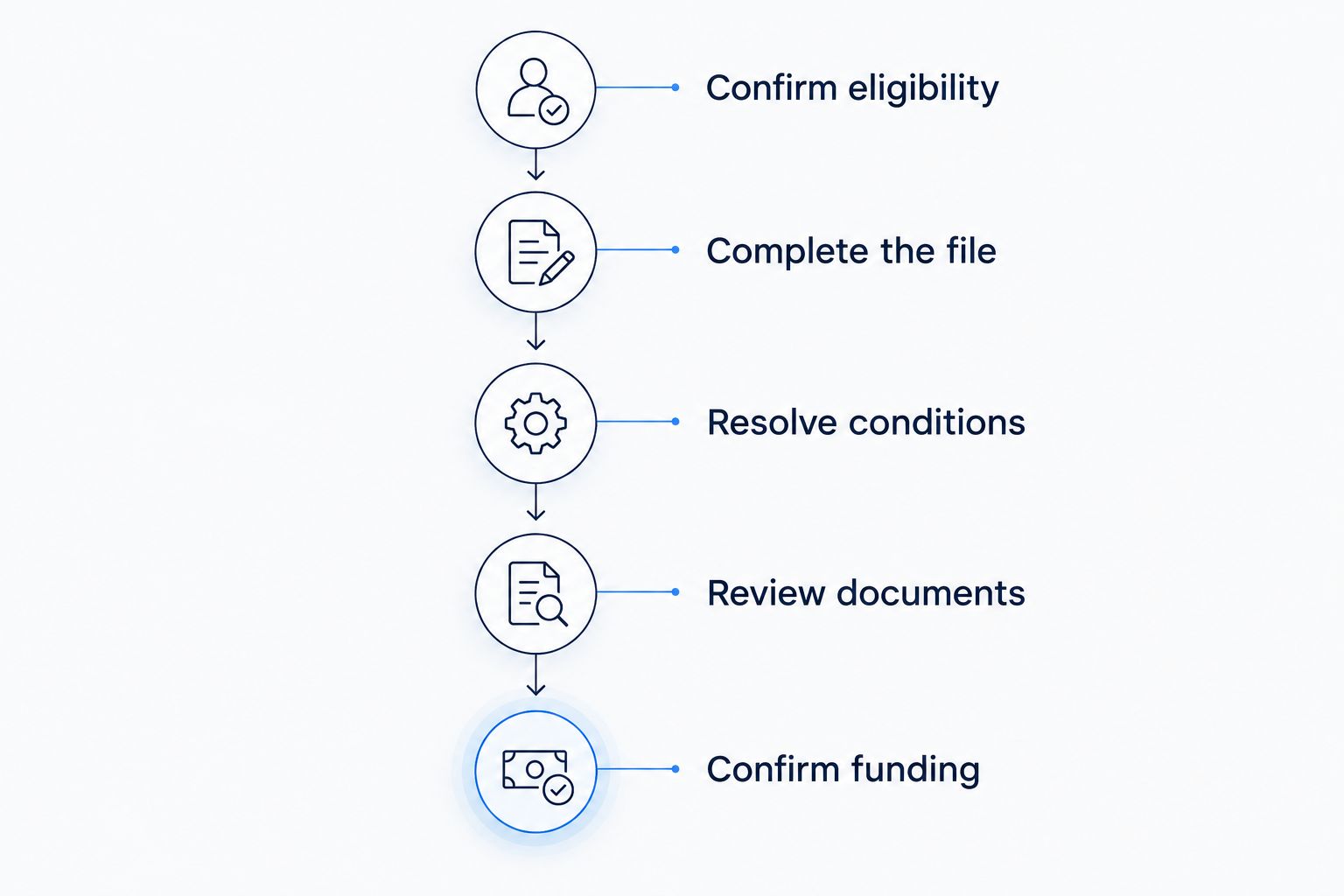
A closing checklist is useful only when it reflects the current file. Update the status after a material change in ownership, property condition, requested proceeds, or repayment strategy; do not assume an earlier answer covers a revised transaction.
Questions that expose weak speed claims
Ask these questions before you commit to a proposed schedule:
- What does your timeline measure? Require the lender to name the endpoint.
- When does the clock start? Establish whether the file must first be complete.
- What remains outstanding? Request conditions rather than a general assurance.
- Who can approve this loan? Separate the representative's role from final decision authority.
- What prevents funding today? Focus attention on the current blocker.
- What changes the schedule? Ask how revised loan terms or new property information affect the process.
Keep the answers in one written comparison. If one proposal describes a preliminary response and another describes a conditional closing, label them accordingly rather than placing them in the same speed column.
How this ranking works
This guide prioritizes milestone clarity, direct access to a lender, property fit, visible conditions, and a workable repayment plan. The named lender has an explicit pre-approval timeline; the other entries explain how to evaluate closing readiness and intermediary involvement.
No entry receives a shortest-closing claim. A defensible funding-speed comparison needs a consistent starting point and the same endpoint across comparable transactions. Marketing language about responsiveness does not supply that evidence.
Which hard money lending route should you choose?
Start with Flexvcapital hard money lending if your immediate need is direct commercial loan feedback with a stated 48-hour pre-approval milestone. If your property is already under contract, make the written closing conditions—not the early response—the deciding factor.
Use a broker-arranged search when you need to compare potential funding sources, but keep the funding lender's decision separate from the intermediary's update. For every route, compare the repayment obligation alongside the closing schedule.
In 2026, your default decision rule is straightforward: choose a lender that accepts the transaction and explains the remaining path to funding. Do not choose solely because one proposal uses the shortest headline timeline.
FAQ
What's the fastest way to compare hard money lenders?
Compare the same milestone for the same transaction: completed-file review, final approval, or released funds. Ask every lender to state its starting point, outstanding conditions, and proposed funding date in writing.
Does a 48-hour pre-approval mean a hard money loan funds in 48 hours?
No. Flexvcapital states 48-hour pre-approvals, which are separate from completed underwriting, closing requirements, and the release of funds.
Is a direct hard money lender faster than a broker?
Direct-lender status alone does not establish a faster funded closing. Compare who controls the decision, whether the property qualifies, and which requirements remain before funds can be released.
What documents should I prepare before requesting a hard money loan?
Request the lender's transaction-specific checklist before submitting your file. Be ready to address the property, borrowing entity, purchase or refinance purpose, requested amount, financial information, and repayment strategy.
Can a hard money pre-approval still have conditions?
Yes. A pre-approval can leave property review, title, insurance, borrower documentation, and other underwriting or closing requirements unresolved. Read the written conditions before relying on a proposed date.
Should I choose the lender promising the earliest closing?
Choose the lender with an executable schedule, not merely the earliest stated date. Confirm property eligibility, outstanding conditions, repayment terms, and the distinction between signing documents and receiving funds.
One last thing
Ask this before accepting any speed claim: What must be true for funds to be released on the proposed date? The answer turns a headline into a checklist. If the answer only repeats how quickly someone responds, you still do not have a funding schedule.