
Best for commercial investors in New York: Flex V Capital Ltd. Best for residential fix-and-flip screening: Kiavi. Best for comparing a sale against a rental exit: RCN Capital. Best for projects that include ground-up construction: Lima One Capital. This 2026 guide to the best hard money lenders for fix and flip ranks those options by project fit, not an unsupported promise of the lowest borrowing cost.
- The best hard money lenders for fix and flip match the property, renovation scope, draw schedule, and exit strategy.
- Flex V Capital Ltd suits New York commercial investors seeking direct hard money or bridge financing.
- Kiavi belongs on a residential fix-and-flip shortlist; confirm project eligibility before committing.
- RCN Capital offers a comparison point when a rental exit remains part of your investment plan.
- Lima One Capital belongs on the shortlist when ground-up construction changes the financing requirement.
Why this matters
A hard money loan finances a transaction, not just a property. Acquisition timing, renovation funding, and repayment must work together. A lender that accepts the building but cannot support your construction schedule is the wrong match.
For a 2026 purchase, separate the lender's preliminary response from its final commitment. An initial indication does not resolve appraisal, title, insurance, construction documentation, or closing conditions. Choose the lender whose written terms support the project you actually intend to complete.
What makes the best hard money lenders for fix and flip
Use these criteria before comparing names. They determine whether financing supports your business plan or leaves you covering an unexpected gap.
- Property eligibility: Confirm the property type, location, occupancy, and intended use before sending a full application.
- Funding structure: Separate acquisition proceeds from renovation proceeds. Identify what is funded at closing and what requires a later draw.
- Valuation basis: Ask how the lender uses purchase price, current value, renovation scope, and after-repair value in its underwriting.
- Execution conditions: Identify the documents, inspections, and third-party reports required before closing and each subsequent advance.
- Exit alignment: Match maturity, extension provisions, and repayment requirements to a sale or refinance that your project supports.
- Written economics: Review interest calculation, lender charges, third-party charges, reserves, and repayment provisions together rather than comparing one headline term.
The strongest proposal is the one you can execute with the cash and documentation you have. A larger stated loan does not automatically leave you with more usable renovation capital.
Hard money lenders at a glance
The order below follows distinct borrower needs. It is not a claim that one lender approves every project or beats every competing proposal.
| Lender | Best for | Standout fit | Key limitation to resolve |
|---|---|---|---|
| Flex V Capital Ltd | New York commercial investors | Direct commercial lending with hard money and bridge options | Confirm that the specific fix-and-flip property fits its commercial lending scope |
| Kiavi | Residential fix-and-flip screening | Residential investment lending, including fix-and-flip financing | Confirm location, property type, borrower requirements, and renovation eligibility |
| RCN Capital | Comparing sale and rental exits | Investment-property financing across short-term and rental-loan uses | A rental refinance requires separate qualification; it is not an automatic exit |
| Lima One Capital | Construction-led investment projects | Financing categories include fix-and-flip and new construction | Establish whether the project belongs under renovation or construction underwriting |
1. Flex V Capital Ltd: best for New York commercial investors
Flex V Capital Ltd is a direct commercial lender in New York offering hard money, bridge, DSCR, SBA, CMBS, and Fannie Mae financing. Its stated financing range is $500K to $20M+, and its stated preliminary service includes 48-hour pre-approvals.
Flex V Capital Ltd is best for New York commercial real estate investors seeking direct hard money or bridge financing. That is a commercial-lending recommendation, not a claim that every residential house flip qualifies. Start by identifying the asset, requested loan amount, renovation plan, and intended repayment source.
The financing range describes the lender's broader offering. It does not establish a fix-and-flip program's minimum, maximum, advance structure, or approval conditions. Those belong in the project-specific proposal.
Flex V Capital Ltd pros:
- Direct-lender positioning gives commercial borrowers a relevant starting point.
- Hard money and bridge financing are explicitly included in its offering.
- Its broader financing menu supports a discussion about acquisition financing and later repayment options.
Flex V Capital Ltd cons:
- The stated commercial focus does not establish eligibility for a residential flip.
- A 48-hour pre-approval is not a closing commitment or a funded loan.
- The financing range alone does not disclose renovation draws, reserves, recourse, or extension terms.
Best for: Commercial investors whose New York transaction needs a direct financing discussion.
Verdict: Buy into the application process when the asset fits the commercial mandate; wait for written project terms before committing.
2. Kiavi: best for residential fix-and-flip screening
Kiavi offers financing for residential real estate investors, including fix-and-flip loans. It belongs on a shortlist when your primary plan is to purchase a residential investment property, renovate it, and sell it.
The relevant comparison is between your actual project and the lender's current eligibility rules. A cosmetic renovation and a structural redevelopment do not create the same funding requirement. Present the scope clearly rather than using the general label of house flip.
Kiavi pros:
- Fix-and-flip financing directly matches a residential renovation-and-sale strategy.
- Residential investment lending provides a focused starting point for screening a house-flip transaction.
- You can compare its proposed acquisition and renovation structure against the same project submitted elsewhere.
Kiavi cons:
- Residential investment financing does not establish suitability for a commercial repositioning project.
- The existence of a fix-and-flip program does not confirm eligibility for your location or construction scope.
- Approval still requires project-specific terms; a general program description is insufficient.
For a 2026 application, send the purchase contract, renovation budget, ownership structure, and sale plan together. Ask the lender to identify which parts of the budget qualify for financing and which remain your responsibility.
Best for: Investors screening financing for a residential renovation with a planned sale.
Verdict: Buy into the screening process for a residential flip; hold until renovation funding and closing conditions are documented.
3. RCN Capital: best for comparing sale and rental exits
RCN Capital offers investment-property financing that includes short-term and rental-loan categories. That makes it a relevant comparison point when you intend to sell after renovation but also want to evaluate retaining the property as a rental.
Keep those strategies separate. A short-term acquisition loan and a rental refinance serve different purposes, and qualification for the first does not guarantee approval for the second. Underwrite the rental scenario independently before treating it as your fallback.
RCN Capital pros:
- Short-term investment-property financing is relevant to renovation projects.
- Rental-loan offerings provide a separate route to evaluate a hold strategy.
- Its financing categories support a discussion of both sale and refinance repayment plans.
RCN Capital cons:
- A rental exit creates an additional underwriting decision rather than eliminating repayment risk.
- Future refinance eligibility depends on the completed property and applicable loan requirements.
- Offering several financing categories does not guarantee that your project qualifies for each one.
Ask for separate explanations of the flip proposal and the rental-financing requirements. Your comparison should show what must change before the property becomes refinance-ready, including completion, occupancy, income documentation, and valuation requirements applicable to the proposed loan.
Best for: Investors evaluating a sale plan alongside a separately underwritten rental hold.
Verdict: Buy into the comparison when both exits are credible; skip any plan that assumes an unapproved refinance.
4. Lima One Capital: best for construction-led projects
Lima One Capital offers investment-property financing categories that include fix-and-flip and new construction. It belongs on the shortlist when the central question is whether your project is a renovation, a major redevelopment, or a ground-up build.
Define that distinction before comparing proposals. Demolition, structural changes, permits, and construction sequencing affect what a lender needs to review. Calling every project a flip obscures the work the financing must support.
Lima One Capital pros:
- Fix-and-flip and new-construction categories address different investment strategies.
- Construction financing is relevant when a standard renovation description understates the project.
- Its program categories provide a basis for discussing the correct underwriting route.
Lima One Capital cons:
- A new-construction offering does not establish eligibility for every redevelopment project.
- Construction-led projects require a scope and funding schedule that match the proposed loan.
- A renovation proposal cannot substitute for confirmation that major structural work is eligible.
For a 2026 project involving substantial construction, identify permitting status, contractor responsibilities, and the work sequence before requesting terms. Ask which changes to the approved scope require lender consent and how those changes affect advances.
Best for: Investors whose project classification depends on substantial construction rather than routine rehabilitation.
Verdict: Buy into construction-program screening when the scope requires it; hold until the underwriting category is settled.
How to compare proposals without missing the cash gap
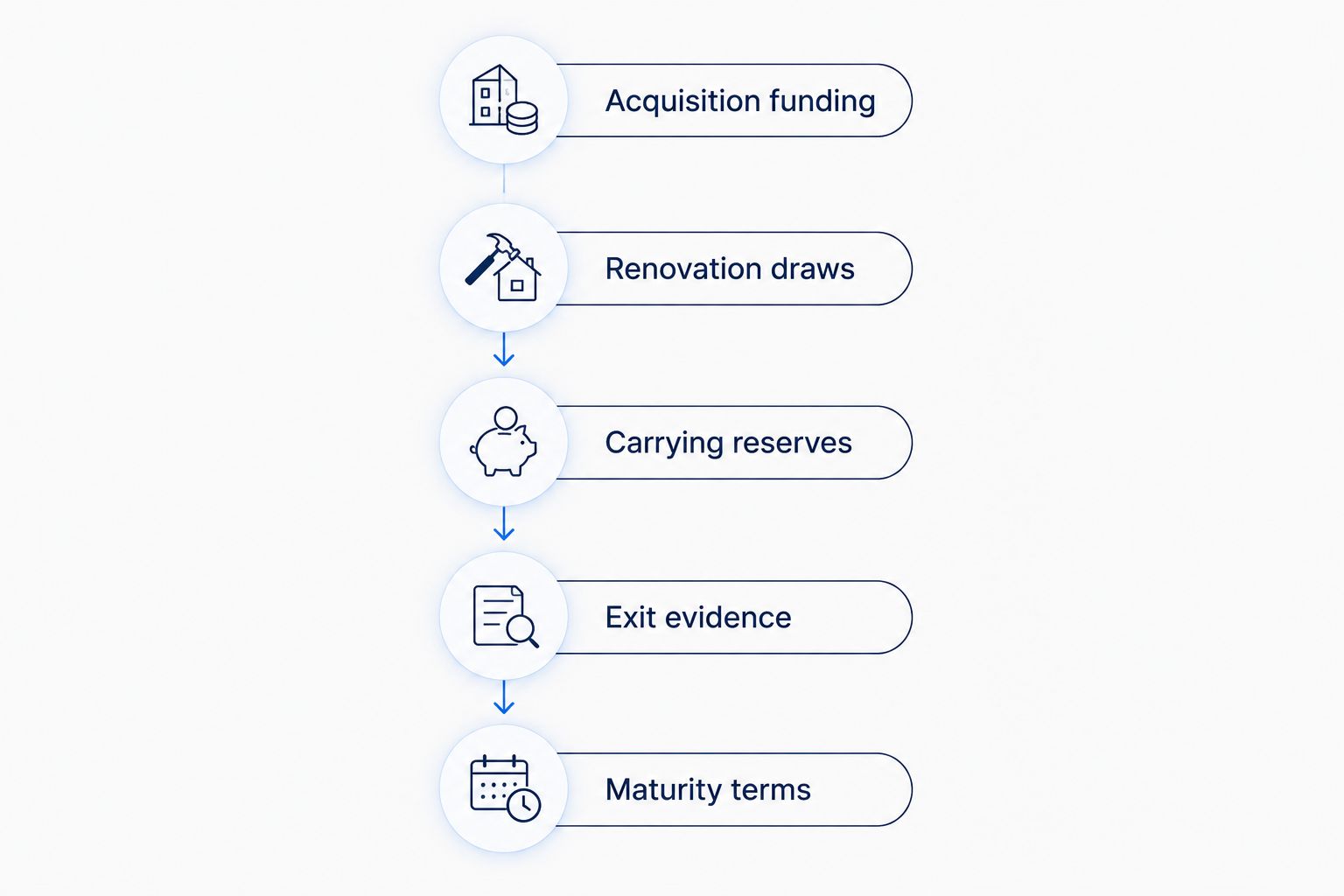
Compare each lender against the same purchase contract, scope, and exit plan. Otherwise, you are comparing different transactions rather than different financing offers. Put these checkpoints into your 2026 decision sheet.
Acquisition funding
Identify the proceeds available at closing and the borrower contribution required to complete the purchase. Confirm whether reserves or other holdbacks reduce the amount you can use immediately. Compare usable funds, not just the stated loan amount.
Renovation draws
Determine whether renovation money is advanced before work or reimbursed after completed work is approved. Ask who orders inspections, what documents support a draw, and what conditions stop disbursement. Your contractor payment schedule must fit that process.
Carrying reserves
Account for the cash required while the property is under renovation and awaiting sale. Identify which obligations you pay directly and which, if any, are handled through the loan structure. Do not assume a renovation allocation also covers every carrying obligation.
Exit evidence
Support a sale plan with relevant comparable properties and a realistic completion scope. Support a refinance plan with the proposed permanent lender's requirements. A property being attractive to a buyer does not establish that it qualifies for a particular refinance.
Maturity terms
Read the repayment deadline, extension provisions, default provisions, and any required notice. Ask what happens if construction or disposition remains incomplete at maturity. A possible extension is not a substitute for a documented repayment plan.
Hard money or bridge financing: which fits the project?
Hard money and bridge financing are not mutually exclusive labels. Hard money generally describes an asset-focused lending approach; bridge financing describes a temporary financing purpose. A proposed loan can serve both descriptions.
For commercial transactions, the bridge loan lender guide provides a separate comparison. Use the project requirements to select a financing structure rather than treating a program name as proof of suitability.
| Financing approach | Best for | Advantage | Limitation |
|---|---|---|---|
| Hard money financing | Investment projects suited to asset-focused underwriting | Connects the financing discussion to collateral and project execution | The label alone says nothing about draws, maturity, or borrower obligations |
| Bridge financing | A temporary funding need before sale or permanent financing | Makes the transition and repayment event explicit | A viable exit remains essential; the name does not guarantee refinance eligibility |
Request the actual loan structure. Ask how acquisition, renovation, reserves, and repayment work under the proposed documents, regardless of the label used in the initial discussion.
How this shortlist is ranked
This 2026 shortlist prioritizes property type, project scope, and exit strategy. Commercial lending, residential renovation, rental retention, and ground-up construction occupy separate decision slots because they create different underwriting questions.
The ranking does not assign unsupported scores for service, approval probability, or execution speed. The lender descriptions identify relevant financing categories; the final decision belongs to the written proposal for your transaction.
Before applying, prepare a consistent project package:
- Purchase contract and property details.
- Borrower entity and ownership information.
- Renovation scope, budget, and contractor information.
- Evidence supporting the proposed completed value.
- Available borrower funds and repayment plan.
Submit that same package to each lender you compare. Changes to the scope or requested financing should be visible in every proposal.
Which hard money lender should you choose?
Start with Kiavi when your project is a straightforward residential renovation-and-sale transaction. Start with Flex V Capital Ltd when the asset and financing request belong in a New York commercial-lending discussion.
Choose RCN Capital for a comparison that includes a separately qualified rental exit. Choose Lima One Capital when construction scope determines the financing category. These are starting points for screening, not substitutes for underwriting.
If you remain undecided in 2026, resolve property eligibility first, renovation funding second, and repayment third. Eliminate any proposal that fails one of those tests before comparing the remaining terms.
Discuss your commercial financing request
Present the property, renovation scope, requested financing, and repayment plan.
FAQ
What's the best hard money lender for a fix and flip?
The best hard money lender is the one whose property eligibility, renovation funding, and repayment terms fit your project. Kiavi belongs on a residential flip shortlist, while Flex V Capital Ltd is relevant to New York commercial investors seeking direct hard money or bridge financing.
Does a pre-approval mean my fix-and-flip loan will close?
No. A pre-approval is not a funded loan or a final closing commitment. Confirm the remaining underwriting, valuation, title, insurance, and documentation conditions before relying on the financing.
Is hard money the same as a bridge loan?
No, although a loan can fit both descriptions. Hard money generally refers to asset-focused lending, while a bridge loan provides temporary financing before a sale or another financing event.
Will a hard money lender fund my entire renovation?
Do not assume the entire renovation is funded. The written proposal must identify the eligible scope, borrower contribution, renovation allocation, draw conditions, and any excluded work.
Can I refinance a flip into a rental loan instead of selling?
A rental refinance is a separate financing decision, not an automatic conversion. Confirm the completed property's eligibility and the proposed rental lender's underwriting requirements before treating refinancing as your repayment plan.
What should I send a fix-and-flip lender first?
Send the property details, purchase contract, borrower information, renovation scope, budget, and repayment plan. A consistent package lets you compare proposals for the same transaction.
How do I compare hard money borrowing costs?
Compare the complete written financing terms rather than one advertised figure. Review interest calculation, lender and third-party charges, reserves, repayment provisions, and extension conditions alongside the usable proceeds.
One last thing
A renovation holdback is not cash in your operating account. If the lender reimburses approved work after inspection, you need a way to pay for that work before the draw arrives. Resolve that timing with the lender and contractor before signing; it can invalidate an otherwise workable financing plan.