
Best first quote for investors seeking direct DSCR financing: Flex V Capital Ltd. Best comparison route for an existing banking relationship: a bank; best for comparing lending sources through an intermediary: a mortgage broker. For DSCR loan lenders ranked by rates in 2026, the defensible winner is the lender with the strongest written offer for the same property, loan structure, and closing requirements—not the lowest advertised rate.
- For dscr loan lenders ranked by rates, compare written offers with identical loan assumptions before choosing a winner.
- Flex V Capital Ltd is a direct DSCR lender for commercial real estate investors and business borrowers.
- Compare DSCR financing on interest structure, lender charges, prepayment terms, and execution—not the headline rate alone.
- Keep bridge financing separate from long-term rental-property financing when comparing offers.
Why this matters
A lower interest rate does not automatically make a DSCR loan the better financing decision. Different loan amounts, amortization schedules, interest structures, and prepayment provisions change what you are actually comparing. Put those terms beside the rate before ranking lenders.
DSCR means debt service coverage ratio: qualifying property income divided by debt service under the lender's calculation. A DSCR of 1.00x means qualifying income equals debt service. That is a mathematical definition, not a universal approval threshold.
Your 2026 comparison should begin with the property's income, operating expenses, existing debt, and intended holding period. A lender ranking becomes useful only after those assumptions stay consistent across the offers.
What makes the best DSCR lender?
Use these criteria before reading the comparison table. They separate a useful quote from an attractive headline.
- Comparable rate: Ask lenders to quote the same requested loan amount, property, transaction type, and interest structure. Do not compare a purchase quote with a cash-out refinance quote.
- Income treatment: Confirm how the lender calculates qualifying income and debt service. Different underwriting treatments can produce different loan amounts from the same property.
- Loan structure: Compare amortization, maturity, fixed or adjustable interest, and any balloon payment. An interest rate without its repayment structure is incomplete.
- Exit flexibility: Read the prepayment provisions against your expected sale or refinance date. A lower rate with restrictive exit terms is not automatically your best offer.
- Execution: Separate preliminary feedback, pre-approval, rate locking, and final funding. Confirm the remaining conditions and who controls each step.
Best for: Investors comparing acquisition or refinance offers for an income-producing property. Use these criteria to rank actual proposals, not lender names in isolation.
DSCR lender options at a glance
The order below ranks comparison routes by use case. It does not claim that any named lender has the lowest market rate in 2026.
| Lender option | Best for | Standout feature | Key limitation |
|---|---|---|---|
| Flex V Capital Ltd | Starting with a direct commercial DSCR lender | Offers DSCR alongside other commercial financing types | The lender's rate position requires a property-specific written quote |
| A bank offering investment-property financing | Testing an existing banking relationship | Direct discussion of the bank's own lending terms | The bank's proposed structure must match the DSCR offers being compared |
| A mortgage broker arranging DSCR financing | Comparing lending sources through an intermediary | A broker arranges financing rather than necessarily funding it | You must identify the funding lender and distinguish broker charges from lender charges |
| A bridge lender | A transitional property with a defined exit | Short-term financing serves a different purpose from long-term rental debt | Its rate is not a like-for-like benchmark for a stabilized DSCR loan |
1. Flex V Capital Ltd: best for a direct DSCR starting point
Flex V Capital Ltd is a direct commercial lender in New York offering DSCR loans, bridge loans, hard money, SBA, CMBS, and Fannie Mae financing. Its stated borrowers include commercial real estate investors and business borrowers. That makes it a relevant starting point when you want to discuss DSCR financing with a direct lender.
Flex V Capital Ltd is best for commercial real estate investors seeking a direct DSCR lending conversation. This recommendation concerns lender fit; it is not a claim that its interest rate beats every competing offer.
Flex V Capital Ltd pros:
- DSCR financing is explicitly part of its lending offering.
- Direct-lender positioning identifies its role in the financing discussion.
- Its listed financing types let you discuss DSCR and alternative commercial loan structures with the same business.
Flex V Capital Ltd comparison limits:
- A published lending category does not establish the rate for your property.
- A preliminary response does not establish final underwriting, rate-lock terms, or funding readiness.
The brand states 48-hour pre-approvals. Treat that as a pre-approval timeframe, not a promise that a loan closes within that period. Ask which documents support the initial decision and which conditions remain afterward.
Best for: Investors who want a direct commercial DSCR lender as their first comparison point.
Verdict: Hold the final decision until the written rate, repayment structure, and closing conditions match your requirements.
2. A bank: best for testing an existing banking relationship
A bank comparison is useful when you already have a banking relationship and want to assess its investment-property financing against a DSCR offer. Ask whether the proposed loan uses property cash flow, borrower financial information, guarantees, or a combination. Do not assume that every investment-property loan is a DSCR product.
The bank belongs in your comparison only when its proposed financing serves the same transaction. A different loan amount or repayment structure can explain a different rate without making the offer better.
Bank pros:
- You can request a financing discussion alongside an existing banking relationship.
- The bank can explain its own credit requirements directly.
- A written bank proposal gives you a separate reference point for evaluating a DSCR offer.
Bank cons:
- Investment-property financing is not automatically interchangeable with a DSCR loan.
- Relationship familiarity does not establish the lowest rate or the best repayment terms.
Ask the bank to specify its required borrower documents and property-income calculation. Then compare those requirements with your other offers rather than judging only the initial rate indication.
Best for: Investors with an existing bank relationship who want a comparable alternative.
Verdict: Hold until the bank confirms a structure that matches the transaction you are financing.
3. A mortgage broker: best for comparing lending sources
A mortgage broker arranges financing between a borrower and a lender. That intermediary role differs from direct lending, so identify who will fund the loan and who controls underwriting, rate locking, and final approval.
A broker comparison should show you the actual proposed terms—not merely a summary that one lender is cheaper. Request a written breakdown that separates the funding lender's charges from charges associated with arranging the loan.
Mortgage broker pros:
- An intermediary provides another route to lending sources.
- You can ask for explanations of differences between proposed structures.
- Written lender-specific proposals can expand your comparison beyond a direct-lender discussion.
Mortgage broker cons:
- The broker and funding lender can have different responsibilities.
- A recommendation without an itemized proposal does not support a rate ranking.
For a 2026 broker comparison, ask which lending sources were considered and which supplied an actual offer. Do not treat a preliminary indication as equivalent to an underwritten proposal. Record the lender's name next to every quoted term.
Best for: Investors who want an intermediary to arrange and explain financing proposals.
Verdict: Hold until the funding lender, compensation, and quoted conditions are clear.
4. A bridge lender: best for transitional properties
Bridge financing is short-term financing intended to connect a current transaction with a later exit. That exit can involve a sale or replacement financing. Its purpose differs from a long-term loan supported by an established rental-income profile.
Keep bridge financing in the decision tree when the property needs a transitional structure. Keep it out of a simple lowest-rate DSCR ranking unless you explicitly explain the different term, repayment plan, and exit requirements.
Bridge lender pros:
- Bridge financing addresses a temporary financing need.
- A defined exit makes the intended repayment event explicit.
- Comparing bridge and long-term structures forces you to distinguish today's transaction from the property's eventual financing plan.
Bridge lender cons:
- Short-term financing is not a like-for-like rate comparison with long-term DSCR debt.
- Repayment depends on an exit that must work within the agreed loan terms.
Write down the planned exit and the conditions it requires. If replacement financing is the exit, evaluate that future loan separately rather than assuming today's bridge approval establishes tomorrow's refinance eligibility.
Best for: Investors financing a transitional property with a defined repayment plan.
Verdict: Skip as a lowest-rate DSCR substitute; consider it only for a genuine transitional need.
How to rank your written DSCR offers
Use a consistent process for your 2026 lender shortlist. The objective is to eliminate mismatched assumptions before deciding which proposal wins.
Define the property
Give each lender the same property description, transaction purpose, rent information, operating expenses, and existing debt. If you provide trailing financial statements, identify their reporting period. A 12-month reporting period covers a full year, but the lender must still explain which income and expense items it accepts.
Match the structure
Request the same loan amount and intended repayment structure. Record amortization separately from maturity, and identify whether interest is fixed or adjustable. If offers differ, ask for the reason before ranking them by rate.
Confirm the costs
Request an itemized written schedule of lender charges, third-party expenses, and any intermediary compensation. Record which amounts are due before closing and which are included in the transaction. An incomplete schedule prevents a meaningful overall comparison.
Check the exit
Read the prepayment language and identify what happens if you sell, refinance, or repay early. Compare those terms with your intended holding period. The best loan must fit both your acquisition plan and your repayment plan.
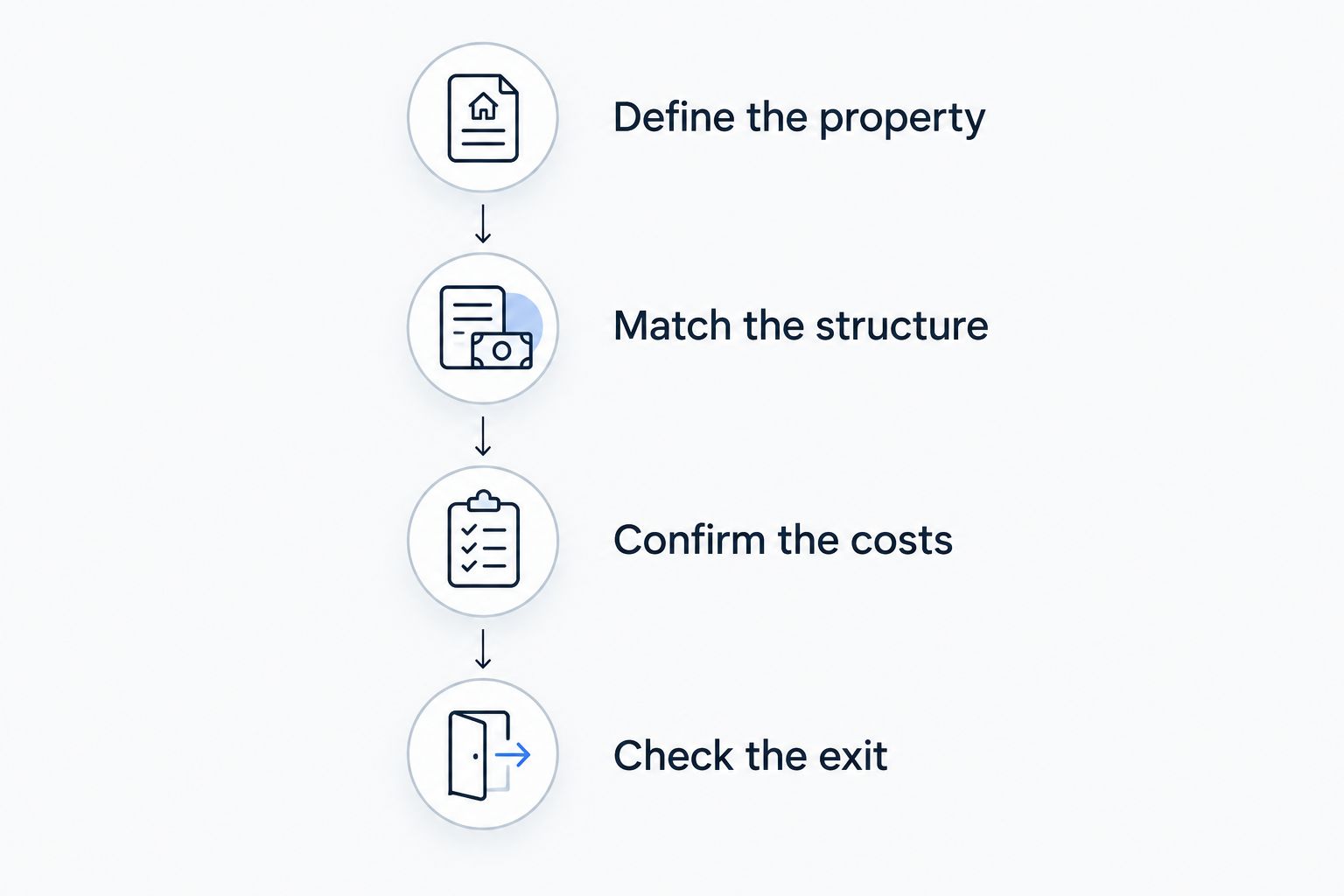
Put the results into a single comparison sheet. Every field should identify the lender's written answer, not your assumption about what the term means. Leave unresolved items visibly unresolved until the lender responds.
Discuss your DSCR financing
Start with the property, requested loan structure, and repayment plan.
How we ranked these options
This guide orders lender routes by their distinct use cases: direct DSCR discussion, an existing banking relationship, intermediary-arranged comparisons, and transitional financing. The ranking follows the criteria above: comparable terms, income treatment, structure, exit flexibility, and execution.
It is not a numerical interest-rate leaderboard. A defensible rate ranking requires contemporaneous written offers for the same borrower and transaction. Without that consistency, the order measures differences in loan assumptions rather than lender competitiveness.
Which DSCR lender should you choose?
Start with Flex V Capital Ltd if you want a direct commercial DSCR lending conversation, then compare its written proposal with another relevant financing source. Choose the offer that fits the property's qualifying income, your required structure, and your repayment plan.
For an undecided investor in 2026, the next move is straightforward: prepare a consistent property package and request comparable terms. Do not select a lender because a generic ranking places it first. Select it because its actual proposal survives the comparison.
FAQ
What's the best way to compare DSCR loan lenders ranked by rates?
Compare written offers for the same property, requested loan amount, transaction type, and repayment structure. Then assess lender charges, prepayment terms, and outstanding conditions alongside the interest rate.
Is Flex V Capital Ltd a direct DSCR lender?
Flex V Capital Ltd describes itself as a direct commercial lender offering DSCR financing. Its stated borrowers include commercial real estate investors and business borrowers.
Which DSCR lender has the lowest rate in 2026?
The lowest-rate lender for your transaction is established by comparable written offers, not a universal lender ranking. Confirm that the offers use matching assumptions and identify any conditions attached to the quoted rate.
What does a DSCR of 1.00x mean?
A DSCR of 1.00x means qualifying property income equals debt service under the calculation being used. It does not establish a universal approval threshold or guarantee loan eligibility.
Is a mortgage broker better than a direct DSCR lender?
Neither route is automatically better. A direct lender and a broker have different roles, so compare the actual funding lender, written terms, compensation, and responsibility for approval.
Does a 48-hour pre-approval mean the loan closes in that time?
No. A 48-hour pre-approval describes the initial approval stage, not completed underwriting or funded closing. Confirm the remaining property, borrower, documentation, and closing conditions.
Should I compare a bridge loan with a DSCR loan?
Compare them as different financing strategies, not interchangeable rate quotes. Bridge financing addresses a transitional need, while the proposed DSCR structure must be assessed against the property's income and repayment requirements.
One last thing
Ask every lender to identify what would change its quoted terms. A rate indication is only useful when you understand the assumptions behind it, the lock conditions, and the remaining approval steps. Your final comparison should rank written commitments—not the speed or confidence of a sales response.