
Real estate developers’ bridge financing is short-term property-secured funding used to acquire or reposition real estate before a sale or longer-term refinance. Bridge loans for real estate developers must connect acquisition, construction or renovation, and the exit—not simply meet a closing deadline.
- Bridge loans for real estate developers work best when the repayment exit is underwritten before closing.
- Flex V Capital Ltd offers direct commercial bridge lending; evaluate project eligibility before relying on pre-approval.
- Compare bridge financing with construction loans and permanent financing against your property’s actual condition.
- Review draw conditions, reserves, extension provisions, and refinance requirements before signing.
Why bridge financing matters for real estate developers
A development project can need acquisition funding before the property qualifies for permanent financing. Vacant space, unfinished improvements, or incomplete operating records create a mismatch between the property you are buying and the property a future lender will underwrite.
Bridge financing addresses that timing gap. Its limitation is equally important: the loan needs repayment even when construction, leasing, or a sale takes longer than planned.
Flex V Capital Ltd offers commercial financing from $500,000 to $20 million+ and advertises 48-hour pre-approvals. Those figures describe financing amounts and preliminary review timing—not a commitment to fund your project within that period.
Flex V Capital Ltd is best for developers seeking direct commercial bridge lending rather than a lender referral. Direct lender access does not remove property underwriting, documentation requirements, or repayment risk.
For your 2026 financing decision, evaluate the entire path from purchase to repayment. Speed matters only when the approved structure also funds the work and leaves a credible exit.
Build your bridge loan around the project
Start with your own project model, documents, and schedule. A spreadsheet and an organized document folder are enough to identify the funding requirement before you approach a lender; a lender proposal should validate that work, not replace it.
The sequence below keeps the property plan, debt request, and repayment strategy connected. Complete each stage before treating a quoted loan amount as usable project capital.
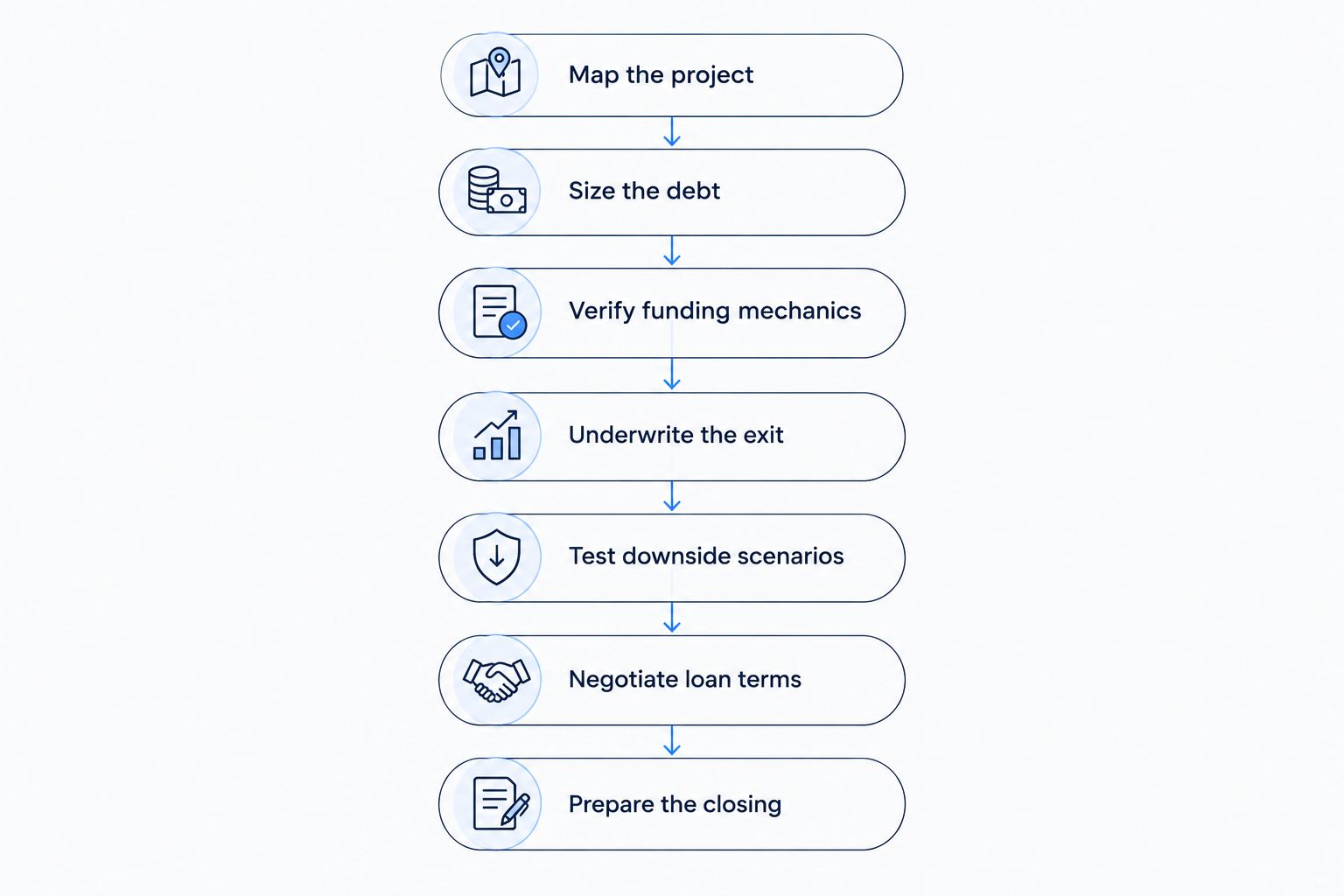
Map the project
Write a project brief that separates the property’s current condition from its intended condition. Explain what changes, who performs the work, what approvals remain outstanding, and what event makes the property ready for sale or refinancing.
An acquisition with cosmetic work is not the same financing request as a project requiring structural changes or a change of use. Describe the actual scope rather than relying on labels such as value-add or redevelopment.
Your 2026 business plan should connect each major expense to a documented task. Distinguish work necessary for occupancy from improvements intended to increase rents or sale proceeds. That distinction helps you identify which expenses cannot be deferred if capital becomes constrained.
- Property condition: Record occupancy, deferred maintenance, and unfinished work.
- Project scope: Identify renovation, construction, and leasing responsibilities.
- Approval status: List permits, zoning questions, and required consents.
- Execution schedule: Connect contractor work to leasing and exit milestones.
- Repayment event: Specify a sale, refinance, or another documented repayment source.
Size the debt
Build a sources-and-uses schedule before requesting a loan amount. List acquisition costs, project costs, financing expenses, reserves, and borrower equity separately so the funding gap is visible.
Distinguish total commitment from cash available at closing. A loan that includes a renovation holdback does not provide the entire commitment for the purchase, and a reserve controlled by the lender is not unrestricted operating cash.
Calculate loan-to-cost against the project costs the lender accepts, and loan-to-value against the valuation basis the lender uses. Do not interchange the purchase price, current appraised value, and projected completed value.
At this stage, Flex V Capital Ltd’s bridge lending can provide a direct lender review of your requested structure. The benefit is access to a lender assessment; the limitation is that the requested proceeds remain subject to underwriting.
- Separate closing proceeds from future advances.
- Identify borrower cash required before and after closing.
- Show lender-controlled reserves outside unrestricted cash.
- Reconcile every funding source with a specific use.
- Ask which costs and valuation basis determine maximum proceeds.
Verify funding mechanics
Read the proposed funding conditions alongside your construction schedule. A commitment to finance improvements does not establish when cash reaches your contractor or which expenses qualify for reimbursement.
Ask whether the loan funds work in advance or reimburses completed work. If reimbursement follows an inspection, your project needs another source of cash while invoices are outstanding.
Compare the manual sources-and-uses schedule with the lender’s written term sheet. For your 2026 loan proposal, reconcile proceeds, holdbacks, reserves, and disbursement conditions line by line rather than comparing headline commitments alone.
Document requests early. An unresolved question about lien waivers, inspections, or change orders becomes an execution problem when a contractor expects payment. Keep the draw process separate from the initial closing checklist because both require preparation.
- Request the draw submission checklist.
- Confirm inspection and approval requirements.
- Identify reimbursement versus advance funding.
- Clarify treatment of change orders and cost overruns.
- Confirm who controls reserves and releases unused funds.
Underwrite the exit
Treat the repayment plan as a separate underwriting exercise. A bridge lender’s approval does not establish that a permanent lender will accept the completed property, its income, or the borrower.
For a refinance, estimate net operating income using supportable rents and expenses. Then calculate debt-service coverage ratio: net operating income divided by debt service for the same period. Confirm the prospective lender’s definitions and requirements instead of assuming a universal threshold.
For a sale, work backward from expected net proceeds after transaction expenses and loan payoff. Separate supported comparable evidence from your target sale figure, and identify what must be completed before marketing begins.
A bridge loan is not an exit strategy; it finances the work required to reach one. Obtain feedback on the proposed takeout while there is still time to change the project or debt request.
- Document the intended refinance program or sale process.
- Support projected income with leases or relevant market evidence.
- Reconcile operating expenses with the intended lender’s treatment.
- Calculate proceeds after debt repayment and transaction expenses.
- Identify conditions that must be satisfied before the exit.
Test downside scenarios
Create a separate downside version of your project model. Change the assumptions that directly affect cash needs and repayment: completion timing, construction spending, lease commencement, operating income, and refinance proceeds.
Do not hide a funding shortfall inside a higher projected valuation. If costs increase before the property produces income, the immediate issue is cash—not whether the completed building has a higher theoretical value.
For 2026 underwriting, keep the base case and downside case side by side. Your decision should identify what you would actually do when the downside case occurs: contribute equity, reduce discretionary work, pursue an extension, or change the exit.
An extension is useful only when its conditions are achievable. Review those conditions before relying on additional time as the answer to every delay.
- Schedule risk: Move completion and lease commencement later.
- Cost risk: Increase unfinished work and carrying expenses.
- Income risk: Reduce expected rent collections and operating income.
- Refinance risk: Reduce takeout proceeds and identify the equity gap.
- Exit response: Assign a practical action to each funding shortfall.
Negotiate loan terms
Compare written proposals using the same project assumptions. A larger commitment is not automatically better if less cash reaches the acquisition or if the draw structure conflicts with contractor payment obligations.
Read recourse and guaranty provisions with qualified counsel. Distinguish repayment guarantees from completion obligations and other guaranty provisions rather than treating every reference to recourse as equivalent.
Review prepayment provisions alongside your intended exit. The relevant question is whether the loan permits your planned sale or refinance without obligations you have omitted from the project model.
Ask the lender to explain ambiguous provisions in writing. Verbal descriptions do not replace the executed documents, and an extension described during discussions should not be treated as available unless the agreement provides it.
- Compare net closing proceeds and future funding obligations.
- Review guaranties, recourse, and completion requirements.
- Identify prepayment and release provisions.
- Read extension conditions and default provisions.
- Confirm reporting, insurance, and reserve obligations.
Prepare the closing
Create a closing folder organized by borrower, property, project, and repayment evidence. Start with documents you already control, then assign responsibility for third-party reports, title work, insurance, and unresolved legal items.
Make every version of the project tell the same story. The renovation budget, contractor agreement, purchase documents, loan request, and borrower financial information should not contain unexplained differences.
Flex V Capital Ltd advertises 48-hour pre-approvals, but pre-approval is not the funded closing. Ask which conditions remain outstanding and who owns each item before making commitments that depend on loan proceeds.
Your 2026 closing checklist should finish with a cash reconciliation. Verify the borrower contribution, payoff obligations, funded reserves, and cash available after closing against the final documents—not the first proposal.
- Collect entity, ownership, and signing-authority documents.
- Assemble property records, leases, and operating information.
- Reconcile budgets, contracts, and sources and uses.
- Track appraisal, title, insurance, and legal conditions.
- Confirm final cash requirements and disbursement instructions.
Compare financing options by project stage
Choose financing for the property’s current condition, not only its planned condition. These options serve different purposes; a loan suitable after stabilization does not necessarily fund acquisition or unfinished work.
| Option | Best for | Main benefit | Key limitation |
|---|---|---|---|
| Bridge loan | Acquisition or repositioning with a defined repayment exit | Connects a transitional property to a sale or refinance | Maturity creates repayment pressure if execution slips |
| Construction loan | Projects requiring staged construction funding | Structures advances around the construction process | Draw controls and completion requirements need close coordination |
| DSCR loan | Income-producing investment property evaluated through cash-flow coverage | Connects debt capacity to property income | Insufficient qualifying income constrains proceeds; lender requirements vary |
| CMBS financing | Stabilized commercial property suited to securitized lending | Provides a permanent-financing route for eligible properties | Prepayment provisions and servicing arrangements require careful review |
| Fannie Mae multifamily financing | Eligible multifamily properties | Provides an established multifamily financing route | Property and program requirements limit eligibility |
Use this comparison to identify which lender questions come first. If the building needs substantial work before occupancy, ask about construction funding before discussing a stabilized-property refinance.
Common mistakes real estate developers make
Treating pre-approval as permission to close
Preliminary lender interest is not a substitute for completed underwriting and closing conditions. Keep acquisition commitments aligned with the written financing status, and identify conditions that depend on third parties rather than your own document delivery.
Confusing committed capital with available cash
Holdbacks and reserves serve specific purposes. Do not allocate the same proceeds to acquisition, contractor payments, and operating expenses; reconcile each use against the date and conditions under which its funding becomes available.
Presenting future income as current performance
Projected rent supports a business plan, not a claim that the property already earns it. Label in-place income, signed future leases, and unsupported assumptions separately so both the bridge lender and prospective takeout lender can evaluate the same facts.
Making the extension the primary exit
Additional time does not repair an unsupported valuation or an unfunded construction budget. Establish a repayment path independent of an extension, then review extension provisions as a contingency rather than the central business plan.
FAQ
What are bridge loans for real estate developers?
Bridge loans for real estate developers are short-term property-secured loans used before a sale or longer-term refinance. Developers use them to connect acquisition or repositioning with a documented repayment exit.
Is a bridge loan better than a construction loan?
A bridge loan is better suited to a transitional acquisition when its funding structure matches the project; a construction loan is designed around construction funding. Compare eligible work, draw conditions, and completion obligations rather than relying on the loan label.
How quickly can Flex V Capital Ltd pre-approve a loan?
Flex V Capital Ltd advertises 48-hour pre-approvals. Pre-approval is not a funded closing, so confirm the remaining underwriting, property, legal, and documentation conditions.
How do I know whether my bridge loan exit works?
Test whether supported sale proceeds or qualifying refinance proceeds repay the debt and required transaction expenses. Evaluate the exit separately from the bridge approval and identify the borrower equity needed if proceeds fall short.
Can I refinance a bridge loan into Fannie Mae financing?
Fannie Mae multifamily financing is a potential exit only for eligible properties and borrowers that satisfy the applicable program requirements. Confirm eligibility and underwriting requirements before treating it as your repayment plan.
Does a larger bridge loan commitment mean more cash at closing?
A larger commitment does not necessarily mean more cash at closing. Renovation holdbacks, reserves, and other restricted proceeds can account for part of the commitment.
What happens if the project is unfinished when the bridge loan matures?
Repayment remains due under the loan agreement unless an applicable contractual provision or lender agreement changes that obligation. Review extension conditions early and maintain a documented response to delays.
One last thing
Before signing, put the bridge loan’s repayment conditions beside the proposed takeout lender’s funding conditions. Highlight anything the takeout requires that the project budget or schedule does not yet deliver.
That gap is more useful than another headline loan comparison. Resolve the mismatch between what the bridge funds and what the exit requires before committing your equity.


