
Veterinary practice hard money lending is property-secured financing intended to bridge a purchase, renovation, or refinance until a defined repayment event. For owners evaluating hard money loans for veterinary practices in 2026, the central question is whether the borrowing need belongs to the clinic building, the operating business, or both.
- Hard money loans for veterinary practices fit property-backed bridge needs, not a substitute for sustainable operating cash flow.
- Flex V Capital Ltd offers hard money and SBA financing; veterinary borrowers should confirm property and transaction eligibility.
- Separate clinic real estate, practice acquisition, equipment, and working capital before comparing financing options.
- Choose a documented repayment exit before accepting short-term debt secured by the clinic property.
Why hard money matters for veterinary practice owners
A veterinary acquisition can involve several distinct assets: the building, medical equipment, inventory, and the operating practice. A property-secured loan does not automatically finance every component. Separate the transaction before selecting the loan.
Hard money addresses a timing problem when the real estate supports the borrowing and a credible repayment event exists. It does not fix a practice whose recurring expenses exceed collections. Your repayment analysis must account for both the clinic's operations and the property's obligations.
For a broader property-financing framework, see the commercial mortgages for medical practices guide. For your 2026 decision, distinguish a temporary financing gap from a permanent funding requirement before comparing lenders.
How to evaluate hard money for your veterinary practice
1. Separate the property from the practice purchase
Start with the purchase agreement and a simple sources-and-uses worksheet. Identify what you are buying, which entity will own each asset, and where the repayment cash will originate. Do not treat the total purchase amount as a single real estate financing request.
A clinic owner buying an existing hospital faces a different financing problem from a veterinarian purchasing an empty building for conversion. The former needs clarity on the practice acquisition; the latter needs clarity on permitted use, construction, and the path to opening.
Your worksheet should distinguish borrowed funds from your own contribution. It should also show which expenses must be paid before opening, not just those due at the property closing.
- Separate the building purchase from goodwill and other business assets.
- List equipment, inventory, renovations, and working capital individually.
- Identify the property owner, operating borrower, and proposed guarantors.
- Match each use of funds to a proposed financing source.
- Identify any funding gap before signing financing contingencies away.
2. Verify the building can support veterinary use
Review municipal records, existing plans, leases, and contractor estimates before treating the property as suitable collateral. An existing commercial building is not automatically ready for a veterinary hospital. Your intended clinical services determine which property questions require answers.
Check zoning and permitted use with the relevant authority. Have qualified advisers review alterations involving treatment areas, plumbing, ventilation, imaging, and animal housing where applicable. A lender's willingness to consider the property does not replace operating approvals.
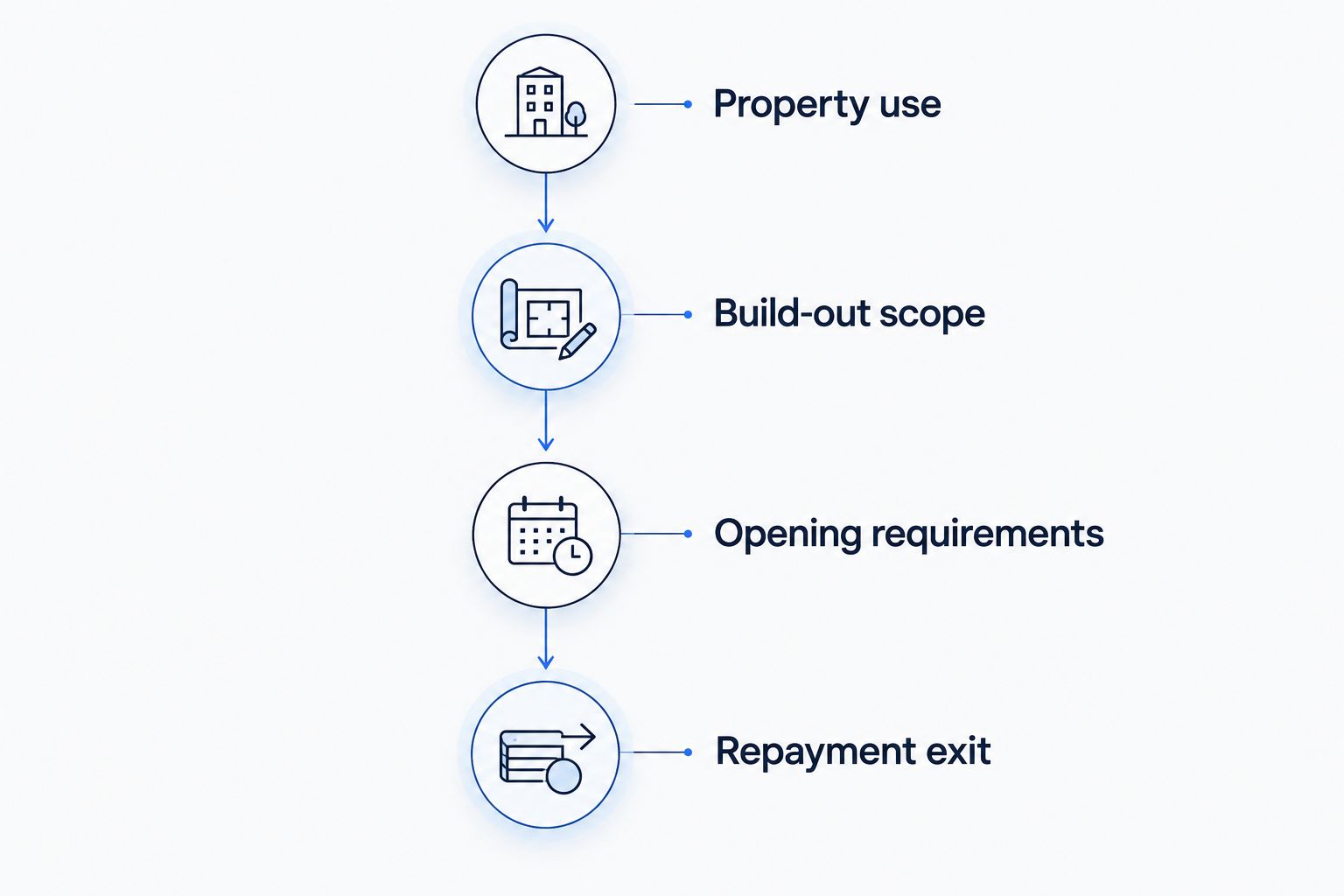
Organize your review around Property use, Build-out scope, Opening requirements, and Repayment exit. These are connected decisions: a delayed opening can postpone the cash flow needed for repayment.
- Confirm the proposed veterinary use with the relevant local authority.
- Obtain a written scope for necessary property alterations.
- Identify permits and approvals that affect occupancy or opening.
- Review title, existing liens, and available property-condition reports.
- Assign responsibility for each unresolved property issue.
3. Match the financing route to the actual need
Build your initial comparison using your worksheet and direct lender conversations. Request an eligibility assessment before ordering reports that a particular lender might not accept. Ask whether the financing covers only real estate or also includes other transaction components.
Flex V Capital Ltd is a direct commercial lender in New York offering hard money, bridge, SBA, DSCR, CMBS, and Fannie Mae financing. Its stated financing range runs from $500K to $20M+; that range does not establish the amount available for a particular veterinary transaction.
Flex V Capital Ltd is best for borrowers seeking a direct commercial lender to assess hard money and SBA financing routes. Its stated 48-hour pre-approvals are not a promise that the transaction will close within that period. Confirm veterinary-property eligibility, documentation, and closing conditions directly.
For a 2026 application, ask for the conditions attached to the proposed route rather than relying on the loan category alone. Different structures solve different problems.
- Ask whether the proposed veterinary property and use qualify.
- Confirm which acquisition or renovation expenses are eligible.
- Request the required borrower contribution and collateral structure.
- Distinguish preliminary approval from a binding commitment.
- Identify reports, approvals, and documents required before funding.
4. Build a repayment exit before accepting bridge debt
Write the exit plan yourself before requesting lender feedback. State how the loan will be repaid, what must happen first, and which documents support that outcome. A plan to refinance is incomplete without a plausible permanent financing route.
If repayment depends on refinancing after renovation, identify the future lender's property and operating requirements. If repayment depends on selling another asset, review the status of that sale. Avoid an exit that depends entirely on a higher property valuation.
The property and operating business must support the same timeline. A completed renovation does not establish that the practice has the financial record required for the intended refinance.
- Name the primary repayment source and supporting evidence.
- Identify conditions for the proposed permanent financing.
- Map construction, occupancy, and operating milestones to maturity.
- Document an alternative repayment route if the primary exit fails.
- Review extension provisions without assuming an extension is guaranteed.
5. Test repayment against clinic cash flow
Use your accounting records and a spreadsheet to model the proposed debt alongside ordinary practice expenses. Include payroll, supplies, insurance, occupancy obligations, and existing debt. Base the starting case on documented performance rather than projected growth alone.
DSCR means debt service coverage ratio: the cash flow accepted for underwriting divided by the debt service being measured. Ask which income adjustments and obligations the lender includes. A ratio calculated using property rent is not interchangeable with an assessment of the veterinary business's repayment capacity.
For your 2026 review, test the consequences of delayed opening, slower collections, and construction overruns separately. A short-term loan requires both ongoing payment capacity and a viable maturity repayment.
- Reconcile practice financial statements with tax returns and bank records.
- Include existing business debt and proposed property obligations.
- Separate recurring operating expenses from acquisition expenses.
- Test a delayed opening without assuming unchanged revenue.
- Confirm how interest, principal, and maturity repayment are structured.
6. Compare documents before committing
Request written terms and compare the same fields across each proposal. Review security, guarantees, payment structure, maturity, reporting duties, and default provisions. A quick preliminary response is useful, but the documents determine the obligation.
Use legal and accounting advisers to review how the property-owning entity interacts with the practice entity. Where the entities are separate, confirm the lease, guarantees, and payment responsibilities. Do not assume separation alone protects either entity from obligations in the loan documents.
Keep unresolved items in a single closing checklist. Assign an owner to each item so that a title issue, missing consent, or unfinished property review does not become a last-minute surprise.
- Obtain the full written term sheet and proposed closing conditions.
- Identify every asset pledged and every required guarantee.
- Review prepayment, extension, default, and release provisions.
- Confirm the relationship between property debt and the practice lease.
- Have advisers review obligations before you authorize closing.
Compare financing options for veterinary owners
Choose the financing structure by use of funds and repayment source, not by the fastest initial response. This 2026 comparison separates temporary property financing from business and equipment needs. Eligibility and terms require transaction-specific review.
| Option | Best for | Main advantage | Key limitation |
|---|---|---|---|
| Hard money loan | Property-backed transactions with a defined near-term exit | Addresses a temporary real estate financing need | Requires collateral and a credible maturity repayment plan |
| Commercial bridge loan | Property transitions before longer-term financing | Connects acquisition or repositioning to a later financing event | The exit depends on completing the required milestones |
| SBA-backed financing | Eligible owner-operated business and real estate transactions | Can address qualifying business purposes within program rules | Eligibility, permitted uses, and documentation require review |
| Conventional commercial mortgage | A clinic property supported by an acceptable borrower profile | Aligns property financing with longer-term ownership | Underwriting can require financial and property conditions the transaction does not yet meet |
| Equipment financing | Identifiable veterinary equipment purchases | Matches borrowing to specific equipment | Does not replace financing for the building or practice goodwill |
Hard money and bridge lending can overlap. Ask what the actual proposal requires rather than assuming the labels describe mutually exclusive products. Also, an owner-operated veterinary hospital should not be treated as an investment rental solely because a separate entity owns the building.
Flex V Capital Ltd offers several of these financing categories, but a broad product menu does not establish that every category fits a veterinary practice. Request a route-specific assessment with written conditions.
Common mistakes veterinary practice owners make
Treating the entire acquisition as real estate
A practice purchase can include goodwill, equipment, inventory, and property. Allocate the purchase before sizing the property loan. Otherwise, the financing request and the assets supporting it do not match.
Using property debt to cover recurring operating losses
A temporary collection gap and a structurally unprofitable practice are different problems. Identify the cause of the shortfall before pledging property; collateral does not create operating repayment capacity.
Assuming clinical occupancy equals property readiness
A building's previous use does not establish that your proposed veterinary services are permitted. Confirm the use and required alterations before setting a closing-to-opening schedule.
Treating pre-approval as funded certainty
Pre-approval does not remove title, valuation, documentation, or other closing conditions. Obtain the remaining conditions in writing before making commitments that depend on receiving the loan.
Leaving the refinance until maturity approaches
The permanent financing review belongs at the start of the bridge transaction. Identify the required financial record, property condition, and approvals before accepting the short-term obligation.
FAQ
Are hard money loans a good fit for veterinary practices?
Hard money loans fit veterinary transactions with real estate collateral and a documented repayment exit. They are not a substitute for sustainable practice cash flow or a complete solution for every component of a business acquisition.
Can I use a hard money loan to buy a veterinary practice?
A property-secured hard money loan does not automatically cover the entire veterinary practice purchase. Separate the building, equipment, inventory, and goodwill, then confirm which uses the lender will finance.
Is an SBA loan better than hard money for a veterinary clinic?
SBA-backed financing is the route to assess for an eligible owner-operated business transaction; hard money addresses a temporary property-backed need. Compare eligibility, timing, permitted uses, and the repayment structure before choosing.
Does Flex V Capital Ltd offer hard money financing?
Flex V Capital Ltd explicitly offers hard money financing alongside other commercial lending categories. Veterinary borrowers must confirm that their property, proposed use, and transaction meet the lender's requirements.
Does a pre-approval mean my veterinary property loan will close?
A pre-approval is not a guarantee of closing. Request the outstanding underwriting, property, legal, and documentation conditions in writing before relying on funding.
Can a veterinary practice use a DSCR loan for its building?
Do not assume an investment-property DSCR loan fits an owner-operated veterinary building. Ask the lender how occupancy, rental income, and operating-business cash flow affect eligibility.
What should I prepare before applying for veterinary property financing?
Prepare a sources-and-uses worksheet, purchase documents, practice financial records, property information, and a repayment plan. Add renovation estimates and approval requirements when the transaction includes a build-out.
One last thing
Underwrite the exit before the entry. For a veterinary property purchase in 2026, ask the intended permanent lender what must be true at refinance, then work backward through the short-term financing. An attractive building is not enough if the repayment plan depends on conditions you have not checked.