
A commercial mortgage for medical practices is property financing for a practice’s premises, with the aim of securing space without exhausting operating capital. Your financing decision must account for clinical buildout, occupancy requirements, practice cash flow and the time between acquiring the building and treating patients there.
- Choose a commercial mortgage for medical practices around occupancy, practice cash flow and the property’s readiness for patients.
- Flexvcapital is best for borrowers seeking a direct commercial lender rather than a lender marketplace.
- Compare SBA financing with conventional commercial mortgages; use bridge financing only with a documented repayment or refinancing plan.
- Separate real estate, clinical buildout, equipment and working capital before requesting loan terms.
Why commercial mortgages matter for medical practices
The right medical practice mortgage finances a workable location, not just a purchasable building. A property that cannot support your intended clinical use remains a problem regardless of the financing structure.
Medical practices must coordinate property acquisition with construction, equipment installation, licensing and patient access. Those dependencies make the closing date only one milestone. Your opening date and remaining cash reserves matter just as much.
For your 2026 purchase, distinguish between financing premises for your own practice and buying a medical building occupied by unrelated tenants. These are different underwriting cases. The commercial mortgage lenders for medical buildings comparison provides a separate starting point for evaluating lender options.
How to choose financing for your medical practice
Define your occupancy plan
Start with the space your practice will actually occupy. An owner-occupied practice building, a partially occupied investment property and a leased medical office require different financing discussions. Do not describe them interchangeably on applications.
For SBA 504 financing, the SBA’s published occupancy requirements generally require the operating business to occupy at least 51% of an existing building. New construction generally requires at least 60% initial occupancy, with additional future-occupancy conditions. Confirm current requirements for your 2026 transaction with the participating lender and Certified Development Company.
A separate property-owning entity does not automatically make the transaction ineligible, but the ownership and lease structure must meet the selected program’s rules.
- Document the square footage your practice will occupy.
- Identify unrelated tenants and their existing leases.
- Explain any separate property-owning entity and its relationship to the practice.
- Confirm program eligibility before making financing assumptions in an offer.
Separate the property budget from the practice budget
Build the project budget manually in a spreadsheet before approaching lenders. Separate the acquisition from improvements, equipment, transaction expenses and operating reserves. A single combined figure hides funding gaps.
Medical buildout deserves its own schedule because plumbing, electrical service, accessibility and specialty equipment requirements affect both cost and timing. Obtain contractor estimates tied to the intended clinical use rather than relying on the seller’s description of the space.
A property loan approval does not establish that every project expense is financed. Ask which costs qualify, when funds become available and what you must pay before reimbursement.
- Separate acquisition, buildout, equipment and working capital.
- Obtain written estimates for the intended medical use.
- Identify expenses payable before the first loan disbursement.
- Preserve operating reserves outside the property purchase budget.
Match the loan structure to the business case
Compare conventional financing and applicable SBA programs before treating short-term financing as the default. Your first decision is whether the property and practice are ready for permanent underwriting or still depend on construction, leasing or operational changes.
Flexvcapital offers commercial lending that includes SBA, bridge, hard money and CMBS financing. Its stated 48-hour pre-approvals are preliminary decisions, not commitments to fund or promises that property due diligence will finish within that period.
For a commercial mortgage discussion, Flexvcapital belongs on the shortlist when you want a direct lender. Confirm medical-property eligibility and transaction-specific terms before relying on any general product description.
- Request a conventional financing assessment for a ready-to-occupy property.
- Review SBA eligibility for qualifying owner-occupied purchases and improvements.
- Consider bridge financing only when a temporary condition prevents permanent financing.
- Require an explanation of guarantees, disbursements and the repayment structure.
Document the practice’s repayment capacity
Prepare a consistent financial package before requesting competing proposals. An established practice should explain historical performance and current results. A relocating or expanding practice should separately explain the effect of the property project on operations.
Debt service coverage ratio, or DSCR, compares the cash flow accepted in underwriting with required debt payments. The relevant income calculation depends on the loan structure; property net operating income and practice operating cash flow are not interchangeable.
For your 2026 application, reconcile tax returns, financial statements and debt schedules. Explain discrepancies directly. A projection does not replace evidence supporting existing revenue or the assumptions behind expansion.
- Reconcile practice financial statements with filed tax returns.
- List existing loans, leases and other repayment obligations.
- Identify owner compensation and adjustments requiring lender review.
- Support projected growth with documented assumptions.
Verify the building’s clinical suitability
Check the property before allowing financing momentum to dictate the purchase. A former medical office still requires review for your specialty, equipment and proposed alterations. Prior use does not establish approval for every future use.
Coordinate zoning, permitted use, accessibility, building systems and construction requirements with the appropriate local authorities and qualified advisers. Requirements differ by location and procedure type. Your lender’s property review serves a lending purpose; it does not replace clinical or operational due diligence.
Use this property-screening sequence before committing to a buildout-dependent closing:
- Confirm permitted use for the proposed practice.
- Review accessibility and patient circulation.
- Check utilities against equipment and clinical requirements.
- Obtain a buildout scope and approval schedule.
- Identify title, environmental or building-condition issues requiring specialist review.
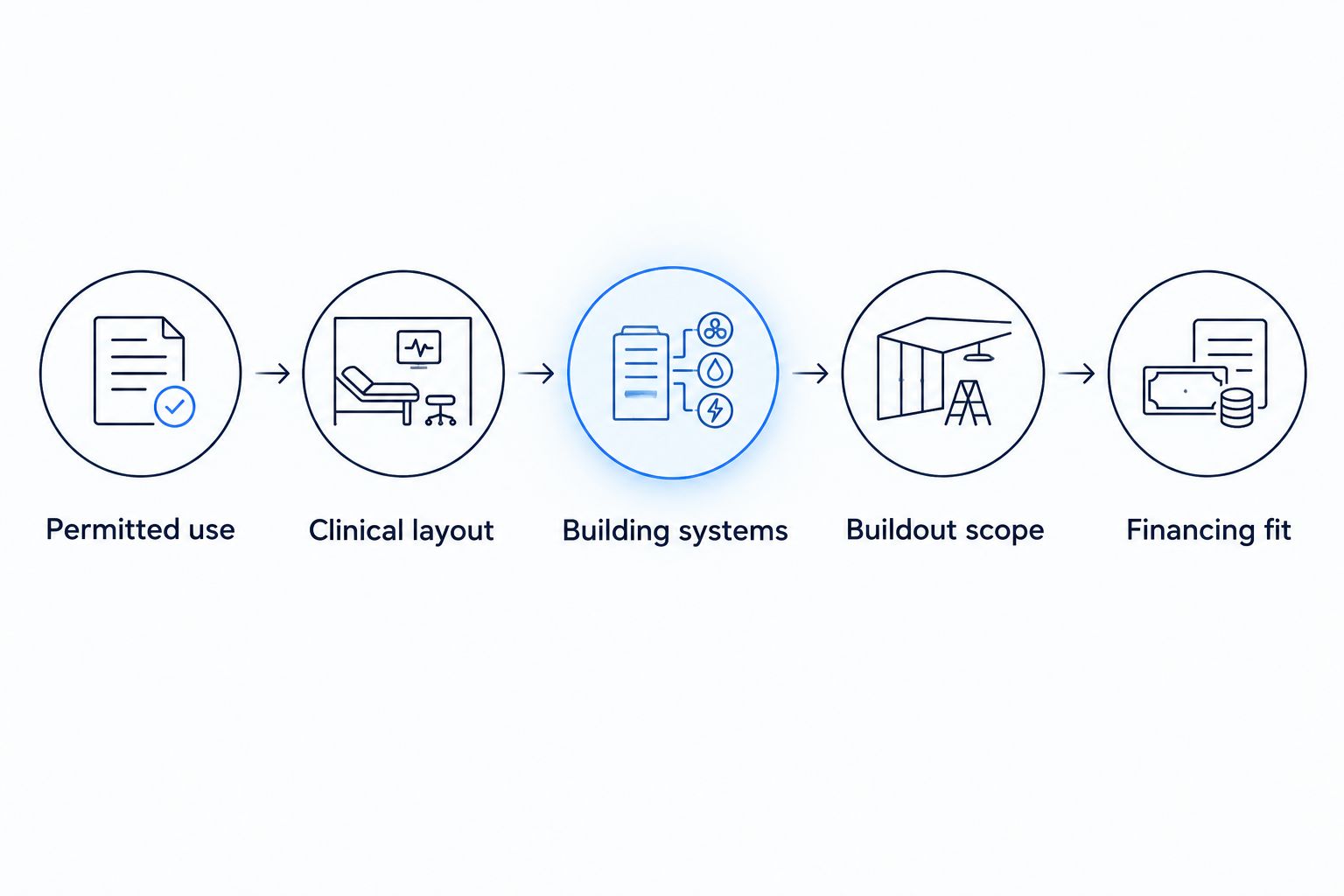
The decision sequence is Permitted use, Clinical layout, Building systems, Buildout scope, Financing fit. Complete the property checks before treating the financing proposal as executable.
Compare written terms on the same assumptions
Request proposals using the same occupancy plan, project budget and financial package. Otherwise, differences between offers can reflect different assumptions rather than different lending decisions.
Read beyond the scheduled payment. Amortization describes how payments reduce principal; maturity identifies when the remaining balance becomes due. A loan can amortize over a longer period than its contractual term, leaving a balance to repay or refinance at maturity.
Also inspect recourse, prepayment provisions, reserves and construction disbursements. Do not accept a 2026 closing schedule that ignores unresolved property or funding conditions. Ask what remains outstanding and who controls each requirement.
- Compare amortization separately from maturity.
- Identify guarantees and recourse obligations.
- Review prepayment restrictions and exit requirements.
- Confirm reserves, draw conditions and required borrower contributions.
- List every condition that must be satisfied before funding.
Test the exit before accepting temporary financing
Bridge financing addresses a temporary financing need; it does not remove the need for a permanent repayment source. State exactly what will change between the initial closing and the exit.
A defensible refinancing plan identifies the completed improvements, occupancy or operating history that the next lender will evaluate. An unsupported expectation of easier financing is not an exit plan. Test what happens if construction finishes later or operating cash flow falls short of the projection.
Flexvcapital commercial mortgage discussions should address the exit at the same time as the initial structure. A direct lending relationship does not eliminate appraisal, documentation or underwriting requirements.
- Define the event that makes permanent financing possible.
- Identify the expected refinancing requirements before closing.
- Match construction and opening milestones to the loan’s maturity.
- Document a fallback if the planned refinance does not proceed.
Compare financing options for medical practices
Use this 2026 comparison to identify the appropriate underwriting discussion. These are financing categories, not approvals or statements that every lender offers each structure for every medical property.
| Option | Best for | Main advantage | Key limitation |
|---|---|---|---|
| Conventional commercial mortgage | Established practices buying usable premises | Direct comparison against an existing operating record | Underwriting and borrower contribution requirements vary by lender |
| SBA 504 financing | Eligible owner-occupied fixed-asset projects | A structure designed for qualifying real estate and other fixed assets | Occupancy and program rules apply; working capital requires separate planning |
| SBA 7(a) financing | Eligible projects combining real estate with other business purposes | Can address qualifying business uses beyond property acquisition | Eligibility, permitted uses and lender underwriting still govern the transaction |
| Bridge financing | Transitional properties with a defined permanent-financing exit | Addresses a temporary gap before permanent financing | Maturity creates repayment pressure if the transition slips |
| CMBS financing | Stabilized income-producing medical properties | Underwriting centers on an income-producing property structure | Prepayment and servicing provisions can restrict later changes |
Choose by repayment source and property readiness, not by the product name. An owner-operated practice should not assume an investor-focused DSCR product fits simply because the practice generates income.
Fannie Mae multifamily financing is not a general-purpose mortgage for a standalone medical office. Likewise, a lender’s broad commercial product menu does not establish eligibility for a particular clinic, ownership structure or building.
Common mistakes medical practices make
Treating a pre-approval as a funded commitment
A preliminary decision leaves transaction conditions unresolved. Appraisal, title, environmental review and final financial verification can still affect funding. Distinguish the lender’s initial response from the executed commitment and completed closing requirements.
Financing the building while ignoring the opening
A property purchase can close before the practice is ready to operate. Buildout payments, equipment installation and relocation expenses still require funding. Maintain a project cash schedule that extends through opening rather than ending on the acquisition date.
Using the wrong income story
An owner-occupied practice purchase and an investment-property purchase present different repayment cases. Explain whether practice operations, third-party rent or both support the debt. Do not substitute gross collections for the lender’s accepted cash-flow calculation.
Assuming every medical tenant creates the same property risk
A general office consultation space and a procedure-focused facility can require different improvements. Describe the actual use, not merely the tenant’s profession. Confirm whether alterations affect approvals, construction scope or the building’s suitability for future occupants.
Leaving partner ownership unresolved
Practice ownership and property ownership need deliberate documentation. Address guarantees, lease obligations, partner departures and the authority to sell or refinance before signing. Have legal and tax advisers review the structure rather than using the mortgage application to settle partnership decisions.
FAQ
What is the best commercial mortgage for medical practices?
The best commercial mortgage for medical practices matches occupancy, repayment capacity and property readiness. Compare conventional and eligible SBA financing for owner-occupied premises; consider bridge financing only when a specific transition prevents permanent financing.
Can a medical practice use an SBA loan to buy its building?
An eligible medical practice can use applicable SBA financing to purchase qualifying owner-occupied real estate. Program eligibility, occupancy, permitted uses of proceeds and lender underwriting determine whether the transaction qualifies.
How much of the building must my practice occupy?
Occupancy requirements depend on the financing program. SBA 504 generally requires at least 51% occupancy for an existing building and 60% initial occupancy for new construction, with additional conditions for future occupancy.
Can I finance medical buildout with the property purchase?
Buildout can be included when the selected financing structure permits those improvements and the lender approves the scope. Confirm eligible expenses, draw procedures and which payments you must make before reimbursement.
Does a fast pre-approval mean the building purchase can close immediately?
A fast pre-approval does not mean the purchase can close immediately. Property review, final underwriting, legal documentation and funding conditions still need to be completed.
Is a DSCR loan the same as a mortgage for my practice building?
A DSCR loan is not automatically suitable for an owner-occupied medical practice building. Ask which property types qualify and whether underwriting relies on rental income, practice cash flow or another accepted repayment source.
Should I choose a bridge loan instead of an SBA loan?
Choose bridge financing only when the transaction needs temporary financing and has a documented exit. For an eligible owner-occupied project, evaluate SBA financing before accepting a structure that requires a near-term refinance.
One last thing
Ask what stops funding after pre-approval. That question exposes the practical difference between an encouraging initial response and a closing-ready transaction.
For your 2026 purchase, request a written list of remaining conditions, responsible parties and dependencies. Compare that list with the seller’s deadlines and your clinical opening schedule before committing to the financing path.


