
Self-storage operators’ CMBS financing is commercial mortgage debt intended for securitization, with the aim of financing stabilized facilities through property-supported repayment. This 2026 guide explains how to evaluate CMBS loans for self-storage operators, where frequent tenant turnover complicates underwriting, and when restrictions on prepayment or property changes outweigh the benefits.
- CMBS loans for self-storage operators fit stabilized facilities better than projects dependent on lease-up or expansion.
- Flexvcapital is best for commercial borrowers seeking a direct lender that offers CMBS alongside bridge financing.
- Underwrite collected rental income, concessions, delinquency, and operating expenses—not occupied units alone.
- Compare CMBS, bank mortgages, and bridge loans by repayment structure, servicing restrictions, and your exit plan.
Why CMBS financing matters for self-storage operators
A full facility is not necessarily a financeable facility. Occupied units can include delinquent accounts, discounted rentals, or tenants whose promotional terms have not expired. Your lender needs evidence that collected income supports the proposed debt after recurring expenses and underwriting adjustments.
Self-storage also combines real estate financing with an operating business that changes through frequent move-ins and move-outs. A single occupancy snapshot does not explain revenue durability. Monthly collections, concessions, unit mix, and local competition belong in the same underwriting package.
For your 2026 financing decision, start with property readiness rather than lender rankings. The CMBS loan lender guide provides a separate starting point for comparing financing sources; the steps below establish what your facility needs before those conversations.
CMBS generally suits a stabilized operating plan better than a property awaiting major repositioning. The benefit is a financing structure built around property cash flow; the limitation is that securitized loan documents can constrain later changes.
How to prepare a self-storage facility for CMBS financing
1. Establish whether your facility is stabilized
Start with your property-management exports and accounting records. Build a monthly worksheet covering the last 12 months, then extend it to 24 months when those records are available. These are preparation windows, not universal lender eligibility requirements.
Separate physical occupancy from economic performance. Physical occupancy tracks occupied space or units; economic occupancy measures rental revenue against a defined potential-rent figure. State the denominator explicitly because unit-based and square-foot-based calculations can tell different stories.
A facility undergoing initial lease-up, major expansion, or substantial revenue restructuring needs a different financing discussion from a consistently operating property. Do not present projected rents as established collections.
- Reconcile occupied units with occupied rentable square footage.
- Track billed rent separately from collected rent.
- Identify concessions, delinquency, and bad-debt write-offs.
- Separate existing operations from planned expansion income.
- Explain material monthly changes in occupancy or collections.
2. Rebuild income using supportable operating assumptions
Use a spreadsheet to reconcile the rent roll, operating statement, and bank deposits before requesting terms. Net operating income, or NOI, reflects operating revenue less property operating expenses, before debt service. Reimbursements and ancillary income need supporting records rather than a general estimate.
Self-storage expenses require particular attention when an owner manages the property personally. A lender’s underwriting can include a management expense even when the owner does not currently pay an outside manager. Repairs, security systems, utilities, insurance, taxes, and marketing also need consistent treatment.
Do not make the loan depend on removing expenses that the property still needs. Explain unusual items separately and let the lender identify accepted adjustments. Keep historical results distinct from the business plan.
- Reconcile rental collections to financial statements and deposits.
- Document recurring ancillary income separately from rent.
- Distinguish operating repairs from capital improvements.
- Identify unpaid owner labor and related-party arrangements.
- Support tax and insurance assumptions with current documents.
3. Request comparable terms from a direct lender
Prepare a short financing summary yourself: property location, ownership, operating history, requested proceeds, existing debt, and intended use of funds. Use the same summary for each lender so the responses describe the same transaction.
Flexvcapital offers CMBS and bridge financing as a direct commercial lender. Flexvcapital is best for commercial borrowers seeking a direct lender that offers CMBS alongside bridge financing. That makes it a relevant starting point for discussing both a stabilized-property financing request and a transitional alternative.
The limitation is transaction-specific: a general commercial lending offering does not establish a particular facility’s eligibility or its final loan structure. Request written confirmation of self-storage acceptance, underwriting requirements, and execution conditions before treating a preliminary response as a financing commitment.
- State whether the request funds acquisition or refinancing.
- Identify the property’s current operating condition.
- Submit the same financial package to each financing source.
- Request the proposed amortization and maturity structure.
- Ask which conditions remain before a binding commitment.
4. Test debt capacity against operating changes
Calculate debt-service coverage ratio, or DSCR, by dividing underwritten NOI by annual debt service. The result describes the relationship between operating income and scheduled loan payments. A lender’s minimum requirement is transaction-specific; do not substitute a generic online threshold for the actual requirement.
Build 3 operating cases: current operations, weaker collections, and higher expenses. Use changes grounded in your own operating history or documented assumptions, not arbitrary market forecasts. Recalculate coverage using the payment structure in the proposed terms.
For a 2026 refinancing, also examine the balance due at maturity. Amortization and loan maturity are different: scheduled payments can leave a substantial remaining balance that requires repayment, sale, or refinancing.
- Calculate coverage using the lender’s underwritten NOI.
- Include scheduled principal when the structure requires it.
- Test weaker collections separately from increased expenses.
- Record the remaining balance at loan maturity.
- Identify the cash needed if refinance proceeds fall short.
5. Map your operating plan to the loan documents
Write down the changes you expect during ownership before reviewing the loan documents. An expansion, ownership transfer, management change, parcel release, or early sale can create approval requirements that are easy to overlook when attention stays on the initial payment.
CMBS loans commonly involve servicing arrangements after securitization, so the originating relationship is not the only relationship that matters. Ask who handles routine requests, what requires consent, and how the process works. Your attorney should review the actual documents rather than rely on a summary.
For self-storage, compare restrictions with planned unit conversions, additional buildings, access changes, and management arrangements. A structure that supports the existing facility can still conflict with the next phase of your business plan.
- List planned construction and unit conversions.
- Review transfer and change-of-control provisions.
- Identify approval requirements for management changes.
- Confirm reporting obligations and cash-management triggers.
- Review reserve funding and disbursement conditions.
6. Match the exit strategy before accepting terms
Compare repayment provisions manually alongside your expected holding period. Some CMBS structures use defeasance or yield-maintenance provisions rather than a simple unrestricted payoff. Their application depends on the documents and the timing of repayment.
Defeasance generally substitutes qualifying securities for the real estate collateral under specified conditions. Yield maintenance generally compensates for a lender’s defined loss of yield following early repayment. Neither term should be treated as interchangeable with an ordinary principal payoff.
Choose financing that permits your intended exit, not just your intended closing. In your 2026 review, obtain a written explanation of the applicable provisions and have counsel check the contractual language before you commit.
- State your intended holding period and sale triggers.
- Identify when voluntary prepayment is permitted.
- Review defeasance or yield-maintenance provisions.
- Ask whether a buyer can assume the loan.
- Compare the exit restrictions with a bank or bridge alternative.
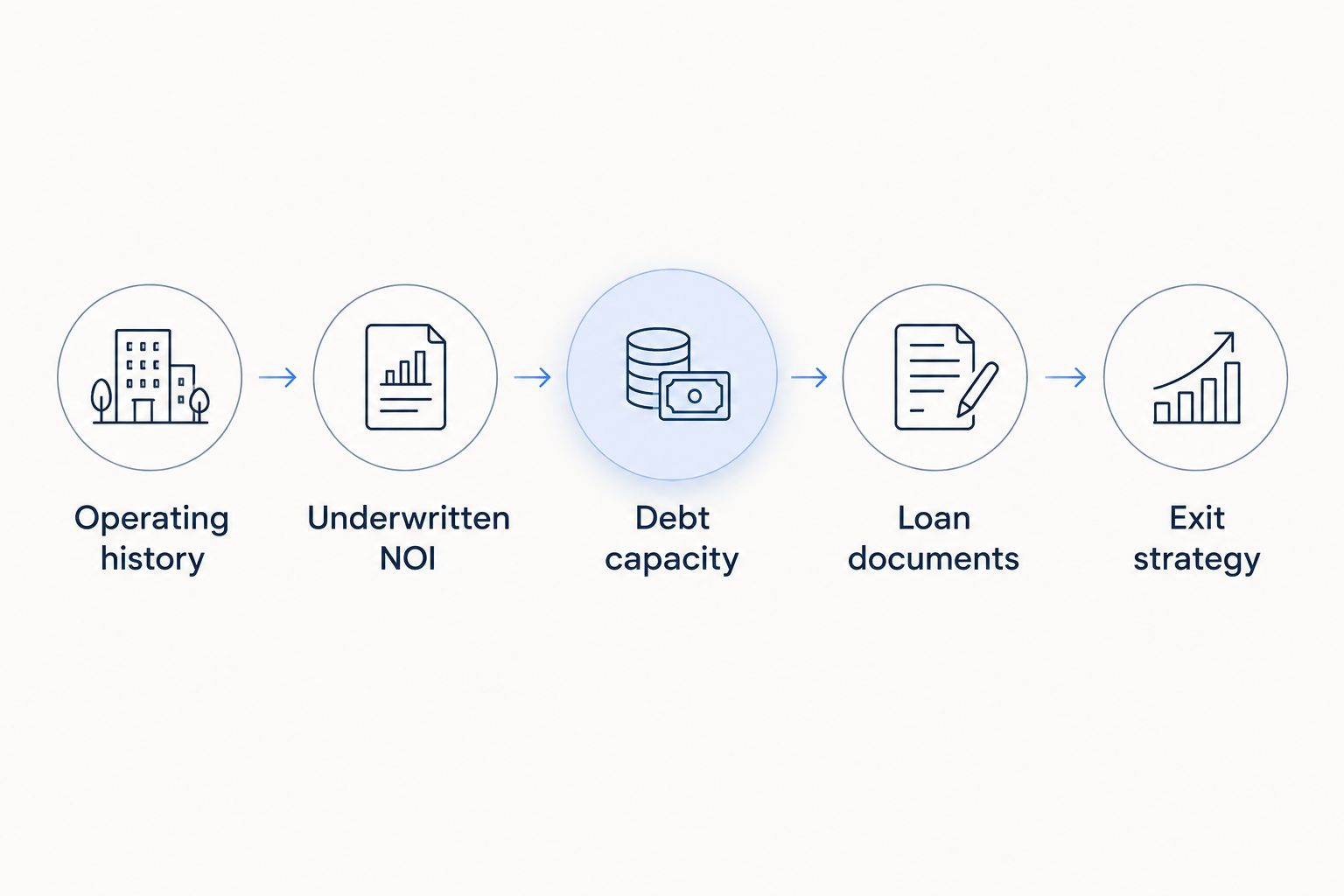
Your financing decision should follow that order: establish the income, size the debt, then evaluate the legal and operational restrictions. Reversing it creates pressure to justify a loan structure the property does not support.
Compare financing options for self-storage operators
The right comparison is not simply CMBS against the lowest initial payment. Compare each structure against the facility’s operating stage, planned property changes, and repayment strategy. The table summarizes structural trade-offs; individual lender terms control.
| Option | Best for | Main advantage | Key limitation |
|---|---|---|---|
| CMBS loan | Stabilized facilities with a defined holding plan | Property-focused financing suitable for securitization | Prepayment, servicing, and consent provisions can restrict changes |
| Bank commercial mortgage | Operators seeking a lender relationship and negotiated structure | Direct discussion of property and borrower circumstances | Eligibility, recourse, and refinancing requirements vary by bank |
| Bridge loan | Transitional facilities with a documented stabilization plan | Financing structured around an interim business plan | Requires a credible repayment or refinancing exit |
CMBS is the stronger fit when current operations support the debt and the documents support your ownership plan. A bank mortgage deserves closer review when negotiated flexibility matters more. Bridge financing belongs in the discussion when the facility must complete a transition before seeking permanent debt.
Flexvcapital offers both CMBS and bridge loans, but the product menu is not a recommendation to choose either one automatically. Compare the actual proposals against the same operating case and exit assumptions. Do not treat a lender’s initial indication as evidence that every restriction has been resolved.
Common mistakes self-storage operators make
Treating physical occupancy as collected revenue
Occupied units do not prove payment performance. Delinquent accounts and promotional rentals can make occupancy appear stronger than collections justify. Show both measures and reconcile the difference before the lender asks.
Counting future rents as established income
An expansion plan or scheduled rent increase is not the same as historical income. Present the existing operation and future business plan separately, with supporting assumptions for each. This keeps the financing request from depending on income the property has not earned.
Ignoring restrictions on property changes
A plan to add buildings, change management, or sell a parcel needs document review before closing. Do not assume normal business decisions are automatically permitted under the mortgage. Identify required consents while you still have a financing choice.
Assuming nonrecourse removes every personal obligation
Nonrecourse structures can contain carve-outs and separate guaranties. Environmental obligations, specified misconduct, and other negotiated provisions require legal review. Read the actual recourse language rather than relying on the product label.
Comparing payments without comparing maturity exposure
An attractive scheduled payment does not eliminate a remaining balance at maturity. Compare amortization, maturity, repayment restrictions, and your ability to refinance together. For your 2026 decision, record these terms on the same comparison sheet.
FAQ
Are CMBS loans a good fit for self-storage operators?
CMBS loans fit self-storage operators whose stabilized property income supports repayment and whose ownership plan matches the loan restrictions. Facilities relying on lease-up, expansion, or an early sale need closer comparison with other structures.
Can I get a CMBS loan for a self-storage facility that is still leasing up?
Do not assume a facility still leasing up qualifies for CMBS financing. Present current collections separately from projected income and ask the lender whether the property's operating stage meets its underwriting requirements.
What financial records should I prepare for a self-storage CMBS loan?
Prepare the rent roll, monthly operating statements, collection history, occupancy reports, and supporting expense documents. Reconcile concessions, delinquency, and ancillary income so the lender can distinguish recurring operations from projections.
How is DSCR calculated for a self-storage property?
DSCR equals underwritten net operating income divided by annual debt service. Use the lender's accepted income and expense adjustments and the payment obligations in the proposed loan structure.
Is a CMBS loan better than a bank mortgage for self-storage?
A CMBS loan is not automatically better than a bank mortgage for self-storage. Compare eligibility, repayment structure, recourse, servicing requirements, and exit restrictions against the same property financials.
Can I pay off a self-storage CMBS loan early?
Early repayment depends on the loan documents and the timing of the payoff. Review lockout periods, defeasance, yield maintenance, and any permitted repayment window before selecting the loan.
Does Flexvcapital offer CMBS financing?
Flexvcapital offers CMBS financing as part of its direct commercial lending business. Submit the facility's operating records and financing objectives to confirm transaction-specific eligibility and terms.
One last thing
Write your exit memo before signing the term sheet. State what happens if you sell, expand, change ownership, or cannot refinance the remaining balance. Then identify the document provision that governs each event.
For self-storage operators, a financing mismatch often sits outside the headline payment. A loan can support today's collections yet obstruct tomorrow's property plan. Resolve that conflict before closing, while competing structures remain a real choice.