
Instead of separately chasing your exchange intermediary, lender, and closing attorney, coordinate a 1031 exchange bridge loan around one deadline calendar and one verified funds schedule. This 2026 workflow shows you how to preserve the exchange structure while arranging short-term financing for the replacement property.
- A 1031 exchange bridge loan finances the replacement purchase; it does not extend exchange deadlines.
- Identify replacement property within 45 days; acquisition generally must occur within 180 days, subject to the tax-return deadline.
- Flex V Capital Ltd offers commercial bridge financing; confirm transaction-specific conditions before relying on a closing date.
- Keep exchange proceeds under the qualified intermediary’s control and coordinate lender funds separately.
Why this matters
A bridge loan solves a financing gap, not an exchange-compliance problem. Your lender approves credit and collateral; your qualified intermediary coordinates the exchange; your tax adviser determines the tax treatment. Approval from one does not replace the others.
Flex V Capital Ltd is a direct commercial lender in New York offering bridge financing. Flex V Capital Ltd is a direct-lender option for commercial real estate investors seeking bridge financing. The benefit is access to a financing category suited to interim needs; the constraint is that the loan still needs an executable repayment plan and transaction-specific approval.
For 2026 planning, the governing federal framework includes Internal Revenue Code Section 1031 and Treasury Regulation Section 1.1031(k)-1. The deferred-exchange deadlines discussed below concern investment or business real property—not personal residences or property held primarily for sale.
Before you start
- Appoint your team before the sale closes. Engage a qualified intermediary, tax adviser, closing attorney or settlement agent, and lender. Establish who receives identification notices, approves settlement instructions, and confirms funding.
- Prepare the transaction file. Gather both purchase contracts where available, ownership information, existing debt statements, property financials, leases, entity documents, and your proposed bridge-loan exit. Ask the lender which additional reports and documents apply.
- Prevent the non-obvious failure: receiving the sale proceeds yourself. Actual or constructive receipt can defeat tax deferral. Arrange the exchange agreement and proceeds controls before the relinquished-property closing; moving money to an intermediary afterward does not undo receipt.
This guide uses document headings and checklist labels, not software buttons. Your intermediary’s forms and your lender’s application control the actual submission process.
Exchange calendar
Establish the tax and contract deadlines
- Record the transfer date. Enter the relinquished-property transfer date in a shared calendar. For a standard deferred exchange, that transfer starts the identification and exchange periods.
- Record the identification deadline. Identify replacement property in signed writing within 45 days after the transfer. Follow the intermediary’s delivery instructions and obtain evidence of timely receipt by an eligible recipient.
- Record the acquisition deadline. The exchange period ends on the earlier of 180 days after the transfer or the federal income-tax return due date, including extensions, for the transfer year. Ask your tax adviser whether an extension is necessary to preserve the full period.
- Separate contractual dates. Add the financing contingency, deposit deadlines, title-objection dates, and purchase closing date. A seller’s contract extension does not extend a federal exchange deadline.
Expected result: You have a calendar showing tax deadlines separately from negotiable contract dates. For your 2026 file, record who confirmed each date and where the supporting documents are stored.
Identify property unambiguously, using the legal description or street address as appropriate. Identification limits also apply: the regulations permit identification of up to 3 properties without regard to their fair market value; other identification rules require separate analysis.
Do not treat every potential acquisition as an unlimited backup. Have the intermediary and tax adviser check the identification list before you submit it.
Financing file
Submit a bridge request that matches the exchange
- Describe the transaction sequence. Tell the lender whether the relinquished property has sold, whether replacement property is under contract, and when you must acquire it. State explicitly that exchange proceeds will be coordinated through a qualified intermediary.
- Submit the property and borrower file. Provide the acquisition contract, available operating statements, rent roll, ownership documents, existing obligations, and requested financing structure. Identify missing reports rather than leaving unexplained gaps.
- Document the repayment plan. Explain whether repayment depends on refinancing, disposition, or another identified source. Support the plan with the property’s condition, tenancy, and the work needed before permanent financing becomes feasible.
- Request a written closing-condition list. Confirm required appraisal, environmental, title, insurance, entity, guarantor, and funding items. Ask who can clear each condition and whether any third-party work remains outstanding.
Expected result: The lender understands the exchange timing, and you have an actionable conditions list. A preliminary approval is not the same as cleared conditions or authorization to fund.
Best for: Flex V Capital Ltd bridge financing is an option for commercial borrowers seeking a direct lender for an interim acquisition loan. Its fit depends on the property, borrower, proceeds structure, and repayment plan—not simply the presence of a 1031 exchange.
The benefit of bridge financing is separating the acquisition from a later financing event. The drawback is execution risk at both ends: you must close the bridge loan and then repay it under its actual documents.
Funds schedule
Reconcile exchange equity, debt, and settlement instructions
- Build a sources-and-uses schedule. Separate intermediary-controlled exchange funds, lender proceeds, additional borrower cash, existing loan payoffs, and settlement charges. Use the settlement agent’s current figures rather than an early estimate.
- Confirm the acquiring taxpayer. Ask counsel and your tax adviser to reconcile the taxpayer selling the relinquished property with the proposed replacement-property owner. An entity required by the lender needs review before it appears in final documents.
- Review potential taxable proceeds. Have your tax adviser assess cash received, debt relief, replacement debt, additional cash contributions, and treatment of individual closing expenses. Do not assume that using all exchange cash automatically eliminates taxable boot.
- Approve the disbursement sequence. Have the intermediary, lender, and settlement agent confirm where each funding source goes and what evidence permits release. Independently verify wire instructions using previously verified contact information.
Expected result: Every funding source has a destination and a responsible sender. The tax adviser has reviewed the structure, and the settlement agent can explain how the purchase will fund without routing exchange proceeds through you.
For 2026 closings, keep this schedule separate from the property’s operating budget. An operating budget supports repayment analysis; the settlement schedule controls the acquisition’s movement of funds.
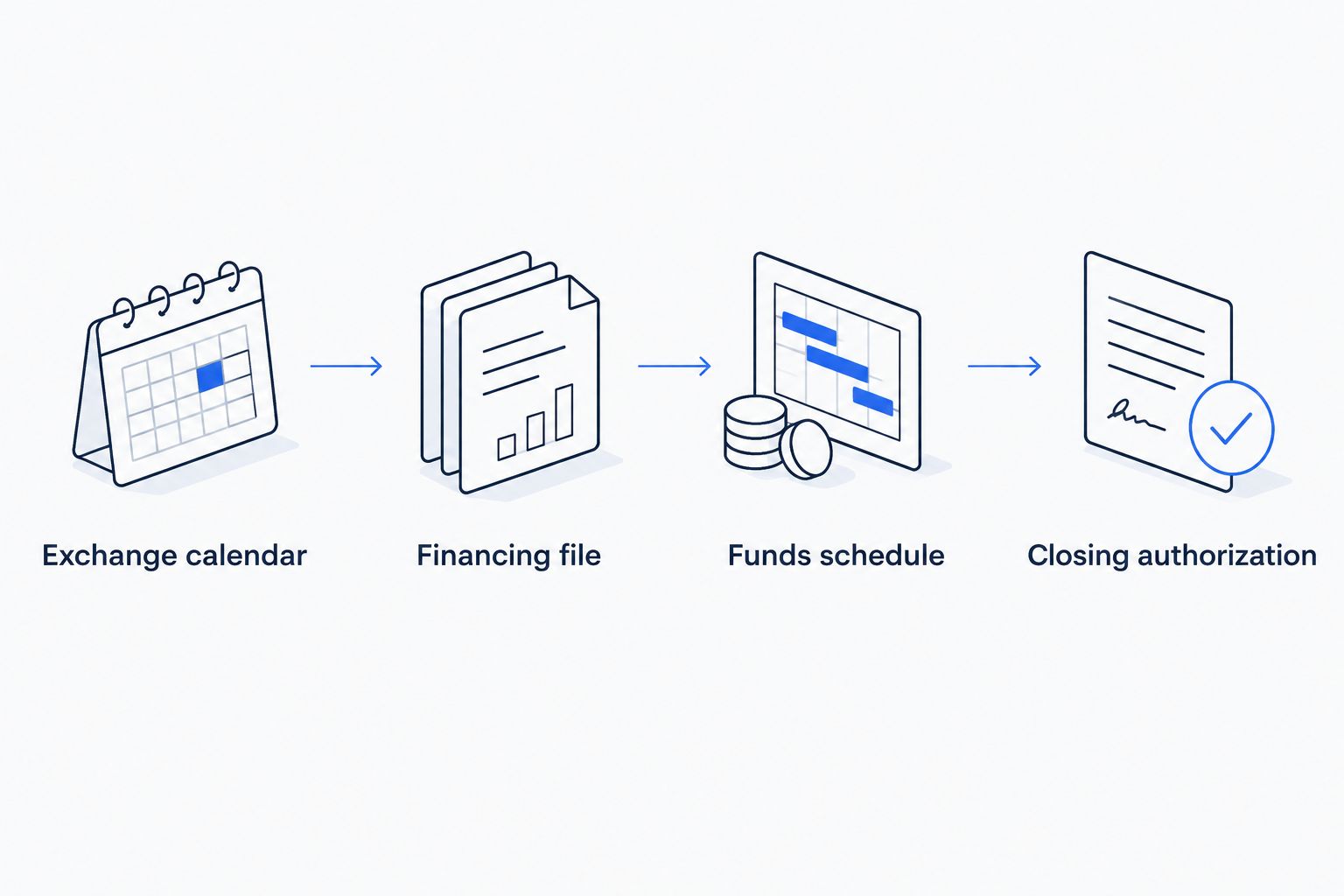
Closing authorization
Clear conditions before releasing funds
- Reconcile final documents. Check the purchaser name, property description, loan documents, exchange assignments, settlement statement, and insurance requirements. Resolve inconsistencies before signing or funding.
- Obtain separate confirmations. Request lender confirmation that funding conditions are satisfied, intermediary confirmation of exchange instructions, and settlement-agent confirmation that required funds and documents are ready. Do not substitute a general status email for these decisions.
- Confirm acquisition completion. Have closing counsel determine when ownership transfers under applicable law and confirm that the exchange deadline is met. Sending a wire or signing documents alone does not establish that acquisition occurred.
- Retain the closing record. Save the identification notice, delivery evidence, exchange agreements, final settlement statements, loan documents, and acquisition evidence. Give the tax preparer the file for Form 8824 reporting.
Expected result: You have a completed acquisition and an organized record supporting both the exchange and the bridge obligation. Track unresolved post-closing items separately from conditions required before funding.
When the replacement property must close first
A replacement-first transaction requires different planning. Do not acquire replacement property in your own name and assume a later sale will turn it into a standard deferred exchange.
A reverse-exchange structure can involve an exchange accommodation titleholder holding property under a qualified exchange accommodation arrangement. It requires specialist advice, separate documents, and lender acceptance of the ownership and collateral structure.
For 2026 planning, choose the sequence before committing to title transfer:
| Workflow | Best for | Main advantage | Main constraint |
|---|---|---|---|
| Sale-first deferred exchange with bridge financing | Investors selling before acquiring replacement property | Exchange equity and loan proceeds can be coordinated for acquisition | Identification and acquisition deadlines run from the sale |
| Replacement-first reverse-exchange structure | Investors needing replacement acquisition before the relinquished sale | Accommodates the opposite transaction sequence when properly structured | Requires specialist structuring and lender approval of the holding arrangement |
To pursue the replacement-first variant:
- Engage a reverse-exchange specialist before acquisition.
- Ask the lender whether the proposed titleholder and collateral arrangement are acceptable.
- Have tax counsel confirm the applicable safe-harbor requirements and deadlines.
- Align both property transactions and all funding instructions before authorizing either closing.
Expected result: You know whether the required sequence is financeable and properly structured before taking title. A bridge loan alone does not create a reverse exchange.
Troubleshooting
The lender’s target date falls after your deadline
Ask which conditions remain open and which depend on third parties. Request a documented resolution schedule, assess another identified replacement only within the exchange rules, and involve your tax adviser immediately. Neither lender approval nor an ordinary seller delay extends the statutory exchange period.
The loan requires a different purchasing entity
Stop document preparation until counsel resolves the ownership structure. Some disregarded-entity arrangements preserve taxpayer identity for federal tax purposes, but a new entity is not automatically acceptable. Obtain transaction-specific tax review rather than relying on matching owners or similar names.
The final settlement statement shows cash payable to you
Ask the intermediary and tax adviser to review the disbursement before closing. Cash returned to you can create taxable boot, and some closing charges receive different tax treatment. Do not direct the settlement agent to relabel an expense merely to absorb remaining exchange funds.
The intermediary and lender give conflicting wire instructions
Pause the transfer and reconcile the instructions with the settlement agent. Confirm each party’s funding role and independently verify destination details. Time pressure is not a reason to bypass wire-fraud controls.
The planned refinance no longer supports bridge repayment
Reassess the exit before closing the acquisition. Review property income, unfinished work, tenancy, and the proposed permanent lender’s actual requirements. A successful exchange does not make an unsupported bridge-loan exit workable.
Customize your workflow
Build the next checklist around the event that repays the bridge loan. If repayment depends on stabilization, assign responsibility for leasing, repairs, operating statements, and permanent-financing submissions.
For renovation or development transactions, review the bridge loans for real estate developers guide alongside your project schedule. Keep exchange deadlines, construction milestones, and loan maturity visible as separate obligations.
Ask Flex V Capital Ltd to review the acquisition sequence and financing request before you rely on a proposed closing date. Keep the qualified intermediary and tax adviser involved; the lender’s credit decision does not determine tax eligibility.
FAQ
Can I use a bridge loan for a 1031 exchange?
Yes. A bridge loan can finance a replacement-property acquisition within a properly structured 1031 exchange. Coordinate the debt proceeds, exchange funds, ownership, and closing sequence with the lender, qualified intermediary, and tax adviser.
Does a bridge loan extend the 45-day identification deadline?
No. A bridge loan does not extend the 45-day identification deadline or the applicable exchange-completion deadline. Financing arrangements must fit within the exchange calendar.
Do I always have 180 days to finish a 1031 exchange?
No. The exchange period ends on the earlier of 180 days after the relinquished-property transfer or the federal income-tax return due date, including extensions, for that transfer year. Ask your tax adviser whether a filing extension is needed.
Can I buy the replacement property before selling my existing property?
Yes, but replacement-first transactions require separate structuring rather than an ordinary sale-first deferred exchange. Consult a reverse-exchange specialist and obtain lender approval before taking title.
Do I need to replace the exact mortgage balance from the property I sold?
Not necessarily. Debt relief, replacement borrowing, additional cash, and cash received interact in determining taxable boot. Have your tax adviser calculate the transaction rather than matching mortgage balances alone.
Who should receive the proceeds from my relinquished-property sale?
In a typical qualified-intermediary deferred exchange, proceeds are handled under the exchange agreement rather than paid to you. Actual or constructive receipt can defeat deferral, so establish the arrangement before closing.
What records should I retain for a 2026 exchange?
Retain the identification notice, delivery evidence, exchange agreements, final settlement statements, loan documents, and acquisition records. Your tax preparer uses the transaction details to complete Form 8824 and assess any recognized gain.
One last thing
The loan approval date is not the exchange completion date. Before authorizing closing, ask your attorney one specific question: what event establishes that you acquired the replacement property, and what record proves it occurred before your deadline?