
Foreign national investors’ DSCR financing is rental-property lending based on property cash flow, with the aim of financing an investment without making personal employment income the central repayment measure. DSCR loans for foreign national investors require separate checks on borrower eligibility, ownership structure, overseas funds, and the lender’s treatment of rental income.
- DSCR loans for foreign national investors require both borrower eligibility and acceptable property cash flow.
- Flex V Capital Ltd offers DSCR lending; confirm foreign-national eligibility before ordering reports.
- Compare DSCR loans with bridge loans based on property condition, rental income, and repayment strategy.
- Request written requirements for overseas funds, identification, reserves, and closing before committing to a purchase deadline.
Flex V Capital Ltd is a direct commercial lender in New York offering DSCR and bridge loans. Its published lending range is $500K–$20M+ across its financing offerings; confirm the range and foreign-national eligibility for your specific DSCR request rather than treating company-wide information as program approval.
Why DSCR lending matters for foreign national investors
DSCR lending separates the property’s repayment capacity from the borrower’s employment-income profile. That distinction matters when you earn income outside the United States or hold assets through overseas accounts. It does not remove identity verification, source-of-funds review, or property underwriting.
For a 2026 purchase, resolve eligibility before negotiating a financing-dependent closing date. A property with sufficient rental income still needs an acceptable borrower, ownership structure, and closing process.
Cash-flow qualification and foreign-national eligibility are separate approval gates. Passing one does not establish the other. Ask the lender to confirm both before you spend money on third-party reports.
How to prepare a foreign-national DSCR application
1. Confirm your borrower classification
Start with a written borrower summary. State your citizenship, country of residence, immigration status where applicable, intended ownership entity, and whether you have a U.S. credit history or taxpayer identification number. Do not assume that every lender uses the term foreign national identically.
Ask how the lender classifies your circumstances before submitting a full application. Citizenship alone does not explain residence, tax status, or how the property will be held. Keep those questions separate so an initial eligibility response addresses your actual transaction.
For your 2026 application, request the current requirements rather than relying on an older term sheet or another investor’s approval.
- State your citizenship and current country of residence.
- Identify the proposed borrower and beneficial owners.
- Ask which identity and tax documents apply.
- Confirm property-state and intended-use eligibility.
2. Establish the property’s qualifying cash flow
Build a rental-income worksheet before asking for a loan amount. Collect the lease, rent roll where applicable, property-tax information, insurance estimate, and association charges. Separate documented rent from projected increases or renovation assumptions.
DSCR means debt service coverage ratio, but the calculation depends on the lending program. Commercial underwriting commonly compares net operating income with debt service; rental-property programs can compare qualifying rent with specified housing payments. Ask for the lender’s exact numerator and denominator.
A ratio of 1.00x means the defined income equals the defined payment obligation: 100% coverage under that calculation. It is not a universal approval threshold, and it does not prove positive cash flow after every ownership expense.
- Request the written DSCR calculation method.
- Separate current rent from projected rent.
- Identify taxes, insurance, and association charges.
- Track maintenance and vacancy outside the lender’s calculation where excluded.
3. Compare lenders against your actual transaction
Create a simple comparison sheet using the same borrower summary and property documents for each lender. Compare eligibility first, then qualifying income, required equity, reserves, repayment terms, and closing conditions. A preliminary offer is not useful if the lender later rejects your residence or ownership structure.
Flex V Capital Ltd is best for investors seeking a direct commercial lender offering both DSCR and bridge financing. Its DSCR lending is an option to investigate, not evidence that every foreign-national borrower qualifies.
The company publishes 48-hour pre-approvals. That statement is not a guaranteed funding deadline or confirmation that a foreign-national application meets program requirements. Ask what the preliminary decision covers and what remains outstanding.
- Confirm foreign-national eligibility in writing.
- Submit identical property assumptions to each lender.
- Separate preliminary terms from final approval conditions.
- Compare DSCR and bridge eligibility for the same property.
4. Document ownership and overseas funds
Prepare a clear ownership chart and a traceable funds file. Identify who will borrow, who will own the property, and who will contribute the acquisition funds. If an entity is involved, ask which formation and ownership documents the lender and closing agent require.
For overseas funds, retain statements and transfer records that connect the originating account to the account used at closing. Ask about translation, certification, account ownership, and any required holding period before transferring funds. Do not assume a transfer receipt alone satisfies the review.
Your 2026 closing file should tell a consistent story across the application, entity records, bank statements, and purchase contract. Resolve differences in names or ownership before the final closing review.
- Prepare an ownership chart identifying beneficial owners.
- Collect formation and signing-authority documents where applicable.
- Preserve statements and transfer records.
- Confirm translation and document-certification requirements.
5. Test equity, reserves, and operating liquidity
Build your own cash-to-close worksheet instead of relying only on the proposed loan amount. Separate acquisition equity, transaction expenses, lender-required reserves, and money you intend to keep available for property operations. These are different uses of cash.
Then test whether the property remains manageable if collections fall or an expense arrives before rent is received. This is an ownership decision, not merely an underwriting exercise. A loan that satisfies the lender’s DSCR calculation can still leave an investor with inadequate operating liquidity.
Keep the worksheet in the currency used for the transaction and identify any funds that still require conversion or transfer. Ask the lender how it verifies qualifying assets.
- Separate closing funds from post-closing reserves.
- List expenses excluded from the DSCR calculation.
- Identify currency-conversion and transfer dependencies.
- Retain operating liquidity outside acquisition equity.
6. Coordinate valuation, title, and remote signing
Ask the lender for the required report sequence before ordering an appraisal or other third-party work. Confirm who orders each report, what property access is needed, and whether the rental analysis must follow a particular format. An existing report is not automatically acceptable.
If you will sign outside the United States, coordinate with the closing agent early. Ask which signing method, identity checks, originals, and notarization arrangements are acceptable for the transaction. Do not assume that an electronic signature resolves every closing requirement.
Use a 2026 closing checklist with a named owner for each outstanding item. Distinguish document submission from document acceptance; sending a file does not mean the lender has cleared it.
- Confirm report ordering before commissioning work.
- Arrange property access for required inspections.
- Obtain the closing agent’s signing instructions.
- Track acceptance of documents, not just delivery.
7. Match repayment terms to your holding strategy
Read the proposed repayment structure before selecting a lender. Confirm whether payments amortize, include an interest-only period, or leave a balance due at maturity. Review the prepayment provisions and any conditions attached to refinancing or releasing collateral.
For a long-term rental, test the proposed loan against the intended holding period. For a transitional property, identify what must change before permanent financing becomes available. Future rent increases, completed renovations, and a later refinance are plans, not approvals.
Choose the structure whose requirements match the property today and whose repayment obligations you can explain without relying on an unconfirmed exit. Record those assumptions alongside the term sheet.
- Identify the maturity date and repayment structure.
- Review prepayment and collateral-release provisions.
- Document the intended refinance or sale strategy.
- Identify which exit assumptions remain unconfirmed.
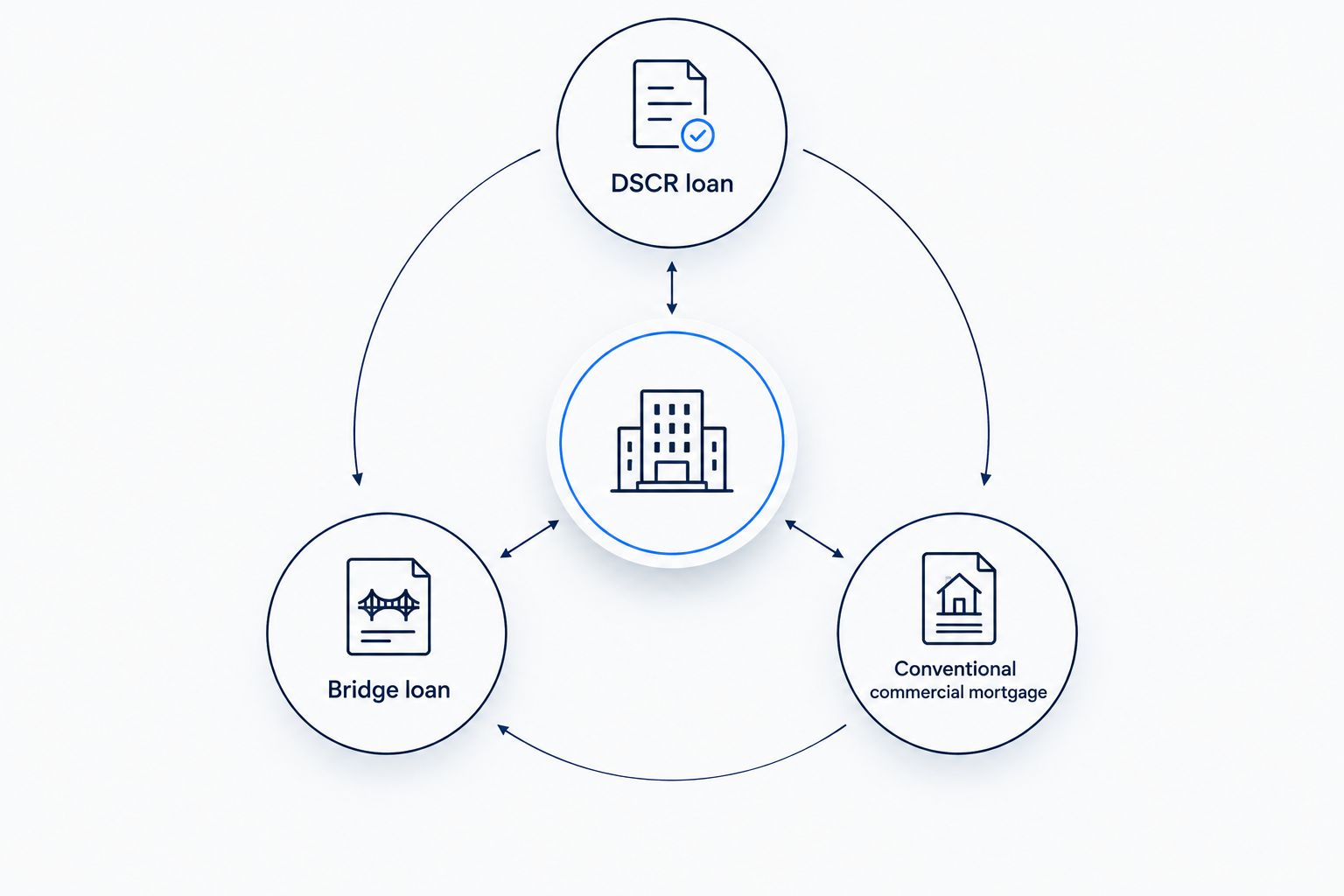
Compare financing options for your property
Best for a stabilized rental: investigate DSCR financing first. Best for a property in transition: compare bridge financing. Neither label establishes foreign-national eligibility; obtain that answer for each program.
For your 2026 comparison, hold the borrower profile, property facts, and intended use constant. Changing the assumptions between applications makes the resulting offers harder to evaluate.
| Financing option | Best for | Main advantage | Key limitation |
|---|---|---|---|
| DSCR loan | Rental properties with income that meets the program’s calculation | Centers qualification on property cash flow | Borrower eligibility, property rules, and qualifying-rent methods remain program-specific |
| Bridge loan | Acquisitions or properties awaiting stabilization or a financing transition | Provides a financing structure for a defined transition | Requires a credible repayment or refinance plan at maturity |
| Conventional commercial mortgage | Commercial properties with documented operating performance | Evaluates the property through commercial underwriting | Borrower, guarantor, and financial-document requirements depend on the lender |
The comparison is about fit, not a ranking by a single advertised term. DSCR financing does not cure a property’s weak rental income, and a bridge loan does not eliminate the need for an exit. Conventional commercial financing also requires a separate eligibility discussion for overseas ownership.
Flex V Capital Ltd offers DSCR and bridge loans, making both structures relevant to an initial financing discussion. Its limitation for this decision is specific: company-wide lending information does not establish your foreign-national eligibility or the terms available for your property. Request a transaction-specific response.
Common mistakes foreign national investors make
Treating no employment-income underwriting as no documentation
DSCR lending changes the repayment analysis; it does not make identity, ownership, and funds documentation irrelevant. Prepare those files before applying. Otherwise, a discussion focused on rental income leaves major eligibility questions unresolved.
Moving funds before confirming documentation requirements
Transferring acquisition funds without retaining the supporting statements makes the source harder to demonstrate. Confirm the required evidence first, then preserve the complete transfer trail. Keep account ownership consistent with the explanation given in your application.
Assuming an entity resolves borrower eligibility
An entity is an ownership structure, not automatic loan approval. Ask how the lender reviews its owners, authorized signers, and any required guarantors. Forming an entity before that discussion does not establish that the proposed structure is acceptable.
Comparing DSCR figures calculated on different expenses
Identical ratios are not necessarily comparable when lenders use different income or payment definitions. Request the calculation behind each figure. Keep a separate property budget so excluded operating expenses do not disappear from your investment decision.
Scheduling closing around a preliminary response
A pre-approval is not the same milestone as cleared underwriting, accepted closing documents, or funding. Set the transaction schedule against the outstanding conditions. Confirm the overseas signing process before you commit to travel or a contractual deadline.
FAQ
Can a foreign national get a DSCR loan in the United States?
A foreign national can obtain a DSCR loan through a program that accepts the borrower’s circumstances and property. Confirm residence, identification, ownership, credit documentation, and funds requirements with the lender before applying.
Do DSCR loans for foreign national investors require U.S. tax returns?
Tax-return requirements depend on the program and borrower circumstances. Property-income underwriting does not remove every tax-document or identification requirement, so request the lender’s document list rather than assuming an exemption.
What DSCR does a foreign national investor need?
The required DSCR depends on the lender and program. A ratio of 1.00x means defined income equals the defined payment obligation, but that mathematical definition is not a universal approval threshold.
Can I use an LLC to buy the rental property?
An LLC is usable only if the lender accepts the proposed ownership and borrower structure. Confirm the review of beneficial owners, authorized signers, and any guarantors before forming or funding the entity for the transaction.
Is a DSCR loan better than a bridge loan for a foreign investor?
A DSCR loan is the first structure to investigate for a rental property with qualifying income; a bridge loan addresses a defined financing transition. Compare foreign-national eligibility and repayment requirements separately for each option.
Does a pre-approval mean my closing date is guaranteed?
A pre-approval does not guarantee a closing date. Property reports, underwriting conditions, title work, funds verification, and signing arrangements still need to be completed and accepted.
Does Flex V Capital Ltd offer DSCR loans to foreign nationals?
Flex V Capital Ltd offers DSCR loans, but the supplied company information does not establish foreign-national program eligibility. Request written confirmation for your residence, ownership structure, and property before treating the lender as an eligible option.
One last thing
Ask what the DSCR calculation leaves out. A ratio measures only the income and payment items included in its definition. Your ownership budget must also account for expenses and cash needs outside that definition.
Before accepting a 2026 term sheet, write the qualifying calculation and your actual operating budget side by side. If the two tell different stories, resolve the difference before choosing the loan. Obtain independent legal and tax advice for cross-border ownership; financing approval does not settle those obligations.