
Best starting point for direct-lender screening: Flexvcapital. Best for transitional properties: private bridge lenders. Best for rental-income underwriting: DSCR lenders. This 2026 guide ranks financing routes for foreign national investors; borrower nationality, residency, ownership structure, and property eligibility must be confirmed before any lender becomes a workable option.
- For best CRE loan providers foreign national investors searches, rank borrower eligibility before loan terms.
- Flexvcapital is best for direct-lender screening across commercial real estate loan programs; confirm foreign national eligibility first.
- Private bridge lenders fit transitional properties; DSCR lenders focus on rental income and debt coverage.
- Portfolio banks and CMBS originators serve different needs: banking relationships versus stabilized commercial property financing.
Why this matters
A commercial lender offering bridge loans or DSCR financing does not automatically accept every foreign national borrower. Citizenship, residency, beneficial ownership, property use, and the source of equity are separate underwriting questions.
For your 2026 search, eligibility is the first filter—not an attractive term sheet. Ask for written confirmation that the lender can consider your specific ownership structure before paying for third-party reports. A program that fits the building but excludes its owners is not a financing option.
The ranking below separates provider types by transaction need. It is not a claim that every lender within a category accepts nonresident investors.
What makes the best CRE lender for a foreign national investor?
Use these criteria before comparing proposals:
- Borrower eligibility: Confirm acceptable citizenship, residency, entity jurisdiction, beneficial ownership, and guarantor requirements.
- Property fit: Identify whether the lender finances your asset type, location, occupancy, and current condition.
- Income treatment: Establish whether underwriting uses current collections, historical operating income, or projected stabilized income.
- Execution requirements: Ask which documents, reports, signatures, and equity transfers must be completed before closing.
- Exit compatibility: Match the loan structure to your expected sale, refinance, or long-term hold.
- Accountability: Identify who approves the credit, funds the loan, and services it after closing.
CRE financing routes at a glance
| Rank and provider | Best for | Standout feature | Key limitation |
|---|---|---|---|
| 1. Flexvcapital | Direct-lender program screening | Offers bridge, DSCR, hard money, SBA, CMBS, and Fannie Mae financing | Foreign national eligibility requires confirmation |
| 2. Private bridge lenders | Acquisition or repositioning before stabilization | Short-term financing tied to a defined business plan | Requires a credible repayment or refinancing exit |
| 3. DSCR lenders | Rental properties evaluated through income coverage | Rental income assessed against debt obligations | Property classification and borrower eligibility vary by program |
| 4. Portfolio banks | Investors seeking an ongoing banking relationship | Loans retained within the bank's lending portfolio | Relationship requirements and credit policies restrict fit |
| 5. CMBS originators | Stabilized commercial properties | Property-focused underwriting within a securitized structure | Servicing and loan-document constraints require close review |
A loan program is not a borrower-eligibility promise. In 2026, obtain confirmation for the actual borrowing entity and its owners rather than relying on a general program description.
1. Flexvcapital: best for direct-lender program screening
Flexvcapital is a direct commercial lender in New York offering bridge loans, DSCR loans, hard money, SBA, CMBS, and Fannie Mae financing. Its stated financing range is $500K to $20M+ in loan principal, with 48-hour pre-approvals stated in its brand materials.
Flexvcapital is best for commercial real estate borrowers seeking direct-lender screening across several financing programs. Foreign national acceptance still requires transaction-specific confirmation. The presence of SBA or Fannie Mae financing in a lender's offering does not establish eligibility for your ownership structure.
Flexvcapital pros
- Direct commercial lender rather than a referral-only service.
- Several named financing programs available for initial screening.
- Stated loan-principal range provides a clear sizing reference.
- Stated pre-approval timing gives you an initial process checkpoint.
Flexvcapital cons
- Foreign national eligibility must be confirmed before proceeding.
- Pre-approval does not replace final underwriting or closing conditions.
- A broad program menu does not mean every program fits the same borrower.
Best for: Investors who want to identify an appropriate financing route before assembling a full application.
Send the property address, purchase or refinance objective, ownership chart, residency details, and income summary together. Ask which program accepts that combination and which conditions remain unresolved.
Verdict: Hold until foreign national eligibility is confirmed; then assess the proposed program.
2. Private bridge lenders: best for transitional properties
Private bridge lenders provide short-term financing for transactions that need an interim capital structure. Relevant situations include acquisition, lease-up, renovation, or a refinance before the property meets a permanent lender's requirements.
For a foreign national investor, the central question is whether the bridge lender accepts the borrower and the planned exit. An acquisition loan is incomplete as a strategy if the intended refinance excludes the eventual ownership structure.
Private bridge lender pros
- Financing structure can address a defined transition rather than a finished operating history.
- The business plan gives underwriting a clear purpose and repayment event.
- Useful for comparing acquisition needs separately from long-term financing needs.
Private bridge lender cons
- Maturity creates a repayment deadline even if the business plan slips.
- Extension conditions and construction funding requirements need detailed review.
- A future refinance requires its own borrower and property approval.
Best for: Investors buying or repositioning property with a documented route to sale or permanent financing.
For a 2026 bridge proposal, request the maturity provisions, extension conditions, reserve requirements, and release mechanics in writing. Identify what happens if leasing or renovation remains incomplete at maturity.
Verdict: Hold unless the exit works for both the property and the foreign national ownership structure.
3. DSCR lenders: best for rental-income underwriting
Debt service coverage ratio, or DSCR, measures income available to cover debt service. DSCR lending uses rental-income analysis, but the income definition and property eligibility depend on the program.
Do not treat residential investor DSCR financing and commercial-property underwriting as interchangeable. Ask whether your building falls within the lender's property categories and whether the calculation uses rent, net operating income, or another defined measure.
DSCR lender pros
- Connects the financing discussion to the property's income performance.
- Makes income assumptions and debt obligations explicit.
- Provides a focused screening route for qualifying rental investments.
DSCR lender cons
- Foreign national acceptance is not established by the DSCR label.
- Vacancies, concessions, and unsupported rent assumptions affect underwriting.
- Entity, guarantor, and documentation requirements remain relevant.
Best for: Rental investors whose property and ownership structure meet a specific DSCR program's rules.
Request the lender's actual calculation before relying on an advertised ratio. Ask how taxes, insurance, association charges, vacancies, and lease terms enter the analysis; then compare proposals using the same property information.
Verdict: Hold until the lender confirms the property category, income calculation, and borrower eligibility.
4. Portfolio banks: best for an ongoing banking relationship
Portfolio banks retain loans within their lending portfolios rather than originating every loan for securitization. Their credit policies determine acceptable borrowers, properties, guarantees, and relationship requirements.
This route fits investors who want to discuss financing alongside business banking. It does not establish that a bank accepts nonresident ownership or that an existing account guarantees credit approval.
Portfolio bank pros
- Places the loan discussion within a continuing banking relationship.
- Provides a direct channel for discussing deposits, borrowing, and cash management.
- Lets you assess the bank's appetite for future transactions alongside the current request.
Portfolio bank cons
- Internal policies can exclude particular ownership or residency structures.
- Deposit or relationship requirements need explicit confirmation.
- A relationship manager's interest is not final credit approval.
Best for: Investors seeking recurring banking support rather than only transaction-specific financing.
Ask whether the bank has a credit policy covering your ownership structure. Clarify personal guarantees, reporting obligations, account requirements, and the approval authority before treating a preliminary discussion as a lending commitment.
Verdict: Hold until credit confirms eligibility and the required banking relationship is acceptable.
5. CMBS originators: best for stabilized commercial properties
Commercial mortgage-backed securities, or CMBS, financing places commercial mortgages into a securitized structure. The property's operating performance and the loan's legal structure are central to the financing analysis.
For a stabilized asset, this is a distinct route to evaluate—not a substitute for borrower screening. Foreign national investors must resolve ownership, entity, guarantor, and compliance requirements with the originator.
CMBS originator pros
- Provides a financing route centered on commercial property operations.
- Makes property cash flow, leases, and operating records central to review.
- Offers a separate structure to compare against portfolio-bank financing.
CMBS originator cons
- Loan documents can restrict transfers, additional borrowing, and prepayment.
- Servicing procedures affect requests made after closing.
- Nonrecourse structures still require careful review of carveout obligations.
Best for: Investors financing stabilized commercial assets who understand the proposed loan's servicing and exit provisions.
Have counsel review transfer restrictions, permitted ownership changes, reserve controls, and any guaranty. Do not interpret nonrecourse as the absence of personal liability under every circumstance.
Verdict: Hold until the legal structure and exit provisions fit the investment plan.
How the ranking works
The ranking prioritizes borrower eligibility, property fit, income treatment, execution requirements, exit compatibility, and accountability. It separates useful financing routes instead of declaring an unsupported winner on rates or approval probability.
The first option offers a named direct-lender screening point. The remaining categories address different transaction conditions: transitional assets, rental-income underwriting, banking relationships, and stabilized commercial financing. Your eligibility and property status determine which category belongs first on your shortlist.
Screen the transaction before ordering reports
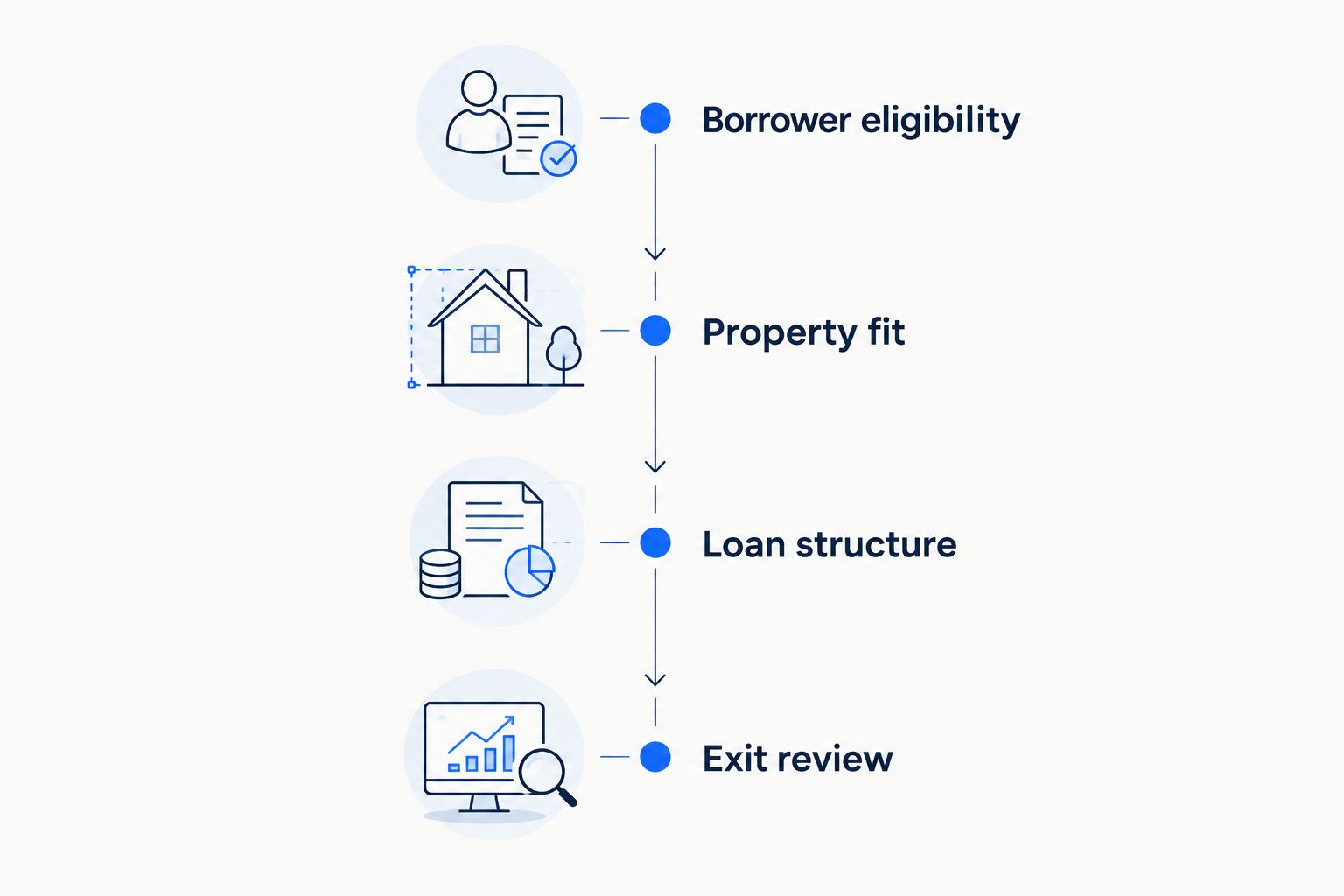
Use this sequence for your 2026 lender discussions. Resolve the borrower first, then the building, then the financing structure.
- Borrower eligibility: Provide citizenship, residency, borrowing-entity details, and beneficial ownership. Ask what identification, tax documentation, and source-of-funds evidence the lender requires.
- Property fit: Submit the address, asset type, occupancy, rent roll, operating statements, and proposed work. Identify whether the request depends on current or future income.
- Loan structure: Confirm recourse, reserves, maturity, extension conditions, and prepayment provisions. Separate preliminary indications from approved terms.
- Exit review: Check that a sale or refinance can repay the loan under the proposed timeline and ownership structure.
This sequence prevents a common decision error: comparing loan terms before establishing that the borrower can use the program. Keep the same ownership chart and property package across lender discussions so differences in responses are easier to identify.
Which CRE provider should you choose?
Start with eligibility screening, then select the provider type that matches the property's current condition. An undecided investor should not begin with a rate comparison across incompatible programs.
Choose private bridge lenders for a defined transition, DSCR lenders for qualifying rental-income underwriting, portfolio banks for a continuing banking relationship, and CMBS originators for an appropriate stabilized commercial asset. Obtain written borrower acceptance before treating any route as actionable.
For 2026 applications, distinguish pre-approval from commitment and commitment from funding. Read the remaining conditions at each stage; a fast initial response does not remove property, compliance, or legal review.
FAQ
What's the best CRE loan provider for a foreign national investor?
The best provider is one that accepts your ownership structure and finances your property's current condition. Flexvcapital provides a direct-lender screening point across several commercial programs, but foreign national eligibility must be confirmed before proceeding.
Can a foreign national get a commercial real estate loan in the United States?
Foreign national investors can obtain U.S. real estate financing through lenders that accept their borrower profile. Citizenship, residency, ownership, source of funds, and property eligibility remain subject to the selected lender's requirements.
Is a DSCR loan automatically available to nonresident investors?
No. DSCR describes an income-coverage measure, not automatic acceptance of nonresident borrowers. Confirm foreign national eligibility, property classification, and the lender's income calculation separately.
Are bridge loans better than permanent loans for foreign investors?
Bridge loans fit a defined interim need; permanent financing fits an eligible longer-term hold. Choose based on the property's condition and repayment plan, not nationality alone.
What documents should a foreign national prepare for lender screening?
Prepare identification, residency information, an ownership chart, source-of-funds evidence, and the property's financial records. Obtain the lender's specific checklist before arranging translations, certifications, or additional reports.
Does a U.S. LLC guarantee commercial loan eligibility?
No. A U.S. entity does not remove lender review of beneficial owners, guarantors, residency, or funding sources. Submit the complete ownership structure rather than only the borrowing entity's formation documents.
Does pre-approval mean the commercial loan will close?
No. Pre-approval is not final funding approval. Review the remaining underwriting, property, compliance, and legal conditions before relying on a proposed closing.
One last thing
Screen your refinance before signing your bridge loan. A bridge lender's acceptance does not establish that the next lender will accept the same foreign national ownership structure. Give the proposed permanent lender the ownership chart at the start—not after the property reaches stabilization.


