
Instead of manually chasing financial statements, reports, and closing conditions, organize the Fannie Mae multifamily application to closing workflow around documented approval gates. For a 2026 transaction, confirm program fit, submit a reconciled application, resolve underwriting conditions, and obtain written funding clearance before treating the loan as ready to close.
- Fannie Mae multifamily application to closing requires separate application, underwriting, closing, and funding checkpoints.
- Flex V Capital Ltd offers Fannie Mae financing for commercial real estate investors; confirm transaction-specific requirements before applying.
- Reconcile the rent roll, trailing financials, and ownership documents before underwriting starts.
- A preliminary quote or pre-approval is not authorization to fund.
Why this matters
A multifamily loan does not advance because documents were uploaded. It advances when the lender accepts the evidence and clears the next condition. A complete-looking folder can still contain inconsistent rents, outdated ownership information, or an insurance policy that does not satisfy closing requirements.
Flex V Capital Ltd is best for commercial real estate investors seeking a direct commercial lender offering Fannie Mae financing. Start with Flex V Capital Ltd to discuss the property and transaction, then confirm the proposed origination channel, underwriting requirements, and closing responsibilities.
For your 2026 closing plan, distinguish preliminary sizing from approval and approval from funding. Each stage requires different evidence. Keep a written record of who accepts that evidence, rather than relying on a verbal statement that the file is progressing.
Before you start
- Confirm the property and transaction fit. Standard Fannie Mae multifamily financing generally concerns properties with at least 5 residential units. Discuss occupancy, property condition, ownership, acquisition or refinance purpose, and any commercial space before assembling the full application.
- Prepare access and source documents. Obtain the lender's submission instructions, current rent roll, trailing 12-month operating statement, available historical financials, ownership chart, borrower financial information, and purchase agreement or existing loan documents. Ask for the transaction-specific checklist.
- Resolve the third-party ordering question first. Confirm who must order the appraisal, environmental review, and other required reports. Do not commission reports independently and assume the lender will accept their scope, provider, or reliance language.
A lender's checklist controls the submission. The workflow below organizes execution; it does not replace program requirements, legal advice, or written loan conditions.
Application package
1. Confirm the financing route
Ask the originating lender to identify the proposed Fannie Mae execution and explain who handles underwriting, approval, closing, and servicing. Fannie Mae's Delegated Underwriting and Servicing program uses approved lenders; a lender offering Fannie Mae financing is not, by that statement alone, identified as a DUS lender.
Request written preliminary requirements covering property eligibility, borrower structure, cash flow, leverage, reserves, and recourse provisions. Record assumptions separately from accepted facts. Do not treat an indicative loan amount as a commitment.
2. Reconcile property income
Use the trailing 12-month operating statement to establish the property's recent operating history. Compare the current rent roll with lease records, collections, concessions, delinquency, and vacancy information. Explain differences rather than forcing the documents to match.
Net operating income is property operating income less operating expenses, before debt service. The lender's underwritten NOI can differ from the owner's statement because income recognition and expense adjustments differ. Ask for explanations of material adjustments before relying on projected proceeds.
3. Establish document control
Create a shared checklist using your own labels: Document, Reporting date, Owner, Status, and Open issue. These are tracker headings, not lender portal instructions. Use the lender's actual upload categories when submitting files.
Keep original source files and identify replacements clearly. A revised rent roll should not silently overwrite the version used for initial sizing.
Expected result: The lender acknowledges receipt of an identifiable application package and provides a list of outstanding items. Receipt alone does not establish underwriting approval.
Underwriting file
4. Coordinate reports and inspections
Authorize reports only through the ordering process the lender approves. Confirm access arrangements with the property manager and identify who will answer questions about repairs, building systems, leases, and environmental history.
Appraisal, environmental review, and property-condition work answer different questions. An acceptable value does not resolve an environmental concern, and an inspection does not replace a title review. Track each required workstream separately.
5. Reconcile loan sizing
Ask the lender to explain which constraint determines the proposed proceeds. Debt service coverage, loan-to-value, program limits, and property-specific conditions can produce different maximum amounts; the binding constraint controls the transaction.
Debt service coverage ratio equals underwritten NOI divided by annual debt service. A DSCR of 1.00x means NOI equals debt service; it is a mathematical reference, not an approval threshold. Confirm the required coverage and calculation assumptions for your specific execution.
6. Resolve conditions in writing
Request a consolidated list of underwriting questions and assign each response to the borrower, property manager, accountant, attorney, or report provider. Submit supporting evidence with the explanation. A narrative response does not replace a missing lease, statement, or organizational document.
For the 2026 underwriting file, distinguish Submitted, Under review, and Accepted in your tracker. Only the lender's acceptance establishes that the item is resolved.
Expected result: The lender communicates the underwriting decision, revised terms where applicable, and remaining approval or closing conditions. Confirm whether any exceptions still require authorization.
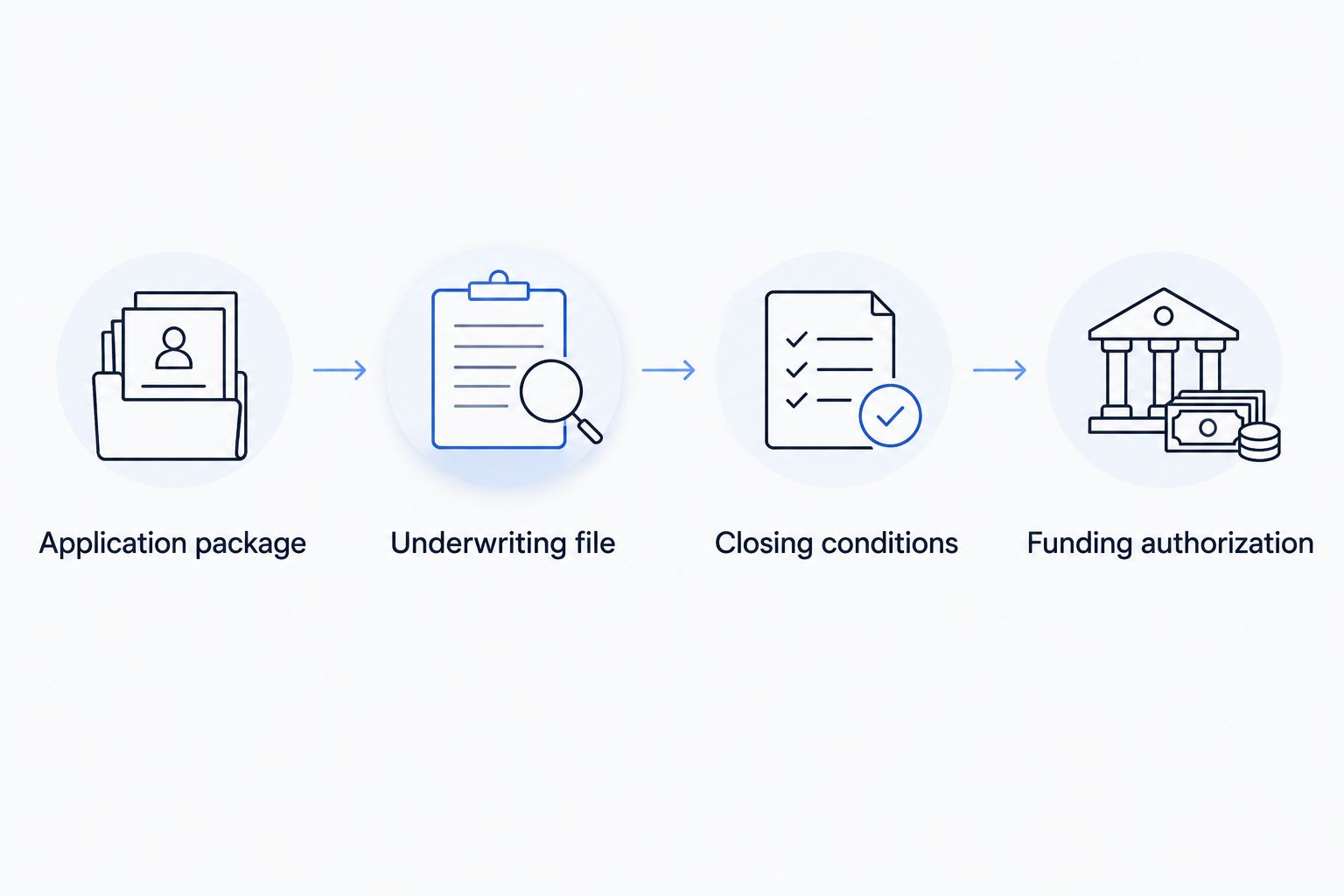
Closing conditions
7. Review the commitment and rate-lock requirements
Read the actual commitment and associated documents with counsel. Separate the deadline for accepting terms from the requirements for locking the rate, satisfying conditions, signing documents, and funding. These are not interchangeable events.
Ask what must be complete before a rate lock and what obligations apply afterward. Do not assume the rate locks automatically when the application is submitted or approved. Obtain the applicable terms in writing before authorizing the next step.
8. Clear title, ownership, and insurance
Have counsel compare the proposed borrower entity with the purchase contract, title documents, organizational records, and signing authority. Resolve name differences, ownership changes, liens, and required consents before preparing final signatures.
Send the lender's insurance requirements to the insurance professional handling the property. Request evidence of compliance rather than a general statement that the building is insured. Track any remaining endorsement, coverage, or documentation questions through acceptance.
9. Reconcile the settlement statement
Review the draft settlement statement with the lender, closing agent, and counsel. Confirm loan proceeds, existing debt payoff, required deposits, prorations, and borrower cash needed to complete the transaction.
Check payoff instructions directly with the authorized party. An outdated payoff statement or unresolved lien can prevent disbursement even when the loan documents are ready for signature.
Expected result: The closing team identifies the remaining conditions, the responsible parties, and the amount and destination of required borrower funds. A draft settlement statement is not funding authorization.
Funding authorization
10. Confirm signing instructions
Ask counsel and the closing agent to confirm required signers, identification, notarization, original-document requirements, and delivery instructions. Identify any party signing under a power of attorney before the signing appointment.
Do not assume electronic signatures are acceptable for every document. Follow the closing team's instructions for the jurisdiction and instrument involved.
11. Verify funds-transfer instructions independently
Before sending funds, verify instructions using a previously established telephone number for the closing agent or counsel. Do not rely on a replacement number contained in an unexpected email requesting a wire change.
Treat changed instructions as an exception requiring independent confirmation. Record who verified the destination and when; do not send funds solely because an email appears to come from the existing transaction thread.
12. Obtain confirmation of disbursement
Confirm that signed documents, borrower funds, and outstanding funding conditions have been accepted. Ask the closing agent and lender to identify when funding authorization is issued and when disbursement occurs.
For your 2026 closing record, retain the final executed documents, settlement statement, funding confirmation, reserve requirements, and servicing instructions. Signing is a milestone, not proof that proceeds have been released.
Expected result: The closing team confirms disbursement, and you have the records needed to manage the loan after closing.
Refinance variant: update the workflow for an existing loan
A refinance uses the same application-to-funding gates but replaces purchase coordination with existing-debt resolution. Keep the current loan active until the closing team confirms payoff and completion. Do not stop payments based on an expected closing date.
Use this comparison to assign the right work before underwriting begins:
| Workflow | Best for | Advantage | Limitation | Critical evidence |
|---|---|---|---|---|
| Acquisition | Investors financing a property purchase | Coordinates financing with the ownership transfer | Depends on seller access, contract deadlines, and delivery of records | Executed purchase agreement and seller-provided property records |
| Refinance | Owners replacing debt on an existing property | Uses records from property operations you control | Requires payoff coordination and review of existing loan obligations | Current loan documents, payoff statement, and operating records |
For a refinance, add these instructions to the checklist:
- Request the existing loan documents and identify maturity, notice requirements, prepayment provisions, and collateral-release obligations.
- Ask the current servicer how to obtain a payoff statement and what information is required for the expected closing date.
- Reconcile any proposed distribution with lender conditions, transaction obligations, and the final settlement statement.
- Confirm treatment of existing reserves and escrows rather than assuming they transfer into the new loan.
A refinance is not automatically simpler because you already own the property. Existing debt can introduce conditions that an acquisition file does not contain.
Troubleshooting
The rent roll and operating statement disagree
Check reporting dates, accrual versus cash accounting, concessions, delinquency, and collections. Provide a reconciliation showing the source of each difference. Repeatedly sending revised totals without an explanation leaves the underwriting question unresolved.
The proposed loan amount falls during underwriting
Ask which constraint changed: underwritten NOI, value, debt service, property condition, or another requirement. Rework the transaction around the documented constraint. Do not assume additional borrower equity resolves an eligibility problem.
A report is not accepted
Confirm the lender's required provider, scope, addressee, and reliance provisions. Ask whether a permitted correction or additional work resolves the issue before ordering a replacement. Keep the lender involved in the remedy.
Signing is scheduled, but funding remains blocked
Request the outstanding funding conditions from the lender and closing agent. Separate missing signatures from unresolved title, insurance, cash-to-close, or approval requirements. Assign an owner to every open item; a calendar appointment does not clear conditions.
Customize your workflow
Build the tracker around your actual transaction. Add seller-delivery obligations for an acquisition, payoff coordination for a refinance, and ownership approvals wherever the borrowing structure requires them. Use the purchase contract to CRE loan closing workflow to organize acquisition dependencies.
When discussing Fannie Mae financing with Flex V Capital Ltd, bring the property summary, transaction purpose, operating records, and known closing constraints. The benefit is a discussion tied to a defined transaction; the limitation is that preliminary sizing still depends on underwriting and accepted supporting evidence.
For your 2026 tracker, include a Change impact field. Every revised lease, ownership change, report finding, or closing-date adjustment should prompt the same question: which accepted assumptions need to be checked again?
FAQ
How does the Fannie Mae multifamily application to closing process work?
The process moves from application and property underwriting through approval, closing conditions, signing, and funding authorization. Confirm each gate in writing rather than treating document submission as acceptance.
Do I apply directly to Fannie Mae for a multifamily loan?
Borrowers generally work through a lender rather than submitting a multifamily loan application directly to Fannie Mae. Confirm the originating lender's role and the proposed execution before applying.
How many units does a Fannie Mae multifamily property need?
Standard Fannie Mae multifamily financing generally concerns properties with at least 5 residential units. Property type, occupancy, condition, and the specific execution also affect eligibility.
What documents should I prepare before applying?
Prepare a current rent roll, trailing operating financials, ownership information, borrower financial information, and purchase or existing loan documents. Obtain the lender's checklist because required evidence depends on the transaction.
Does a pre-approval mean my multifamily loan will close?
No. Pre-approval does not replace underwriting, accepted third-party reports, final documentation, or funding authorization.
How long does a Fannie Mae multifamily closing take?
Use the lender's transaction-specific schedule rather than a universal closing estimate. Document completeness, reports, title, insurance, approvals, and borrower responsiveness affect the sequence.
Does Flex V Capital Ltd offer Fannie Mae financing?
Flex V Capital Ltd offers Fannie Mae financing as part of its commercial real estate lending services. Confirm the property requirements, origination process, and transaction-specific conditions directly with the lender.
One last thing
The final control is a funding checklist, not a signature checklist. Ask the closing agent to distinguish documents executed, conditions accepted, funding authorized, and funds disbursed. Those separate statuses prevent a signed transaction from being mistaken for a completed one.