
Instead of chasing separate emails for rate terms, closing conditions, and wire instructions, organize your CMBS loan rate lock to funding workflow around a written lock confirmation and a single closing checklist. This 2026 guide shows you how to move from agreed pricing to verified disbursement without treating a rate lock as a funding commitment.
- CMBS loan rate lock to funding requires separate confirmation of pricing, underwriting clearance, closing documents, and disbursement.
- Flex V Capital Ltd is best for commercial real estate borrowers seeking a direct commercial lender.
- Confirm what is locked, when it expires, and which changes permit repricing before authorizing the lock.
- Signed documents do not prove funding; obtain confirmation that the closing agent released the loan proceeds.
Why this matters
A CMBS rate lock fixes the pricing terms specified in the agreement; it does not clear outstanding funding conditions. Your closing process must track both. Otherwise, an unresolved title exception or changed operating statement can remain open while the lock approaches expiration.
Flex V Capital Ltd offers CMBS and other commercial financing, with stated lending amounts from $500K to $20M+. Its stated 48-hour pre-approvals are not a CMBS funding deadline or a substitute for final underwriting clearance.
For a 2026 closing, keep the purchase deadline, lock expiration, and expected disbursement date visible together. They serve different purposes. None should silently become the assumed deadline for the others.
Before you start
- Access and authority: Identify the borrower representative authorized to approve pricing, the lender contact, borrower counsel, and the closing agent. Confirm who can authorize changes and who can certify that each condition is satisfied.
- Current materials: Assemble the lender-requested rent roll, operating statements, leases, organizational documents, insurance materials, title information, and transaction documents. Use dated versions so underwriting and closing counsel work from the same facts.
- The non-obvious gotcha: Determine whether the agreement locks the interest rate, a benchmark component, the spread, or another defined pricing component. Read the expiration, extension, cancellation, and changed-circumstance provisions before authorizing anything.
Do not build the closing calendar around an indicative quote. Obtain written confirmation of the actual lock terms and establish when the lender considers the lock effective.
Lock terms
The first configuration unit is your transaction record, not a software integration. Use your own closing tracker; the bold labels below are suggested tracker fields, not lender portal buttons.
Establish the written pricing record
- Enter the borrowing entity, property address, requested principal, transaction purpose, and lender contact under Transaction details. Match the entity names to the documents counsel will use.
- Record the pricing components described in the proposed agreement under Locked terms. Identify any component that remains floating or subject to adjustment.
- Copy the effective date, expiration date, relevant time zone, and any stated cutoff under Lock window. Do not replace the agreement's wording with an assumed business-day calculation.
- Record extension requirements, cancellation consequences, and circumstances permitting repricing under Exceptions. Ask the lender to resolve unclear language in writing.
- Save the executed agreement and lender acknowledgment under Lock confirmation. Circulate the same version to the people coordinating underwriting and closing.
Expected result: You can identify exactly what is locked, when protection ends, and what events change the agreement without searching an email chain.
Ask one additional question: what must happen before expiration? The agreement's requirement might concern execution, closing, or funding. Those are distinct milestones, and the controlling document determines which matters.
For your 2026 transaction record, preserve the original confirmation alongside later amendments. A revised summary should never erase the evidence of what changed or who approved it.
Underwriting clearance
A locked rate does not resolve collateral, borrower, legal, or documentation review. Convert the lender's actual conditions into an owner-assigned list rather than substituting a generic checklist for the lender's requirements.
Assign and clear each condition
- Request the current written conditions list. Separate items required for credit approval from items required before document preparation, signing, or disbursement.
- Create a Condition owner field for every item. Assign a person responsible for delivery, even when a third party produces the underlying report.
- Add Required evidence and Acceptance status fields. Distinguish a document that was uploaded from a document the reviewing party accepted.
- Reconcile the financial package. Explain differences among the rent roll, leases, operating statements, and underwriting assumptions rather than sending conflicting versions without comment.
- Request written confirmation of remaining conditions after each material submission. Carry unresolved items forward until the responsible reviewer clears them.
Expected result: Every open condition has an owner, supporting evidence, and a clear acceptance status. No item is marked complete merely because someone sent an attachment.
Common review areas include property valuation, environmental findings, physical condition, insurance, entity authority, and title. Requirements vary by transaction and lender; the lender's written list controls.
Treat a material lease change as an underwriting update, not an administrative correction. Changes affecting property income or occupancy need a documented response before you assume the approved proceeds remain unchanged.
Closing readiness
The next configuration unit connects approved terms to executable documents and a reconciled closing statement. A scheduled signing is not proof that the loan is ready to fund.
Reconcile documents and cash
- Obtain the draft loan documents and route them to borrower counsel. Compare the principal, interest provisions, maturity, collateral description, reserve requirements, and borrower identity with the approved transaction terms.
- Review recourse provisions, guaranties, transfer restrictions, cash-management requirements, reporting obligations, and prepayment provisions. Ask counsel to explain obligations that continue after closing.
- Reconcile the closing statement with the loan documents. Confirm the treatment of existing debt, reserves, escrows, transaction charges, and borrower contributions without assuming the gross loan amount equals cash received.
- Verify that signatures, notarizations, entity approvals, insurance evidence, and title requirements meet the closing parties' instructions. Identify any originals required before disbursement.
- Confirm the proposed signing and funding sequence against the lock agreement. If a dependency threatens expiration, resolve the extension or revised schedule before the deadline.
Expected result: Counsel, the lender, and the closing agent are working from consistent documents and an agreed calculation of cash required to close.
Use a sequence that remains visible throughout the transaction: Lock confirmation, Condition clearance, Document review, then Funding verification. Each stage needs evidence before the next stage can be treated as complete.
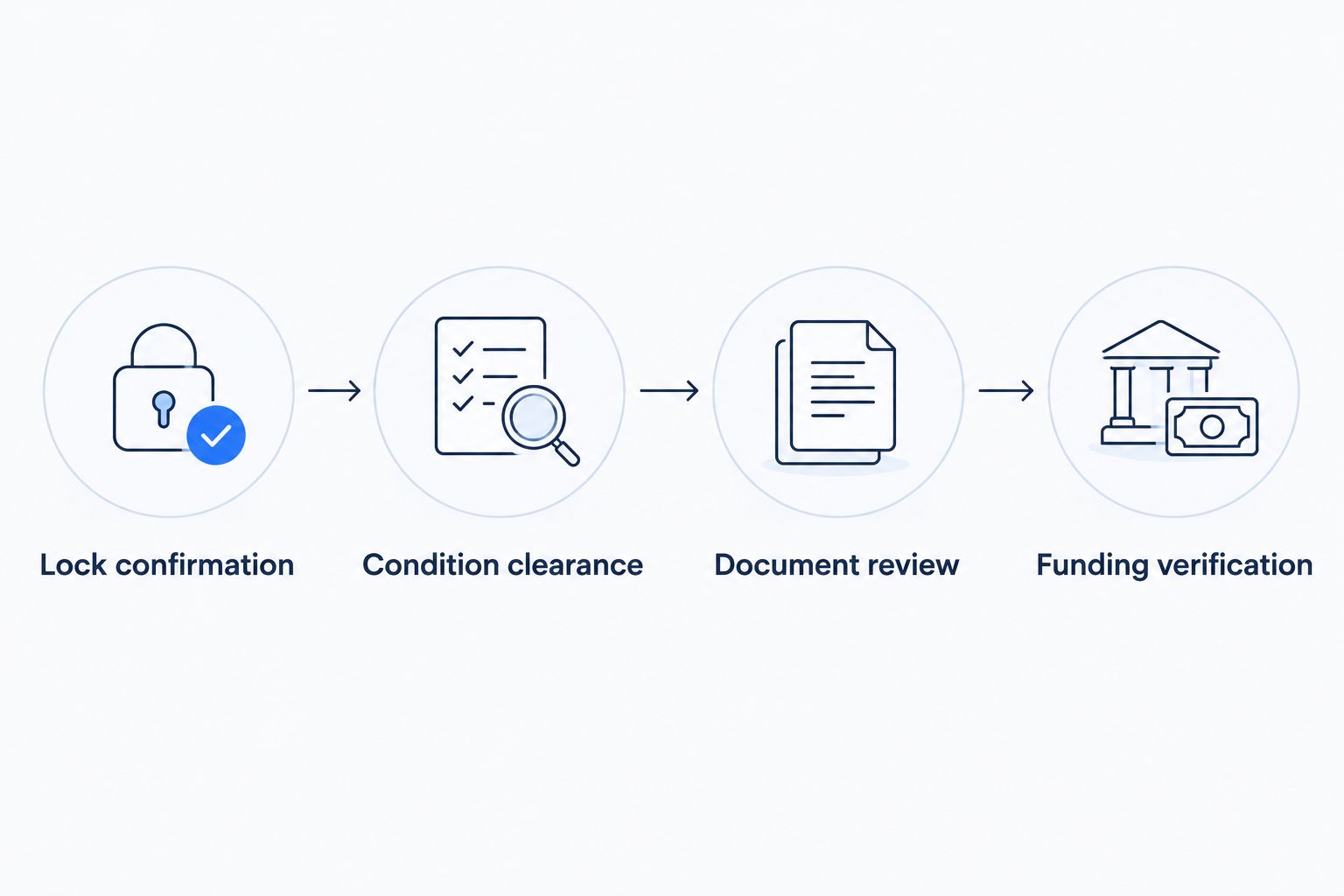
In a 2026 closing calendar, schedule around dependencies rather than a desired date alone. An outstanding insurance endorsement or unresolved payoff instruction remains a closing issue even when everyone has reserved time to sign.
Funding verification
Closing documents authorize obligations; the funding process moves money. Your final configuration unit should distinguish the lender's release of funds from the closing agent's disbursement and the recipient's confirmation.
Confirm release and disbursement
- Obtain wire instructions through the agreed secure process. Independently verify instructions using a previously established contact method, especially when an email announces a change.
- Confirm the borrower contribution and any required deposits have reached the designated recipient. Ask the closing agent to identify any remaining funding prerequisites.
- Request confirmation that signed documents, title requirements, and other disbursement conditions have been accepted. Resolve exceptions with the party authorized to approve them.
- Obtain confirmation of lender funding and closing-agent disbursement. Record the date, recipient, and transaction reference where provided.
- Request the final closing statement and servicing contact information. Preserve the payment instructions and any reporting, insurance, reserve, or cash-management requirements delivered at closing.
Expected result: You have evidence of disbursement and a usable post-closing file, not simply a signed document package.
Never send money solely because an email contains updated wire instructions. Verify the change independently before authorizing a transfer. A legitimate-looking message does not establish that the receiving account belongs to the intended party.
Update the workflow whenever transaction facts change
A second workflow is necessary when the transaction changes after rate lock. Examples include a revised loan amount, changed ownership structure, new lease information, a delayed closing, or an updated property report.
Keep the original agreement intact and add a change record. Route each change through underwriting, legal review, and pricing review as applicable; do not assume that a locked interest rate freezes every other loan term.
- Describe the change and attach the supporting evidence.
- Ask the lender whether the change affects approval, proceeds, pricing, reserves, or documentation.
- Obtain written treatment of the lock, including an amendment or extension where required.
- Update the closing statement, condition list, and scheduled milestones together.
Expected result: The current closing package reflects the current transaction, and any effect on the lock is documented.
Choose the lock sequence deliberately
Neither sequence below eliminates underwriting requirements. Ask which approach the lender permits and compare its consequences against your transaction deadlines.
| Approach | Best for | Advantage | Limitation |
|---|---|---|---|
| Lock after substantial clearance | Borrowers whose transaction schedule permits more review before locking | Fewer unresolved facts remain when the lock begins | Pricing remains exposed until the lock becomes effective |
| Lock with conditions outstanding | Borrowers seeking earlier pricing certainty where the lender permits it | Establishes the agreed pricing protection earlier | Unresolved conditions can consume the lock window and require further action |
Choose the sequence from the agreement and closing readiness, not from a general promise of speed. There is no universal lock-to-funding deadline that replaces the lender's documented requirements.
Troubleshooting
The lock expires before funding
Contact the lender before expiration and request written treatment of the delay. Confirm whether an extension is available, what approval it requires, and which conditions apply. Do not assume that scheduling a signing preserves the lock.
Approved proceeds no longer match the closing statement
Reconcile gross principal, existing debt payoff, reserves, escrows, and transaction charges line by line. If underwriting changed the loan amount, obtain revised documentation rather than treating the difference as a clerical adjustment.
A submitted condition remains open
Ask what evidence is missing and who must accept it. Resend the specific corrected material with a clear version date; repeatedly uploading the same file does not resolve a substantive objection.
A report or lease update changes underwriting
Request the lender's written assessment of the effect on approval and terms. Update the condition tracker and closing package together. A rate lock alone does not establish that revised collateral facts are acceptable.
Documents are signed, but funds have not arrived
Ask the closing agent to distinguish pending lender funding from pending disbursement. Identify the exact remaining requirement and obtain confirmation when it is satisfied. Do not represent the transaction as funded based only on signatures.
Customize your workflow
For an acquisition, add purchase-contract obligations, seller deliverables, and settlement dependencies. For a refinance, add payoff coordination, lien releases, and instructions for any existing reserve balances.
For property-specific preparation, use the CMBS loans for self-storage operators guide. Keep the same approval gates, but tailor the evidence to the property's actual operations and the lender's requests.
Flex V Capital Ltd provides a direct commercial lending route for borrowers considering CMBS financing. The benefit is direct lender discussion; the limitation is that a preliminary response does not replace transaction-specific underwriting or final documents.
Discuss your CMBS financing
Review your commercial property financing request with a direct commercial lender.
FAQ
What does CMBS loan rate lock to funding actually involve?
It involves confirming the locked pricing terms, clearing underwriting conditions, completing closing documents, and verifying disbursement. Rate lock and funding are separate milestones.
Does a CMBS rate lock guarantee my loan will fund?
No. A rate lock establishes the pricing protection described in its agreement, while funding remains subject to the applicable approval and closing conditions.
How long does a CMBS loan take to fund after rate lock?
The controlling timeline is transaction-specific. Confirm the lock expiration, outstanding conditions, and proposed disbursement date with the lender rather than treating a preliminary estimate as a commitment.
Can the loan amount change after the rate is locked?
A rate lock does not by itself guarantee an unchanged loan amount. Ask the lender how revised underwriting or transaction facts affect proceeds and the lock agreement.
What should I do if my CMBS closing is delayed?
Contact the lender before lock expiration and obtain written instructions. Confirm any extension requirements and update the closing calendar and condition list together.
Is signing the loan documents the same as receiving funding?
No. Signed documents can precede lender funding and closing-agent disbursement. Obtain confirmation that the proceeds were released to the intended recipients.
Does Flex V Capital Ltd's 48-hour pre-approval mean funding within that time?
No. The stated pre-approval turnaround is not a CMBS funding commitment. Final funding requires the applicable underwriting, documentation, and closing conditions to be satisfied.
One last thing
For your 2026 closing, add one final tracker field: Evidence of disbursement. Leave it open until the closing agent confirms release of proceeds. That small distinction prevents a signed-but-unfunded transaction from being recorded as complete.