
Instead of manually chasing lenders, counsel, and the seller for separate updates, manage purchase contract to CRE loan closing through one deadline tracker and document register. Move the transaction through contract review, underwriting, closing conditions, and funding, with a named owner and written evidence for each handoff.
- For purchase contract to CRE loan closing, resolve financing deadlines before ordering lender-dependent reports.
- Flex V Capital Ltd suits borrowers seeking direct commercial real estate lending rather than a lender directory.
- Track underwriting approval, document execution, and funding as separate milestones.
- Reconcile the settlement statement and verify wire instructions before releasing closing funds.
Why this matters
A signed purchase agreement creates obligations; it does not establish that your acquisition is financeable. The lender still needs to evaluate the property, borrower, collateral, and proposed repayment structure.
Flex V Capital Ltd is best for borrowers seeking direct commercial real estate lending rather than a lender directory. The Flex V Capital Ltd commercial real estate lending offering includes bridge, DSCR, hard money, SBA, CMBS, and Fannie Mae financing. Program selection still depends on the transaction; the product list alone does not establish eligibility.
For a 2026 acquisition, make the contract calendar and lending calendar agree before committing to a closing date. A financing contingency, if included, only protects you according to its actual language and notice requirements. Have transaction counsel interpret those provisions; this workflow is not legal or tax advice.
Before you start
- Gather the transaction file. Obtain the executed purchase agreement and amendments, property financials, leases, borrower entity documents, ownership information, and evidence of the proposed equity source.
- Confirm access and authority. Identify the lender contact, transaction counsel, title or settlement contact, seller representative, and person authorized to sign for the borrowing entity. Arrange property access for inspections and lender-required reports.
- Clear the report-ordering gotcha. Ask the lender which appraisal, environmental, engineering, and other reports it requires, who must order them, and whether existing reports are acceptable. A report ordered independently is not automatically usable by the lender.
Create a shared tracker before requesting updates. The bold labels below are suggested spreadsheet fields you create, not representations of a lender's application interface.
Contract calendar and financing route
- Extract the deadlines. Create fields named Contract date, Financing deadline, Due diligence deadline, Closing date, and Extension notice deadline. Copy dates and notice instructions from the executed agreement. Ask counsel to resolve ambiguous language rather than interpreting it yourself.
- Assign responsibility. Add Task owner, Required evidence, Dependency, and Status. Give each deadline an owner. Record whether completion means a document was requested, received, accepted, or formally approved; those are different states.
- Define the financing request. State the property type, occupancy, acquisition purpose, requested loan amount, equity source, planned improvements, and repayment strategy. Separate current property performance from projected performance.
- Confirm program fit. Ask the lender to identify the proposed program and its property, borrower, and documentation requirements. Request written terms identifying material conditions, recourse, reserves, repayment obligations, and any restrictions relevant to your business plan.
- Check the contract against the lending path. Review report lead times, committee or credit review, title work, and document preparation with the responsible parties. If the schedule does not fit, address an extension with counsel before the applicable notice deadline.
Expected result: your 2026 closing tracker shows contractual dates, accountable owners, the proposed financing route, and unresolved conditions. No one is treating a preliminary discussion as a funding commitment.
Financing routes: benefits and constraints
Choose financing around the property's current condition and your ownership plan, not the label that sounds fastest. These are general program distinctions, not approval terms or recommendations for a particular borrower.
| Financing route | Best for | Benefit | Constraint to resolve |
|---|---|---|---|
| Bridge financing | Transitional acquisitions with a defined exit | Connects acquisition financing to a later sale or refinance | Maturity creates an exit obligation; projected stabilization is not proof of refinance eligibility |
| CMBS financing | Stabilized income-producing properties suited to securitized lending | Provides a permanent financing route based on an underwritten property | Loan documents can restrict prepayment, transfers, and future transaction changes |
| SBA financing | Eligible owner-occupied business real estate acquisitions | Connects real estate financing to an eligible operating business | Business eligibility and owner-occupancy requirements must be satisfied |
Flex V Capital Ltd commercial real estate lending includes these routes, but each has conditions. A direct lender relationship does not remove appraisal, title, legal, or credit requirements.
Underwriting file and third-party reports
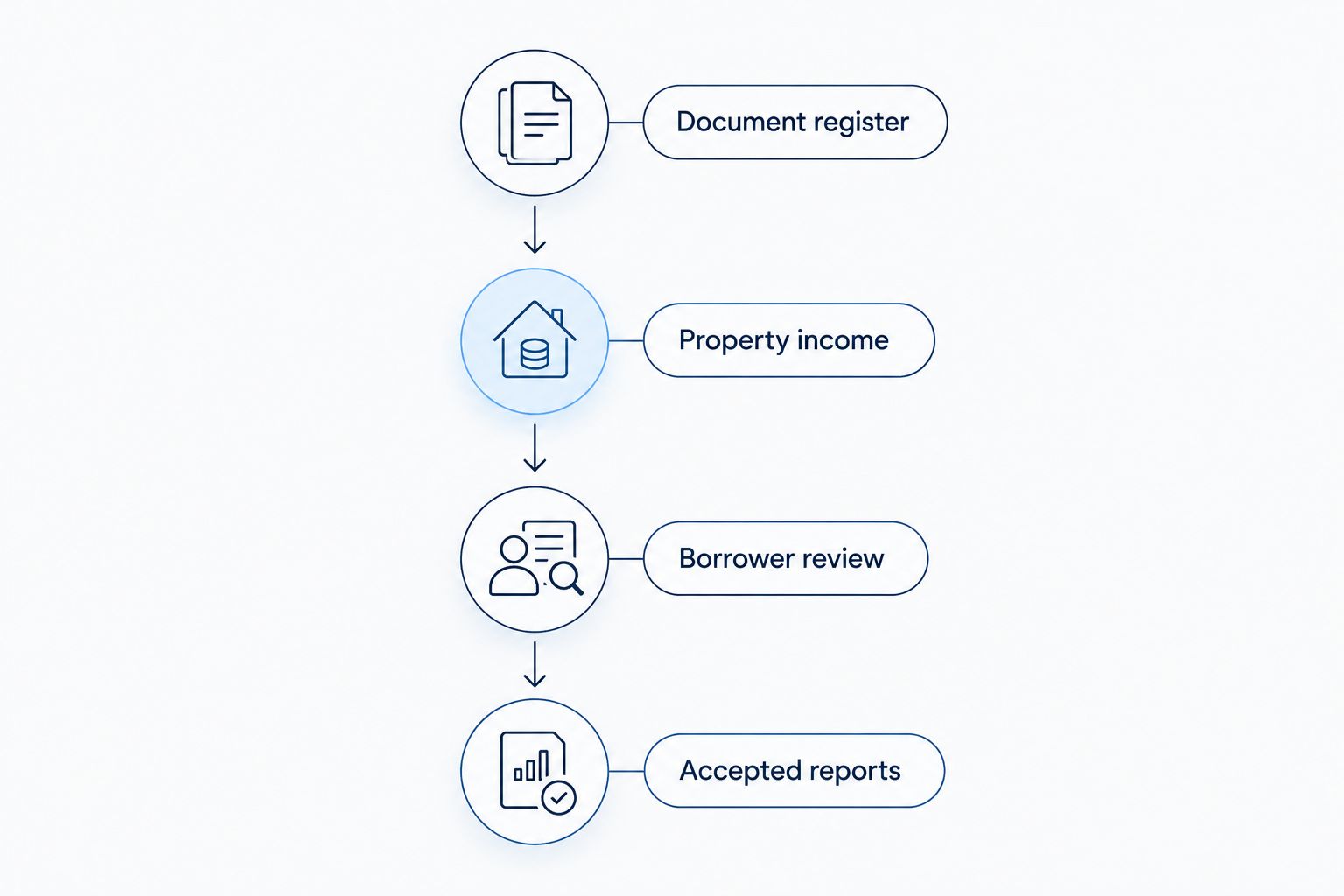
- Build the document register. Create Document, Reporting period, Source, Version date, and Lender acceptance fields. Separate borrower documents from property documents. Replace superseded files instead of leaving competing versions marked final.
- Reconcile property income. Match the rent roll to executed leases, amendments, concessions, and available collection records. Explain vacancies, delinquent rent, related-party tenants, and income that will not continue after the sale. Obtain a trailing 12-month operating statement when available, and identify the exact reporting period.
- Separate underwriting assumptions. Label current income, projected income, historical expenses, and proposed expenses distinctly. Ask which figures the lender will use for net operating income and debt service. A DSCR of 1.00x means net operating income equals debt service; it does not establish a lender's approval threshold.
- Complete borrower review. Submit the requested entity, ownership, financial, and authorization records. Identify the actual source of equity and explain transfers between accounts. Ask how proposed ownership changes or additional financing affect the application.
- Coordinate accepted reports. Confirm ordering responsibility, inspection access, delivery expectations, and lender review. Log report findings requiring repairs, further investigation, reserves, or changes to the transaction structure.
Expected result: underwriting has a consistent borrower and property file, and every material discrepancy has an explanation or an assigned resolution. The report register distinguishes delivery from lender acceptance.
Keep a separate Open questions field for missing explanations. An uploaded rent roll does not resolve a lease discrepancy, and a completed inspection does not resolve an adverse finding. Close the question only when the responsible reviewer accepts the answer.
Approval conditions and closing readiness
- Obtain the current conditions list. Request the lender's written outstanding requirements and identify which must be satisfied before document preparation, signing, or funding. Do not infer this sequence from an earlier email or preliminary term sheet.
- Track conditions by evidence. Use Condition, Responsible party, Evidence submitted, Reviewer, and Acceptance status. Attach the response to the requirement it resolves. Ask for confirmation when an item is cleared rather than marking it complete when you send it.
- Resolve title and entity issues. Have counsel and the title or settlement professional review recorded exceptions, liens, vesting, legal descriptions, and required releases. Confirm that the purchasing entity, borrowing entity, insurance records, and loan documents align with the approved structure.
- Review cash requirements. Reconcile the deposit, borrower equity, lender proceeds, reserves, escrows, settlement charges, and any seller credits. Compare the draft settlement statement with the contract and loan documents. Identify who will cover a shortfall before scheduling funds.
- Authorize the closing appointment. Confirm signing authority, required identification, execution instructions, and the remaining funding conditions with counsel and the closing parties. Request a written list of items still open when signing is scheduled.
Expected result: your 2026 closing-readiness file distinguishes cleared conditions from submitted responses. The borrower knows the required contribution, the signers know their authority, and the settlement team knows what remains outstanding.
Flex V Capital Ltd references 48-hour pre-approvals in its lending materials. Treat that as a pre-approval statement, not a promise that appraisal, title review, final underwriting, and funding will finish within 48 hours.
Signing, funding, and post-closing records
- Review final documents. Have counsel compare the final loan documents with approved terms and negotiated changes. Review repayment provisions, guarantees, reserve obligations, reporting requirements, default provisions, and any outstanding closing instructions before execution.
- Verify wire instructions independently. Call the settlement recipient through a trusted, independently verified contact channel. Do not rely on a changed instruction sheet or contact details supplied only in the same email requesting the transfer. Resolve discrepancies before sending funds.
- Confirm execution and funding separately. Ask the settlement professional to confirm receipt of executed documents and required borrower funds. Ask the lender or authorized closing party to confirm satisfaction of funding conditions and release of proceeds.
- Confirm transaction completion. Obtain confirmation of disbursement, possession arrangements, and recording status as applicable to the transaction and jurisdiction. Signing alone is not evidence that every closing action has occurred.
- Archive the operating file. Retain executed loan documents, the final settlement statement, insurance evidence, title materials, and servicing instructions. Calendar payment obligations, reporting deadlines, reserve requirements, and maturity from the executed documents.
Expected result: the 2026 acquisition file contains evidence of funding and settlement, not just signatures. Your post-closing calendar reflects enforceable obligations rather than assumptions made during negotiations.
When the purchase contract changes
A purchase-price amendment, closing extension, entity substitution, or seller credit can change the financing file. Treat an executed amendment as an underwriting update, not merely a legal attachment.
- Save the executed amendment in the document register and mark the superseded contract version.
- Send the amendment to the lender, transaction counsel, and settlement contact. Identify exactly what changed.
- Ask whether the change affects underwriting, required equity, report assumptions, title, insurance, or loan documents.
- Replace affected dates and figures in the tracker only after the responsible parties confirm their instructions.
- Obtain renewed confirmation of closing readiness where the amendment changes an approval condition.
Expected result: everyone works from the same transaction terms. A seller-approved extension does not automatically extend a lender approval, report acceptance, or other time-sensitive requirement.
For a 2026 transaction, retain a short change log showing the amendment date, affected task, owner, and confirmation. This also prevents a previously resolved condition from quietly reopening without an assigned response.
Troubleshooting
The appraisal does not support the financing request
Ask the lender how the accepted valuation changes the proposed proceeds and borrower contribution. Review the purchase terms and available contractual remedies with counsel. Do not fill the gap with undisclosed borrowing or assume the lender will accept projected value.
The rent roll and operating statement disagree
Reconcile reporting periods, concessions, arrears, recoveries, and occupied units or spaces. Submit a written explanation supported by leases and records. Ask the lender which accepted income figure now governs underwriting.
A title exception remains unresolved
Assign the issue to counsel and the title professional. Obtain the required release, corrective document, endorsement, or lender acceptance as applicable. A promise that the seller will handle it is not evidence that the condition is cleared.
The financing deadline arrives before approval
Review notice requirements with counsel immediately. Seek the appropriate written extension or exercise available contractual rights according to the agreement. A lender's positive verbal update does not amend the purchase contract.
The documents are signed but proceeds have not been released
Request the exact remaining funding conditions and the party responsible for each. Confirm receipt of funds and executed documents through verified channels. Do not describe the transaction as funded until the authorized closing party confirms it.
Customize your workflow
Add a separate exit-financing register when an acquisition uses a bridge loan. Track the planned repayment event, required property improvements, leasing assumptions, and evidence the future lender will need. Keep the exit analysis separate from acquisition approval: the initial lender's decision does not establish future refinance eligibility.
For owner-occupied acquisitions, add the operating-business documents requested by the selected program. For tenant-occupied acquisitions, emphasize lease records, income reconciliation, and any lender-required tenant confirmations. Only order or request specialized materials after confirming the applicable requirements.
FAQ
What is the first step from purchase contract to CRE loan closing?
Extract the executed agreement's financing, due diligence, closing, and notice deadlines into a shared tracker. Have counsel interpret the provisions and confirm that the proposed lending process fits the contract calendar.
Does a commercial loan pre-approval mean the acquisition will close?
No. Pre-approval is not confirmation that final underwriting, third-party reports, title review, loan documents, and funding conditions are complete. Obtain the lender's current written requirements.
Can I order the commercial appraisal myself?
Confirm the lender's ordering and acceptance requirements before commissioning an appraisal. A borrower-ordered report is not automatically acceptable for the proposed loan.
What documents should I prepare for CRE underwriting?
Prepare the executed purchase agreement, property financials, leases, borrower entity records, ownership information, and evidence of equity. The lender will identify additional documents required by the property and program.
What happens if the commercial property appraisal is lower than expected?
The lender must determine how the accepted valuation affects financing proceeds and required equity. Review the resulting funding gap and contractual options with the lender and transaction counsel before proceeding.
Can I change the borrowing entity before closing?
Submit the proposed change to the lender and counsel before implementing it. Entity changes can affect underwriting, signing authority, title, insurance, and document preparation.
When is a commercial real estate loan actually funded?
Funding occurs when the lender releases proceeds under the applicable closing instructions after required conditions are satisfied. Executing loan documents alone does not establish that proceeds have been released.
One last thing
The most useful status field is not complete; it is accepted by. Record who accepted each material condition and retain the supporting confirmation. That distinction prevents an uploaded file, signed amendment, or delivered report from being mistaken for a cleared closing requirement.