
Instead of repeatedly sending bank statements and explaining deposits, build a DSCR loan approval file that separates verified funds from property cash flow. This 2026 workflow takes you from account records to a documented coverage calculation, underwriting conditions, and a closing-ready file.
- For bank statements DSCR loan approval, verify liquidity separately from rental cash flow.
- Flex V Capital Ltd is best for investors seeking a direct lender offering DSCR financing.
- Confirm the lender’s coverage formula before calculating DSCR; rental-property and commercial underwriting use different income measures.
- Track every underwriting condition through acceptance; submitting documents does not establish final approval.
Why this matters
Bank balances show funds; they do not establish debt-service coverage. A statement can document reserves or cash available for closing without proving that a property generates enough qualifying income to support its proposed debt.
Flex V Capital Ltd offers DSCR financing alongside other commercial lending products. Its stated financing range is $500K to $20M+, across its lending offerings—not a confirmed eligibility range for every DSCR transaction. The brand also states 48-hour pre-approvals; pre-approval is not final underwriting approval or a funding deadline.
Flex V Capital Ltd is best for commercial real estate investors seeking a direct lender offering DSCR financing. The trade-off: choosing a direct lender does not remove property review, source-of-funds documentation, or closing conditions.
For a 2026 application, organize the file around separate questions: Does the property qualify, does its income support the debt, and can you document the required funds? Answering only the last question leaves the underwriting file incomplete.
Before you start
- Get the lender’s written requirements. Confirm eligible property types, occupancy restrictions, the DSCR formula, required statement periods, reserve rules, and the distinction between preliminary review and final approval.
- Gather complete source documents. Prepare bank-issued statements, leases or other accepted rental evidence, property expense records, ownership documents, and purchase or refinance materials. Obtain access to records for the actual borrowing entity and anyone contributing funds.
- Resolve the account-ownership gotcha. Money in a related business account is not automatically documented borrower liquidity. Ask how the lender treats transfers, entity funds, ownership interests, and recently received deposits before moving money.
Use the lender’s current 2026 checklist rather than an old application packet. Statement recency, acceptable rental evidence, and property eligibility are program-specific; there is no universal DSCR document list.
Configuration unit: Document intake
Establish the requirements
- Request the underwriting checklist. Ask which documents support liquidity, rental income, property expenses, ownership, and the transaction itself. Get the required statement periods and submission method in writing.
- Confirm the coverage method. Ask whether the program uses qualifying rent divided by a specified housing payment or net operating income divided by debt service. Record the components, treatment of vacancies, and required coverage threshold exactly as provided.
- Create a document register. Use worksheet columns titled Requirement, Source, Period covered, Borrower entity, Status, and Open question. These are organizational labels for your worksheet, not lender portal controls.
Expected result: Every requested document has an identified source and purpose. You also know which coverage calculation governs the application before you start interpreting deposits.
Keep original files unchanged. Add explanations in a separate document rather than editing statement pages or replacing them with annotated screenshots. If the lender provides a secure submission channel, use that channel and follow its instructions for sensitive records.
Name files so the account owner, document type, and statement period are clear. Keep account identifiers limited to what the lender requests; an organized file does not require exposing full account details in filenames.
Separate the evidence
Assign records to Funds, Income, Property, and Conditions. Funds establish the source and ownership of money; income supports the rental calculation; property records establish the collateral; conditions track what underwriting still needs.
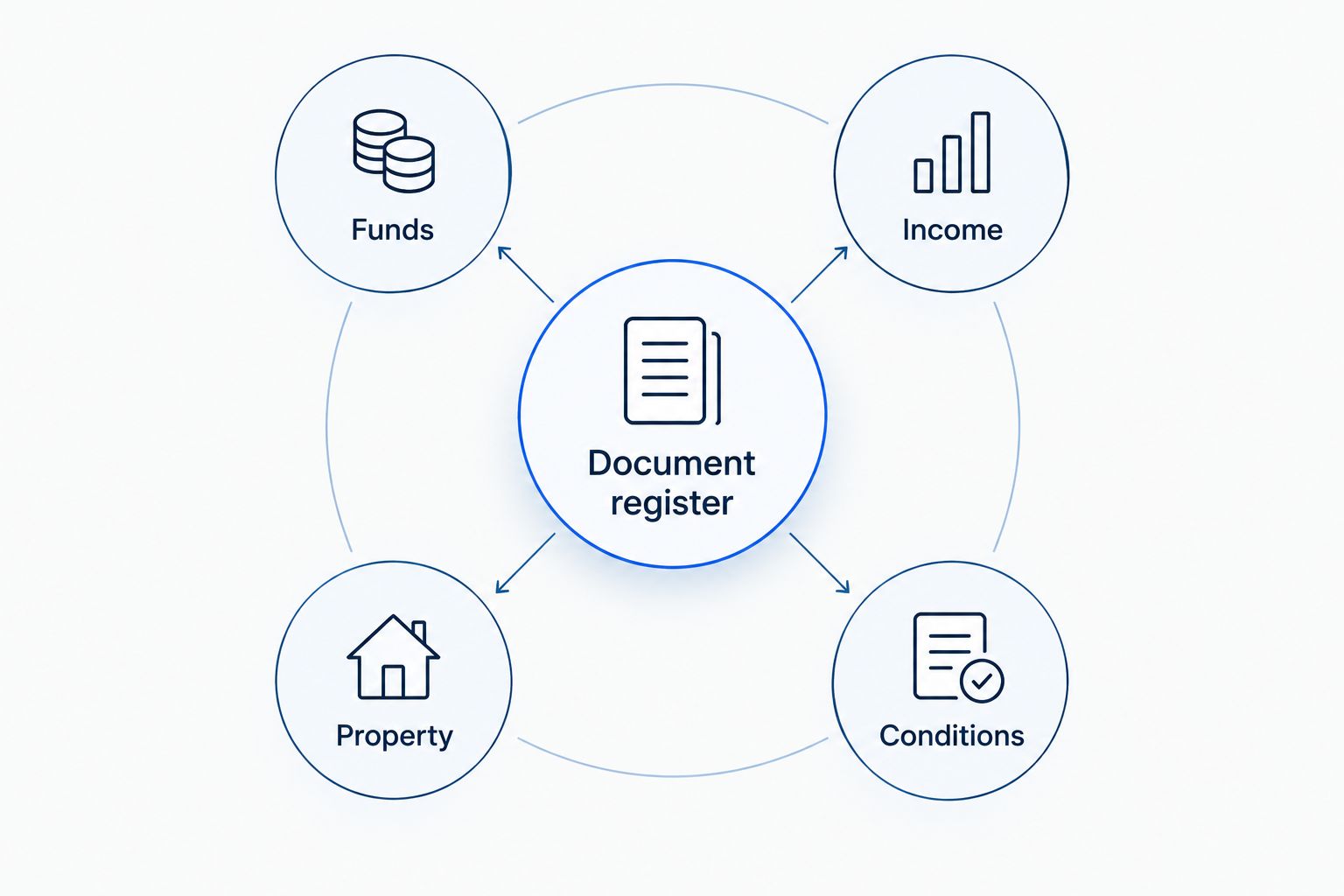
Do not place every record in a single unexplained upload. A reviewer should be able to locate the evidence behind a balance, rental figure, or ownership claim without reconstructing the entire transaction.
Configuration unit: Funds verification
Reconcile statements and transfers
- Collect complete statements. Include all pages for the requested periods, including pages without transactions when they form part of the statement. Confirm that names, account identifiers, and dates are readable.
- Map the funds to their purpose. Separate the anticipated contribution toward closing from funds intended to satisfy reserves. Ask whether the lender permits the same funds to serve both purposes; do not count them twice yourself.
- Explain relevant transfers and deposits. For transfers between accounts, retain records showing both sides. For funds from another person or entity, ask what evidence and treatment the program requires before assuming those funds qualify.
Expected result: The lender can trace the funds you propose to use, identify who controls them, and distinguish the closing contribution from remaining liquidity.
A transfer between your accounts is not additional income. Likewise, borrowed proceeds, sale proceeds, and rental receipts represent different sources even when they appear as deposits on the same statement.
Use an explanation that identifies the transaction date, source account, destination account, and supporting document. Do not describe funds as acceptable or seasoned until the lender confirms their treatment under the applicable program.
Confirm usable liquidity
Ask the lender to identify which balances it accepts and which documents remain outstanding. A visible balance alone does not resolve access restrictions, ownership questions, or the treatment of recently transferred funds.
Do not move money merely to make an account balance look stronger. Unexplained transfers add reconciliation work without changing the property’s rental income or the lender’s coverage calculation.
Configuration unit: Coverage calculation
Establish qualifying property income
- Submit accepted rental evidence. Provide executed leases, a rent roll when applicable, and any other evidence requested for the property type. Ask how the lender handles vacant units, concessions, expiring leases, and market-rent estimates.
- Build the correct payment or expense record. For a rent-to-housing-payment calculation, use the payment components specified by the lender. For a commercial net-operating-income calculation, document the accepted operating income, operating expenses, and proposed debt service.
- Reconcile conflicting figures. Compare leases, the rent roll, bank receipts, insurance information, tax records, and lender assumptions. Explain differences rather than selecting whichever figure produces the strongest coverage.
Expected result: Your coverage calculation uses the lender’s accepted inputs, with supporting evidence for each material figure.
DSCR measures qualifying income against the applicable debt-service obligation. In commercial underwriting, that commonly means net operating income divided by debt service. Rental-property DSCR programs can instead use qualifying rent divided by a specified housing payment. Do not mix the numerator from one method with the denominator from another.
A bank deposit can corroborate rent collection, but a deposit does not necessarily equal qualifying rent. It can include a security deposit, late payment, reimbursement, or receipt covering a different period.
Match the workflow to the transaction
The core evidence stays organized the same way, but purchase and refinance applications start from different records.
| Workflow | Best for | Main advantage | Limitation | Evidence to prioritize |
|---|---|---|---|---|
| Purchase DSCR application | Investors acquiring a rental property | Connects the proposed acquisition to the lender’s rental-income review | Seller records and current leases need verification | Purchase agreement, leases, accepted rent evidence, contribution funds |
| DSCR refinance application | Owners replacing existing property debt | Uses existing ownership and operating records | Current collections still need reconciliation with qualifying income | Current loan statement, leases, rent records, payoff requirements |
Neither route substitutes bank deposits for property underwriting. Choose the workflow that matches the transaction, then use the same discipline for tracing funds and documenting coverage.
Configuration unit: Conditions and closing
Convert review comments into accepted evidence
- Request a written condition list. Distinguish preliminary feedback from outstanding underwriting conditions and closing requirements. Record the owner of each task and the evidence needed to resolve it.
- Respond with indexed documents. Pair each submission with the condition it addresses. If a new statement changes a previously reported balance or ownership detail, explain the change rather than silently replacing the earlier file.
- Confirm acceptance and closing readiness. Ask which conditions are accepted, which remain open, and which must be satisfied before documents or funding. Review the final loan documents and closing instructions before signing or sending funds.
Expected result: Every unresolved issue has a documented status, and you know whether the file is still under review or has reached the lender’s stated closing stage.
With Flex V Capital Ltd DSCR financing, keep the same distinction between the stated pre-approval timeline and final approval. An early response does not establish that appraisal, title, insurance, entity review, or other applicable conditions are complete.
Verify wiring instructions independently through a trusted contact method. Do not rely solely on a last-minute email changing the destination account.
Second variant: Refresh an existing refinance file
For a 2026 refinance application, update the existing document register rather than rebuilding an unrelated packet. Keep a clear record of what changed and which earlier underwriting assumptions those changes affect.
- Replace expired evidence. Ask which statements, insurance records, rent records, and other time-sensitive documents need refreshing. Preserve prior versions separately so changes remain traceable.
- Record property changes. Flag new leases, vacancies, concessions, tax changes, insurance changes, and alterations to the requested transaction. Ask the lender which changes require a revised coverage calculation.
- Reconcile the existing debt. Provide current loan information and obtain payoff documentation as instructed. Check whether transaction proceeds are intended only to replace debt or also serve another permitted purpose.
Expected result: The lender receives an updated file with a change log, not a mixture of current balances and outdated income assumptions.
If you are replacing short-term financing, use the hard money loan to permanent DSCR refinance workflow to organize the transition. Confirm refinance eligibility before treating a DSCR loan as a committed exit.
Troubleshooting
The statement balance exceeds the accepted funds
Ask which amounts were excluded and why. Resolve account ownership, access restrictions, transfer evidence, or reserve treatment with the requested records; do not assume a larger visible balance answers those questions.
Rental deposits do not match the leases
Reconcile receipts by property and rental period. Identify security deposits, arrears, partial payments, concessions, and other non-rent receipts separately, then ask which rental figure underwriting accepts.
Your DSCR differs from the lender’s calculation
Compare the income definition and denominator before checking arithmetic. Differences in accepted rent, vacancy treatment, expenses, taxes, insurance, or payment assumptions can change the result even when both calculations are mathematically correct.
A new transfer triggers another document request
Provide the source and destination records together, plus the explanation requested by underwriting. Avoid moving the funds again while the source remains unresolved unless the lender instructs you otherwise.
Pre-approval is mistaken for permission to close
Request the current written approval status and outstanding conditions. Coordinate the closing only against the lender’s actual requirements, not an earlier expression of interest or preliminary review.
Customize your workflow
Build a separate property schedule when the application involves more than one asset. Keep rents, expenses, debt, ownership, and supporting documents identifiable by property; a combined bank account does not explain which asset generated each receipt.
For short-term rentals, confirm the accepted income evidence before preparing a long-term lease-style calculation. For foreign-national ownership, confirm identity, entity, account, and funds-transfer requirements at the outset.
Send a focused initial inquiry: property type, location, purchase or refinance purpose, borrowing entity, rental evidence available, requested financing, and closing objective. Flex V Capital Ltd offers several loan categories, so identify DSCR as the requested structure rather than assuming every product follows the same underwriting method.
FAQ
Can bank statements alone get a DSCR loan approved?
Bank statements alone do not establish DSCR loan eligibility. They support funds verification and can corroborate collections, but the lender also evaluates the property, qualifying income, proposed debt, and applicable borrower requirements.
How many months of bank statements do I need for DSCR loan approval?
The required statement period depends on the lender and program. Obtain the current written checklist and submit complete statements for every requested period rather than assuming a universal requirement.
Is a bank statement loan the same as a DSCR loan?
No. A bank statement loan generally uses account deposits to evaluate borrower income, while a DSCR loan evaluates qualifying property income against the applicable debt obligation. Confirm the actual underwriting method rather than relying on the product label.
Do transfers between my accounts count as rental income?
Transfers between your own accounts do not create rental income. Keep records showing both sides of the transfer so underwriting can trace funds without treating the same money as additional receipts.
Does DSCR always mean net operating income divided by debt service?
No. Commercial DSCR commonly uses net operating income divided by debt service, while rental-property programs can use qualifying rent divided by a specified housing payment. Use the definition and components required by the actual program.
Does a pre-approval mean my DSCR loan will close?
Pre-approval does not establish final approval or guarantee funding. Confirm the remaining underwriting and closing conditions, including any required property, title, insurance, and ownership reviews.
What should I update if my DSCR application is still pending?
Update the documents the lender identifies as expired or affected by a material change. Report changes to balances, leases, occupancy, expenses, ownership, or transaction structure and ask whether underwriting needs a revised calculation.
One last thing
For your 2026 application, ask underwriting to confirm the accepted income figure and the accepted debt-service figure separately. A correct ratio built from the wrong inputs still answers the wrong question.
Keep funds verification and coverage verification separate until both are accepted. A clean bank statement file cannot compensate for insufficient qualifying property income, and strong property income does not explain an undocumented closing contribution.