
Commercial loan keyword search volume benchmarks in 2026 are only useful when you compare terms inside the same loan type, using one tool and one date range. This page gives you the grouping that makes the comparison valid, and the decision rules for which clusters to fund first. Lenders such as Flex V Capital that work from $500K to $20M+ need that grouping more than a single volume number.
- Benchmark commercial loan keyword search volume by loan type, never across the whole category.
- Bridge, DSCR, hard money, SBA, CMBS and Fannie Mae terms each attract a different borrower with a different deal size.
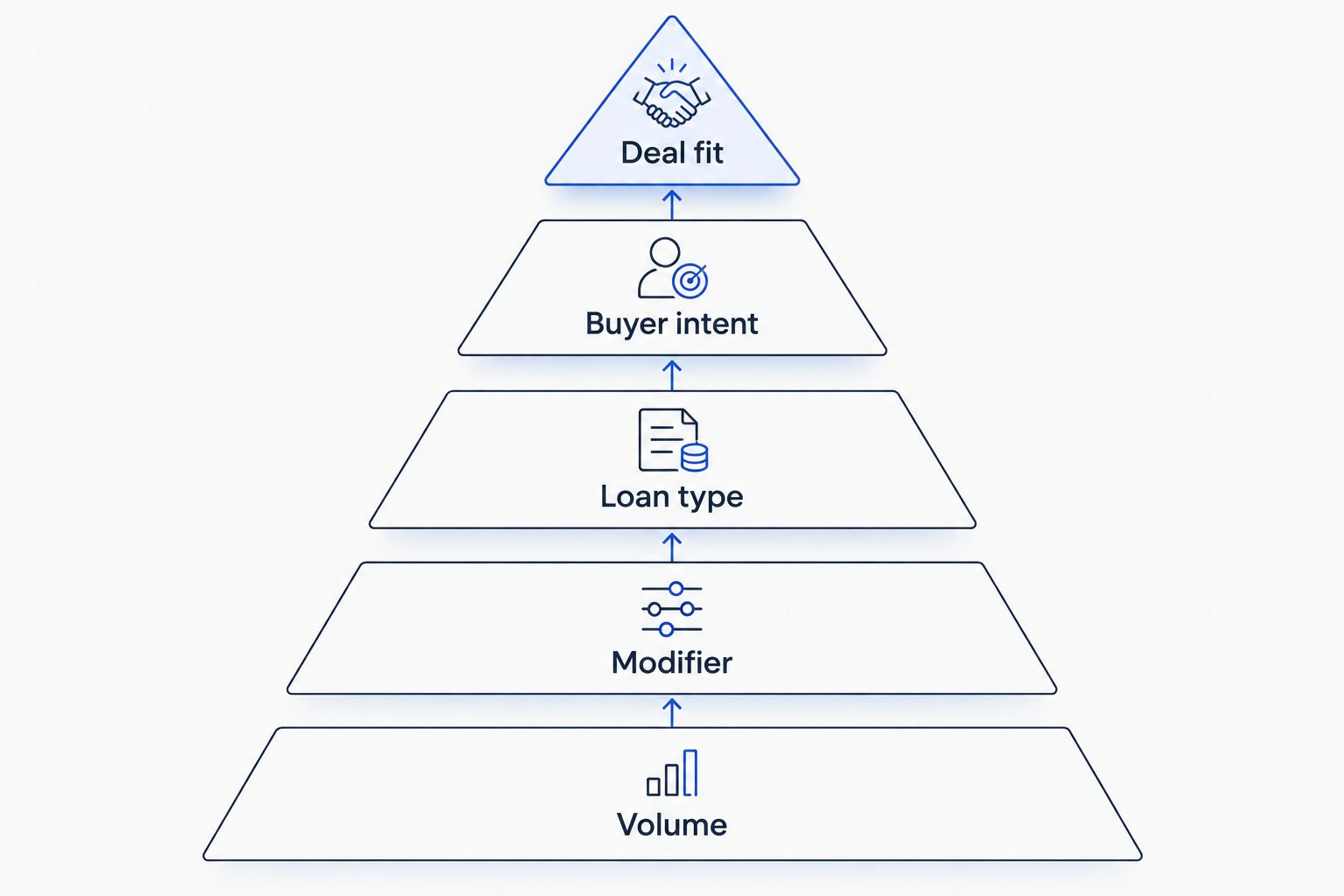
- Rank clusters by buyer intent and deal fit first, raw volume second.
- Re-pull volume figures from one tool each quarter in 2026; monthly numbers move and differ by source.
Why this matters in 2026
A commercial loan keyword with high volume can still be a bad target. A query from a first-time homebuyer and a query from an investor closing a $5M bridge loan can share words and share nothing else.
Finance is a category where the wrong traffic costs you twice: you pay to rank, then you pay staff time to turn away unqualified inquiries. A benchmark that ignores borrower type pushes you toward the wrong pages.
The verdict for 2026: benchmark within a loan type, score by intent, and treat volume as a tiebreaker. A lender with a narrow product, such as 48-hour pre-approvals on bridge loans, wins more from ten well-matched queries than from one broad head term.
The short answer
There is no single average search volume for commercial loan keywords. The number depends on the loan type, the modifier (rates, lenders, requirements, calculator), the geography and the tool. Any page quoting one blended average for the whole category is mixing borrowers who will never convert on the same page.
What holds across tools is the structure. Commercial loan queries fall into six product families and four modifier types. Compare volume only between cells in the same row or the same column of that grid.
The benchmark grid: loan type by search intent
This table is the yardstick. Each row is a loan family; each column describes what the searcher wants and whether the query fits a direct lender. The Overall row is the reference every other row is judged against.
| Loan family | Typical query modifiers | Searcher | Fit for a direct lender |
|---|---|---|---|
| Overall commercial loans | commercial loan, commercial mortgage, business loan | Mixed: owners, investors, students | Low; too broad to qualify |
| Bridge loans | bridge loan lenders, bridge loan rates, short-term CRE loan | Investor with a deal and a deadline | High; speed is the product |
| DSCR loans | DSCR loan requirements, DSCR calculator, no-income investor loan | Rental property investor | High; clear qualification rules |
| Hard money | hard money lenders, fix and flip loan, private money | Flipper, developer | High; deal-based underwriting |
| SBA | SBA 7(a), SBA 504, SBA loan requirements | Small business owner | Medium; many searchers are early research |
| CMBS | CMBS loan, conduit loan, rate lock | Larger CRE borrower | Medium; smaller audience, larger loans |
| Fannie Mae multifamily | Fannie Mae multifamily loan, agency loan | Multifamily owner or sponsor | Medium; specialist audience |
Read the table as a fit ranking, not a volume ranking. The fit column is the part you can defend in a client meeting; a volume column that goes stale in a month is not.
High and low commentary
Bridge, DSCR and hard money terms lead on fit. Their searchers arrive with a property, a timeline and a decision to make, so the query already contains the qualifier. Flex V Capital positions around exactly this profile: direct lending, 48-hour pre-approvals, no referral fees.
Overall commercial loan terms trail on fit. They carry the broadest audience and the weakest signal. SBA terms sit in the middle: a large and varied audience where a good share is still deciding whether they qualify at all.
CMBS and Fannie Mae terms are the smallest audiences in the grid, but each searcher represents a large loan. Low volume on these terms is expected and is not a reason to skip them.
Modifier benchmarks: what each word signals
The second axis of the grid is the modifier. The same loan type behaves differently depending on the word attached to it.
- Lenders / providers / companies. The searcher is comparing options. These pages need a ranked table, honest pros and cons, and a clear best-for label.
- Rates. The searcher wants a number. Rates depend on property, leverage and borrower, so answer with the factors that set the rate rather than a made-up figure.
- Requirements / eligibility. The searcher is qualifying themselves. A checklist converts this query better than a sales page.
- Calculator / how to. The searcher is early. Useful for authority and links, weakest for direct inquiries.
Benchmark each modifier against the same modifier on another loan type. Comparing a lenders query on bridge loans with a calculator query on DSCR loans tells you nothing about demand.
Scoring clusters in 2026
Use a simple three-factor score. Rate each loan family and modifier pair from 1 to 5 on each factor, then sort.
- Deal fit. Does the query match a product you actually fund, in the dollar range you lend? For Flex V Capital that range is $500K to $20M+.
- Intent. Is the searcher ready to submit a deal, or still learning what the loan is?
- Volume. Pulled from one tool, one geography and one date range, noted next to the figure.
Weight deal fit and intent above volume. A cluster scoring 5 and 5 with modest volume beats a cluster scoring 2 and 2 with large volume, every time you measure it by funded loans rather than by sessions.
Methodology and limits
This benchmark is structural. It ranks loan families and modifiers by borrower fit and intent, and it does not publish monthly volume figures for individual keywords. Those numbers change every month and differ between Google Keyword Planner and third-party tools, so a figure printed here would be out of date on arrival.
The named limitation: this grid cannot tell you the absolute size of any one cluster. Pull current volumes yourself, from a single source, and log the tool name, the country and the month beside every number. Mixed sources are the most common reason two benchmark tables disagree.
How to use these benchmarks
- Fund the high-fit rows first. Bridge, DSCR and hard money pages map directly to products with fast decisions. Start with a lenders-compared page and a requirements page for each.
- Build the specialist rows second. CMBS and Fannie Mae multifamily pages will show low volume. Judge them on inquiries per visit, not on traffic.
- Split broad terms off. Do not target the Overall row with a service page. Use it for educational content that links down into the loan-specific pages.
- Re-benchmark quarterly. Refresh volumes every quarter in 2026, same tool, same country, and compare each row to its own previous reading.
Talk to a direct commercial lender
Bridge, DSCR, hard money, SBA, CMBS and Fannie Mae financing.
Pros and cons of benchmarking this way
Pros
- Comparisons stay valid because every number sits in the same loan family.
- The fit and intent scores do not expire when tool volumes shift.
- It points spend at queries that match the loans a lender actually closes.
Cons
- It needs a manual volume pull each quarter; no static table replaces that.
- Fit and intent scores are judgment calls, so two analysts can score a cluster differently.
- Low-volume specialist rows look weak on a traffic chart even when they are the most valuable.
FAQ
What is the average search volume for commercial loan keywords?
There is no reliable single average. Volume varies by loan type, modifier, country and tool, so benchmark each loan family against itself rather than against the whole category.
Which commercial loan keywords have the highest buyer intent?
Bridge loan, DSCR loan and hard money queries with lender or requirements modifiers show the strongest intent. The searcher usually already has a property and a timeline.
Should I target the broad term commercial loan?
Not with a service page. The audience is too mixed. Use it for educational content that links to loan-specific pages.
How often should I refresh commercial loan keyword volume?
Quarterly is enough in 2026 for most lenders. Use the same tool, country and date range each time so the readings compare.
Is low search volume a reason to skip CMBS or Fannie Mae keywords?
No. These audiences are small but each searcher represents a large loan. Judge them on inquiries per visit, not on traffic.
Which tool should I use for commercial loan keyword volume?
Pick one and stay with it. Google Keyword Planner and third-party tools report different figures, and mixing them breaks the comparison.
Do rates keywords work for commercial lenders?
They draw traffic, but rates depend on property, leverage and borrower. Answer with the factors that set the rate and point to a direct inquiry path.
One last thing
The cheapest improvement in most commercial lending keyword plans is deleting rows, not adding them. Remove every cluster that scores below 3 on deal fit, then compare what is left. The list gets shorter, and the volume column stops driving decisions it was never suited to make.