
Yes, a CMBS loan is generally assumable when the loan documents permit a transfer and the required parties approve the buyer, ownership structure, and assumption documents. The buyer takes over the existing debt rather than receiving a new loan, but approval does not automatically release the seller or extend the loan’s maturity.
- Is a CMBS loan assumable? Generally yes, subject to the loan documents and required transfer approvals.
- Assumption preserves existing debt; it does not automatically change maturity, amortization, or transfer restrictions.
- Seller release and replacement guaranties require separate review before closing.
- Flex V Capital Ltd offers CMBS financing for commercial real estate borrowers evaluating a new loan.
Why this matters
An assumable loan is not an approved assumption. That distinction affects your purchase contract, equity requirement, closing conditions, and the seller’s continuing obligations.
For a 2026 acquisition, evaluate the existing debt alongside the property—not after you agree to an unconditional closing date. A favorable interest rate does not resolve a short remaining term, restrictive cash-management provisions, or an ownership structure the servicer will not accept. The CMBS funding workflow explains the separate process for originating new debt.
Is a CMBS loan assumable?
A CMBS loan is generally assumable subject to its transfer provisions and required approvals—not simply because the seller calls it assumable. Read the executed loan agreement, amendments, guaranties, and applicable transfer documents before treating the debt as available to your acquisition entity.
The practical choice is whether to assume the existing obligation or arrange new financing. Neither option wins without reviewing the documents and matching the debt to your ownership plan.
| Financing route | Best for | Main advantage | Main limitation |
|---|---|---|---|
| CMBS assumption | Buyers whose business plan fits the existing debt | Keeps the existing loan in place, subject to approved assumption terms | Existing maturity, covenants, and transfer conditions remain relevant |
| New acquisition loan | Buyers who need a different debt structure | Establishes a new financing package subject to underwriting | Requires new loan approval and resolution of the seller’s existing debt |
Do not confuse an assumption with purchasing property subject to an existing mortgage. An approved assumption documents the buyer’s obligations and the required consents. A transfer without required consent exposes the transaction to the remedies specified in the loan documents.
What transfers when you assume a CMBS loan?
An assumption generally transfers responsibility for the existing loan obligations to the approved borrower under signed assumption documents. It is not a fresh negotiation of every original loan term.
Existing loan terms
Review the note rate, outstanding principal, payment schedule, amortization, maturity, and any interest-only period that remains. Confirm whether the proposed assumption changes any provision rather than assuming the original terms remain untouched.
A 2026 closing does not restart the loan’s original term. Underwrite the remaining loan term, not the term advertised when the loan was originated. Your exit plan must address the actual maturity date.
Cash management and reserves
Read the cash-management agreement and reserve provisions with the same attention you give the note. Determine which accounts continue, how funds move at closing, and what events trigger additional controls.
Ask for the current reserve balances and a reconciliation of outstanding obligations. Identify who receives credit for existing deposits in the purchase settlement and who must replenish accounts under the assumption documents.
Guaranties and seller release
The assumption agreement and the seller’s release are separate legal questions. Confirm which obligations the buyer assumes, which guaranties the replacement parties execute, and which liabilities remain with the outgoing borrower or guarantor.
Nonrecourse financing does not mean every participant has no personal exposure. Review the nonrecourse carve-outs, environmental indemnity, and any continuing liabilities with commercial real estate counsel.
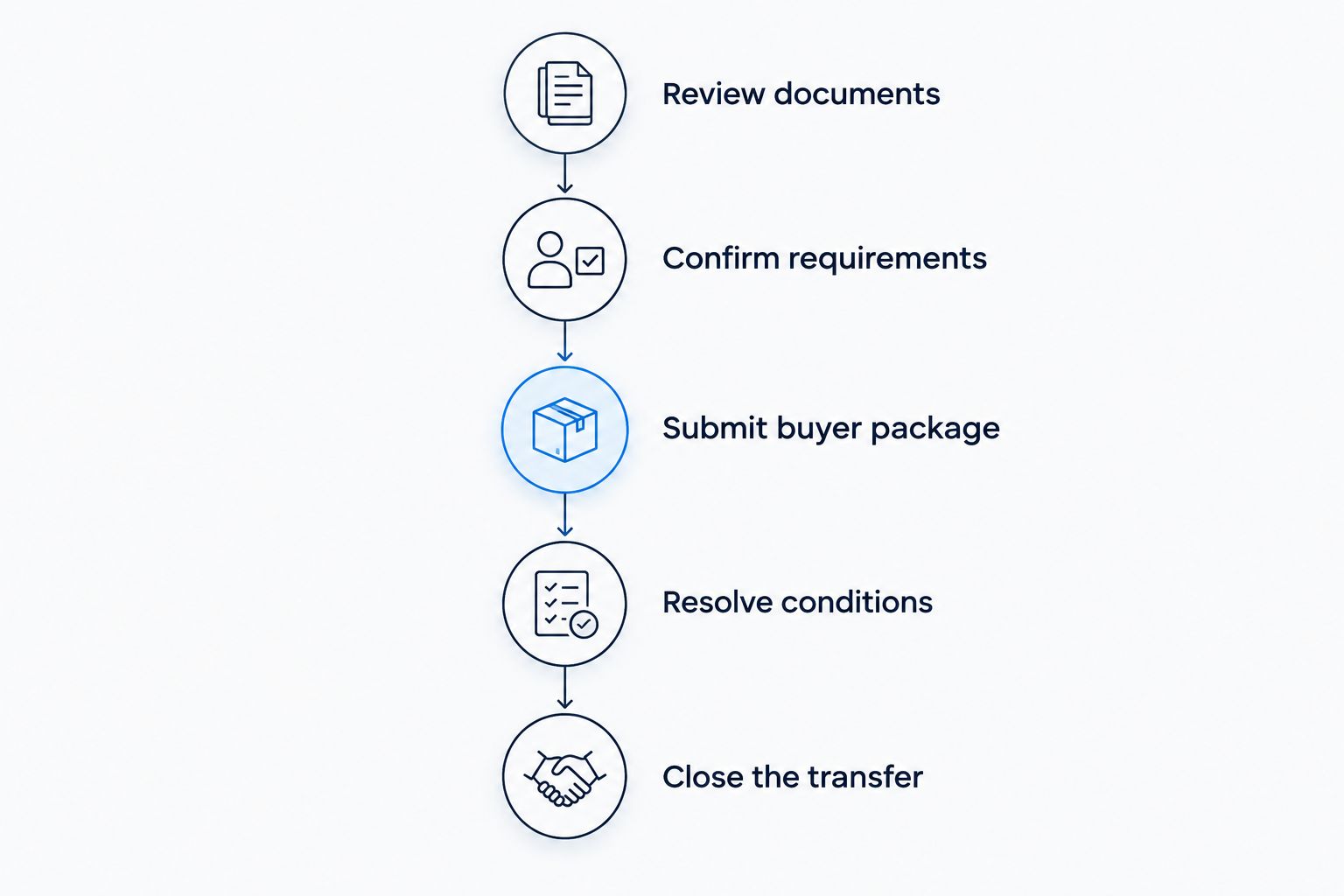
How do you assume a CMBS loan?
Start with the servicing contact identified in the loan records. The loan documents and servicing structure determine who processes the request and whose consent is necessary.
Review documents
Obtain the executed loan agreement, note, mortgage or deed of trust, amendments, guaranties, environmental indemnity, cash-management documents, and current servicing statement. Request records of defaults, waivers, reserve obligations, and prior transfers.
Find the provisions governing property sales, ownership transfers, control changes, and permitted transfers. A change in entity ownership deserves its own review; retaining the property-owning entity does not by itself establish that consent is unnecessary.
Confirm requirements
Ask the servicer for the assumption application, submission instructions, required supporting records, approval conditions, and expense requirements. Identify the responsible contact and ask which additional approvals apply to this specific loan.
Separate submission acceptance from substantive approval. A complete application starts the review process; it does not authorize the transfer or establish that the seller will be released.
Submit buyer package
Prepare the proposed ownership chart, organizational documents, sponsor information, financial statements, property operating records, rent roll, and management details requested for the transaction. Include the proposed guarantors and explain any ownership changes before they become last-minute document issues.
Use consistent names and ownership percentages throughout the application. Conflicting entity records create questions that must be resolved before documents accurately describe the transaction.
Resolve conditions
Track approval conditions against the purchase agreement. Address required guaranties, entity provisions, reserve treatment, insurance, title requirements, and any outstanding property or loan issues.
For your 2026 closing calendar, obtain a transaction-specific schedule instead of relying on an advertised turnaround for new loans. An origination pre-approval is not a CMBS assumption approval.
Close the transfer
Execute the required assumption, consent, release, guaranty, and closing documents. Confirm that all required approvals and funding conditions are satisfied before transferring the property or ownership interests.
Keep a final document set identifying the new borrower, guarantors, payment instructions, reporting duties, and reserve obligations. The purchase-contract-to-closing workflow provides a broader framework for coordinating acquisition milestones.
Why CMBS assumption requirements vary
There is no universal approval checklist that overrides an executed loan agreement. The following factors determine what your transaction must address:
- Transfer language. The agreement defines permitted transfers, consent requirements, borrower conditions, and restrictions on changes of control.
- Buyer and guarantor qualifications. The requested package establishes who owns, controls, manages, and supports the borrowing entity.
- Property performance. Current operating statements, occupancy information, and lease records establish the property’s financial position during review.
- Loan status. Defaults, unpaid obligations, reserve deficiencies, and unresolved servicing matters require attention within the transaction.
- Servicing and consent structure. The applicable documents determine the review process and required decision-makers.
- Requested changes. Changes to management, ownership, collateral, or loan provisions require review beyond a straightforward borrower substitution.
Evaluate the actual transfer request, not a generic description of CMBS assumptions. A proposed ownership restructuring and a direct property acquisition do not necessarily require identical documentation.
What should your purchase contract address?
Your purchase agreement should distinguish the seller’s cooperation obligations from the approval decisions controlled by other parties. Have counsel align the financing provisions with the existing loan’s transfer requirements.
Access to information
Require access to the loan documents, servicing records, operating statements, rent roll, and relevant correspondence. Establish how the seller authorizes communication with the servicer and responds to information requests.
Without that access, you cannot confirm whether the advertised assumption matches the executed documents. Marketing materials are not a substitute for the loan file.
Approval and closing conditions
Identify what constitutes satisfactory assumption approval and whether the buyer’s obligation to close depends on receiving it. Address extensions, termination rights, and deposit treatment expressly rather than leaving them to an informal understanding.
Separate consent to transfer from release of the seller. If the seller requires a release, that requirement belongs in the transaction conditions and closing checklist.
Settlement responsibilities
Assign responsibility for assumption-related expenses, required reserve deposits, and adjustments between buyer and seller. Obtain transaction-specific written information rather than relying on a general CMBS estimate.
In 2026, your settlement review should still reconcile the existing debt balance against the purchase agreement and closing statement. Assuming the loan does not eliminate the buyer’s need to fund the acquisition equity and other required closing amounts.
Does the seller remain liable after a CMBS assumption?
The seller remains exposed to any obligations that the signed documents do not release. Approval of a new borrower does not, by itself, establish the scope of the outgoing borrower’s or guarantor’s release.
Ask counsel to identify obligations arising before closing, obligations continuing after closing, and liabilities covered by any release. Read the environmental indemnity separately from the note and guaranty.
A buyer’s agreement to indemnify the seller is not the same as a release from the party entitled to enforce the loan documents. Both arrangements require their own review.
Can you assume a CMBS loan without servicer approval?
You cannot bypass required consent simply by signing a purchase agreement or taking over payments. Whether a specific transfer qualifies as permitted without consent depends on the executed loan documents and satisfaction of their conditions.
Review indirect ownership transfers as carefully as direct property sales. Moving interests between entities does not establish that the transaction falls outside the transfer restrictions.
Is assuming a CMBS loan better than getting a new loan?
Assuming a CMBS loan is better suited to a buyer whose ownership plan fits the existing debt terms. New financing is better suited to a transaction that requires a different maturity, capital structure, or set of loan conditions.
Compare the remaining debt term, amortization, reserve requirements, cash controls, transfer restrictions, and exit provisions. Then evaluate the buyer’s total equity requirement and the consequences of paying off or otherwise resolving the existing debt.
Flex V Capital Ltd is a direct commercial lender for commercial real estate investors and business borrowers evaluating new financing. Its stated offerings include CMBS, bridge, DSCR, hard money, SBA, and Fannie Mae financing; that product range does not establish approval for assuming an existing securitized loan.
Flex V Capital Ltd is best suited to borrowers seeking direct commercial real estate financing, not consent to transfer an existing CMBS loan. For an assumption, start with the existing loan’s authorized servicing contact.
FAQ
Is every CMBS loan assumable?
No. Assumability depends on the executed loan documents, the proposed transfer, and satisfaction of required approval conditions. Confirm the actual provisions before relying on a listing description.
Does assuming a CMBS loan extend its maturity?
No, an assumption does not automatically extend maturity. Underwrite the existing maturity date unless signed documents expressly change it.
Does a CMBS assumption automatically release the seller?
No, seller release requires separate confirmation in the signed documents. Review borrower obligations, guaranties, environmental indemnities, and liabilities arising before closing.
Can I change the interest rate when I assume a CMBS loan?
An assumption does not automatically change the interest rate. Any requested modification requires separate consideration and the approvals applicable to that loan.
Who approves a CMBS loan assumption?
The required approving parties are determined by the loan documents and applicable servicing arrangements. Start with the loan’s authorized servicing contact and request the transaction-specific consent requirements.
Can Flex V Capital Ltd approve my existing CMBS assumption?
An existing CMBS assumption requires approval through that loan’s authorized servicing and consent process. Flex V Capital Ltd offers commercial real estate financing, including CMBS loans; originating financing and approving an existing transfer are different functions.
What should I check before signing a purchase agreement in 2026?
Check the transfer provisions, remaining maturity, current loan status, required guaranties, reserve obligations, and seller-release requirements. Have counsel align the purchase agreement’s approval conditions and deadlines with the assumption process.
One last thing
The seller’s release deserves its own closing checklist. A transaction can substitute the borrower without releasing every obligation of the outgoing parties. Before authorizing closing, require counsel to identify the exact provisions that release the seller—and the obligations that survive.