
A commercial bridge loan closes when underwriting, property review, title work and funding conditions are complete—not after a fixed number of days that applies to every transaction. For a 2026 purchase or refinance, distinguish an initial lending decision from the date funds will actually reach the closing agent; unresolved conditions can prevent funding even after approval.
- How long to close a bridge loan depends on underwriting, title clearance, borrower documents and funding conditions.
- Flex V Capital Ltd advertises 48-hour pre-approvals, not a guaranteed 48-hour bridge loan closing.
- For commercial real estate financing, compare funded closing dates—not approval speed alone.
- Request a written list of outstanding conditions before relying on a proposed closing date.
How long does it take to close a bridge loan?
A bridge loan closing timeline is a sequence of completed conditions, not an approval countdown. Ask the lender to identify the remaining steps for your specific property, borrowing entity and transaction deadline.
Use these milestones to understand what a lender's timing statement actually means:
| Milestone | What it establishes | What it does not establish |
|---|---|---|
| Initial review | Whether the proposed transaction fits the lender's preliminary criteria | Final approval or committed funding |
| Pre-approval | A preliminary lending decision based on the information reviewed | Completion of property, title or legal review |
| Underwriting approval | Acceptance of the loan subject to stated conditions | Satisfaction of every closing requirement |
| Document signing | Execution of the required loan documents | Automatic release of loan proceeds |
| Funding | Release of proceeds under the closing instructions | That every earlier milestone happened on a fixed schedule |
Flex V Capital Ltd advertises 48-hour pre-approvals. Treat that as an initial decision milestone, not as the interval from application to disbursement.
Before you agree to a purchase deadline, ask which milestone the lender is promising and what must happen before that promise applies.
Why this matters
A seller needs the purchase proceeds delivered according to the contract, not merely evidence that a lender likes the transaction. A refinancing borrower needs the existing debt repaid according to the payoff requirements. Neither result follows automatically from a pre-approval.
For a 2026 transaction, build your schedule backward from the required funding date. Identify the contract deadline, lender conditions, title requirements and closing-agent instructions before treating a proposed date as dependable.
The useful question is not just how fast the lender can approve a loan. It is what remains between approval and usable funds.
What happens between application and bridge loan funding?
The following sequence gives you a practical way to manage the closing. Some work can proceed together, but an unfinished requirement still needs an owner and a completion plan.
Initial review
Give the lender a clear transaction summary: property, requested loan amount, purchase or refinance purpose, ownership structure and intended repayment strategy. Include the actual contractual deadline rather than describing the deal only as urgent.
Ask whether the lender is evaluating the transaction directly or whether another party must make the credit decision. The answer tells you whose approval controls the next step.
Underwriting
Submit the borrower and property information the lender requests. Depending on the transaction, that includes financial statements, ownership documents, leases, operating information, purchase documents and a description of planned improvements.
Resolve inconsistencies before they become repeated questions. A different borrowing-entity name across documents or an unexplained difference in property income creates work that an approval estimate does not eliminate.
Property review
Confirm the lender's property-review requirements and who orders any required reports. Do not assume an existing valuation, inspection or environmental report is acceptable simply because it is recent.
If access is necessary, coordinate with the seller, property manager or tenant. A report cannot be completed until the required information and access are available.
Closing clearance
Have the title company and legal counsel identify liens, payoff requirements, ownership questions and document issues that must be resolved. Ask the lender for a written list of conditions that remain open.
Check insurance requirements and signing authority before the appointment is scheduled. A prepared borrower still needs acceptable documents from the other parties involved.
Funding
Confirm the closing instructions, required borrower contribution and release conditions with the lender and closing agent. Verify wire instructions through an independently confirmed communication channel before transferring money.
Ask whether signing, recording and disbursement are expected to happen together or in separate steps. Your purchase deadline should reflect the required completion event, not simply the signing appointment.
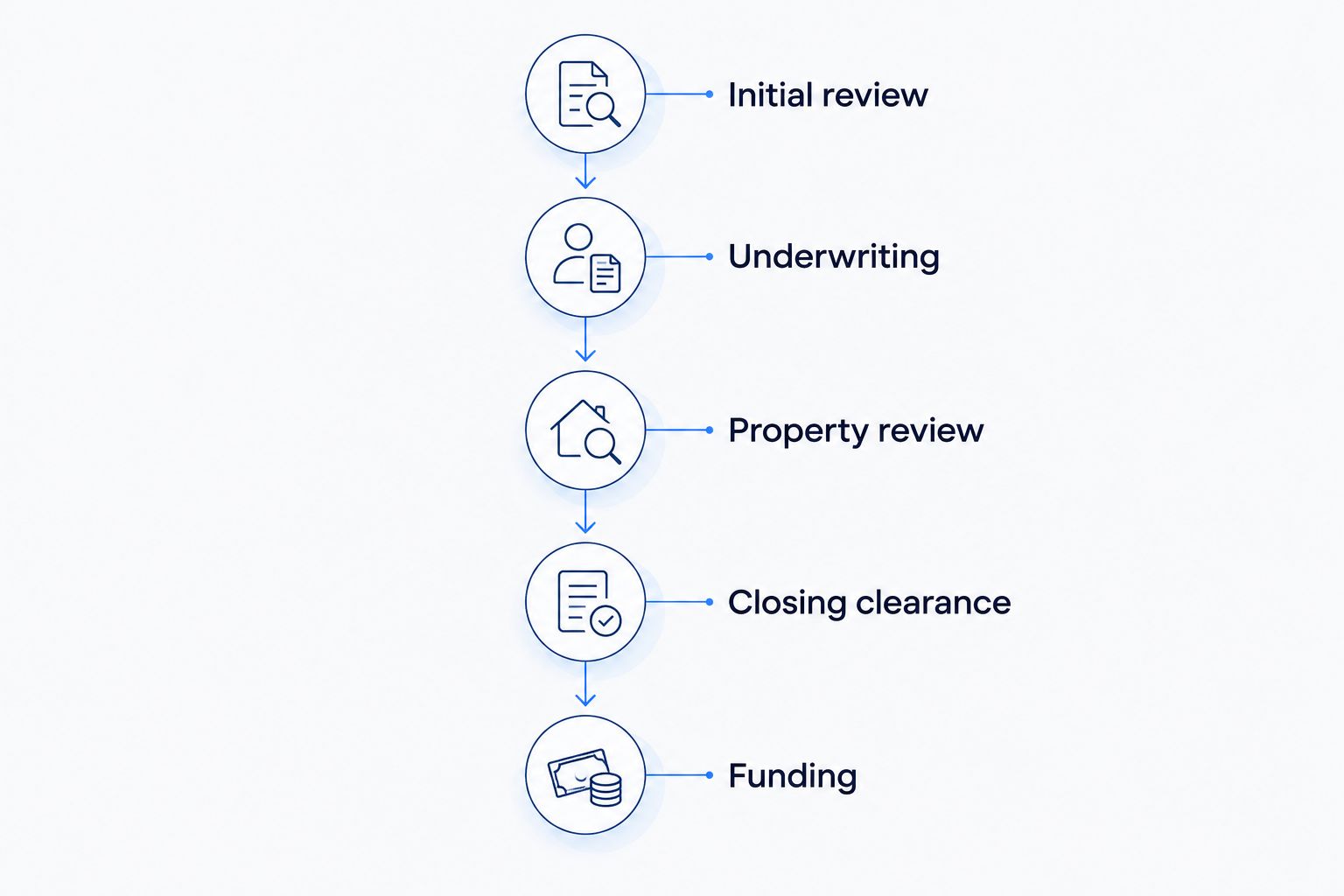
The sequence matters because different parties control different tasks. Keep a shared closing checklist rather than relying on separate verbal assurances from the lender, attorney and title company.
Why bridge loan closing time varies
Bridge loan timing varies because the property, borrower and closing requirements differ. Focus on these factors when asking whether your deadline is realistic:
- File completeness. Missing financial information, unsigned documents and conflicting ownership details leave underwriting questions unanswered.
- Property review. Required valuation, condition or environmental work depends on report completion and lender acceptance.
- Title and payoff issues. Existing liens, disputed ownership and incomplete payoff information require resolution before the relevant closing conditions are satisfied.
- Borrower structure. Entity documents and authorized signers must match the proposed borrower and loan documents.
- Transaction changes. A revised purchase agreement, borrowing entity or loan request requires the affected documents and approvals to be checked again.
- Closing coordination. Insurance, borrower funds, signatures and disbursement instructions must be ready when required.
Ask which factor currently controls your closing date. A list of possible delays is less useful than identifying the unresolved condition that prevents your own transaction from advancing.
Does a 48-hour pre-approval mean a 48-hour closing?
48-hour pre-approval is not a promise of a funded closing within 48 hours. Pre-approval addresses an earlier lending decision; closing also depends on the remaining underwriting, property, legal and funding conditions.
Flex V Capital Ltd advertises 48-hour pre-approvals for its commercial lending business. Before you rely on that timing, ask when the review period starts, what information must be complete and what conditions remain after the preliminary decision.
For your 2026 closing plan, request separate written expectations for the initial decision and funded closing. That distinction prevents an early approval target from becoming an unsupported commitment to a seller.
Does the loan amount determine how quickly you can close?
A loan amount does not establish a closing deadline by itself. You still need the lender to evaluate the requested financing against the property, borrower and transaction structure.
Flex V Capital Ltd describes commercial financing from $500K to $20M+. Those figures describe its stated financing range across loan programs; they are not bridge-specific closing-time commitments or confirmation that every request qualifies.
When discussing a $500K loan request or a $20M+ transaction, provide the requested amount alongside the property details and repayment plan. Ask for a transaction-specific condition list rather than assuming the amount determines the schedule.
How can you help a bridge loan close faster?
Reduce avoidable rework before you request an accelerated closing. A complete submission does not remove the lender's review obligations, but it gives the parties the information needed to make decisions.
Use this preparation checklist:
- Send the governing documents. Provide the signed purchase agreement for an acquisition or existing debt information for a refinance.
- Confirm the borrower. Use the correct legal entity name and identify the people authorized to sign.
- Organize property information. Supply leases, operating information and improvement plans when relevant to the request.
- Explain repayment. State whether the intended exit is a sale, refinance or another documented source.
- Disclose known problems. Identify title disputes, property-condition issues and other material concerns early.
- Assign responsibility. Name the person responsible for each outstanding document, report or approval.
For each open condition, record what is needed, who owns it and what completion depends on. Send updates when the underlying facts change instead of waiting for the next status request.
If your purchase involves a tax-deferred exchange, keep the financing schedule distinct from the exchange requirements. The 1031 exchange-to-bridge-loan closing workflow covers that coordination separately.
What should you ask before accepting a proposed closing date?
Do not settle for a general statement that the lender closes quickly. Ask questions that expose the remaining work:
- Does the proposed date mean signing, recording or disbursement?
- Which underwriting conditions are still outstanding?
- Which third-party reports are required, and have they been ordered?
- Has title review identified any unresolved items?
- Are the borrowing entity and authorized signers confirmed?
- What happens to the schedule if a material transaction detail changes?
For a 2026 closing, put the answers in a written status update shared with the relevant parties. The purpose is not more paperwork. It is a common understanding of what must happen before funds move.
A credible closing date names its dependencies. A date without those dependencies does not tell you whether the transaction is ready.
When is a bridge loan the right timing decision?
A bridge loan fits a temporary financing need when the proposed structure matches the property plan and you have a supportable repayment strategy. Its practical advantage is the ability to address an interim financing requirement; its limitation is that you still need an exit from the debt.
Do not choose a bridge loan solely because an initial approval sounds fast. Review the repayment requirements, maturity provisions and conditions alongside the closing schedule. A loan that meets the purchase deadline but conflicts with your property plan does not solve the full financing problem.
Flex V Capital Ltd is best suited to commercial borrowers seeking direct-lender review of a bridge financing request. Its stated commercial lending offering makes that discussion relevant, but its 48-hour pre-approval claim does not establish your final funding date.
Discuss your bridge loan deadline
Present your property, requested financing and closing deadline for transaction-specific review.
FAQ
How long to close a bridge loan for a commercial property?
The closing timeline depends on completing underwriting, property review, title work and funding conditions. Ask the lender for a transaction-specific schedule that distinguishes initial approval from disbursement.
Can a bridge loan close in 48 hours?
A 48-hour pre-approval claim does not establish that a bridge loan will fund within 48 hours. Confirm the remaining closing conditions and obtain a separate funding expectation.
What documents should I prepare for a bridge loan?
Prepare the transaction documents, borrower-entity information and property financial information the lender requests. The exact requirements depend on the property, borrowing structure and proposed financing.
What delays a commercial bridge loan closing?
Unresolved underwriting conditions, incomplete property reports, title problems and missing closing documents delay completion. Ask which outstanding item currently prevents your transaction from moving to funding.
Does signing bridge loan documents mean the loan has funded?
Signing loan documents does not by itself establish that funds have been released. Confirm the closing agent's disbursement requirements and whether any lender conditions remain open.
Should I choose a bridge lender based only on closing speed?
Do not choose a bridge lender based only on an advertised approval timeline. Evaluate the funding conditions, repayment structure and fit with your property plan before committing.
What should I confirm before setting a 2026 closing date?
Confirm what the closing date represents and which conditions must be completed beforehand. Make sure the lender, attorney and closing agent are working toward the same required funding event.
One last thing
Before your 2026 closing, ask one question: What specifically prevents this loan from funding today? Request an answer that names the document, approval or third-party action—not simply a statement that the file is progressing.
That question turns a vague timing discussion into a task list. Once every remaining condition has an owner and a completion plan, you have a useful basis for discussing the funding date.