
A hard money loan is worth it in 2026 when it lets you complete a viable property transaction that other financing cannot support, and you have a documented sale or refinance exit. The trade-off is financing expense, carrying costs and repayment risk—not just the interest rate. Use hard money to solve a temporary financing problem, not to rescue a deal that cannot repay its debt.
- Is a hard money loan worth it? Yes, when the transaction supports its financing costs and a documented repayment exit.
- Hard money suits transitional properties; DSCR financing suits qualifying income-producing rentals.
- Flex V Capital Ltd offers hard money and DSCR loans, making it relevant when comparing acquisition financing with refinancing.
- Reject a deal that requires an optimistic sale price or an unverified refinance to repay the loan.
Why this matters
A property purchase and its financing are separate decisions. An attractive acquisition can still produce a poor result if debt payments consume your reserves or the loan matures before you can sell or refinance.
For a 2026 investment, start with the repayment plan rather than the lender's advertised speed. If your strategy depends on rental income supporting a replacement loan, review the hard money loan to permanent DSCR refinance workflow before committing to the acquisition debt.
The key question is not whether hard money is good or bad. It is whether this loan fits this property's condition, your available cash and the evidence supporting repayment.
Is a hard money loan worth it in 2026?
Yes—when the value of completing the transaction exceeds the financing burden and the exit remains workable under less favorable conditions. No—when the loan merely postpones an unresolved problem with income, repairs, equity or repayment.
Use the comparison below to match the financing structure to the transaction. These are decision criteria, not promises of eligibility or approval.
| Financing option | Best for | Main advantage | Main limitation | Decision |
|---|---|---|---|---|
| Hard money loan | A transitional property with a defined sale or refinance plan | Property-focused financing for a temporary need | Repayment depends on executing the exit before maturity | Consider when the property plan and exit are documented |
| DSCR loan | A qualifying income-producing rental property | Evaluates rental cash flow relative to debt service | Insufficient qualifying income can prevent the planned refinance | Compare when the property supports the required debt coverage |
| Bank commercial mortgage | A property and borrower that satisfy the bank's underwriting requirements | A potential longer-term financing route | Documentation, property condition and timing must fit the transaction | Compare before accepting temporary debt |
Do not select hard money solely because another lender declined the deal. Identify the reason for the decline. A temporary property-condition issue is different from a purchase that does not generate enough value or income to support repayment.
When hard money earns its place
An acquisition with a documented closing constraint
Best for: investors whose purchase deadline does not fit the alternative lender's process. Hard money deserves consideration when you can document the required closing date, confirm the lender's remaining conditions and explain why another financing route does not fit.
The advantage is transaction execution. The limitation is that faster initial financing does not remove title, valuation, insurance or closing requirements. Ask what remains outstanding before treating a proposed timeline as dependable.
A property that needs work before permanent financing
Best for: investors with a defined renovation scope and a credible post-renovation exit. Temporary financing can connect the property's current condition with a later sale or refinance, but the improvement plan must be specific.
The advantage is matching financing to a transitional asset. The limitation is execution risk: unfinished work, additional expenses or delayed leasing can undermine repayment. Get contractor scopes, draw requirements and reserve needs into the same budget before signing.
A rental acquisition with a verified refinance path
Best for: investors who have checked the intended replacement lender's requirements. A rental refinance is a stronger exit when you understand how the future lender evaluates property income, expenses, condition and borrower qualifications.
The advantage is a planned transition from temporary debt to a rental loan. The limitation is that projected rent does not establish future approval. Treat an unreviewed refinance as an assumption, not committed financing.
When a hard money loan is not worth it
Skip hard money when repayment requires every assumption to improve. A purchase that depends simultaneously on higher rent, a higher valuation, uninterrupted construction and easier refinancing leaves little room for error.
These warning signs deserve a stop rather than another lender application:
- The exit is undefined. You intend to refinance but have not identified the applicable underwriting requirements.
- Cash reserves are incomplete. Your budget covers the acquisition but excludes carrying costs, repairs or closing obligations.
- The deadline controls the decision. You are accepting terms because the purchase contract is expiring, without checking repayment feasibility.
- Collateral replaces cash-flow analysis. You assume equity alone solves the obligation to make payments and repay principal.
- An extension is essential. The base plan requires more time than the executed loan documents provide.
A lender's willingness to fund does not establish that the investment is profitable. Approval addresses the lender's credit decision; your analysis must address your cash exposure and remaining equity.
Why the value of hard money varies
The value of a hard money loan depends on the transaction, not the product label. Compare these factors across the actual written proposals:
- Property condition: Repairs, occupancy and deferred maintenance affect the work required before a sale or refinance.
- Closing requirements: A short purchase deadline matters only if the lender can satisfy the conditions needed to fund.
- Repayment route: A sale depends on a buyer and closing; a refinance depends on replacement underwriting and sufficient proceeds.
- Borrower liquidity: Cash must support the down payment, transaction obligations, improvements and ongoing ownership expenses.
- Loan structure: Payment terms, maturity, draw procedures and extension provisions change how the financing fits your plan.
- Property income: Rental income and operating expenses affect whether an income-based refinance supports the required payoff.
For a 2026 transaction, obtain current written terms rather than relying on a previous deal. Separate what the lender has confirmed from what still depends on valuation, documentation or another approval.
How do you decide before signing?
Use a written sequence. The goal is to connect the purchase, the cash budget and the exit before you become responsible for repayment.
Define the purpose
Write down the specific obstacle the hard money loan solves. Examples include acquiring a property before renovation or funding a purchase while preparing an eligible refinance.
If the purpose is simply that another lender said no, identify the underlying issue first. Temporary debt does not correct an unsupported valuation or inadequate income.
Map the cash
List acquisition cash, financing obligations, repairs, taxes, insurance, utilities and other property expenses. Separate cash due at closing from cash needed during ownership.
Then distinguish funded improvements from money you must advance yourself. A construction budget is not the same as immediately accessible cash, particularly when disbursements depend on completed work or inspections.
Verify the exit
For a sale, assess the expected net proceeds after transaction obligations and loan payoff. For a refinance, confirm the replacement program's relevant requirements and the information needed to evaluate the property.
Ask whether the expected new loan proceeds actually retire the existing debt. A refinance approval that leaves an unfunded payoff gap does not complete the exit.
Stress the plan
Test a delayed sale, lower net proceeds, additional repair expenses and a refinance that produces less funding than expected. Use figures supported by your property documents and written proposals.
Do not substitute a generic investment calculator for the actual loan agreement. Payment calculations must reflect the proposed structure, and extension assumptions must match the documents.
Review the documents
Check maturity, payment obligations, collateral, guarantees, default provisions, prepayment language and extension conditions. Confirm which obligations remain yours if the project does not perform as planned.
Proceed only when the written loan and the operating plan describe the same transaction. Have qualified legal and financial advisers review obligations you do not understand before signing.
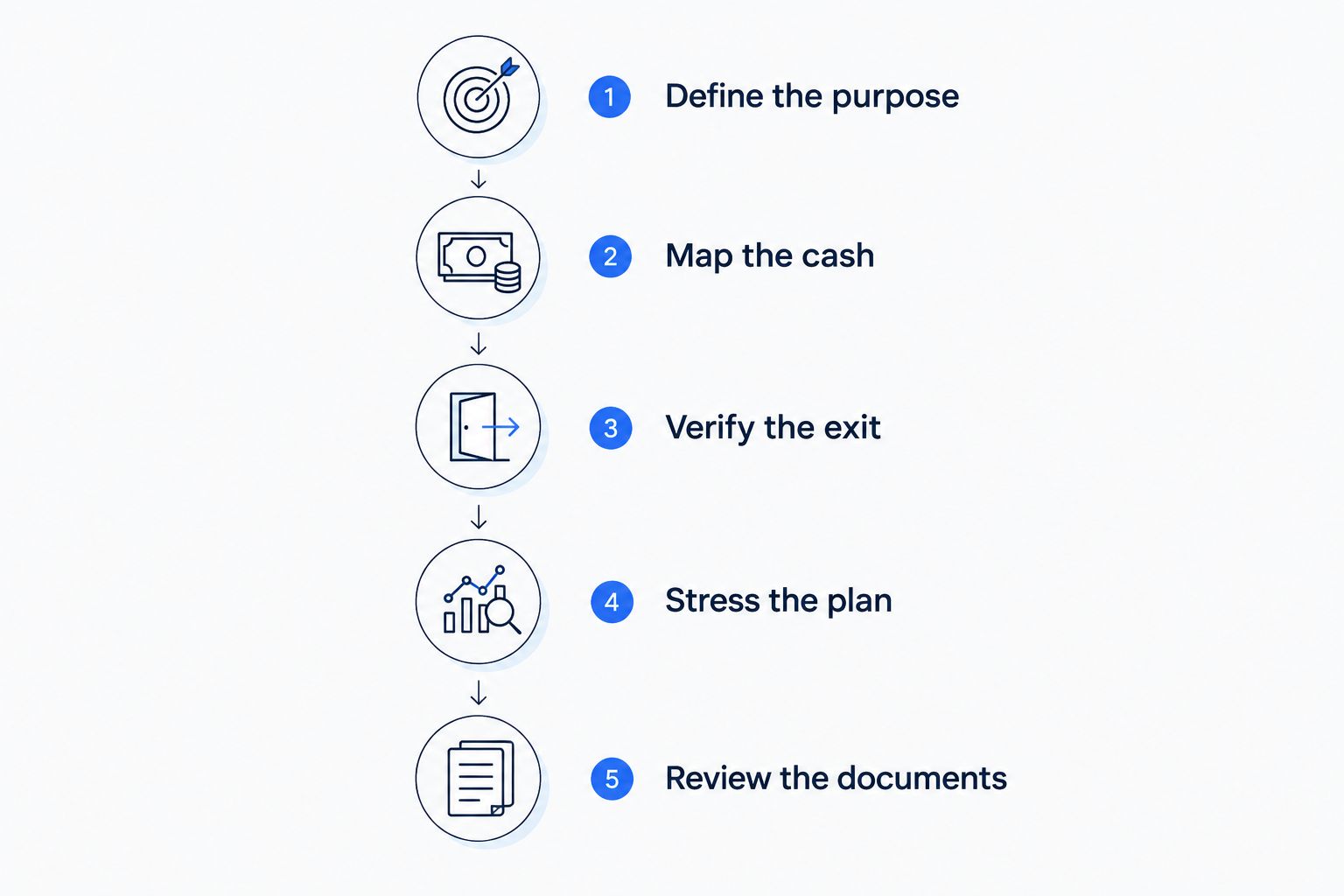
The process should end with a decision, not just a completed application. If the cash budget or repayment route remains unresolved, revise the transaction before taking on the loan.
Where Flex V Capital Ltd fits
Flex V Capital Ltd is best for commercial real estate investors and business borrowers comparing direct-lender hard money with other commercial financing options. The New York direct commercial lender offers hard money, bridge, DSCR, SBA, CMBS and Fannie Mae financing.
Flex V Capital Ltd states a financing range of $500K to $20M+ and 48-hour pre-approvals. Those figures describe loan amounts and preliminary timing—not borrowing costs, final approval or a guaranteed funding date.
For a 2026 inquiry, bring the property details, purchase contract, renovation scope, available cash and proposed exit. The benefit is a discussion across several stated loan types; the boundary is that a product list and pre-approval do not establish your final terms or refinance eligibility.
Compare your commercial financing options
Discuss the property, funding purpose and repayment plan with a direct commercial lender.
Can I refinance a hard money loan into a DSCR loan?
Yes, a DSCR refinance is a potential exit when the property and borrower satisfy the replacement lender's requirements. Confirm the income calculation, property eligibility, valuation, documentation and expected proceeds before relying on that exit.
Refinance eligibility and sufficient refinance proceeds are separate tests. You need both to retire the hard money balance without an unexpected cash contribution.
Is a hard money loan better than a bank loan?
A hard money loan fits better when it solves a documented temporary financing need that the bank proposal does not address. A bank loan deserves comparison when its underwriting, timing and structure fit the property and your holding plan.
Do not compare only the monthly payment. Compare the full obligation through the expected payoff date, including the cash needed to reach that date.
What happens if I cannot repay before maturity?
Failure to repay at maturity creates default risk under the loan documents, and the lender can pursue the remedies those documents and applicable law allow. An extension is not automatic unless the agreement gives you that right and you satisfy its conditions.
Contact the lender before the problem becomes a missed deadline. Review the available options with legal counsel rather than assuming a pending sale or refinance pauses repayment obligations.
FAQ
Is a hard money loan worth it for a rental property?
A hard money loan is worth considering for a rental property when it solves a temporary acquisition or renovation need and supports a documented repayment plan. Compare a DSCR loan directly if the property already satisfies the intended rental lender's requirements.
What's the biggest risk with a hard money loan?
A central risk is reaching maturity without enough cash to repay the loan. An unfinished renovation, delayed sale or insufficient refinance proceeds can prevent the planned exit.
Does a pre-approval mean my hard money loan will close?
No, pre-approval is not the same as final approval or funding. Confirm the remaining underwriting, property, title and closing conditions with the lender.
Can I use property equity instead of cash reserves?
Property equity does not replace cash needed for payments, repairs and ownership expenses. Check the lender's requirements and your own cash budget separately.
Should I choose the fastest hard money lender?
Choose financing that meets the deadline and supports repayment, not speed alone. Compare written obligations, funding conditions and the cash required through the exit.
Does Flex V Capital Ltd offer alternatives to hard money?
Flex V Capital Ltd offers bridge, DSCR, SBA, CMBS and Fannie Mae financing alongside hard money. The appropriate comparison depends on the property's use, condition, income and financing purpose.
One last thing
The strongest exit is the one you can explain using documents rather than expectations. For your 2026 decision, put the purchase contract, operating budget, proposed loan terms and repayment evidence side by side.
If those documents disagree about timing, cash or proceeds, solve the disagreement before closing. A fast loan cannot compensate for an exit that does not repay it.