
A DSCR loan’s cost in 2026 includes interest, lender charges, and transaction expenses; the amount depends on the property, loan structure, and written offer. Your cash requirement also includes equity and any required reserves, which are separate from the fees you pay to obtain financing.
- DSCR loan cost 2026 comparisons must include interest, closing charges, reserves, and prepayment terms—not just the quoted rate.
- Flexvcapital offers DSCR financing as a direct commercial lender in New York; compare the written terms against your investment plan.
- Separate money spent on fees from equity and reserves when calculating cash to close.
- Compare loan offers using the same loan amount, payment structure, and expected ownership period.
How much does a DSCR loan cost in 2026?
The cost is the combination of financing charges at closing, interest during ownership, and any charges triggered when you repay. A rate quote alone does not answer the question. Request an itemized proposal that separates these expenses from the cash you must contribute or retain.
Flexvcapital provides DSCR loans as a direct commercial lender in New York. For investors seeking that lending relationship, the next step is a property-specific proposal—not a generic rate estimate.
| Component | What it covers | What to verify |
|---|---|---|
| Interest | The charge for using borrowed funds | Rate, calculation method, payment schedule, and adjustment terms |
| Lender charges | Origination, underwriting, processing, or other charges listed in the offer | Each charge, who receives it, and when it becomes payable |
| Property review | Appraisal and other required property reports | Required reports, payment timing, and refund terms |
| Closing expenses | Title, settlement, recording, legal, and other applicable transaction charges | Which expenses belong to the purchase and which relate to financing |
| Prepaid amounts | Items collected in advance, such as interest or insurance | The period covered and whether later collections continue |
| Required reserves | Funds the lender requires you to retain or deposit | Amount, permitted account, access restrictions, and release conditions |
| Repayment charges | Charges triggered by an early payoff or another contractual event | Trigger, calculation, expiration, and exceptions |
Not every loan includes every item. Use the written proposal to identify what applies, rather than treating this checklist as a mandatory fee schedule.
Why this matters
The lowest stated rate does not necessarily produce the lowest cost over your ownership period. An offer with higher upfront charges or restrictive repayment terms requires a different comparison from an offer without those features.
Cash to close answers another question: how much money must you have available to complete the transaction? Mixing that figure with financing expense makes both your budget and your lender comparison less useful.
Build separate totals for transaction expenses, invested equity, and retained liquidity. Keep them separate through closing so that a reserve requirement does not become mislabeled as a fee.
Separate closing costs from cash to close
Your closing statement can contain money that serves very different purposes. Read each line according to what happens to the money, not simply whether it appears in the total due.
Closing expenses are money paid for the transaction
Lender charges and applicable third-party expenses pay for financing or closing services. Ask which charges are due before approval, which are due at closing, and which remain payable if the transaction stops.
An appraisal charge, for example, is not the same as an origination charge. Identify the recipient and refund conditions before authorizing either expense.
Equity is capital invested in the property
Your down payment contributes equity rather than paying a lender fee. It still affects your cash requirement and investment return, so include it in your acquisition budget without labeling it a financing expense.
For a refinance, review the sources-and-uses statement instead of assuming that no new cash is required. The existing payoff, transaction charges, and approved proceeds determine the funding gap or cash distribution.
Reserves are liquidity requirements
Required reserves are not automatically money spent. Their treatment depends on whether the lender requires proof of accessible funds, a deposit into a controlled account, or another arrangement.
Ask whether reserve funds remain accessible, earn interest, or require lender approval for release. A reserve requirement affects usable liquidity even when it is not a fee.
Why DSCR loan costs vary in 2026
DSCR financing evaluates rental income against debt obligations, but coverage is not the only input in a loan offer. Review these factors before comparing proposals:
- Loan-to-value ratio: The requested debt relative to the lender’s accepted property value affects leverage and the equity required.
- Debt-service coverage: The lender’s accepted income and payment calculation affect whether the property supports the requested financing.
- Property and rental use: Property type, condition, occupancy, and rental strategy affect eligibility and required documentation.
- Borrower profile: Credit, liquidity, ownership structure, and experience are underwriting considerations; ask which requirements apply.
- Payment structure: Fixed or adjustable interest and interest-only or amortizing payments create different payment and balance outcomes.
- Repayment terms: Prepayment provisions and maturity determine how the financing fits a planned sale or refinance.
Request a revised proposal when a material assumption changes. A quote based on a different loan amount, property use, or payment structure is not a like-for-like comparison.
Fixed versus adjustable interest: compare payment risk
A fixed rate and an adjustable rate solve different planning problems. Neither is automatically the cheaper choice across every ownership period, and the initial payment alone cannot settle the comparison.
| Structure | Best for | Advantage | Limitation | What to inspect |
|---|---|---|---|---|
| Fixed interest | Investors prioritizing a predictable interest rate during the fixed period | Removes rate adjustments during that period | Does not eliminate changes in taxes, insurance, or other property expenses | Fixed period, maturity, and repayment provisions |
| Adjustable interest | Investors able to budget for rate changes | Provides a contractual method for future rate adjustments | Future interest payments depend on the adjustment terms | Index, margin, adjustment dates, floors, and caps |
For an adjustable offer, ask the lender to explain the adjustment formula in writing. Identify what limits rate changes and whether the quoted payment reflects only the initial period.
For a fixed offer, confirm how long the rate remains fixed and when the loan matures. Do not assume that the fixed-rate period, amortization period, and loan term are identical.
Interest-only versus amortizing payments: compare the balance
Interest-only payments and amortizing payments differ in what happens to principal. A smaller scheduled payment is not proof of a lower total financing cost.
| Payment structure | Best for | Advantage | Limitation |
|---|---|---|---|
| Interest-only | Investors whose plan requires payment flexibility and a defined repayment strategy | Scheduled payments exclude principal during the interest-only period | The scheduled principal balance does not decline during that period |
| Amortizing | Investors prioritizing scheduled principal reduction | Each scheduled payment includes principal reduction under the amortization schedule | Payments include principal as well as interest |
Principal repayment is a cash outflow, but it is not interest expense. When comparing structures, track both the money paid during ownership and the balance remaining at the expected exit.
Ask what happens when an interest-only period ends. Your analysis should use the subsequent payment terms if your planned ownership extends beyond that date.
How do you compare DSCR loan offers in 2026?
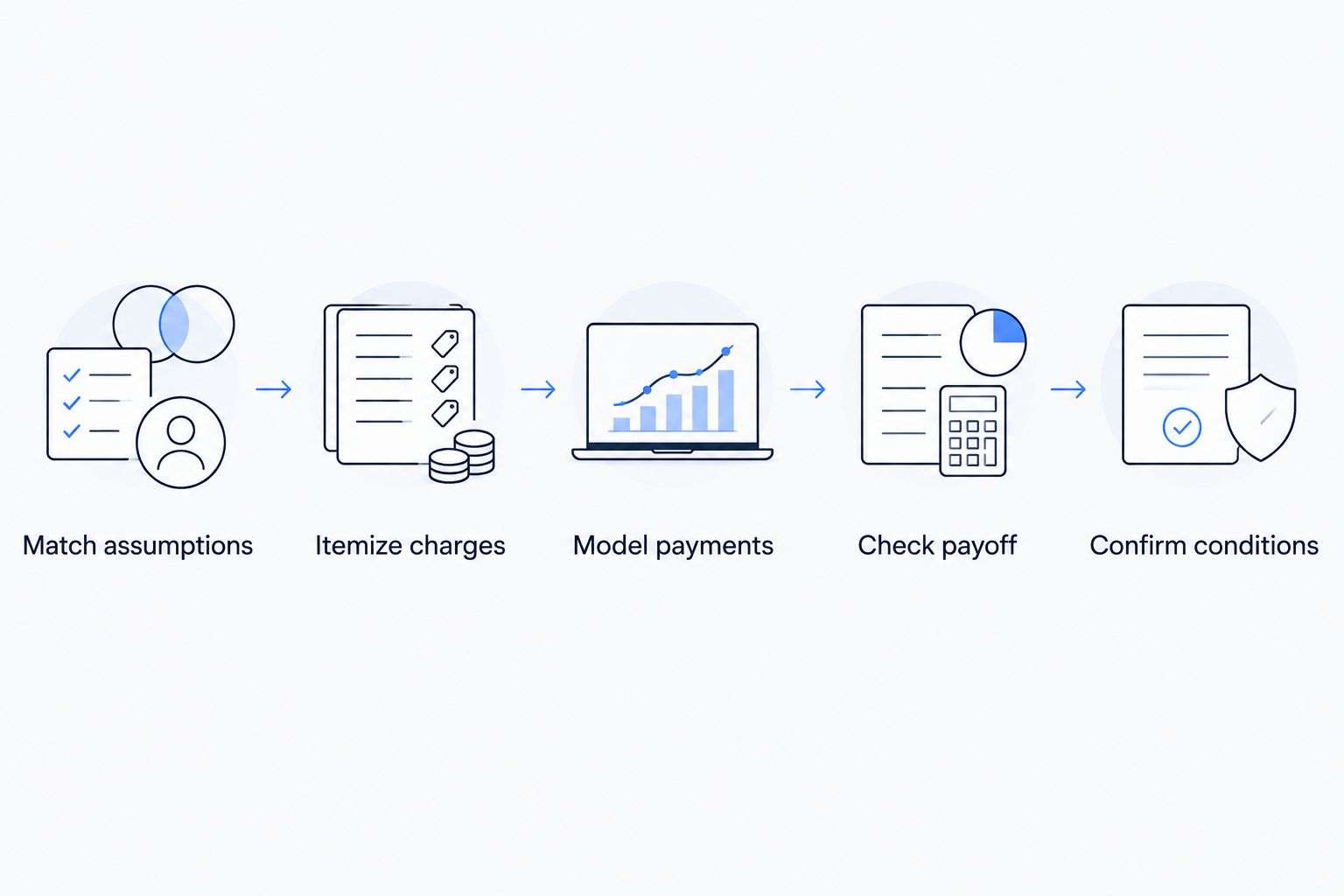
Use the same property assumptions and expected payoff date for each proposal. Then follow this sequence before selecting a lender.
- Match assumptions. Confirm the loan amount, property value, rental income, occupancy, and transaction purpose used in each offer.
- Itemize charges. Separate lender charges, third-party expenses, prepaid amounts, equity, and reserves. Identify estimates that remain subject to confirmation.
- Model payments. Obtain the payment schedule, adjustment provisions, and any transition from interest-only to principal-and-interest payments.
- Check payoff. Request the outstanding balance and applicable repayment charges at your intended sale or refinance date.
- Confirm conditions. Identify what remains outstanding before the lender can approve, document, and fund the loan.
The sequence keeps a low initial payment from hiding a different loan balance or exit obligation. It also exposes proposals that rely on different underwriting assumptions.
If you are replacing short-term financing, include the existing loan’s payoff requirements in this analysis. The hard money loan to permanent DSCR refinance workflow addresses that transition.
How does DSCR affect what you can borrow?
DSCR measures the income available to cover debt service using the lender’s calculation. At 1.00x coverage, accepted income equals the debt service used in that calculation; that is mathematical break-even, not a universal approval standard.
Ask the lender to show the numerator and denominator. For commercial property underwriting, a calculation based on net operating income differs from a rental-loan calculation using rent against specified housing expenses.
Use matching periods when checking the math: annual income should be compared with annual obligations covering 12 months. At 1.00x, those obligations consume 100% of the accepted income in that calculation, leaving no coverage cushion within that measure.
Do not substitute an advertised minimum for the actual underwriting worksheet. The treatment of vacancy, operating expenses, rental history, and payment components determines whether your calculation matches the lender’s.
Does a lower rate always mean a cheaper DSCR loan?
A lower rate does not establish a lower total cost. Compare interest, lender charges, and applicable repayment charges over the same period, then review principal reduction separately.
A proposal with a lower rate but larger upfront charges requires a holding-period comparison. Ask how the result changes if you sell earlier than planned or keep the property longer.
Keep property expenses consistent across the analysis. Taxes and insurance affect investment cash flow, but changing those assumptions between offers obscures the financing comparison.
What should you ask before paying for an appraisal?
Confirm the property’s preliminary eligibility, the proposed leverage, the required coverage calculation, and the outstanding underwriting conditions. Then ask who orders the appraisal, who pays, and what happens if the value does not support the requested loan.
An appraisal is not a loan approval. Before authorizing the expense, distinguish preliminary terms from a commitment and identify every unresolved condition that affects funding.
FAQ
How much does a DSCR loan cost in 2026?
A DSCR loan’s 2026 cost consists of interest, lender charges, applicable transaction expenses, and any repayment charges. Obtain an itemized written offer and keep equity and required reserves separate from financing expenses.
What fees should I ask a DSCR lender to disclose?
Ask for every lender charge, required third-party expense, prepaid amount, and contractual repayment charge. Confirm who receives each payment, when it becomes due, and whether it is refundable.
Are reserves part of DSCR loan closing costs?
Required reserves are not automatically a closing expense; they are a liquidity requirement whose treatment depends on the loan terms. Confirm whether you retain access to the funds or must deposit them into a restricted account.
Is an interest-only DSCR loan cheaper than an amortizing loan?
An interest-only payment does not by itself establish a cheaper loan. Compare interest and fees over the same ownership period, then account separately for the principal balance remaining at payoff.
Can a prepayment charge affect my refinance?
A prepayment charge affects your refinance when the planned payoff triggers the contractual provision. Check the calculation, expiration, and exceptions before choosing an expected refinance date.
Does a DSCR of 1.00x guarantee approval?
A DSCR of 1.00x means accepted income equals the debt service in the calculation, not that approval is guaranteed. Eligibility also depends on the lender’s coverage requirements and other underwriting conditions.
Does Flexvcapital offer DSCR loans?
Flexvcapital offers DSCR loans as a direct commercial lender in New York. Request a property-specific proposal to establish the applicable financing terms and requirements.
One last thing
Flexvcapital is best for commercial real estate investors seeking DSCR financing from a direct commercial lender in New York. Evaluate the actual offer against your property and exit plan rather than treating the lender category as proof of fit.
Before accepting a 2026 proposal, ask for a written payoff illustration at your intended exit date. That single request brings the remaining balance, accrued interest, and applicable repayment charges into the same decision.