
CMBS loan fees have no universal total: your cost depends on the lender’s charges, property due diligence, legal work, servicing provisions, and exit terms. Origination is only part of the bill; reserves and escrows also affect cash required at closing, while defeasance or other prepayment obligations can affect the cost of leaving the loan. For a 2026 transaction, compare an itemized closing budget and the contractual exit provisions—not the origination charge alone.
- CMBS loan fees require an itemized budget covering closing, servicing, and exit obligations.
- Separate earned fees from deposits, reserves, and escrows before comparing commercial mortgage quotes.
- Defeasance is an exit mechanism, not a fixed administrative fee.
- Flex V Capital Ltd offers CMBS financing for commercial real estate investors; compare written terms before committing.
Why this matters
A loan quote can look attractive while leaving important cash requirements outside the headline terms. Compare both the cost of borrowing and the cash you must contribute. Those are different calculations.
Your rate-lock-to-CMBS-funding workflow should identify when deposits become payable, when third-party work is ordered, and which charges survive a canceled transaction. For a 2026 closing, put those obligations on the same schedule as your purchase deadline and equity contribution.
How much do CMBS loans cost in fees?
The payable amount comes from your transaction’s written fee schedule, third-party estimates, closing statement, and loan documents. A useful breakdown separates charges earned by service providers from money held for future property obligations.
| Cost category | What you are paying for | What to verify |
|---|---|---|
| Origination or lender charges | Arranging and underwriting the loan | Calculation basis, payment timing, and credits |
| Appraisal and property reports | Valuation, environmental review, and property-condition work | Scope, ordering authority, and cancellation treatment |
| Legal and documentation | Loan documents, borrower counsel, and required legal opinions | Separate counsel charges, scope, and approval of additional work |
| Title, survey, and recording | Title coverage, survey work, and recording the security instrument | Local requirements and responsibility for each charge |
| Deposits, reserves, and escrows | Funds held for expenses or property obligations | Ownership, release conditions, and replenishment requirements |
| Servicing and consent charges | Administration of requests during the loan term | Triggering events and third-party expenses |
| Exit obligations | Contractual prepayment or defeasance requirements | Permitted dates, calculation method, and execution expenses |
Do not treat every dollar collected at closing as a fee. A charge paid to counsel is an expense; a reserve held for future repairs is restricted cash. Both affect liquidity, but they serve different purposes.
Ask for a written reconciliation between the initial estimate and the final closing statement. Every changed line should identify the reason, recipient, and treatment of any deposit already paid.
Upfront fees: distinguish lender charges from transaction expenses
Lender charges and third-party expenses belong on separate lines. Otherwise, you cannot tell whether a revised budget reflects a different lender charge, additional legal work, or a newly identified property issue.
Request a schedule that names the recipient of each payment. Labels such as processing or administration are not enough without an explanation of the work covered.
Your upfront review should answer these questions:
- Is the charge fixed, calculated against the loan amount, or based on actual expenses?
- When does the payment become due?
- Is an advance deposit credited against the final bill?
- Who authorizes additional third-party work?
- What remains payable if the loan does not close?
Borrower counsel and lender counsel perform different roles. Do not assume a legal estimate includes both, or that a documentation charge covers every required opinion, entity revision, and negotiated amendment.
Negotiate scope and approval rights as well as the charge itself. A clearly defined estimate is more useful than an unexplained allowance that changes near closing.
Deposits and reserves: cash requirements, not interchangeable fees
An application or expense deposit can fund work ordered before closing. The governing agreement determines whether unused funds are returned, applied to another charge, or retained under specified conditions.
Reserves address different obligations. Depending on the documents, these can include repairs, replacement items, taxes, insurance, or tenant-related expenditures. A reserve balance is not automatically available for general operations.
Read the release conditions before treating reserve funds as accessible cash. Requirements can include completed work, invoices, inspections, evidence of payment, or confirmation that the loan remains in compliance.
For your 2026 cash-to-close calculation, keep these categories distinct:
- Earned expenses: payments for completed services.
- Deposits: advance funds subject to contractual application and refund terms.
- Restricted balances: reserves and escrows held for specified purposes.
- Borrower equity: your contribution to the acquisition or refinance.
Combining them into a single closing-cost figure hides the difference between money spent and money restricted. That distinction matters when you plan post-closing operating liquidity.
Servicing charges: review the events that trigger them
The closing statement does not describe every expense you can incur during the loan term. Servicing provisions govern later requests, approvals, and administration.
Depending on your documents, charges and expense reimbursement can accompany an ownership transfer, loan assumption, collateral release, document modification, or another consent request. Identify the approval process before relying on a future transaction.
A request can involve more than an administrative charge. Legal review, reports, and other third-party work can create separate obligations, even where the requested action is ultimately denied.
Ask counsel to distinguish ordinary servicing provisions from provisions that apply after a transfer to special servicing. Do not assume the same process or expense treatment applies throughout the loan’s life.
Read the consent provisions against your actual business plan. If you expect to change ownership interests, restructure the borrower, or sell the property subject to the debt, those provisions deserve attention before closing.
Exit obligations: defeasance is not a flat fee
Defeasance generally involves substituting qualifying securities for the property collateral under the loan documents. It is not simply a penalty added to the outstanding balance, and it does not necessarily mean the note is paid off at that moment.
The required securities, transaction structure, professional work, and contractual conditions determine the execution requirements. The documents also establish whether defeasance is permitted and when it becomes available.
Yield maintenance is different: it is a contractual prepayment calculation. Do not use the terms yield maintenance, defeasance, and prepayment penalty interchangeably when requesting an exit estimate.
For a contemplated 2026 sale or refinance, obtain a transaction-specific estimate for the intended date. Review these items together:
- Whether the proposed exit is permitted.
- Whether a lockout still applies.
- Which contractual mechanism governs the exit.
- Which professional and administrative expenses apply.
- Whether an assumption is available instead, subject to approval.
An attractive closing budget does not establish an attractive exit. Evaluate both before selecting the loan.
Why CMBS loan fees vary
The transaction’s structure and required work determine the budget. These factors explain differences without relying on an unsupported market average:
- Property condition: identified repairs and further investigation change report scope, reserve requirements, and legal review.
- Property type: leases, operating arrangements, and collateral characteristics affect underwriting and documentation.
- Borrower structure: entity organization, ownership layers, and required opinions affect counsel’s work.
- Jurisdiction: recording requirements, applicable taxes, and title practices affect closing obligations.
- Execution changes: revised loan terms, changed collateral, or additional negotiations can require repeated work.
- Exit structure: lockouts, defeasance provisions, and other prepayment terms determine later obligations.
A larger loan amount does not tell you every expense. Some charges follow a contractual calculation; others reflect the work required regardless of the principal balance.
Ask each lender to explain which assumptions underpin its estimate. Comparisons break down when one quote includes work that another leaves outside the stated budget.
How do you compare CMBS fee quotes fairly?
Use a consistent transaction description and the same anticipated closing date. A quote based on different collateral, borrower ownership, or required reserves is not a like-for-like comparison.
Follow this sequence:
- Define the transaction. State the property, requested financing, borrower structure, and intended holding period.
- Itemize charges. Separate lender charges, third-party work, legal expenses, and government charges.
- Separate restricted cash. Show deposits, reserves, and escrows outside earned fees.
- Review triggers. Identify cancellation obligations, servicing events, and exit restrictions.
- Reconcile closing. Match the final statement to the estimate and document every material change.
A 2026 comparison worksheet should also record who receives each payment and whether it remains due if the transaction stops. Keep conditional expenses visible rather than treating them as zero.
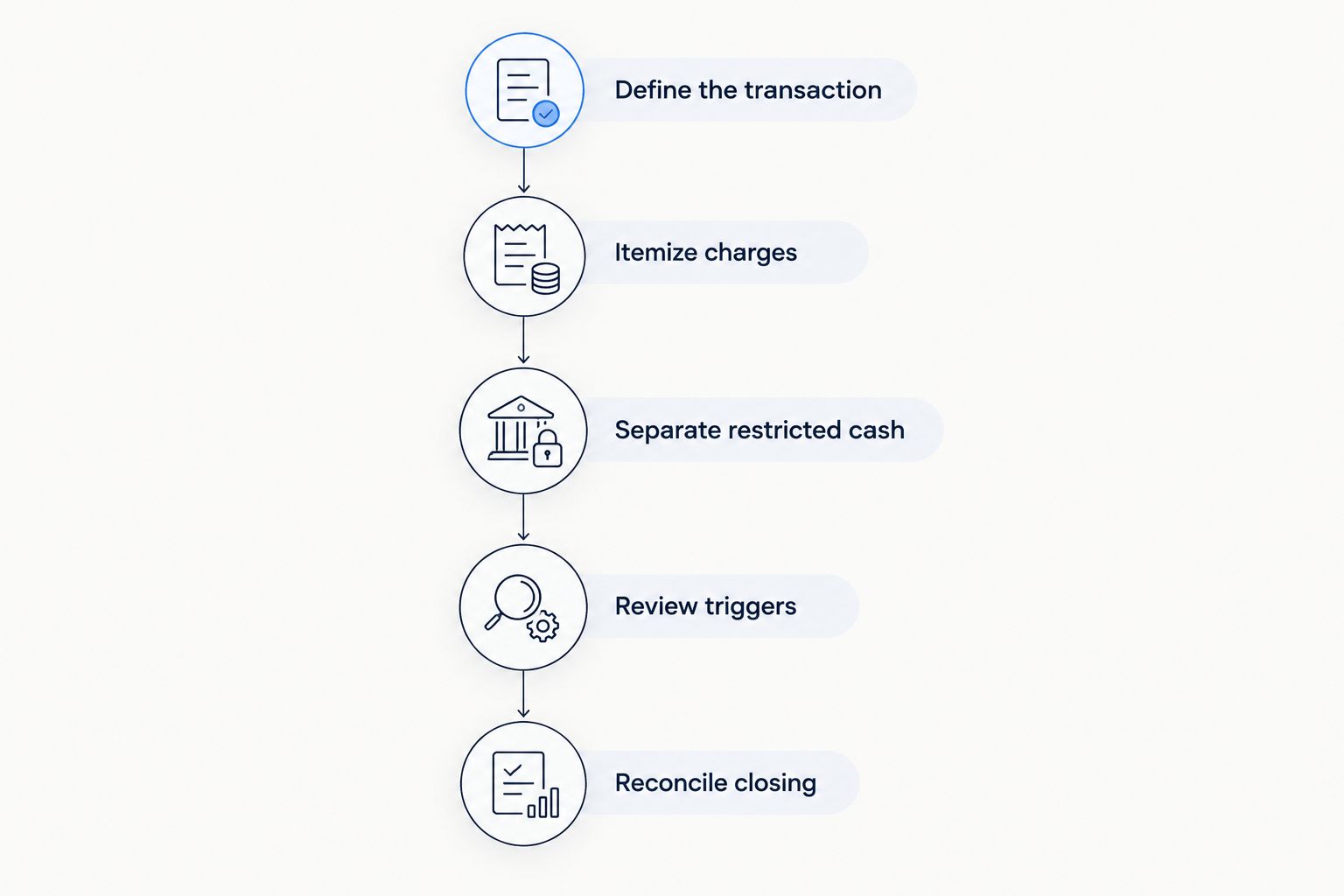
The worksheet is a decision tool, not a replacement for the documents. If a summary conflicts with the executed agreement, the agreement needs legal review before you rely on the summary.
Does a direct lender eliminate CMBS fees?
A direct lender does not eliminate appraisal, legal, title, servicing, or contractual exit obligations. Direct lending describes the financing relationship, not an exemption from transaction expenses.
Flex V Capital Ltd is a direct-lending option for commercial real estate investors seeking CMBS financing. Its stated financing range is $500K to $20M+, and its stated pre-approval turnaround is 48 hours; neither establishes a transaction’s final fee budget or closing date.
Flex V Capital Ltd also lists bridge, DSCR, hard money, SBA, and Fannie Mae financing. For a CMBS request, ask for the written expense schedule and reserve requirements; the benefit of a direct-lender relationship does not remove the need to examine servicing and exit restrictions.
Request a CMBS financing review
Discuss the property, requested financing, and written fee and reserve requirements.
FAQ
How much should I budget for CMBS loan fees?
Budget from an itemized transaction estimate rather than a universal percentage. Include lender charges, third-party work, legal expenses, and applicable closing charges, then show reserves and escrows separately.
Are CMBS reserves part of the lender’s fee?
CMBS reserves are restricted funds for specified obligations, not automatically compensation earned by the lender. The documents determine how the funds are held, released, and replenished.
Do I lose my deposit if a CMBS loan does not close?
Your deposit agreement determines what is returned or retained. Review the treatment of completed third-party work, unused balances, and cancellation before authorizing payment.
Is defeasance the same as a prepayment penalty?
Defeasance is a collateral-substitution mechanism, not simply a flat prepayment penalty. The loan documents establish eligibility, timing, required securities, and associated execution obligations.
Can I negotiate CMBS loan fees?
Ask which lender charges and engagement terms are negotiable before signing. Third-party work and contractual requirements still need separate review; a negotiated lender charge does not settle the entire closing budget.
Does a 48-hour pre-approval mean my loan closes in 48 hours?
A 48-hour pre-approval is not a commitment to close in 48 hours. Flex V Capital Ltd states that pre-approval turnaround, while closing still requires the applicable underwriting, diligence, documentation, and funding conditions.
What should I ask about CMBS costs before a property sale?
Ask which exit mechanism applies on your intended sale date and request a transaction-specific estimate. Confirm lockouts, consent requirements, professional expenses, and whether a loan assumption is permitted.
One last thing
The cheapest-looking fee quote can require more cash at closing. That is not a contradiction: a quote with lower earned expenses can still require larger restricted balances.
Before signing, ask for separate totals for earned expenses, restricted cash, and borrower equity, plus a written explanation of exit obligations. Have your counsel check that the fee letter, term sheet, and loan documents describe the same transaction.