
Yes, you can get a commercial loan without verifying personal income when the lender underwrites rental cash flow, collateral, or a documented repayment strategy instead. You still need evidence supporting the transaction, and avoiding personal tax returns does not eliminate property underwriting, identity checks, or loan conditions. No personal income verification is not the same as no repayment verification.
- A commercial loan no income verification search should focus on which income documents the lender actually waives.
- DSCR loans assess rental cash flow; bridge loans and hard money emphasize collateral and the repayment strategy.
- Flex V Capital Ltd offers commercial lending; confirm documentation requirements for the specific loan before applying.
- No-doc language does not remove title review, property valuation, or verification of the borrowing entity.
The guide to no-doc commercial loan lenders provides a starting point for comparing programs. Your first screening question should be narrower than whether a lender offers no-doc financing: ask whether personal tax returns, business returns, or property income records are required.
Can you get a commercial loan with no income verification?
Yes—some investment-property loans replace personal income verification with property-level underwriting. Other asset-based loans focus on collateral and a credible sale or refinance exit. Neither approach means the lender ignores repayment risk.
The distinction matters when comparing these financing options in 2026:
| Financing option | Best for | Main underwriting focus | Main limitation |
|---|---|---|---|
| DSCR loan | Rental-property investors with documented rent | Rental income relative to the required debt payment | Rental performance and property eligibility still matter |
| Bridge loan | Investors financing a transition before sale or refinancing | Property condition, business plan, collateral, and exit | Repayment depends on completing the transition |
| Hard money loan | Property investors seeking collateral-focused financing | Property value, borrower equity, and exit | A workable payoff plan remains essential |
| SBA business loan | Eligible businesses able to document repayment capacity | Business cash flow, financial records, and program eligibility | Not a substitute for documenting business repayment ability |
These are underwriting categories, not universal documentation promises. A lender offering DSCR, bridge, or hard money financing can still request borrower financial information.
Why this matters
A self-employed borrower can have substantial assets and rental income without fitting a salary-based mortgage application. That does not make the transaction unfinanceable. It changes which evidence establishes repayment capacity.
The reverse is equally important: owning valuable property does not automatically qualify you for an unsecured business loan. Keep the purpose of the financing clear—investment-property acquisition, refinance, rehabilitation, or business operations—before comparing lenders.
For a 2026 application, define exactly what you want to avoid submitting. A personal tax-return waiver is a different request from financing a vacant building with no current rental income.
DSCR loans: best for documented rental cash flow
A DSCR loan evaluates rental income against the debt payment under the lender's calculation. This can support investors who want the property, rather than their employment income, to drive qualification.
The advantage is a closer connection between the asset being financed and the repayment analysis. The limitation is equally direct: weak rents, vacancy, or an ineligible property can prevent the deal from meeting the lender's requirements.
Expect questions about leases, rental evidence, expenses, property condition, and the proposed loan payment. Ask whether the calculation uses actual rent, market rent, or another permitted measure, and which payment components it includes.
Choose a DSCR application when documented rental performance is the strongest part of your file. Do not assume every commercial building qualifies merely because it produces rent; property eligibility and program definitions differ.
Bridge loans: best for a defined property transition
A bridge loan finances an interim period before a planned sale, refinance, or other payoff. It is relevant when the property's current condition or occupancy does not fit the intended permanent financing.
The benefit is matching financing to a transition rather than requiring the property to look fully stabilized at application. The constraint is the exit: renovations, leasing, and the eventual payoff must form a coherent plan.
A lender can review the purchase contract, rehabilitation scope, ownership structure, property value, borrower liquidity, and proposed exit. Personal income documentation remains a lender-specific question, not an automatic exemption attached to the words bridge loan.
Choose bridge financing only when you can explain what changes during the loan and how that change supports repayment. A hoped-for refinance is not equivalent to a documented refinance strategy.
Hard money loans: best for collateral-focused transactions
Hard money lending places substantial emphasis on real estate collateral and the transaction itself. That makes it relevant to investors whose strongest evidence is property equity, acquisition terms, or a defined improvement plan rather than employment income.
Its advantage is collateral-focused evaluation. Its limitation is that collateral does not eliminate execution risk: an unfinished project or unsuccessful sale still leaves a debt to repay.
Ask what valuation the lender uses, what borrower funds must be verified, and whether rehabilitation funding requires inspections or other conditions. Also establish whether the proposed structure requires a personal guarantee.
Choose hard money financing for a transaction with a specific property plan and payoff source—not simply to avoid paperwork. A reduced-documentation application still needs a financeable deal.
Why commercial loan documentation varies
Documentation follows the repayment risk being evaluated. These factors explain why two lenders can answer the same no-income-verification question differently:
- Loan purpose: Buying an income-producing investment and funding an operating business require different repayment evidence.
- Property cash flow: Occupied, leased property supports a different analysis from a vacant or transitional asset.
- Collateral: Value, condition, existing liens, and ownership affect the security available to the lender.
- Repayment source: Rent, business operations, sale proceeds, and refinancing each require different support.
- Borrower structure: Entity ownership, guarantors, and the people controlling the borrower affect the requested records.
For 2026 comparisons, ask each lender for a written document checklist tied to your property and loan purpose. A general advertisement is not a commitment to waive a particular document.
What documents replace personal income verification?
The documents depend on the program, but the purpose is consistent: establish who is borrowing, what secures the debt, and how repayment works. Organize your file around those questions rather than collecting unrelated records.
| File category | Documents to discuss with the lender | What they establish |
|---|---|---|
| Borrower identity | Identification, entity formation records, ownership information | Who borrows and who can authorize the transaction |
| Property income | Leases, rent roll, operating statements, rental evidence | Whether property cash flow supports the proposed structure |
| Collateral | Purchase contract, valuation materials, existing loan statements | What the lender finances and what claims already exist |
| Borrower funds | Bank statements and evidence of required contributions | Whether transaction funds and required liquidity are documented |
| Exit strategy | Sale plan, rehabilitation scope, leasing plan, refinance support | How an interim loan is expected to be repaid |
This is a preparation framework, not a promise that every lender accepts the same records. Request the actual checklist before paying for transaction work that depends on eligibility.
Bank statements also require careful interpretation. Evidence that funds exist is not necessarily evidence that those funds represent recurring income.
How do you apply without personal tax returns?
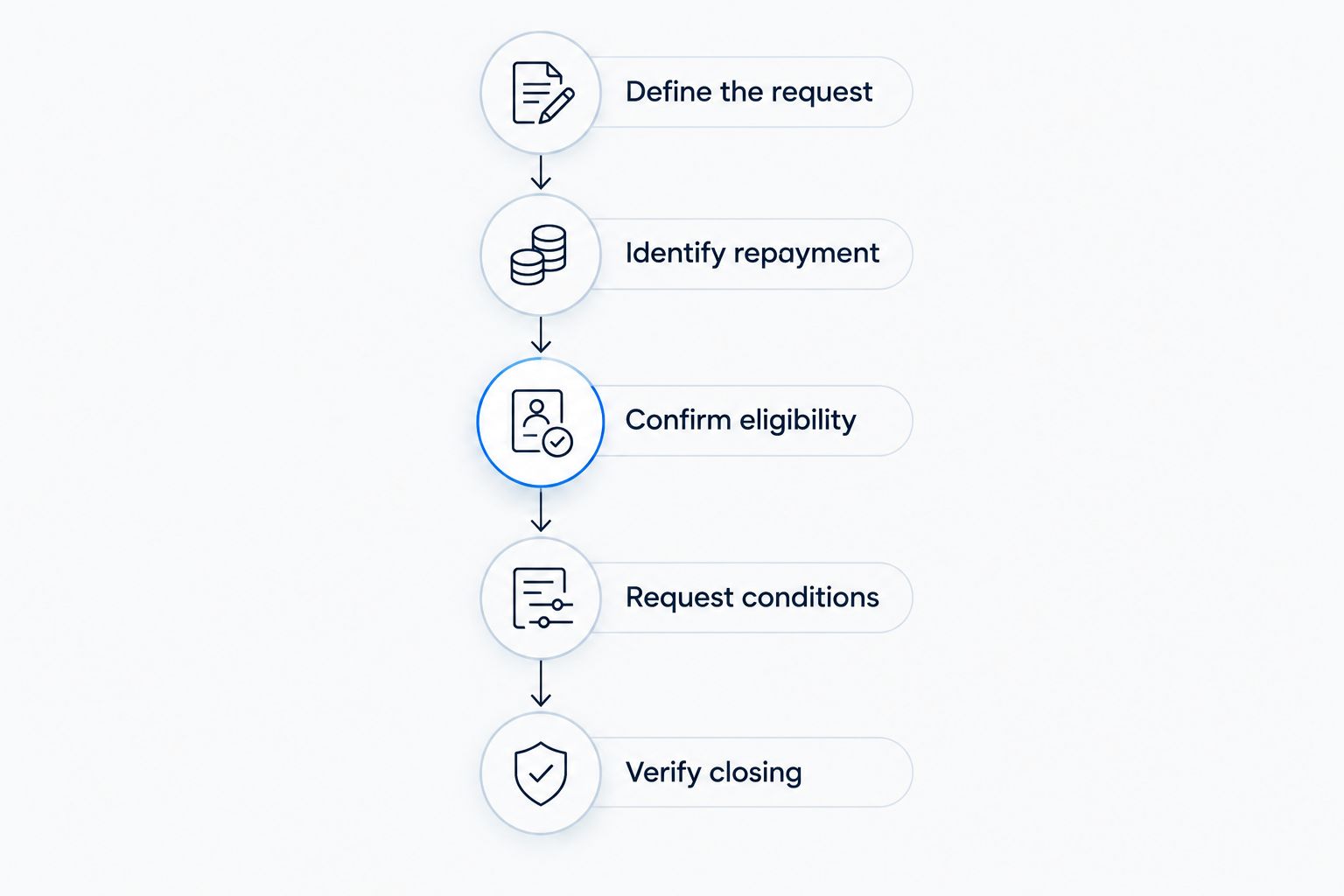
Start by obtaining a clear documentation answer, then test whether your transaction fits the alternative underwriting method. Follow this sequence before treating an initial response as an approval.
- Define the request. State the property type, loan purpose, requested amount, occupancy, and documents you want waived. Do not describe the entire file as no-doc if you only need a personal tax-return exemption.
- Identify repayment. Explain whether repayment comes from rent, business cash flow, sale proceeds, or refinancing. Match that explanation to supporting records.
- Confirm eligibility. Ask whether the lender accepts the property, location, borrowing entity, and proposed use of proceeds. Establish whether current income or a future exit drives the decision.
- Request conditions. Obtain the document checklist, guarantee requirements, valuation requirements, and outstanding approval conditions. Separate preliminary feedback from a commitment to fund.
- Verify closing. Confirm which conditions remain before funding and who is responsible for satisfying them. A complete application and an approved closing are different milestones.
For a 2026 closing, keep the property records and transaction details current throughout underwriting. Changes in occupancy, ownership, or the proposed exit need to be addressed before funding, not left for closing-day discovery.
Where does Flex V Capital Ltd fit?
Flex V Capital Ltd is a direct commercial lender for commercial real estate investors and business borrowers. Its stated financing range is $500K to $20M+, with bridge loans, DSCR loans, hard money, SBA, CMBS, and Fannie Mae financing.
The practical benefit is access to several financing categories through one lender. The constraint is that a loan category alone does not establish whether your personal income documentation will be waived; confirm that requirement for your transaction.
Flex V Capital Ltd states 48-hour pre-approvals. Treat pre-approval as an initial lending milestone, not a promise of closing within 48 hours or an unconditional commitment to fund.
Confirm your documentation requirements
Describe your property, loan purpose, repayment source, and the income documents you want waived.
Can I qualify if the property has no rental income?
A property without current rental income requires a different analysis from a performing rental. A bridge or collateral-focused structure can evaluate a transition plan, but the lender still needs an acceptable repayment strategy.
Separate current vacancy from permanent lack of income. A building awaiting lease-up presents different questions from land or a property intended for immediate resale, so describe the asset and planned exit precisely.
Is a no-income-verification loan the same as an SBA loan?
No—SBA business financing is not a substitute for documenting business repayment capacity. A borrower seeking to avoid personal income records should not assume that business financial statements and repayment analysis disappear as well.
If the proceeds support an operating business, ask which business and owner records are required. Do not apply investment-property underwriting assumptions to a business acquisition or working-capital request.
FAQ
Can I get a commercial loan without personal tax returns?
Yes, some investment-property loan programs qualify borrowers without personal tax returns. Confirm the specific waiver and the property, rental, liquidity, and borrower records required instead.
Does no income verification mean I can borrow with no income?
No, no income verification does not mean the lender ignores repayment. The lender can evaluate rental cash flow, collateral, sale proceeds, or another acceptable repayment source.
Are DSCR loans completely no-doc?
No, DSCR loans still require documentation supporting the property and transaction. The distinction is that rental cash flow can drive qualification instead of personal employment income.
Can I get a no-income-verification loan for a vacant commercial building?
A vacant commercial building needs underwriting that addresses the absence of current rent. Ask whether a bridge or collateral-focused structure accepts the property and its proposed sale, lease-up, or refinance exit.
Will a commercial lender still check my credit?
A personal income-document waiver does not establish a credit-check waiver. Ask the lender which borrower and guarantor checks apply before submitting the application.
Does no personal income verification mean no personal guarantee?
No, income documentation and personal guarantees are separate requirements. Confirm recourse and guarantor obligations in the proposed loan documents.
What should I ask a lender before applying in 2026?
Ask exactly which income documents are waived and what replaces them. Then confirm property eligibility, repayment analysis, guarantees, valuation requirements, and conditions remaining before funding.
One last thing
Test the exit before you accept an interim loan. If your payoff depends on refinancing, identify what the next lender will require and whether the property is expected to meet those requirements.
Avoiding personal tax returns at origination does not prove you can refinance at maturity. The documentation question matters, but the payoff question determines whether the financing fits your plan.