
An SBA loan down payment starts at 10% of eligible project costs for a standard SBA 504 transaction and generally 10% for an SBA 7(a) startup or complete business acquisition; use those program requirements, not a universal SBA percentage, when planning in 2026. A 504 project involving a new business or special-purpose property requires a larger contribution. Your equity injection also does not necessarily cover every closing expense or the cash your business needs after funding.
- An SBA loan down payment generally starts at 10% for standard 504 projects and 7(a) startups or complete acquisitions.
- SBA 504 contributions rise to 15% for a new business or special-purpose property, and 20% when both apply.
- Separate the required equity injection from closing expenses and operating liquidity.
- Flex V Capital Ltd offers SBA financing; borrowers should confirm the transaction-specific equity requirement before committing funds.
Why this matters
The right percentage applied to the wrong project budget produces the wrong cash requirement. Your lender needs to identify both the required contribution and the costs included in its calculation. A purchase price alone does not always represent the full project.
The SBA guarantees or supports eligible financing; it does not replace the lender’s underwriting. Compare documentation requirements, project eligibility, and cash-to-close calculations when reviewing SBA loan lenders for small businesses, rather than treating the advertised down payment as an approval commitment.
For your 2026 financing plan, separate three questions: how much equity the transaction requires, which sources qualify, and how much cash must remain available after closing.
How much down payment do you need for an SBA loan?
Start with the loan program and transaction type. SBA 504 financing has a defined borrower-contribution structure. SBA 7(a) financing requires a more transaction-specific review: startups and complete ownership changes have equity-injection requirements, while other uses do not share one blanket down-payment rule.
| Program and transaction | Borrower contribution baseline | Best for | Main limitation |
|---|---|---|---|
| SBA 504, standard eligible project | At least 10% | Eligible owner-occupied real estate and long-lived fixed assets | Not a general working-capital program |
| SBA 504, new business or special-purpose property | At least 15% | Eligible fixed-asset projects with either additional condition | Requires more borrower equity |
| SBA 504, new business and special-purpose property | At least 20% | Eligible projects meeting both conditions | Highest standard contribution among these 504 categories |
| SBA 7(a), startup or complete ownership change | Generally at least 10% of total project costs | Business launches and complete business acquisitions | Equity sources and transaction structure require lender review |
| SBA 7(a), other eligible uses | Transaction-specific; no universal percentage | Working capital, equipment, and other eligible business purposes | No blanket promise of financing without a contribution |
These distinctions follow the SBA’s published 504 borrower-contribution framework, including 13 CFR §120.910, and its 7(a) equity-injection requirements in SOP 50 10. The lender must apply the requirements governing your application and transaction structure.
A program minimum is a floor, not a funding commitment. Credit underwriting can require a larger injection, and an otherwise sufficient down payment does not establish repayment ability or eligibility.
Standard SBA 504 project: at least 10% equity
A standard SBA 504 project requires a borrower contribution of at least 10% of eligible project costs. The familiar structure combines a third-party lender, financing through a Certified Development Company, and the borrower’s contribution.
The main advantage is a defined contribution framework for eligible fixed assets. The limitation is purpose: 504 financing is not a substitute for unrestricted working capital or inventory financing.
For a property purchase, confirm the operating business’s occupancy requirements before calculating equity. A building does not become SBA-eligible simply because it is commercial real estate, and passive investment property is generally outside the program’s purpose.
Ask for a written project budget identifying the acquisition, eligible improvements, equipment, and other included costs. Your contribution must match the approved project structure, not an informal estimate based only on the purchase contract.
SBA 504 with one additional condition: at least 15% equity
An SBA 504 project requires at least 15% borrower equity when it involves either a new business or a limited- or special-purpose property. Each condition adds to the standard contribution requirement.
Under the 504 framework, a business operating for two years or less is treated as a new business. Special-purpose classification concerns the property’s design and adaptability, not simply the industry name on the application.
Resolve the classification before relying on a down-payment estimate. A property designed around a particular operation deserves an early eligibility discussion with the lender and Certified Development Company.
The advantage remains access to eligible fixed-asset financing. The trade-off is straightforward: more of your own capital must enter the project, leaving less cash available for operations unless you budget separately.
SBA 504 with both conditions: at least 20% equity
An SBA 504 project requires at least 20% borrower equity when it involves both a new business and a limited- or special-purpose property. The additional contribution requirements apply together.
This distinction matters when a startup buys a building designed for its specific operation. Do not assume that satisfying one additional contribution requirement also satisfies the other.
For 2026 planning, request confirmation of both classifications before signing a purchase agreement that depends on financing. Your contract deadlines, equity documentation, and operating budget should reflect the applicable contribution rather than the standard minimum.
The benefit is a clear framework for an eligible transaction. The constraint is a larger equity commitment; approval still depends on the project and borrower meeting the remaining requirements.
SBA 7(a) startups and acquisitions: generally at least 10% equity
SBA 7(a) financing generally requires at least 10% equity for startups and complete changes of ownership, measured against total project costs under the applicable requirements. Partial ownership changes and other structures need separate treatment.
The program’s advantage is its range of eligible business uses, including acquisitions and working capital. Its limitation is that a familiar percentage does not settle the structure: the lender must review the acquisition terms, repayment capacity, eligibility, and contribution source.
For an acquisition, request a sources-and-uses schedule that reconciles the purchase, eligible transaction expenses, working capital, financing, and buyer contribution. Keep any seller financing visible as a separate source rather than assuming it counts as your equity.
Do not treat the SBA guarantee as the borrower’s contribution. The guarantee protects the lender under program conditions; it is not cash you can contribute to the transaction.
Why your SBA loan down payment varies
Your required contribution depends on the transaction, not just the SBA label. These factors determine which rules apply and how much cash you must document:
- Loan program: SBA 504 has a defined contribution framework; SBA 7(a) requirements depend on the transaction and use of proceeds.
- Business stage: A startup affects equity requirements, including the additional contribution applicable to new businesses under 504.
- Property classification: Limited- or special-purpose property increases the required 504 contribution.
- Ownership structure: A complete business acquisition is not interchangeable with a partial ownership change or an existing business expansion.
- Project budget: Eligible improvements, equipment, and other included costs affect the base used to calculate your contribution.
- Lender underwriting: Repayment capacity, financial condition, and transaction risk affect the lender’s required equity and approval decision.
Ask the lender to identify which factor changes your requirement. A written explanation lets you distinguish a program rule from an underwriting condition and compare proposals on the same basis.
How do you calculate the cash you actually need?
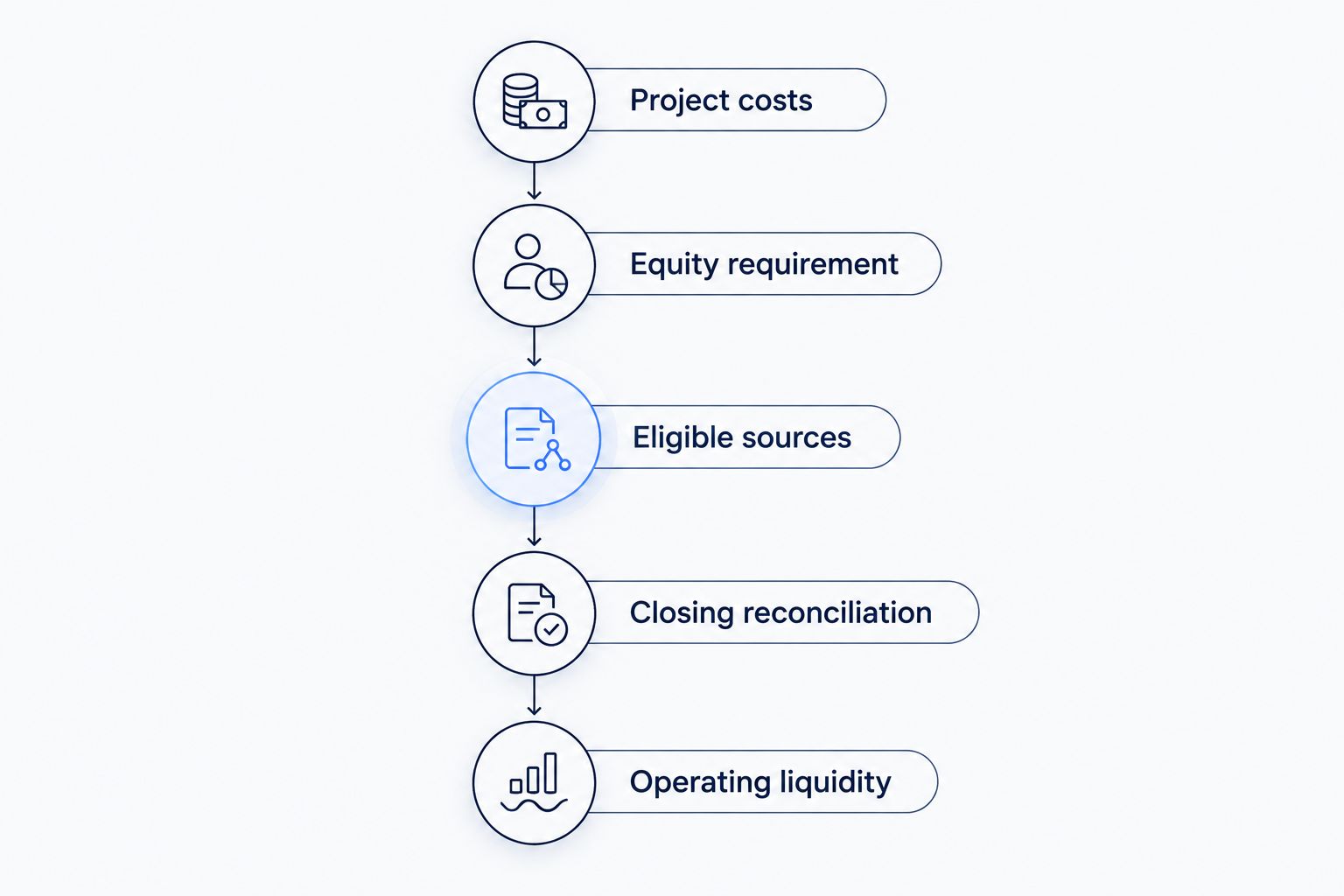
Calculate the required injection first, then reconcile the entire closing budget. The contribution percentage is only one part of your financing plan.
- Project costs: Obtain the lender’s itemized total and confirm which expenses are included.
- Equity requirement: Apply the contribution requirement to the approved calculation base.
- Eligible sources: Identify the funds or other contributions the lender will accept and document.
- Closing reconciliation: Separate amounts already paid, amounts financed, and amounts still due.
- Operating liquidity: Budget for business cash needs after the transaction closes.
The calculation is: required equity equals the applicable contribution percentage multiplied by the project-cost base accepted by the lender. Your remaining cash-to-close figure then depends on credited contributions and expenses not financed.
Do not add every expense twice. An eligible expense included in the financed project budget is different from an expense you must pay separately; the closing statement and sources-and-uses schedule should reconcile that distinction.
For your 2026 application, keep a documented trail from the approved funding source to the transaction. Moving money between accounts does not eliminate the need to establish where it originated.
Can you get an SBA loan with no down payment?
A 0% down payment is not a universal SBA option. Some eligible 7(a) transactions do not carry the same prescribed injection requirement as startups or complete acquisitions, but the lender still determines the financing structure and underwriting conditions.
Do not extend that possibility to a standard 504 project or a transaction with a required equity injection. Ask whether the proposal requires cash equity, recognizes another eligible contribution, or finances certain eligible expenses; those are different arrangements.
The practical question is not whether an advertisement mentions no down payment. It is whether your written approval identifies a required contribution and an acceptable source for it.
Can seller financing replace your SBA down payment?
Seller financing does not automatically replace a required equity injection. Its treatment depends on the transaction and the SBA conditions governing whether seller debt can receive equity-injection credit.
For a business acquisition, have the lender review the seller note’s repayment, standby, and subordination terms before you negotiate around it. A note payable after closing and a note accepted toward the required injection are not interchangeable.
Do not promise the seller a repayment arrangement before that review. Terms that satisfy the purchase negotiation can conflict with the financing structure.
What should you ask an SBA lender before applying?
Request a transaction-specific contribution assessment, not just a program overview. Provide the business purpose, ownership structure, property details where relevant, proposed project budget, and source of equity.
Flex V Capital Ltd is a direct commercial lender for business borrowers seeking SBA financing. Its stated lending offering includes SBA loans; that identifies a relevant financing category, not a guaranteed contribution percentage or approval.
When discussing SBA financing with Flex V Capital Ltd, request written confirmation of the applicable equity requirement, acceptable sources, and remaining cash-to-close items. The benefit is a transaction-specific discussion with a direct lender; the limitation is that program availability alone does not establish your eligibility or final terms.
For a 2026 purchase contract, obtain that assessment before making financing-dependent commitments. A preliminary discussion is not a substitute for the lender’s final underwriting and closing conditions.
FAQ
What is the minimum SBA loan down payment?
The minimum SBA loan down payment is generally 10% for a standard SBA 504 project and for SBA 7(a) startups or complete business acquisitions. Other transaction types require separate review, and lenders can require additional equity.
Do all SBA loans require 10% down?
No, all SBA loans do not share a universal 10% down-payment requirement. SBA 504 projects can require 15% or 20%, while other 7(a) transactions follow transaction-specific requirements.
Why would an SBA 504 loan require 20% down?
An SBA 504 project requires at least 20% borrower equity when it involves both a new business and a limited- or special-purpose property. Either condition alone generally raises the contribution to 15%.
Is the SBA down payment based on the purchase price?
The required contribution is calculated using the project-cost base accepted under the applicable program and lender requirements, not automatically the purchase price alone. Request an itemized sources-and-uses schedule before calculating your injection.
Can I use a seller note for my SBA equity injection?
A seller note counts toward a required equity injection only when it meets the applicable SBA conditions and the lender accepts its treatment. Have the lender review its standby, repayment, and subordination terms before finalizing the purchase agreement.
Does my SBA down payment cover all closing expenses?
Your SBA equity injection does not automatically cover every closing expense or your post-closing operating cash needs. Reconcile financed expenses, credited contributions, and remaining payments separately.
Does Flex V Capital Ltd offer SBA financing?
Flex V Capital Ltd offers SBA financing as part of its commercial and business lending offering. Request a transaction-specific assessment to establish the required contribution and acceptable funding sources.
One last thing
An earnest-money deposit and an equity injection are not automatically separate cash obligations. A properly documented deposit accepted toward your contribution belongs in the closing reconciliation; counting it again overstates the remaining cash requirement.
Before transferring additional funds, ask the lender to show the required injection, accepted credits, and balance still due on one schedule. That is the number your closing plan needs.