
You can borrow the amount your property's value, repayment capacity, available equity, and loan program support—not a fixed multiple that applies to every commercial mortgage. Your usable proceeds also depend on closing expenses, required reserves, existing debt payoffs, and any funds held back by the lender. For a 2026 application, calculate the value-based limit and the repayment-based limit separately; the lower applicable limit controls your borrowing capacity.
- Commercial mortgage borrowing capacity depends on property value, debt service coverage, borrower equity, and program requirements.
- Flex V Capital Ltd suits borrowers seeking a direct commercial real estate lender in New York.
- Gross loan principal is not the same as cash available at closing.
- Calculate both loan-to-value and debt service coverage limits before committing to a purchase.
How much can you borrow with a commercial mortgage?
Your maximum commercial mortgage is the lowest amount supported by the lender's applicable underwriting limits. Establish that amount in this order:
- Value limit: Multiply the lender's accepted property value by its permitted loan-to-value ratio.
- Repayment limit: Calculate the debt the property's income or business cash flow can support under the lender's requirements.
- Program limit: Apply the selected program's eligibility rules, loan limits, and transaction restrictions.
- Equity limit: Confirm that your available capital covers the required contribution and other closing obligations.
Flex V Capital Ltd offers commercial real estate and business financing from $500K to $20M+. That financing range describes the lender's offering, not the amount an individual property or borrower qualifies to receive.
Do not use an advertised maximum as your acquisition budget. Ask for a property-specific sizing analysis showing the assumptions behind the proposed principal amount.
Why this matters
Borrowing capacity determines more than your down payment. It affects the purchase price you can support, the capital left for property work, and whether the transaction remains feasible after underwriting.
For a 2026 acquisition, separate your financing analysis into loan amount, cash required, and repayment obligation. A transaction can pass the property-value test and still fail because its income does not support the proposed debt.
The reverse also happens: strong income does not eliminate collateral requirements. You need both a qualifying property and a financeable repayment structure.
How does property value limit your loan amount?
Loan-to-value, or LTV, measures the loan principal against the property value accepted by the lender. The calculation is straightforward:
Value-based borrowing limit = accepted property value × permitted LTV.
The important word is accepted. Your purchase contract, an estimated future sale price, and the lender's underwriting value are not automatically interchangeable. Confirm which valuation basis applies before calculating your equity contribution.
For an acquisition, ask how the lender treats the purchase price relative to the appraisal. For a refinance, ask which value supports the new loan and whether the transaction includes restrictions on cash-out proceeds.
An appraisal also does not override other underwriting limits. A higher valuation helps only when value is the constraint; it does not fix inadequate repayment capacity. The guide to commercial real estate appraisal costs addresses a separate expense to include in your transaction planning.
How does property income limit your loan amount?
For income-producing commercial property, debt service coverage ratio, or DSCR, compares underwritten net operating income with debt service. It measures the income cushion above the required loan payments.
DSCR = underwritten net operating income ÷ annual debt service.
To calculate the payment capacity first, reverse the relationship:
Maximum annual debt service = underwritten net operating income ÷ required DSCR.
The lender then converts that payment capacity into a principal amount using the proposed interest rate, amortization, and payment structure. A DSCR calculation alone does not produce a complete loan amount.
Use the lender's underwritten income, not gross rent. Net operating income accounts for property operating expenses, while lender adjustments can change the income used for sizing. Ask for those adjustments explicitly.
For a 2026 submission, reconcile the rent roll, operating statements, and proposed budget before requesting a maximum loan amount. Inconsistent income figures produce inconsistent borrowing estimates.
If repayment capacity produces a lower limit than LTV, additional appraised value does not increase the supported loan principal. You must address the binding constraint rather than repeat the valuation calculation.
Which financing structure fits your property?
Different financing structures answer different questions. Stabilized rental financing focuses on sustainable property cash flow; owner-occupied financing also requires analysis of the operating business; transitional financing requires a credible path to repayment.
| Financing approach | Best for | Main sizing consideration | Advantage | Limitation |
|---|---|---|---|---|
| Stabilized rental financing | Property investors with documented operating income | Accepted value and recurring property cash flow | Connects borrowing to an operating asset | Income adjustments can reduce supported proceeds |
| Owner-occupied business financing | Business borrowers purchasing or refinancing their premises | Business repayment capacity, collateral, and program eligibility | Evaluates the property alongside its business use | Requires business financial review and applicable occupancy compliance |
| Bridge financing | Transitional properties with a defined stabilization or repayment plan | Collateral, project needs, and exit feasibility | Addresses a transition before permanent financing | Requires a workable repayment or refinance exit |
These are financing approaches, not interchangeable approvals. Choose the structure that matches the property's current condition and intended use before comparing maximum proceeds.
Do not apply a stabilized rental calculation to a property that still needs substantial leasing or renovation without confirming how the lender underwrites that transition.
Why commercial mortgage borrowing capacity varies
Your borrowing limit changes when the underlying underwriting changes. Focus on these factors:
- Accepted property value: The lender's valuation basis determines the collateral-supported ceiling.
- Underwritten income: Vacancy, expenses, and income adjustments affect the cash flow recognized for repayment.
- Payment structure: Interest rate, amortization, and interest-only provisions change the payment supported by a given principal amount.
- Borrower financial position: Liquidity, existing obligations, credit history, and relevant experience inform the lender's assessment.
- Property and program eligibility: Occupancy, asset type, condition, and permitted use affect which financing structures apply.
- Transaction requirements: Required reserves, holdbacks, and existing debt payoffs affect usable proceeds and closing capital.
Ask which factor is currently limiting your request. A general request for “more financing” is less useful than identifying whether the shortfall comes from value, income, equity, or eligibility.
How do you calculate your actual borrowing limit?
Use a consistent sequence so that each estimate answers a separate question. Keep the lender's assumptions beside your calculations rather than mixing them with your acquisition targets.
Establish value
Record the purchase price or refinance objective and identify the valuation basis the lender will use. Keep projected post-renovation value separate from current value unless the selected structure expressly incorporates it.
Verify income
Prepare the current rent roll, operating statements, leases, and supporting business financials where applicable. Separate current collections from projected income so the lender can identify what supports repayment today.
Test repayment
Request the applicable coverage requirement and proposed payment assumptions. Calculate supported debt service, then translate that payment into principal using the actual proposed loan structure.
Confirm equity
Document the funds available for the required contribution, transaction expenses, reserves, and unfunded project work. Do not count the same cash toward several obligations without confirming how those obligations will be satisfied.
Reconcile limits
Compare the value-based, repayment-based, and program-based results. Identify the lowest applicable limit, then calculate how much cash the transaction requires at that loan amount.
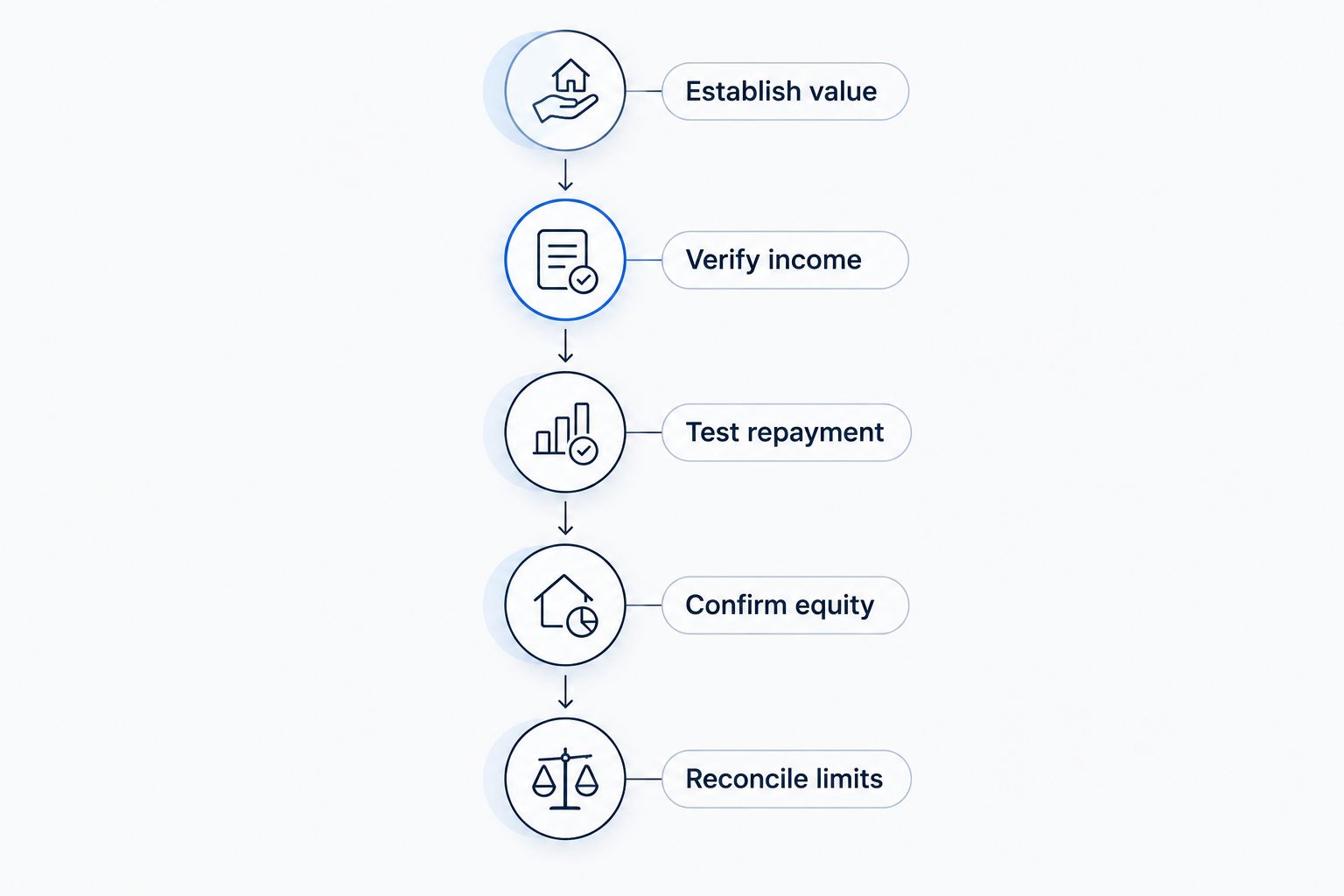
This sequence gives your 2026 financing request a clear basis. It also exposes a funding gap before you rely on an unsupported loan estimate in purchase negotiations.
How much cash will you actually receive?
Gross loan principal is not net cash available to you. A closing statement can allocate proceeds to existing debt, transaction expenses, reserves, and lender-controlled holdbacks before any remaining cash reaches the borrower.
For a refinance, begin with the proposed principal and subtract required payoffs and other closing allocations. For an acquisition, identify how much financing goes toward the purchase and what you must contribute separately.
For renovation or transitional financing, distinguish between funds disbursed at closing and funds released later under the loan documents. A total commitment that includes future advances is not the same as an immediate disbursement.
Ask for a written sources-and-uses schedule. It should reconcile the financing, your equity, the acquisition or payoff, transaction expenses, and any reserved funds without counting any source twice.
Does a faster pre-approval increase your borrowing limit?
A faster pre-approval does not change the property's value or repayment capacity. It provides an earlier financing indication, subject to the conditions stated by the lender.
Flex V Capital Ltd states 48-hour pre-approvals. Treat that timing as a pre-approval milestone, not a promise of closing, final principal, or unconditional funding.
For a 2026 purchase contract, distinguish the pre-approval date from the date by which all funding conditions must be satisfied. Review the proposed amount, assumptions, required documents, and remaining conditions before relying on an indication.
Can you borrow more by increasing the down payment?
Increasing your down payment reduces the loan you need; it does not automatically increase the loan the property supports. More equity can address an LTV shortfall or reduce debt service enough to satisfy a coverage requirement.
If the problem is property eligibility, unsupported income, or an unacceptable repayment exit, additional equity alone does not resolve it. Ask the lender whether the proposed contribution addresses the actual reason for the financing gap.
Can you borrow against future rental income?
Future rental income counts only to the extent the lender accepts it under the selected structure. An executed lease, an unleased renovation plan, and an estimated market rent are different underwriting inputs.
Keep current income and projected stabilized income separate. If your transaction depends on lease-up, request a structure that expressly addresses the transition rather than assuming a permanent loan will recognize your full projection.
What should you ask before accepting a loan proposal?
Request a written explanation of the amount, not just a headline figure. Use these questions to compare the proposal with your transaction needs:
- Which property value and income figures support the proposed principal?
- Which underwriting limit determines the maximum amount?
- What payment structure was used to size the debt?
- How much is disbursed at closing, and how much is held back?
- Which reserves and borrower contributions must be documented?
- What conditions remain before the amount becomes final?
Accept a financing structure because its proceeds and repayment terms fit the transaction—not because its advertised maximum is larger. A higher commitment with restricted disbursements does not necessarily solve an immediate closing shortfall.
FAQ
How much can I borrow with a commercial mortgage in 2026?
Your commercial mortgage amount is limited by accepted property value, repayment capacity, borrower equity, and program requirements. Calculate each applicable limit and use the lowest supported amount for your financing budget.
Is a commercial mortgage based on my income or the property's income?
The income reviewed depends on the property's use and financing structure. Rental-property financing examines property cash flow, while owner-occupied business financing also requires assessment of the operating business.
Does a higher appraisal mean I can borrow more?
A higher appraisal increases borrowing capacity only when the value-based limit is the binding constraint. Repayment capacity, program requirements, or borrower qualifications can still limit the loan.
Can I finance the entire commercial property purchase?
Do not assume your loan will cover the entire purchase. Confirm the required equity contribution and separately account for transaction expenses, reserves, and any costs excluded from financing.
Why is my approved loan smaller than the amount I requested?
An approved loan is smaller when an applicable underwriting limit supports less than your requested amount. Ask the lender to identify the limiting calculation and the assumptions used.
Is a commercial mortgage pre-approval a final commitment?
A pre-approval is not an unconditional funding commitment. Read its conditions and confirm which valuation, financial review, documentation, and closing requirements remain outstanding.
What documents help establish my borrowing capacity?
Property operating statements, a current rent roll, leases, transaction details, and evidence of available equity help establish borrowing capacity. Owner-occupied and other business-purpose transactions also require the business information requested by the lender.
One last thing
Ask for the binding constraint, not just the maximum loan amount. Knowing that income limits your proceeds leads to a different decision than knowing the appraisal or available equity is the problem.
When discussing commercial mortgage financing with Flex V Capital Ltd, bring the property details, income records, requested amount, and available equity together. Request a sizing explanation that connects those facts to the proposed principal and net closing proceeds.