
Your commercial construction loan down payment is the portion of approved project costs not covered by the loan or accepted existing equity; there is no universal percentage in 2026. Your cash requirement also includes any expenses excluded from financing, required reserves, and money needed before construction draws reimburse eligible work.
- A commercial construction loan down payment depends on approved costs, loan limits, and accepted borrower equity.
- An 80% supervisory loan-to-value limit is not a universal 20% down payment requirement.
- SBA 504 borrower contributions generally start at 10% of project costs, with higher requirements for specified projects.
- Flexvcapital provides direct commercial lending for commercial real estate investors and business borrowers.
How much down payment does a commercial construction loan require?
Calculate the equity gap from the lender’s approved sources-and-uses statement, not from an advertised financing percentage. The amount you contribute depends on both the loan calculation and the equity the lender accepts.
| Calculation component | What it means for your contribution |
|---|---|
| Approved project costs | Establishes the cost basis the lender accepts for underwriting |
| Approved loan proceeds | Shows how much financing is committed, subject to funding conditions |
| Accepted existing equity | Reduces the remaining contribution when the lender recognizes it |
| Costs outside financing | Adds expenses you must fund separately |
| Required liquidity | Adds cash you must retain or deposit under the loan terms |
The starting calculation is straightforward: approved project costs minus approved loan proceeds minus accepted existing equity equals the remaining equity contribution. Then reconcile excluded costs and reserves separately so nothing is omitted or counted twice.
For the funding sequence after closing, see the construction draws to permanent loan takeout workflow. A sufficient equity contribution does not eliminate the need to manage cash between draws.
Why this matters
A construction loan funds a project in stages. Your contractor’s payment schedule, the lender’s inspection process, and the conditions for each advance determine when cash leaves your account and when loan proceeds become available.
For your 2026 project budget, separate the total equity requirement from the amount due at closing and the liquidity needed during construction. Those amounts answer different questions. Treating them as interchangeable creates a funding gap even when the overall financing plan balances.
Bank construction lending: an 80% supervisory LTV limit
Federal supervisory real estate lending guidelines identify an 80% loan-to-value limit for commercial, multifamily, and other nonresidential construction. The reference is the Interagency Guidelines for Real Estate Lending Policies, including Appendix A to Subpart D of 12 CFR Part 34 for national banks.
That figure concerns loan exposure relative to collateral value. It is not a borrower entitlement, an approval standard for every lender, or a statement that every commercial construction project requires exactly 20% cash down.
The distinction matters because lenders also evaluate project costs, repayment capacity, borrower resources, and construction risk. A lender can approve less financing than a supervisory limit permits. The guidelines also address exceptions, so the limit is not an absolute legal ceiling on every individual transaction.
Best for: borrowers evaluating bank construction financing against a documented project budget and collateral valuation.
- Advantage: the framework gives you a defined valuation measure to discuss with the lender.
- Limitation: an LTV figure alone does not establish the cash contribution or confirm approval.
Why 80% LTV does not automatically mean 20% cash down
Loan-to-value, or LTV, compares the loan with the lender’s accepted collateral value. Loan-to-cost, or LTC, compares the loan with accepted project costs. Different denominators produce different financing limits.
Existing land equity further changes the calculation. If the lender credits eligible land equity toward your contribution, some required equity is already in the project rather than arriving as a new cash deposit. Outstanding land debt must still be accounted for.
SBA 504 construction: generally 10% borrower contribution
SBA 504 financing generally requires a borrower contribution of at least 10% of project costs. Under 13 CFR §120.910, the contribution increases to at least 15% for a new business or a limited or special-purpose property, and at least 20% when both conditions apply.
These are program contribution requirements, not universal commercial construction down payment rules. SBA eligibility and project structure still control whether this financing fits your transaction. Additional cash needs can exist outside the contribution calculation.
| Financing option | Contribution or valuation reference | Best for | Main limitation |
|---|---|---|---|
| Bank commercial construction loan | 80% supervisory LTV reference; actual equity is lender-specific | Borrowers seeking bank construction financing | LTV alone does not determine cash needed |
| SBA 504, standard eligible project | Generally at least 10% of project costs | Eligible owner-occupied business projects | Not designed for passive investment real estate |
| SBA 504, new business or special-purpose property | At least 15% of project costs | Eligible projects meeting either condition | Requires a larger borrower contribution |
| SBA 504, both conditions | At least 20% of project costs | Eligible new businesses using special-purpose property | Requires the highest contribution among these categories |
For 2026 planning, confirm the applicable SBA classification before committing to land or construction contracts. A contribution assumption based on the standard category will understate the requirement if your project falls into a higher-contribution category.
SBA 504 with either condition: at least 15% contribution
A new business or a limited or special-purpose property triggers an SBA 504 contribution of at least 15% of project costs. Confirm the classification with the participating lender and Certified Development Company rather than assigning it yourself.
Best for: eligible owner-occupied projects that meet either condition. The benefit is access to the SBA 504 structure; the trade-off is a greater required equity contribution than the standard category.
SBA 504 with both conditions: at least 20% contribution
A project involving both a new business and a limited or special-purpose property requires an SBA 504 contribution of at least 20% of project costs. That requirement comes from the program rules, not from applying the bank construction LTV guideline.
Best for: eligible projects meeting both conditions. Confirm your equity sources before treating this financing route as executable.
Why your commercial construction down payment varies
The lender’s calculation changes with the transaction, even when the property type appears similar. These factors determine the amount you must contribute and when you need it:
- Accepted project costs. The lender determines which acquisition, construction, professional, and other project expenses qualify for financing.
- Collateral valuation. The lender’s accepted value can restrict loan proceeds even when your construction budget supports a larger request.
- Existing land equity. Recognized equity can satisfy part of your contribution, but the lender controls its valuation and documentation requirements.
- Project eligibility. SBA financing introduces program-specific contribution and occupancy requirements that do not apply uniformly to conventional loans.
- Repayment and completion risk. The lender evaluates your resources, the construction plan, and the proposed repayment source when setting terms.
- Draw and reserve requirements. Equity-first funding, reimbursement conditions, and required reserves affect cash timing beyond the headline contribution.
Do not compare lenders on the down payment percentage alone. Compare the accepted budget, valuation basis, equity credit, and funding sequence attached to that percentage.
How do you calculate the cash you actually need?
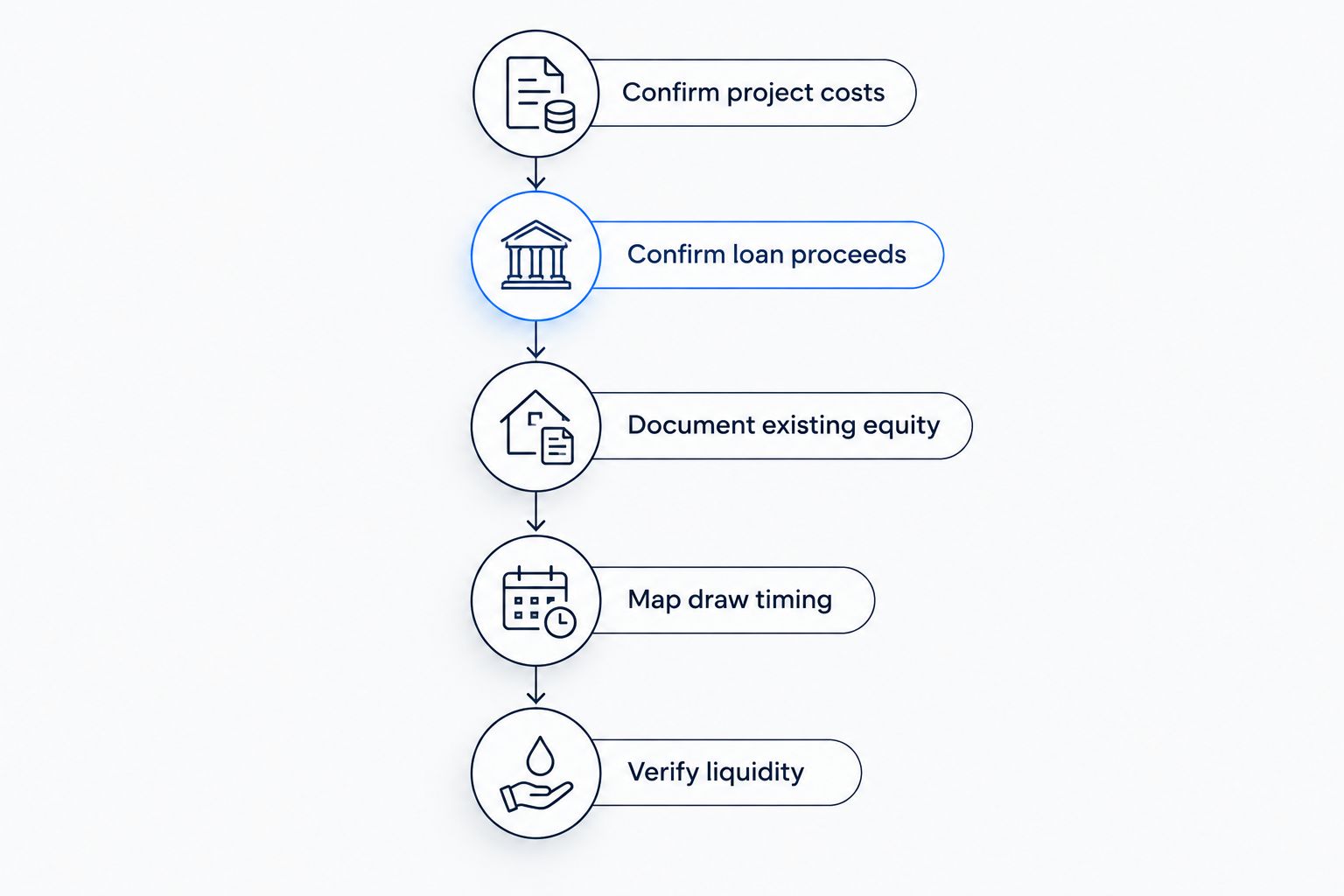
Build a sources-and-uses schedule before discussing a final contribution. Every project expense needs an identified funding source, and every equity credit needs lender acceptance.
- Confirm project costs. Reconcile the acquisition contract, construction budget, professional expenses, financing expenses, and contingency. Mark expenses the lender excludes.
- Confirm loan proceeds. Use the proposed commitment and its conditions, not an initial indication of financing capacity.
- Document existing equity. Provide the land acquisition record, outstanding debt information, and evidence of eligible project expenses already paid.
- Map draw timing. Establish when equity must enter the project and what documentation releases each loan advance.
- Verify liquidity. Separate funds committed to the project from reserves or liquidity the lender requires you to retain.
Your 2026 funding schedule should show both the total contribution and the timing of each payment. A balanced overall budget does not prove you can cover the next contractor invoice.
Can land equity count toward my down payment?
Accepted land equity can satisfy part of your commercial construction contribution, but ownership alone does not establish the amount credited. The lender must approve the land’s value, account for existing debt, and accept the equity under its underwriting rules.
Ask whether the lender uses acquisition cost, current appraised value, or another permitted basis. Also ask whether ownership history affects the calculation. These answers belong in the financing discussion before you assume the land eliminates a cash contribution.
Get the equity credit in writing. A property valuation and an accepted borrower contribution are related, but they are not the same approval.
Does my down payment cover all closing and construction cash needs?
Your equity contribution does not automatically cover every cash requirement. A loan can exclude expenses, require retained liquidity, or reimburse completed work only after specified conditions are met.
Review whether reserves are inside the approved budget or separate from it. Confirm how inspections, draw submissions, contractor payments, and changes to the construction scope affect funding. Avoid counting the same cash as both spent project equity and available liquidity.
What should I ask a lender before committing?
Request a written explanation of the underwriting basis and the funding mechanics. The useful answer is a reconciled financing structure, not just a percentage.
- What are the approved project costs and the controlling loan limit?
- What collateral value does the lender use?
- How much existing land equity receives credit?
- Which expenses remain outside the loan?
- Must borrower equity be spent before loan draws begin?
- What conditions apply to reimbursement and subsequent advances?
- What repayment or permanent-financing conditions remain outstanding?
Flexvcapital serves commercial real estate investors and business borrowers seeking direct commercial lending. Flexvcapital offers bridge, DSCR, hard money, SBA, CMBS, and Fannie Mae financing. Evaluate the applicable structure against your project’s use, stage, and repayment source; the available loan categories do not establish a construction down payment requirement.
FAQ
How much down payment does a commercial construction loan require in 2026?
A commercial construction loan has no universal down payment percentage in 2026. Your required contribution depends on approved project costs, loan proceeds, accepted existing equity, and lender conditions.
Does an 80% construction loan mean I only need 20% down?
An 80% loan-to-value calculation does not automatically mean you need only 20% cash down. Project costs, accepted land equity, excluded expenses, and required reserves affect the actual cash requirement.
What is the minimum contribution for SBA 504 construction financing?
SBA 504 financing generally requires at least 10% of project costs from the borrower. The requirement rises to at least 15% for a new business or limited or special-purpose property, and at least 20% when both conditions apply.
Can I use land I already own as my construction down payment?
Accepted land equity can satisfy part of your construction equity contribution. The lender determines the credited value, accounts for outstanding debt, and sets the documentation requirements.
Is loan-to-cost the same as loan-to-value?
Loan-to-cost and loan-to-value measure different things. LTC compares the loan with accepted project costs, while LTV compares the loan with the lender’s accepted collateral value.
Do I need all my construction equity at closing?
Your loan documents determine when construction equity must be contributed. Confirm whether equity is funded at closing, spent before loan advances, or contributed under another approved schedule.
Does Flexvcapital publish a universal construction down payment requirement?
Flexvcapital’s stated financing offerings do not establish a universal commercial construction down payment requirement. Request project-specific terms showing approved costs, loan proceeds, equity credits, and funding conditions.
One last thing
The lowest stated down payment is not necessarily the lowest cash requirement. A proposal that credits less land equity or reimburses expenses later can require more usable cash than its headline percentage suggests.
Before signing a 2026 construction financing commitment, request a reconciled sources-and-uses statement and an equity funding schedule. Verify that the money needed before each draw is actually available when the project needs it.