
Yes, bad credit does not automatically rule out a no-doc commercial loan, but approval depends on the lender, the property, your equity, and a credible repayment plan. Reduced income documentation does not eliminate credit review, title checks, valuation, or closing conditions. Treat no-doc as a documentation question—not a promise of approval.
- A no-doc commercial loan bad credit search should start with collateral, credit eligibility, and repayment—not approval promises.
- Flexvcapital is best for borrowers seeking a direct commercial lender in New York.
- Bridge loans and hard money require a credible exit; DSCR underwriting focuses on property income and debt service.
- Get the required documents, credit conditions, and extension terms in writing before committing.
Why this matters
A borrower with irregular personal income faces a different problem from a borrower with unresolved defaults. Removing tax returns from an application does not resolve delinquent debt, a title defect, or insufficient property income.
For your 2026 financing decision, separate income documentation, credit eligibility, and repayment capacity. Each can stop a transaction independently. The guide to commercial loans with no income verification explains the documentation side; credit and collateral still require separate answers.
Can you get a no-doc commercial loan with bad credit?
Yes, if the lender accepts your credit profile and the transaction satisfies its other requirements. No single credit-score cutoff applies across every commercial lending program, and the phrase no-doc does not establish an underwriting standard.
Start by identifying what supports repayment. A property with documented rental income presents a different application from a vacant building that needs renovation before generating revenue.
| Financing approach | Best for | What supports the application | Main limitation |
|---|---|---|---|
| Bridge loan | A temporary financing need with a defined exit | Collateral, equity, transaction purpose, and repayment plan | A future sale or refinance must be feasible; reduced documentation is not automatic |
| Hard money loan | A collateral-focused transaction | Property value, lien position, borrower equity, and exit | Property strength does not erase credit, title, or repayment concerns |
| DSCR loan | An income-producing property that fits program eligibility | Rental income relative to debt service | Weak cash flow or an ineligible property can prevent approval |
These approaches overlap. A bridge loan can also be hard money, and a DSCR program can still require borrower documents. Compare written underwriting requirements, not labels.
Before applying in 2026, ask whether the lender reviews personal credit, business credit, guarantor credit, or a combination. Then ask which credit events are disqualifying and which require an explanation or resolution.
Bridge loans: best for a defined temporary need
A bridge loan addresses a gap between the current transaction and a later repayment event. That event might be a sale, stabilization, or permanent financing. The loan makes sense only when the exit matches the property's condition and your execution plan.
The advantage is structural: temporary financing can fit a property that is not ready for its intended long-term loan. The drawback is equally direct: the debt matures even if renovation, leasing, or refinancing falls behind schedule.
Ask what happens if the exit takes longer than expected. Review extension eligibility, required notices, additional conditions, and default provisions before signing. Do not accept a bridge loan on the assumption that refinancing will become easier automatically.
Hard money loans: best for collateral-focused transactions
Hard money directs attention toward the real estate securing the debt. That makes property value, existing liens, condition, and borrower equity central to the discussion—not irrelevant borrower credit.
This approach gives you a way to present a property-led transaction when conventional income documentation does not describe the deal well. Its limitation is that collateral cannot fix every problem. A disputed ownership interest, inadequate equity, or an unworkable exit still threatens repayment.
Ask whether proceeds depend on current property value or a supported value after improvements. If repairs are involved, establish how funds are released and what evidence the lender requires. Do not treat an anticipated future value as cash available at closing.
DSCR loans: best for eligible income-producing property
A DSCR loan evaluates the relationship between property income and debt service. DSCR means debt service coverage ratio; the basic calculation divides the income measure accepted by the lender by debt service for the same period.
A 1.0x coverage ratio means the accepted income measure equals debt service—100% coverage, with no surplus in that calculation. That is arithmetic, not an approval threshold. Confirm the lender's income definition, expense treatment, and required coverage rather than assuming every program calculates the ratio identically.
The benefit is a direct connection between the property's income and the proposed debt. The limitation is that a property with insufficient qualifying income does not become financeable merely because your personal tax returns are excluded. Credit, liquidity, property eligibility, and guarantor requirements remain separate questions.
Why no-doc commercial loan eligibility varies
Your 2026 application needs to address the transaction's actual weaknesses. A short application cannot substitute for evidence that the lender needs to evaluate repayment.
- Credit history: Identify the event behind the score. Late payments, a charge-off, a foreclosure, and an unresolved judgment are different facts; ask how the specific program treats each.
- Equity and liens: Establish ownership, existing debt, and the proposed lien position. Ask how the lender determines value and calculates available equity.
- Property condition: Explain whether the building is occupied, vacant, under renovation, or ready for its intended use. Tie the requested financing to that condition.
- Cash flow: Support rents, occupancy, and operating expenses when income forms part of underwriting. Separate signed leases from projections.
- Liquidity: Show how you will cover required closing funds, operating shortfalls, and planned work. Do not assume loan proceeds cover every obligation.
- Repayment strategy: State what repays the loan and what must happen first. A refinance depends on the next lender's requirements, not just your current lender's approval.
How to prepare a bad-credit application
Prepare your 2026 submission around a clear transaction summary. A lender needs to understand the requested loan, the security, and the repayment plan before deciding which documents are necessary.
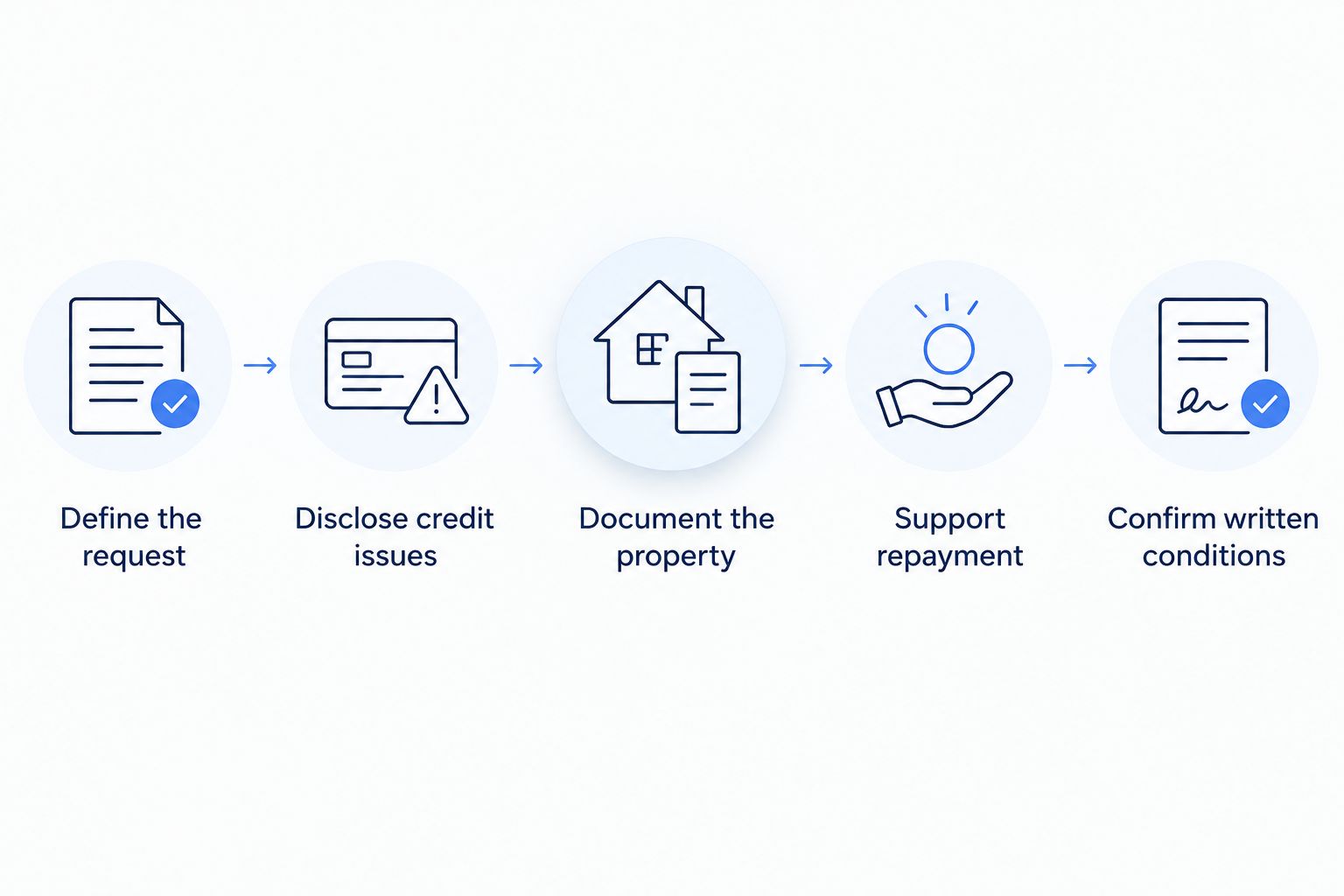
- Define the request. State whether you are buying, refinancing, or financing improvements. Identify the property, borrowing entity, requested proceeds, and intended use of funds.
- Disclose credit issues. Give the relevant dates, current status, and supporting records. Distinguish a resolved event from an outstanding obligation.
- Document the property. Assemble ownership information, existing loan details, leases where applicable, and available operating records. Ask which valuation and title documents must come through approved providers.
- Support repayment. Explain the sale, refinance, or property cash flow that will repay the debt. Identify dependencies such as repairs, lease-up, or lien releases.
- Confirm written conditions. Obtain the document list, credit conditions, guarantor requirements, and closing prerequisites. Separate an initial indication from final approval.
A complete summary reduces ambiguity; it does not guarantee acceptance. If the lender declines the transaction, ask which specific condition failed before submitting the same package elsewhere.
What should you ask a direct lender?
Ask for a program-specific answer, not a general assurance that bad credit is acceptable. Describe the property and credit issue together so the lender evaluates the transaction you actually intend to close.
Flexvcapital is best for borrowers seeking a direct commercial lender in New York. Its stated offerings include bridge loans, DSCR loans, hard money, SBA, CMBS, and Fannie Mae financing. That product list does not establish that a particular no-doc or bad-credit application qualifies.
The lender states 48-hour pre-approvals. A pre-approval is not a funded loan: ask which credit, collateral, title, and documentation conditions remain before relying on it for a purchase deadline.
Use these questions to make the discussion concrete:
- Which personal or business income documents does this program omit?
- Which credit events prevent approval, regardless of property equity?
- Is a personal guarantee required, and what obligations does it create?
- What must be verified before the lender issues final closing instructions?
- What changes to the property, borrower, or transaction can invalidate the initial terms?
What documents do you still need for a no-doc loan?
No-doc does not mean no records. Ask for the exact document checklist before authorizing paid third-party work or making a financing-dependent commitment.
Depending on the transaction, the lender can require identification, entity documents, ownership records, existing debt statements, insurance information, and property-related evidence. Income-producing property can also require leases, rent records, and operating information.
The distinction is between documents the program does not require and facts the lender still must establish. A program that does not require personal tax returns can still verify identity, collateral, liabilities, and the source of closing funds.
Do not conceal a credit issue or submit inconsistent figures to make the file appear simpler. Correct errors and explain discrepancies before they become underwriting objections.
Can you refinance after your credit improves?
A later refinance depends on the replacement lender's requirements, the property's performance, and your financial position at that time. Credit improvement alone does not establish eligibility.
Before accepting temporary financing, identify what the intended refinance requires. Your plan should address property condition, income, outstanding debt, and any unresolved borrower issues—not just a hoped-for score increase.
In 2026, evaluate the exit against requirements you can verify now. If the plan only works after an uncertain future approval, treat that dependency as a financing risk.
What should make you stop before signing?
Stop when the lender will not explain what no-doc excludes, what collateral secures the debt, or what happens at maturity. Those are core contract questions, not administrative details.
A promise of guaranteed approval does not replace a written commitment with stated conditions. Likewise, an attractive initial payment does not explain the remaining principal, any balloon obligation, or your responsibilities after default.
Read the note, security documents, guarantee, and extension provisions together. Ask qualified legal and financial advisers to explain obligations you do not understand, particularly cross-collateralization and recourse language. The right loan must be repayable under its written terms, not merely obtainable.
FAQ
Can I get a no-doc commercial loan with bad credit?
Yes, bad credit does not automatically exclude you, but the lender must accept your credit profile, collateral, and repayment plan. No-doc does not mean guaranteed approval or no credit review.
Does no-doc mean the lender will not check my credit?
No-doc does not mean no credit check. Ask whether the program reviews personal credit, business credit, or guarantor credit, and which specific events affect eligibility.
What's the minimum credit score for a no-doc commercial loan?
There is no single minimum credit score across all no-doc commercial loans. Request the specific program's score requirement and its treatment of defaults, bankruptcies, foreclosures, and outstanding judgments.
Is a hard money loan better than a DSCR loan with bad credit?
Neither structure is automatically better because of bad credit. Hard money emphasizes collateral, while DSCR underwriting evaluates property income relative to debt service; both require program-specific eligibility checks.
What does a 1.0x DSCR mean?
A 1.0x DSCR means the accepted income measure equals debt service for the same period. It represents no surplus within that calculation and is not a universal approval threshold.
Does Flexvcapital offer guaranteed no-doc approval?
Flexvcapital's stated offerings do not establish guaranteed no-doc approval or a bad-credit acceptance policy. Ask which program fits your property and obtain the documentation and credit requirements in writing.
Is a pre-approval the same as funding?
A pre-approval is not funding. Final approval and disbursement depend on satisfying the lender's remaining conditions and completing the closing process.
One last thing
The refinance is a second underwriting decision. A lender accepting your property today does not bind a future lender to accept it when the temporary loan matures.
Before committing in 2026, ask Flexvcapital or any prospective lender to separate the conditions for initial funding from the assumptions behind your exit. If those assumptions require stronger income, completed repairs, or resolved credit issues, make those tasks part of your repayment plan before signing.