
Your bridge loan equity requirement equals 100% minus the lender’s approved loan-to-value ratio, measured against the property value the lender accepts; there is no universal minimum for commercial bridge loans in 2026. That property equity is not your entire cash requirement: closing expenses, reserves, renovation contributions, and existing debt payoffs also affect the money you need.
- Bridge loan equity requirement: calculate equity from approved LTV, then separately calculate cash needed to close.
- Existing property equity is not cash; refinancing depends on accepted value, debt payoff, and net loan proceeds.
- Compare initial funding with total commitment when a bridge loan includes renovation draws.
- Flex V Capital Ltd offers commercial bridge loans; confirm transaction-specific equity requirements before committing to a purchase.
How much equity do you need for a bridge loan?
You need enough equity to satisfy the lender’s approved leverage limits. Required equity percentage = 100% − approved LTV. The calculation is straightforward; determining which property value and loan amount belong in it requires the term sheet.
For commercial property transactions, distinguish an acquisition contribution from equity already held in a property. The bridge loans for real estate developers guide provides related context for financing projects that involve property improvements.
| Transaction | How equity is established | Best for | Advantage | Constraint |
|---|---|---|---|---|
| Acquisition bridge loan | Your contribution fills the gap between acquisition funding and the purchase obligation | Buyers acquiring commercial property | Connects financing to a defined purchase | The lender’s accepted value can differ from the contract price |
| Refinance bridge loan | Accepted property value exceeds existing secured debt | Owners replacing an existing loan | Recognizes equity already held in the property | Debt payoff and deductions reduce usable proceeds |
| Bridge loan with renovation funding | Borrower contribution supports the acquisition and improvement budget | Investors completing a property business plan | Can finance eligible improvements through draws | Undisbursed renovation funds are not acquisition cash |
These are transaction structures, not standardized lending tiers. A lender’s decision depends on the property, proposed debt, borrower contribution, and repayment plan—not the bridge-loan label alone.
Why this matters
A deal can satisfy an equity test and still leave you short at closing. Property value, borrower liquidity, and funded proceeds answer different questions. Treating them as interchangeable produces an incomplete acquisition budget.
For your 2026 financing review, separate the equity requirement from the cash-to-close calculation. Then identify the cash you must retain after closing. A transaction that consumes your operating cushion leaves less room for vacancy, repairs, or a delayed refinance.
Your immediate task is to obtain a written proceeds breakdown. A headline loan amount does not establish how much reaches the seller, pays off existing debt, funds improvements, or remains available to you.
Acquisition bridge loans: calculate the purchase gap
For an acquisition, begin with the purchase price and the amount available for the purchase at closing. Subtract purchase funding from the purchase obligation to identify the gap you must cover. Add transaction expenses and required deposits separately.
Do not assume that an appraisal above the contract price eliminates your contribution. Ask whether the lender sizes acquisition proceeds against the purchase price, appraised value, or another stated valuation basis. The written sizing rule controls the calculation.
Use the initial funded amount—not the total loan commitment—to calculate your acquisition cash gap. This distinction matters when the facility includes money reserved for future work. Funds released after construction milestones cannot simultaneously pay the seller at acquisition.
Before your purchase obligation becomes binding, request confirmation of:
- The accepted valuation basis for acquisition sizing.
- The amount funded toward the purchase at closing.
- Any required borrower contribution to renovation work.
- Required deposits and reserves.
- The source-of-funds documentation needed for your contribution.
An acquisition bridge loan gives you a financing structure for the purchase. Its limitation is that the advertised commitment alone does not tell you whether your available cash completes the transaction.
Refinance bridge loans: separate equity from available proceeds
For a refinance, property equity starts with accepted value less outstanding secured debt. That figure describes ownership value before transaction deductions; it does not establish what a new lender will advance.
A refinance must first satisfy the new lender’s leverage limit. Existing loan payoffs, closing deductions, required reserves, and any improvement holdbacks then determine net proceeds. Request a payoff statement rather than relying on an old principal balance.
A property with substantial equity can still produce little usable refinance cash. The outcome depends on the approved new debt and the obligations that must be satisfied from it.
For a 2026 refinance application, reconcile the requested loan with the actual use of proceeds. Separate debt replacement, project funding, and cash distribution. Each use affects whether the proposed structure meets your objective.
Refinancing is most relevant when you already own the collateral and need to replace debt or fund a defined plan. Its constraint is simple: ownership equity is not a promise of cash-out approval.
Renovation bridge loans: distinguish commitment from funding
A renovation facility can include acquisition funding and future improvement advances. Those components perform different jobs. Your equity calculation must reflect the lender’s valuation method, while your cash budget must reflect when funds become usable.
Ask whether the lender applies loan-to-value, loan-to-cost, or both. LTV compares debt with accepted property value. LTC compares debt with the eligible project costs recognized in underwriting; those costs are not automatically identical to every expense in your budget.
Do not treat projected completed value as current available collateral value. Ask which valuation supports initial funding and which supports the total commitment. A future-value appraisal does not, by itself, establish the amount released on closing day.
Draw procedures also affect liquidity. If work must be completed or paid for before reimbursement, you need cash to bridge that timing gap. Confirm the inspection, documentation, and release conditions before signing construction contracts.
Renovation funding is best suited to a defined improvement plan. Its trade-off is administrative and financial: a larger commitment can still require you to carry expenses before the next advance.
Why the bridge loan equity requirement varies
There is no single equity percentage that describes every commercial bridge transaction. The following underwriting factors determine how the lender calculates and accepts your contribution:
- Valuation basis: Current value, acquisition price, and projected completed value answer different lending questions. Confirm the basis used for each leverage test.
- Project costs: A lender’s eligible cost budget determines the denominator for LTC. Costs outside that budget still require funding.
- Existing debt: Payoffs and other secured obligations affect refinance proceeds and the equity remaining behind the new loan.
- Property cash flow: Current income, vacancy, and operating expenses affect the repayment analysis and required reserves.
- Execution risk: Renovation scope, leasing work, and the borrower’s ability to complete the business plan affect underwriting.
- Exit plan: A sale or permanent refinance must support repayment. A proposed exit is not the same as an approved takeout loan.
For a 2026 term-sheet comparison, ask each lender to state these assumptions explicitly. Comparing only the maximum loan amount hides differences in initial funding, required liquidity, and the basis used to measure equity.
How do you calculate the cash you actually need?
Build the calculation from the transaction documents rather than working backward from a desired down payment. Follow this sequence before accepting a bridge-loan commitment.
- Confirm value. Identify the accepted property value and whether acquisition sizing uses a separate purchase-price limitation. Record the value that applies at closing.
- Confirm proceeds. Separate initial funding from later draws. Identify which proceeds pay the seller or existing lender and which remain restricted.
- Reconcile obligations. List the purchase obligation or debt payoff, transaction expenses, required reserves, and borrower-funded project costs. Avoid counting the same obligation twice.
- Verify liquidity. Compare the resulting cash requirement with documented, usable funds. Keep post-closing operating cash separate from the amount committed to closing.
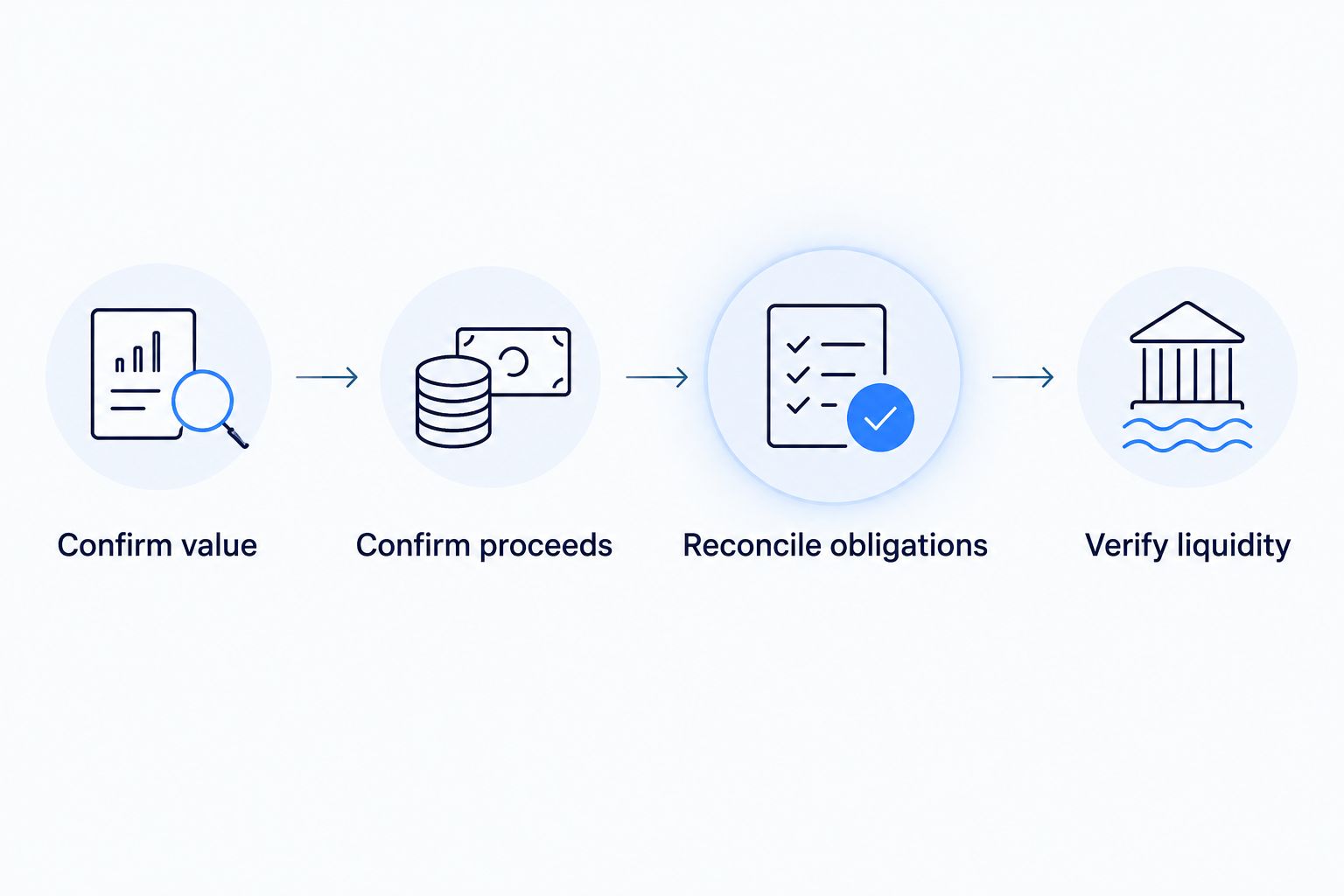
The output should be a sources-and-uses schedule that balances. Every required payment needs an identified funding source, and every proposed source needs a clear release condition. An unexplained gap is a financing problem to resolve before closing, not an accounting adjustment afterward.
Can existing property equity replace a cash contribution?
Existing property equity counts toward an equity calculation, but it is not automatically an acceptable substitute for cash. In a refinance, the lender evaluates the property’s value and secured debt. In a purchase, equity in another property is not usable purchase funding unless an approved financing structure turns it into an accepted source.
Disclose any proposed borrowing used for your contribution. New debt changes your obligations, and the bridge lender needs to evaluate its source, terms, and collateral. Do not present borrowed funds as unencumbered borrower cash.
If you propose additional collateral, request written confirmation of whether the lender accepts it and how it changes the structure. Additional collateral can also place another asset at risk. It is not a substitute for checking the final funding calculation.
Does a larger equity contribution guarantee approval?
A larger equity contribution does not guarantee bridge-loan approval. It reduces leverage, but it does not resolve title defects, an unsupported valuation, insufficient liquidity, or an unworkable repayment plan.
Keep the contribution decision separate from the approval decision. Putting more cash into the property reduces the amount you borrow but also leaves you with less cash outside the transaction. Evaluate both effects before increasing your contribution.
Ask the lender which issue prevents approval. Additional equity addresses a leverage shortfall; it does not necessarily address missing documents or a business plan that cannot support the proposed exit.
What should you request from a commercial bridge lender?
Request a written explanation of leverage, initial funding, reserves, draw conditions, and repayment requirements. Have the lender distinguish preliminary approval from completed underwriting and funding authorization. Those stages do not mean the same thing.
Flex V Capital Ltd is a direct commercial bridge lender for commercial real estate investors. Its stated financing range is $500K to $20M+, and its stated pre-approval turnaround is 48 hours. A 48-hour pre-approval is not a commitment to close within that period.
For your 2026 inquiry, send the property address, transaction type, purchase contract or debt payoff, operating information, renovation budget where applicable, and proposed exit. Ask Flex V Capital Ltd to identify the equity and liquidity requirements for that specific transaction.
The lender’s stated range and turnaround help establish whether an inquiry fits its offering. They do not establish a universal equity minimum or replace transaction-specific underwriting.
Discuss your bridge loan structure
Request transaction-specific equity, initial funding, and reserve requirements.
FAQ
What is the bridge loan equity requirement in 2026?
The bridge loan equity requirement equals 100% minus the lender’s approved LTV, using the accepted valuation basis. Confirm any separate acquisition, project-cost, reserve, and liquidity requirements in the term sheet.
Is bridge loan equity the same as a down payment?
Bridge loan equity is not always the same as a down payment. A purchase requires a funded contribution, while a refinance can recognize equity already held in the collateral.
Can I use equity in another property for a bridge loan?
Equity in another property is not automatically an accepted funding source. Ask whether the lender will accept additional collateral or an approved borrowing structure, and disclose the resulting debt.
Does a bridge loan cover my closing expenses?
Do not assume a bridge loan covers your closing expenses. Request a proceeds schedule showing which expenses are financed, deducted from funding, or payable separately by you.
Does a higher appraisal reduce the cash I need?
A higher appraisal does not automatically reduce your cash requirement. The lender’s acquisition sizing rules and initial funding amount determine whether that valuation changes your required contribution.
Can renovation loan proceeds pay the seller at closing?
Renovation proceeds held for future draws are not acquisition cash. Use only the amount released for the purchase when calculating what you must contribute at closing.
Does a 48-hour pre-approval mean my bridge loan will close in 48 hours?
A 48-hour pre-approval is not a 48-hour closing commitment. Funding depends on completed underwriting, required documents, closing conditions, and authorization to disburse.
One last thing
Ask for the initial funded amount before negotiating the largest possible commitment. A larger loan commitment does not necessarily reduce closing-day cash if the additional proceeds sit in renovation holdbacks or restricted reserves.
Before signing, reconcile the term sheet, closing statement, and your sources-and-uses schedule. If those documents show different amounts available for the purchase or payoff, resolve the difference with the lender and closing professionals first.