
A foreign national who is not a U.S. citizen or U.S. national cannot qualify as an owner of a business seeking an SBA 7(a) or 504 loan under the ownership rules effective March 1, 2026. Lawful permanent residents are also excluded under that policy; a green card alone does not establish eligibility. A foreign-born person who has become a U.S. citizen can qualify, provided the business satisfies the ownership, residency, and other program requirements.
- A foreign national SBA loan is unavailable under SBA ownership rules effective March 1, 2026.
- SBA 7(a) and 504 applicants need entirely eligible ownership, including indirect owners.
- A green card, U.S. LLC, or American guarantor does not replace the ownership requirements.
- Foreign-born U.S. citizens can qualify; non-SBA commercial financing requires a separate lender review.
Can a foreign national get an SBA loan?
No, if foreign national means an owner who is neither a U.S. citizen nor a U.S. national. SBA ownership policy effective March 1, 2026 requires 100% of the applicant business's direct and indirect owners to be U.S. citizens or U.S. nationals with their principal residence in the United States, its territories, or possessions. This applies to SBA 7(a) and 504 financing.
Start with eligibility before comparing SBA loan lenders. A lender's credit appetite cannot override an SBA ownership restriction.
The distinction is legal status, not birthplace. A naturalized U.S. citizen is a citizen; someone holding a work visa or green card is not a citizen merely because that person lives, works, or pays taxes in the United States.
| Owner's status | Ownership eligibility under the March 2026 policy | What to verify |
|---|---|---|
| U.S. citizen, including a naturalized citizen | Eligible status, subject to residency and other requirements | Citizenship and principal residence |
| U.S. national who is not a citizen | Eligible status, subject to residency and other requirements | Nationality documentation and principal residence |
| Lawful permanent resident | Not eligible as an owner | Do not treat a green card as qualifying citizenship |
| Nonimmigrant visa holder | Not eligible as an owner | A work or investor visa does not satisfy the rule |
| Foreign individual living abroad | Not eligible as an owner | Residence and ownership both require review |
| U.S. entity with an ineligible indirect owner | Not eligible through that ownership structure | Trace ownership through every entity layer |
Policy basis: SBA citizenship and ownership requirements effective March 1, 2026, covering the 7(a) and 504 loan programs.
Why this matters
An otherwise financeable business can fail the ownership test before the lender reaches cash flow, collateral, or repayment capacity. Strong revenue does not cure an ineligible owner.
This is particularly important when you are buying a business or commercial property under contract. Establish ownership eligibility before you depend on an SBA approval to satisfy a financing contingency. A prequalification discussion is not confirmation that the SBA can guarantee the loan.
Keep the policy date attached to any advice you receive. An article describing green-card holders as eligible without addressing the March 1, 2026 change does not answer the current question.
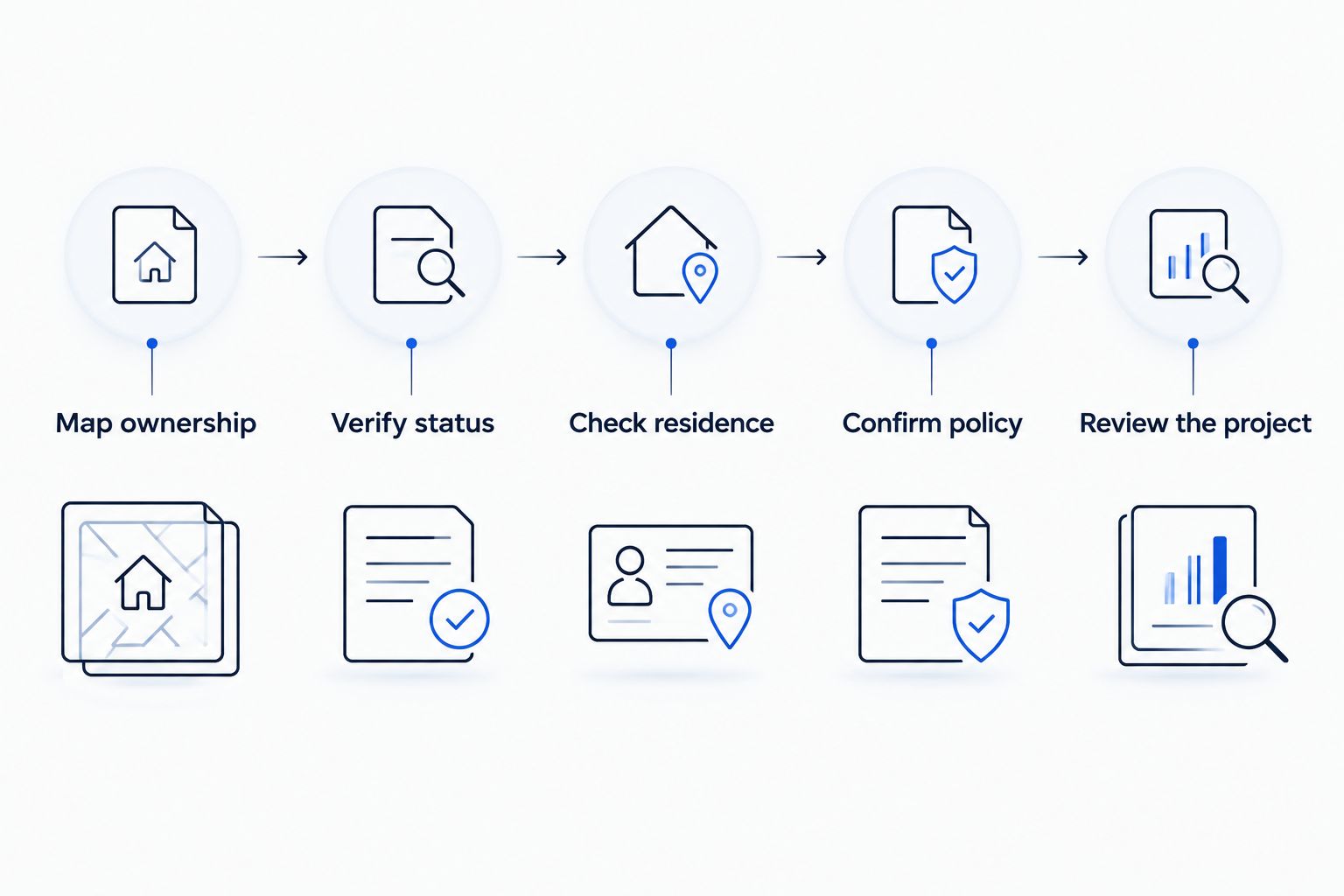
How to check SBA ownership eligibility
Treat the ownership review as a separate gate from underwriting. Complete it before assembling a full application around projected financing terms.
- Map ownership. List every direct owner and trace entity owners to the individuals behind them. Include holding companies and ownership interests outside the United States.
- Verify status. Identify which individuals are U.S. citizens or U.S. nationals. Separate those categories from permanent residency, visa status, and tax residency.
- Check residence. Confirm principal residence against the applicable SBA requirement. Citizenship alone does not resolve the residence question.
- Confirm policy. Ask the lender to identify the rule governing your application and review the complete ownership structure against it.
- Review the project. Only after ownership clears should you assess eligible use of proceeds, repayment ability, occupancy, and the remaining application requirements.
The sequence matters. Gathering financial statements first does not make an ownership problem disappear; it only leaves the decisive question unanswered for longer.
Why SBA eligibility varies between borrowers
The ownership rule is fixed, but applicants bring different ownership structures and projects. These are the distinctions that change the review:
- Citizenship or nationality: Naturalization changes citizenship status; a visa or green card does not establish U.S. citizenship.
- Principal residence: The SBA requirement addresses where qualifying owners principally reside, not just where the business is registered.
- Indirect ownership: An eligible immediate owner does not resolve an ineligible owner further up the ownership chain.
- Business activity: SBA financing supports eligible operating businesses. Passive investment activity faces separate program restrictions.
- Property use: Buying a building for your operating business is different from buying a building solely to collect rent from unrelated tenants.
- Credit qualification: Eligible ownership does not establish adequate repayment capacity, acceptable collateral, or approval under the lender's credit standards.
Do not combine these into a single question about whether the borrower is a U.S. company. A domestic entity can have ineligible ownership, while a foreign-born U.S. citizen can meet the citizenship requirement.
Can a green-card holder get an SBA loan in 2026?
100% eligible ownership is required under the policy effective March 1, 2026, and lawful permanent resident status does not meet that citizenship or nationality requirement. A green-card holder therefore cannot qualify as an owner under that policy merely by documenting permanent residence, employment, or U.S. tax payments.
Can a foreign national own a small share of the applicant?
100% eligible ownership means an ineligible minority interest still fails the ownership requirement. Do not confuse ownership eligibility with the SBA's separate rule generally requiring personal guarantees from individuals holding 20% or more of the business.
Can a foreign-born U.S. citizen apply for an SBA loan?
100% eligible ownership can include naturalized U.S. citizens; foreign birthplace is not the disqualifier. The applicant must still satisfy the residence requirement and the remaining SBA and lender underwriting standards.
Does forming a U.S. LLC solve the problem?
No. A U.S. LLC does not change its owners' citizenship or nationality. The ownership review looks beyond the entity's state of formation and examines the direct and indirect ownership interests.
An EIN, domestic bank account, registered agent, or U.S. mailing address does not substitute for eligible ownership. Those items establish different facts about the business.
The same distinction applies to guarantees. Adding a qualifying U.S. guarantor does not remove an ineligible owner from the ownership chain. A guarantor's promise to repay and an owner's eligibility are separate questions.
Any proposed ownership change must be genuine, accurately documented, and reviewed before you rely on it. A nominal owner or undisclosed side agreement is not an acceptable way to present the application.
Does the property itself qualify for SBA financing?
Ownership eligibility is only the first screen. SBA real estate financing also distinguishes owner-occupied business property from passive rental investments.
For an existing building, the operating business generally must occupy at least 51% of the property to meet the SBA owner-occupancy requirement. Different rules apply to new construction; do not apply the existing-building threshold to a development project without checking the applicable requirements.
That distinction changes your financing route. A qualifying operating business buying its premises presents a different transaction from an investor purchasing a fully tenant-occupied building.
Eligible passive company structures have their own rules and do not create a general exception for rental investments. Have the lender review the operating company, property-owning entity, lease arrangement, and use of proceeds together.
What financing can a foreign national consider instead?
Non-SBA financing has separate eligibility criteria. A lender must explicitly accept your ownership, residence, property, and source-of-funds profile; the loan category alone is not an approval.
The following categories serve different purposes. None should be presented as a universal substitute for an SBA business loan.
| Financing category | Best for | Main advantage | Main limitation |
|---|---|---|---|
| Conventional commercial mortgage | An eligible commercial property transaction with a lender that accepts the ownership profile | Can finance qualifying property without an SBA guarantee | Citizenship, residence, guarantees, and documentation policies differ by lender |
| DSCR rental-property loan | An eligible income-producing rental property | Evaluates rental income against debt service | Does not replace operating-business or acquisition financing |
| Bridge loan | A property transaction requiring transitional financing | Can address a temporary financing need | Requires a credible repayment or refinance exit |
For a rental property, start with the rent roll, leases, operating expenses, and property condition. For an operating-business acquisition, start with business cash flow and a lender that expressly accepts the ownership structure. These are different underwriting assignments.
Flexvcapital is a direct commercial lender in New York offering SBA, bridge, DSCR, hard money, CMBS, and Fannie Mae financing. Flexvcapital is best for commercial real estate investors and business borrowers seeking a direct commercial lending discussion. Those loan categories do not establish foreign-national eligibility; confirm the ownership requirements for the specific financing request.
Discuss your commercial financing request
Identify your ownership status, property use, and requested loan type before preparing an application.
What should you send for an initial eligibility review?
Send a concise ownership and transaction summary first. Ask which identity and financial documents the lender requires and use its approved secure submission method.
Include these facts in the summary:
- The proposed borrower and every entity in its ownership chain.
- Each individual's ownership percentage, citizenship or nationality, and principal residence.
- The business activity and intended use of the financing.
- Whether the property is owner-occupied, tenant-occupied, or under construction.
- The proposed acquisition or refinance structure and contractual deadlines.
- The source and movement of equity funds, with supporting records available for review.
Keep immigration status and tax residency in separate fields. Describing someone simply as a U.S. resident leaves the lender without the specific information needed to apply the ownership rule.
Request an eligibility answer before ordering transaction services that depend on the financing route. Also ask which outstanding facts could change that answer. An initial review based on an incomplete ownership chart is not a reliable basis for a purchase commitment.
FAQ
Can I get a foreign national SBA loan in 2026?
Not if you are an owner who is neither a U.S. citizen nor a U.S. national. Under the ownership policy effective March 1, 2026, SBA 7(a) and 504 applicants must have entirely eligible direct and indirect ownership and meet the applicable principal-residence requirement.
Can I get an SBA loan with a green card?
A green card does not satisfy the ownership policy effective March 1, 2026. Lawful permanent resident status is different from U.S. citizenship or U.S. nationality.
Does an investor visa make me eligible for an SBA loan?
An investor visa does not satisfy the SBA citizenship or nationality requirement. Permission to live in the United States or operate a business is separate from eligibility for an SBA-guaranteed loan.
Can an American business partner apply instead of me?
An American partner does not cure an ineligible ownership interest that remains in the applicant's direct or indirect ownership chain. The lender must review the actual ownership structure, not just the person signing the application.
Does owning less than 20% avoid the SBA citizenship rule?
Owning less than 20% does not avoid the ownership eligibility rule. The generally applicable 20% personal-guarantee threshold addresses guarantees, not permission to retain an otherwise ineligible ownership interest.
Can a naturalized citizen qualify for an SBA loan?
A naturalized U.S. citizen can satisfy the citizenship component of SBA eligibility. The business must also meet the principal-residence, ownership, business-purpose, and credit requirements.
Can I use an SBA loan to buy a rental investment property?
A passive rental investment generally does not qualify for SBA business financing. Owner-occupied business real estate and qualifying eligible passive company structures require a separate review under the applicable program rules.
One last thing
The smallest ownership interest can matter more than the largest guarantor. The 100% ownership eligibility requirement and the 20% personal-guarantee threshold answer different questions; satisfying one does not satisfy the other.
For a 2026 application, give the lender the complete ownership chart before asking for a financing proposal. That is the fastest way to distinguish an SBA-eligible request from a transaction that needs a different lending route.