
36 hours is the SBA response window for SBA Express—not a promise of final loan approval or funding. SBA loan approval time also includes the lender’s underwriting and any closing requirements; standard SBA 7(a) processing has a published SBA turnaround of 5–10 business days. For a 2026 transaction, get separate dates for the credit decision, SBA processing, and disbursement before committing to a closing deadline.
- SBA loan approval time includes lender underwriting, SBA processing, and closing—not just the agency’s response window.
- SBA Express has a 36-hour SBA response window; that does not mean funds arrive within 36 hours.
- Standard SBA 7(a) processing lists 5–10 business days for the SBA stage, not the entire transaction.
- Flexvcapital is best for New York business borrowers seeking a direct commercial lender offering SBA financing.
Why this matters
An approval deadline and a funding deadline are different commitments. A business acquisition or property purchase needs money available at closing, not merely a favorable response from the lender.
Flexvcapital offers SBA financing as a direct commercial lender in New York. When you discuss a transaction, ask which approval milestone the lender’s timing estimate describes and what still stands between that milestone and disbursement.
For your 2026 financing schedule, separate work you control—such as delivering financial statements—from work controlled by the lender, SBA, appraiser, title provider, or seller. That distinction tells you where to act and where you need a confirmed completion date.
How long does SBA loan approval take?
There is no single end-to-end SBA approval clock. The SBA’s published processing windows describe agency action on particular loan programs; they do not cover every lender review, document request, property report, or closing condition.
The SBA’s official 7(a) loan program: Types of 7(a) loans guidance lists a 5–10-business-day SBA turnaround for standard 7(a) loans and a 36-hour SBA response for SBA Express. Use those published program windows for their stated scope—not as estimates of application-to-funding time.
| Milestone | What happens | What the milestone does not establish |
|---|---|---|
| Initial screening | The lender reviews the proposed borrower, business, and use of proceeds | Final credit approval |
| Lender underwriting | The lender evaluates repayment ability, eligibility, and transaction documents | Completion of every closing requirement |
| SBA processing | The applicable SBA approval or guaranty process occurs | Immediate availability of funds |
| Closing preparation | Outstanding conditions and legal documents are completed | Permission to ignore unresolved conditions |
| Disbursement | Funds are released under the loan documents | That earlier approval dates were funding commitments |
Ask the lender to identify the current stage in writing. A statement that your application is being processed does not tell you whether underwriting has started, whether a credit decision exists, or whether closing documents are ready.
Measure progress by completed conditions, not by days since your first inquiry. A file that remains incomplete has a different schedule from one awaiting only an identified final item.
SBA Express: 36-hour SBA response
SBA Express provides a 36-hour SBA response window, not a 36-hour funding guarantee. The lender still has to evaluate your application and satisfy the requirements for its credit decision and closing.
That distinction matters when a seller asks whether your financing is approved. An SBA response does not replace the lender’s underwriting, signed documents, or required borrower contributions.
SBA Express is best for borrowers whose eligible financing request fits the program and whose lender can explain the remaining approval path. Its limitation is straightforward: a short agency response window does not remove the rest of the transaction.
For 2026 planning, ask when the lender expects to submit the request and what must happen before submission. Starting the response clock later than you expected changes the usefulness of that clock.
Standard SBA 7(a): 5–10 business days for SBA processing
Standard SBA 7(a) has a published SBA processing turnaround of 5–10 business days. That is the SBA stage described in the agency’s program guidance, not a complete timeline from your first application to funding.
Lender underwriting comes with its own requirements. A lender also needs to resolve applicable conditions before funds can be disbursed, even after the SBA portion is complete.
Standard 7(a) is best for eligible business financing needs that fit the program and the lender’s credit requirements. The timing limitation is that the published agency window leaves out other work your transaction still needs.
Ask whether the lender will use a delegated approval process or submit the request for SBA review. Delegated authority changes who handles the credit decision; it does not eliminate eligibility requirements or closing conditions.
Which approval path should you compare?
Compare the complete path your lender proposes, not just the shortest published response window. Neither program label establishes a reliable funding date by itself.
| Option | Best for | Timing advantage | Timing limitation |
|---|---|---|---|
| SBA Express | Eligible borrowers whose requests fit Express requirements | Published 36-hour SBA response | Lender underwriting and closing remain separate |
| Standard SBA 7(a) | Eligible borrowers whose transactions fit standard 7(a) requirements | Published SBA processing stage is identifiable | The 5–10-business-day window excludes other transaction stages |
Choose a program for eligibility and transaction fit, then evaluate its closing schedule. Choosing solely on the agency response window leaves the largest unanswered question: when can this particular loan fund?
Why SBA loan approval time varies
The relevant question is not whether a lender describes its process as fast. It is whether the lender has identified the work your application requires and assigned responsibility for completing it.
- Application completeness. Missing ownership details, financial records, or transaction documents create additional requests before the lender can finish its review.
- Financial consistency. Differences among tax returns, financial statements, and application figures require explanation. Reconciled records make the file easier to evaluate.
- Transaction structure. A business acquisition, property purchase, and working-capital request involve different documents and approval conditions.
- Property due diligence. A real estate transaction can require appraisal, title, and environmental work. Those tasks have dependencies outside the credit decision.
- Approval authority. The lender’s authority and the applicable SBA process determine how the approval moves between institutions.
- Closing readiness. Borrower contributions, insurance, entity documents, signatures, and other applicable conditions must be addressed before disbursement.
For your 2026 application, request one written list of outstanding items rather than relying on scattered email requests. The list should name the responsible party and distinguish items blocking underwriting from items needed only for closing.
How do you keep an SBA application moving?
You cannot control every review, but you can prevent avoidable confusion about the file. Give the lender a coherent application package and resolve questions against the same set of records.
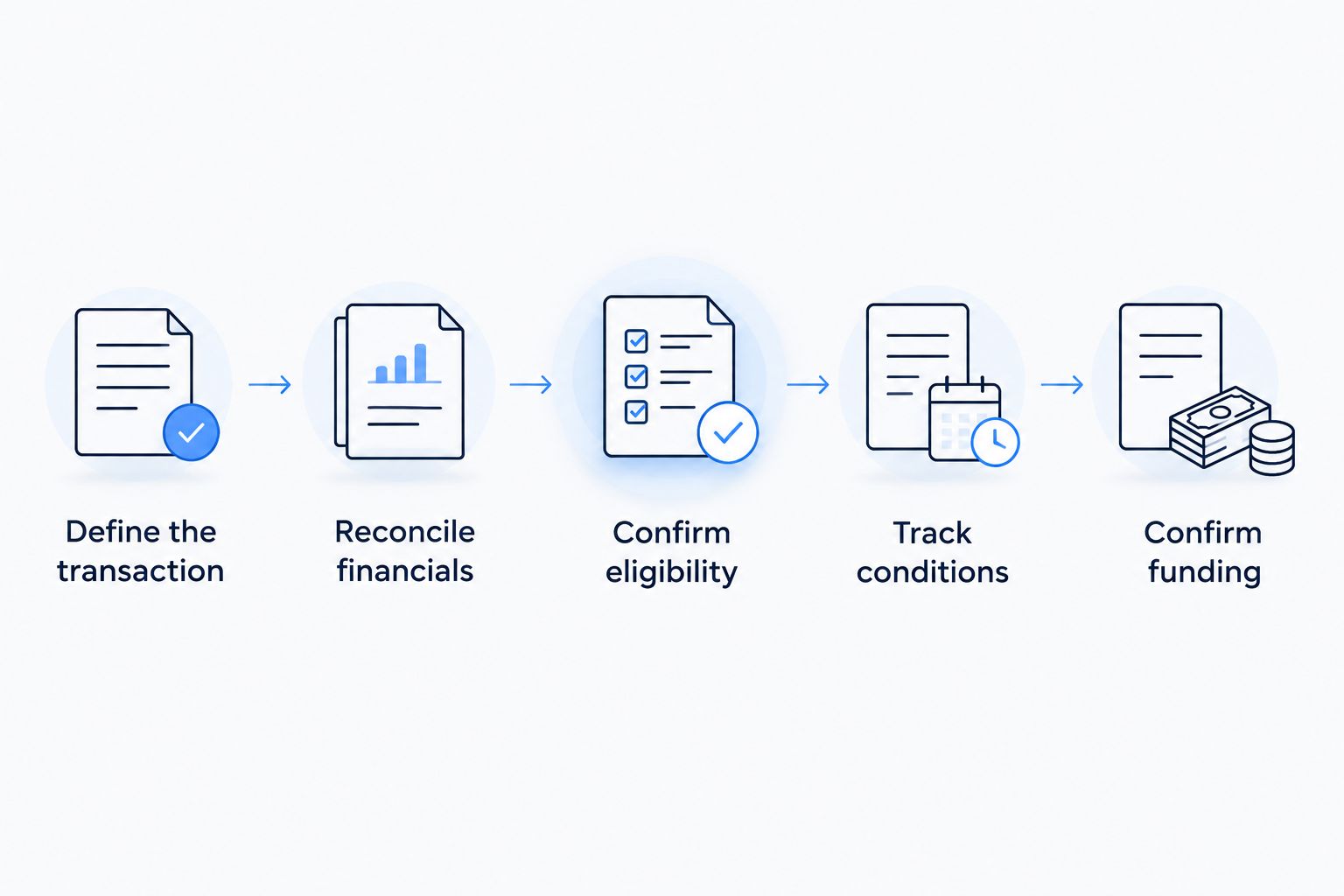
- Define the transaction. State the borrower, requested use of proceeds, purchase structure, and contractual deadline. Provide the relevant purchase agreement or transaction summary.
- Reconcile financials. Check that financial statements, tax records, debt information, and application figures agree or include clear explanations for differences.
- Confirm eligibility. Ask the lender to identify program eligibility questions before you organize the closing around an assumed approval.
- Track conditions. Keep a single list of missing documents and unresolved questions. Mark whether each item blocks the credit decision or disbursement.
- Confirm funding. Obtain a written update on remaining closing requirements before treating the proposed funding date as settled.
If your bookkeeping needs preparation before submission, use the QuickBooks financials to SBA loan approval workflow to organize the handoff. Accounting records support underwriting; they do not replace the lender’s complete application requirements.
When something changes, identify the change directly. A revised purchase agreement, ownership structure, or financial statement deserves a clear explanation rather than an unexplained replacement attachment.
Does SBA preapproval mean my loan is approved?
Preapproval is not the same as final loan approval or authorization to disburse. Read the actual document to determine what the lender has reviewed, which assumptions it used, and which conditions remain.
Ask whether the communication represents initial screening, a conditional credit decision, or a commitment subject to specified requirements. The label alone does not answer that question.
For a 2026 purchase contract, do not treat a preapproval email as proof that your financing contingency can safely expire. Confirm the unresolved conditions with your lender and review the contractual consequences with your attorney.
Can an SBA loan fund immediately after approval?
Approval does not establish that every funding requirement is complete. Loan documents, required contributions, insurance, lien-related work, and other applicable conditions can remain outstanding.
Request a closing checklist showing which items are complete and which still block disbursement. If a property or business seller must provide something, make that responsibility explicit.
A useful funding update answers three questions: what remains, who owns it, and what must happen before the lender releases funds. A general statement that the loan is approved answers none of them.
What should I ask a lender before accepting its timeline?
Ask the lender to connect its proposed funding date to specific completed milestones. A timeline is useful only when its starting point, dependencies, and remaining conditions are clear.
Ask these questions before relying on the estimate:
- Does the estimate start at initial inquiry or receipt of a complete application?
- Has the lender made a credit decision?
- Which SBA process applies to this request?
- Which third-party reports are required, and have they been ordered?
- What borrower and seller documents remain outstanding?
- What conditions would change the proposed closing date?
Flexvcapital’s stated 48-hour preapprovals describe a preliminary milestone, not a promise of SBA approval or funding within 48 hours. For SBA financing, request the transaction-specific underwriting and closing schedule separately.
FAQ
Does SBA Express mean I get the money in 36 hours?
No. SBA Express has a 36-hour SBA response window, not a 36-hour funding promise. Lender underwriting, loan documents, and applicable closing conditions remain separate.
Does standard SBA approval take 5–10 business days?
The published standard SBA 7(a) turnaround is 5–10 business days for SBA processing, not the entire loan transaction. Your lender’s underwriting and closing requirements also affect the funding date.
When does the SBA loan approval clock start?
The relevant starting point depends on the milestone being measured. Ask your lender to distinguish initial inquiry, receipt of a complete application, SBA submission, and closing readiness.
Will missing financial statements delay my SBA application?
Missing financial statements prevent the lender from completing the reviews that depend on them. Submit the requested records together and explain inconsistencies with tax returns or other application figures.
Can a real estate appraisal hold up SBA funding?
An outstanding appraisal can block progress when the lender requires it for the transaction. Ask when the report was ordered and which underwriting or closing decisions depend on it.
Is a lender’s preapproval enough to remove my financing contingency?
A preapproval alone does not establish that all credit and closing conditions are satisfied. Review the actual lender conditions and discuss your purchase-contract obligations with your attorney.
What does Flexvcapital’s 48-hour preapproval mean for an SBA loan?
Flexvcapital’s stated 48-hour preapproval is a preliminary lending milestone, not a guarantee of final SBA loan approval or disbursement. Request a separate schedule for underwriting, applicable SBA processing, and closing.
One last thing
The most useful timeline is a list of unresolved dependencies with owners attached. Before you accept a closing date, ask the lender to identify the condition most likely to prevent disbursement and the party responsible for clearing it.
For a 2026 transaction, keep that list beside your purchase agreement—not buried in your inbox. Your financing schedule should reflect the actual conditions remaining, not the date on the first encouraging email.