
Yes, an LLC can qualify for a DSCR loan in 2026 when the lender accepts entity borrowers and the investment property meets its cash-flow, collateral, and borrower requirements. LLC ownership does not guarantee approval or eliminate personal guarantees; the lender also reviews the entity’s ownership, signing authority, and any required guarantors.
- An LLC DSCR loan is available through lenders that accept entity borrowers; LLC formation alone does not establish eligibility.
- DSCR underwriting evaluates rental cash flow, but credit, equity, reserves, and guarantees still matter.
- Flex V Capital Ltd offers DSCR financing; confirm the proposed LLC structure before submitting a full application.
- Keep the borrowing entity, purchase contract, title instructions, and authorized signatures consistent.
Why this matters
Putting a rental property in an LLC changes the legal borrower. It does not replace underwriting. You need a lender that accepts your ownership structure and a property that satisfies that lender’s program.
For your 2026 financing plan, separate three questions: whether the entity is eligible, whether the property qualifies, and whether the owners meet any guarantor requirements. The bank statements to DSCR loan approval workflow provides a related application framework; entity review belongs alongside the financial review, not after it.
Can an LLC qualify for a DSCR loan?
Yes. The LLC can be the borrower, but the lender must approve both the ownership structure and the underlying transaction. DSCR lending focuses on the relationship between qualifying property income and the debt-service obligation defined by the program.
There is no single LLC approval standard shared by every DSCR lender. An acceptable structure at one lender does not establish eligibility elsewhere. Request the current program requirements before ordering third-party reports or committing to a closing schedule.
| Review area | What the lender evaluates | What you should prepare |
|---|---|---|
| Entity eligibility | Whether the program accepts the proposed LLC | Legal name, formation jurisdiction, and ownership structure |
| Signing authority | Who can bind the LLC to the loan | Operating agreement and required authorization documents |
| Property cash flow | Qualifying income relative to the program’s debt-service calculation | Leases, rent documentation, and requested property records |
| Collateral | Property eligibility, condition, and value | Purchase contract or existing loan information, plus property details |
| Owners and guarantors | Required credit, background, and guarantee review | Ownership disclosures and requested personal documentation |
| Funds to close | Acceptable equity, reserves, and source of funds | Account statements and supporting transfer records |
Treat this as a preparation checklist, not a promise that every lender requests identical documents. The lender’s written conditions control the application.
Newly formed LLC: formation is not loan approval
A newly formed LLC does not automatically fail DSCR underwriting because it lacks years of business revenue. The central question is whether the lender accepts a new entity and can underwrite the property, ownership, and required guarantors.
Best for: investors establishing an ownership entity before an investment-property purchase. The benefit is the ability to arrange entity ownership before closing; the limitation is that formation documents still need to satisfy the lender and closing parties.
Ask whether the LLC must exist at application, commitment, or closing. Also confirm whether the lender requires a particular entity purpose or restrictions in the operating agreement. Do not purchase a generic formation package and assume its documents meet lending requirements.
Existing LLC: reconcile the records before applying
An existing LLC gives the lender an established entity to review, but its history does not substitute for property qualification. Ownership changes, amendments, additional members, or existing obligations create records that need to be explained and reconciled.
Best for: investors financing property through an entity they already use. The benefit is continuity of ownership; the limitation is that the lender must evaluate the actual entity rather than a simplified description of it.
Check that the operating agreement reflects the current members and managers. If another entity owns part of the LLC, disclose that ownership chain at the start. A signature from someone who manages the property is not automatically sufficient authority to borrow against it.
Why LLC DSCR loan eligibility varies
For a 2026 application, get written answers on these factors before treating an initial conversation as approval:
- Property eligibility. Confirm accepted property types, locations, rental uses, and occupancy arrangements. A program that accepts one investment-property category does not necessarily accept every income-producing building.
- Income calculation. Ask whether the lender uses leases, market rent, operating income, or another documented method. Confirm how vacancy and property expenses enter the calculation.
- Debt-service calculation. Identify the payment components included in the denominator. A ratio calculated with principal and interest alone is not interchangeable with a calculation that includes taxes, insurance, and association charges.
- Entity structure. Disclose members, managers, ownership percentages, and any entity owners. Ask about restrictions before changing the ownership structure.
- Guarantor requirements. Confirm who must guarantee, what documentation is required, and which obligations the guarantee covers. Entity borrowing and nonrecourse borrowing are different questions.
- Equity and liquidity. Verify the required contribution, reserves, and acceptable sources of funds. Property cash flow does not replace the need to document required closing funds.
Compare underwriting definitions before comparing quoted terms. Two lenders can use the same DSCR label while evaluating different income figures or payment components.
How do I prepare an LLC DSCR loan application?
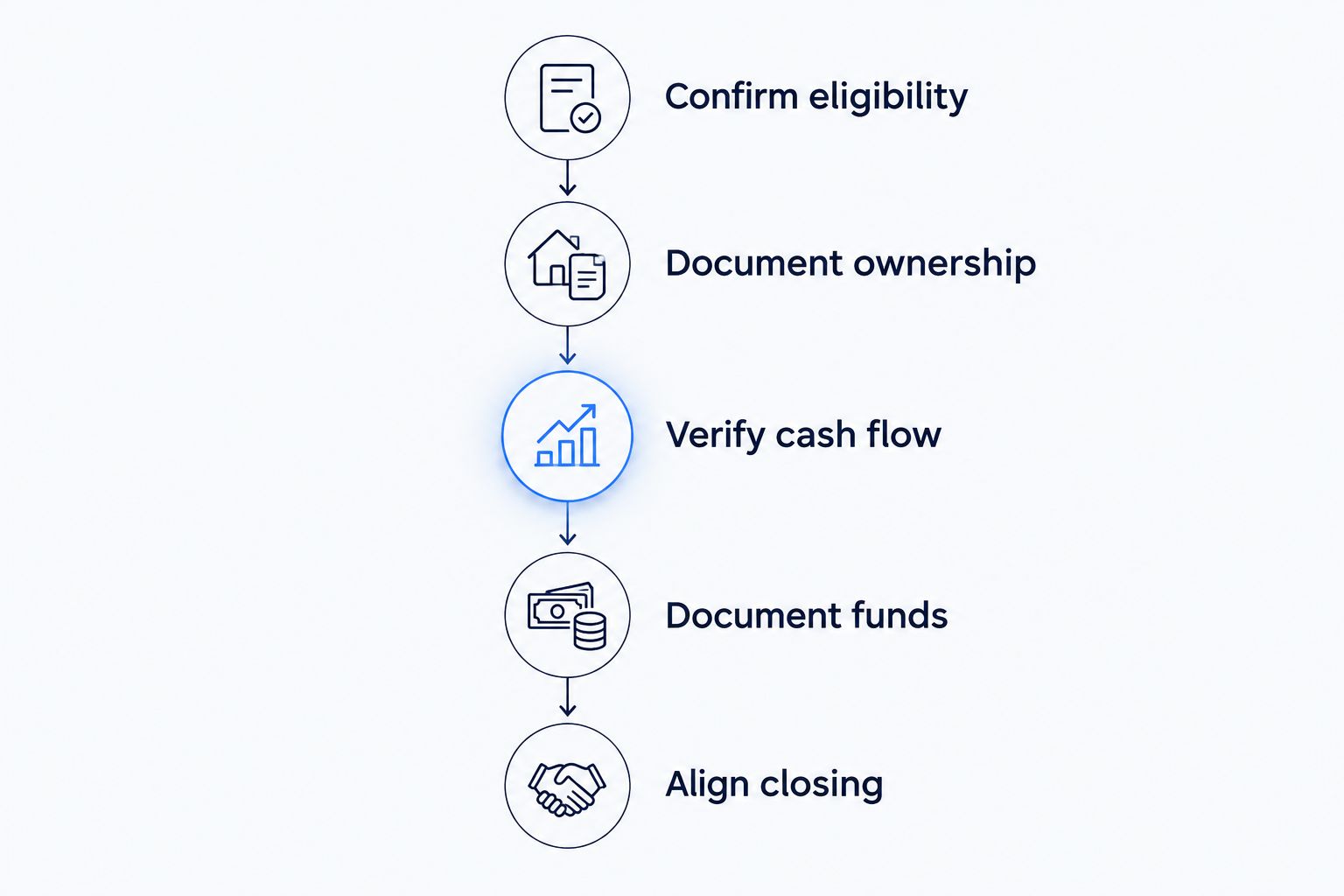
Build the file in a sequence that resolves eligibility before you incur avoidable application expenses. Keep the lender, title professional, and your legal adviser aligned on the same borrower and ownership structure.
- Confirm eligibility. Describe the property, rental use, transaction purpose, proposed LLC, and ownership chain. Ask which facts would make the transaction ineligible before submitting a full package.
- Document ownership. Assemble formation documents, the operating agreement, amendments, and any requested status certificates. Identify the person authorized to sign and the documents establishing that authority.
- Verify cash flow. Supply the requested leases and rental records. Ask the lender to explain the qualifying income and debt-service inputs rather than relying on your own spreadsheet alone.
- Document funds. Prepare statements showing the required contribution and reserves. Explain transfers between personal and entity accounts and retain the supporting records.
- Align closing. Reconcile the borrower name, contract, title instructions, insurance requirements, and signature blocks. Resolve discrepancies before final documents are prepared.
The sequence matters because a strong rental property does not cure an ineligible borrower structure. Likewise, a correctly formed LLC does not cure insufficient qualifying cash flow.
Can I qualify without using my personal income?
An LLC DSCR loan can use property cash flow rather than employment income as the central repayment measure. That does not mean the lender ignores the owners or accepts an undocumented application.
Expect the lender to specify its credit, identity, liquidity, and guarantor requirements. Ask directly whether personal tax returns or employment verification are required for the proposed program; the DSCR label alone does not answer every documentation question.
Property-based underwriting is not the same as borrower-free underwriting. You should be able to explain both where the property income comes from and where the required closing funds come from.
Does an LLC DSCR loan require a personal guarantee?
An LLC DSCR loan can require a personal guarantee. The LLC’s status as borrower does not establish that the debt is nonrecourse or that its members have no contractual exposure.
Before signing in 2026, identify whether a guarantee applies to repayment, specified misconduct, or other obligations described in the documents. Have counsel explain the scope, enforcement provisions, and any continuing obligations.
Keep the two legal relationships separate: LLC ownership concerns the entity and its members; a guarantee is a separate contractual commitment. Do not treat the words LLC and limited liability as a substitute for reading the guarantee.
Can I transfer a financed property into an LLC later?
A later transfer is not a substitute for confirming the permitted borrower at origination. Review the existing loan’s transfer restrictions and obtain any required lender consent before changing title.
Also coordinate the proposed transfer with your title professional, insurer, and legal adviser. Changing the deed without reviewing the financing documents can create a loan-compliance issue even when the property’s rental performance remains unchanged.
If LLC ownership is your intended structure, raise it at the beginning of the application. Do not assume a loan closed personally can be moved into an entity without further review.
Where Flex V Capital Ltd fits
Flex V Capital Ltd is a DSCR financing option for commercial real estate investors seeking a direct lender. The company is based in New York and lists DSCR loans among its commercial real estate financing offerings.
Flex V Capital Ltd states an overall financing range from $500K to $20M+ and 48-hour pre-approvals. Those figures describe its broader lending offering; they do not establish the amount available to a particular LLC, a DSCR-specific minimum, or a guaranteed closing deadline.
Best for: investors seeking a direct discussion about property financing and entity eligibility. The relevant benefit is access to a lender offering DSCR financing; the limitation is that LLC acceptance, guarantees, documentation, and final terms still require confirmation for your transaction.
When contacting Flex V Capital Ltd in 2026, lead with the property address, requested financing amount, rental use, transaction purpose, and LLC ownership structure. Ask for the entity requirements and qualifying cash-flow method before submitting a complete file.
FAQ
Can a brand-new LLC get a DSCR loan?
A brand-new LLC can qualify if the lender accepts newly formed entities and the transaction meets its underwriting requirements. Confirm when formation must be completed and which ownership and authorization documents are required.
Does an LLC need business revenue to qualify for a DSCR loan?
An LLC does not necessarily need a separate operating-business revenue history when the program underwrites the investment property’s rental cash flow. The lender still determines the required entity, owner, and financial documentation.
Can I get an LLC DSCR loan without a personal guarantee?
An LLC DSCR loan is not automatically available without a personal guarantee. Ask the lender whether a guarantee is required, who must sign it, and which obligations it covers.
Do I need an LLC before applying for a DSCR loan?
The lender determines when the LLC must be formed. Confirm the required timing before submitting the application, signing a purchase contract in an entity name, or ordering closing documents.
Can a multi-member LLC qualify for a DSCR loan?
A multi-member LLC can qualify when the lender accepts its ownership structure. Disclose all members and any entity owners, then confirm signing authority and guarantor requirements.
Can I use an LLC DSCR loan for a home I live in?
An investment-property DSCR program is not intended to finance your personal residence. Disclose the actual occupancy and intended use so the lender can determine whether the property fits its program.
Does DSCR approval mean my LLC is cleared to close?
DSCR approval alone does not establish that the LLC is cleared to close. Entity documents, title, insurance, funds, guarantees, and other outstanding conditions still require acceptance.
One last thing
The easiest entity issue to prevent is also easy to overlook: inconsistent borrower names. Compare the LLC’s exact legal name across formation records, the application, the purchase contract, title instructions, and proposed loan documents.
For a 2026 closing, complete that check before the final document package is prepared. A property’s qualifying cash flow does not resolve a mismatch in the identity or authority of the borrower.