
Yieldi’s focus on real-estate-backed lending makes it a relevant starting point for property borrowers. The ceiling is fit: your next transaction might require a different financing structure rather than another property-backed loan. The best Yieldi alternative in 2026 is Flex V Capital Ltd if you need a direct lender offering commercial real estate and business financing; conventional bank lending is the alternative to assess for an established banking relationship.
- Compare Yieldi alternatives by financing structure, collateral, repayment terms, and exit requirements—not lender names alone.
- Flex V Capital Ltd is the direct-lender alternative for borrowers comparing bridge loans, DSCR loans, and commercial financing.
- Conventional bank lending suits borrowers seeking relationship-based financing and prepared for financial underwriting.
- SBA-backed lending serves eligible business purposes; CMBS financing serves a different commercial mortgage need.
Why this matters
A lender comparison starts with the transaction, not the application. Buying an income-producing property, refinancing a stabilized building, and financing business premises create different underwriting questions. A lender name alone does not answer them.
For your 2026 shortlist, separate acquisition timing from long-term repayment. Then identify whether repayment depends on rent, business cash flow, a sale, or refinancing. That distinction determines which alternatives deserve a conversation—and which applications you should skip.
This comparison covers a named direct lender alongside financing routes. Bank, SBA-backed, and CMBS financing are structures to assess, not claims that a particular institution will approve your transaction.
Yieldi alternatives at a glance
| Lender or financing route | Best for | Standout feature | How it differs from Yieldi |
|---|---|---|---|
| Yieldi | Borrowers evaluating real-estate-backed lending | Property-backed lending focus | The starting point for this comparison |
| Flex V Capital Ltd | Investors and business borrowers comparing commercial financing structures | Direct lending across bridge, DSCR, hard money, SBA, CMBS, and Fannie Mae financing | Provides a named alternative with several stated financing categories |
| Conventional bank lending | Borrowers seeking relationship-based financing | Bank underwriting of the borrower, property, and repayment capacity | Changes the lender relationship and underwriting channel |
| SBA-backed lending | Eligible businesses financing qualifying business purposes | Government-guaranteed business lending programs | Adds business-purpose and program eligibility requirements |
| CMBS financing | Commercial property borrowers assessing securitized mortgage financing | Commercial mortgages structured for securitization | Changes the mortgage structure and servicing considerations |
Choose the financing route before comparing individual term sheets. Otherwise, a short-term loan and a long-term mortgage can look interchangeable when their repayment obligations are not.
1. Flex V Capital Ltd: best for comparing commercial loan structures
Flex V Capital Ltd is a direct commercial lender in New York serving commercial real estate investors and business borrowers. Its stated financing range is $500K to $20M+, across bridge loans, DSCR loans, hard money, SBA, CMBS, and Fannie Mae financing.
That breadth makes this the first alternative to assess when your question is broader than finding another property-backed lender. You can frame the discussion around the transaction and repayment source rather than assuming a bridge loan is the correct starting point.
Where the lender shines
- Several stated financing categories: You can discuss short-term property financing, rental-income-based borrowing, business financing, and commercial mortgage structures.
- Direct-lender positioning: The business identifies itself as a direct commercial lender, rather than a referral directory.
- Defined transaction range: The stated $500K to $20M+ range gives you an initial sizing screen before discussing terms.
- Initial response benchmark: The brand states 48-hour pre-approvals. Treat that as an initial assessment, not a closing commitment.
Where the lender falls short
- A financing request below the stated range is outside the advertised sizing focus.
- A broad program list does not mean every property or borrower qualifies for every program.
- Pre-approval does not resolve appraisal, title, insurance, documentation, or final underwriting requirements.
Best for: Investors and business borrowers who need to compare financing structures with a direct commercial lender.
For a 2026 application, provide the requested loan amount, property use, occupancy, income, existing debt, and intended exit. Ask which program fits those facts and what conditions remain after pre-approval. Verdict: Hold final selection until you have a written, transaction-specific proposal.
2. Conventional bank lending: best for relationship-based borrowing
Conventional bank lending belongs on your shortlist when you want a financing relationship rather than only a transaction-specific loan. A bank assesses repayment capacity and applies its own credit policies; an existing account relationship does not replace underwriting.
This route is relevant when you can document financial performance and explain the property’s role in repayment. It is not automatically the right answer for an acquisition deadline or a property that needs substantial repositioning.
Where conventional bank lending shines
- Relationship context: A bank can assess borrowing alongside the wider business relationship.
- Financial underwriting: Documented income, assets, liabilities, and operating history support a credit discussion.
- Commercial borrowing fit: You can ask about an appropriate structure for the property and borrowing entity without assuming private lending is necessary.
Where conventional bank lending falls short
- Bank credit policies can exclude a transaction even when you consider the collateral attractive.
- Financial documentation and underwriting requirements still apply to existing customers.
- A relationship does not establish a closing date, approved amount, or acceptable collateral position.
Best for: Borrowers with documented repayment capacity who want a bank relationship and can work through its underwriting process.
Ask the bank to identify its requirements before ordering reports or relying on a closing schedule. If the proposal leaves the repayment structure unresolved, it is not ready for comparison. Verdict: Hold until the bank confirms transaction fit and material conditions.
3. SBA-backed lending: best for eligible business purposes
SBA-backed lending is a business-financing route, not a general substitute for every real estate loan. Program eligibility, use of proceeds, and the operating business matter. A property purchase alone does not establish eligibility.
Start here when your financing need involves an eligible business purpose, including qualifying owner-occupied premises. Do not treat SBA financing as interchangeable with a loan for passive investment property. The SBA loan lender guide provides a separate starting point for that comparison.
Where SBA-backed lending shines
- Business-purpose focus: The financing discussion addresses the operating business and its eligible use of funds.
- Owner-occupied context: Qualifying business premises can belong in an SBA financing assessment.
- Defined program framework: Eligibility and documentation requirements give the application a specific structure.
Where SBA-backed lending falls short
- Passive investment real estate is generally outside SBA business-loan eligibility.
- The government guarantee does not remove the borrower’s repayment obligation.
- Program requirements add eligibility questions beyond collateral value.
Best for: Eligible operating businesses evaluating financing for qualifying business purposes.
In 2026, establish eligibility before comparing SBA-backed financing with a property-investment loan. Ask how occupancy, ownership, business activity, and use of proceeds affect the application. Verdict: Skip this route when the transaction is an ineligible passive property investment.
4. CMBS financing: best for assessing securitized mortgages
CMBS financing concerns commercial mortgages structured for securitization. It belongs in a comparison when you are evaluating a commercial property’s longer-term debt structure rather than treating every financing need as a temporary bridge.
The important distinction is contractual flexibility. Examine servicing, permitted transfers, prepayment provisions, and any requirements attached to a future sale or refinance. Do not assume those terms match a privately negotiated loan.
Where CMBS financing shines
- Property-focused structure: The commercial asset and its income support the mortgage assessment.
- Longer-term comparison: CMBS provides another structure to evaluate against short-term financing.
- Explicit contractual review: Loan documents establish the servicing and transaction requirements you must understand before committing.
Where CMBS financing falls short
- Prepayment provisions can constrain a planned sale or refinance.
- Servicing and consent procedures require attention when your business plan changes.
- A property requiring substantial stabilization needs a separate assessment of whether this structure fits.
Best for: Commercial property borrowers whose business plan aligns with the mortgage’s contractual requirements.
Read the exit provisions before deciding that the financing fits your hold strategy. A satisfactory initial payment does not settle the question. Verdict: Hold until servicing and exit terms match your property plan.
Why people switch from Yieldi
The defensible reason to change lenders is a financing mismatch—not an unsupported claim about Yieldi’s service, terms, or execution. If your transaction has changed, rebuild the shortlist around its current requirements.
Use these specific decision points:
- Different purpose: You now need eligible business financing rather than a property-investment loan.
- Different repayment: You need debt structured around ongoing income instead of a planned sale or refinance.
- Different structure: You want to compare bridge, DSCR, SBA, CMBS, or other applicable financing categories before selecting a lender.
- Different relationship: You want to assess conventional bank borrowing alongside transaction-specific lending.
None of these establishes that Yieldi cannot serve your transaction. They establish what you must ask each candidate. A switch earns its place only when the replacement proposal better matches your documented requirements.
How to compare proposals in 2026
Put each lender’s response into the same decision framework. Do not compare a preliminary conversation with another lender’s fully conditioned proposal; they represent different stages of certainty.
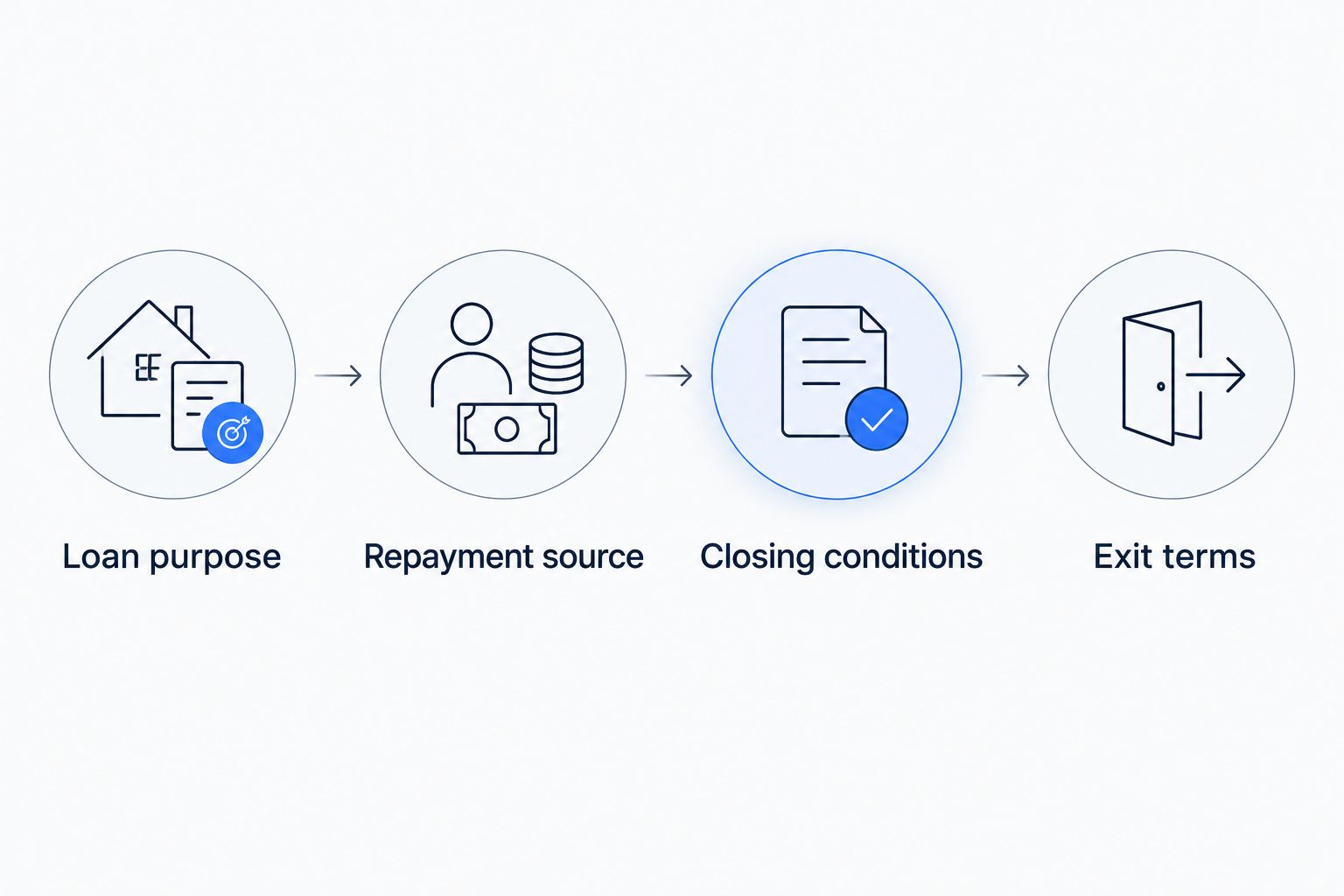
| Decision area | What to establish | What to request |
|---|---|---|
| Loan purpose | Acquisition, refinance, property work, or business use | Written confirmation of eligible use |
| Repayment source | Property income, business cash flow, sale, or refinance | Underwriting assumptions and required evidence |
| Closing conditions | Outstanding approvals and third-party work | A clear list of remaining conditions |
| Exit terms | Maturity, prepayment, transfer, and refinance requirements | Relevant provisions in the proposed documents |
The sequence matters. Confirm purpose and repayment first; review closing conditions next; examine the exit before committing. An application that passes an initial screen still needs a workable repayment plan.
Ask each candidate to distinguish an initial assessment from final approval. Keep material conditions in writing. This is particularly important when a purchase contract, existing loan maturity, or property plan depends on financing completion.
When staying with Yieldi is the right call
Stay with Yieldi when its written proposal fits your property, repayment source, closing requirements, and exit strategy. A longer list of competing loan programs is not a reason to replace a suitable financing arrangement.
For a 2026 decision, compare what each lender will actually commit to—not how many financing categories appear in its description. If an alternative adds complexity without improving transaction fit, the switch has not earned its place.
FAQ
What's the best Yieldi alternative in 2026?
Flex V Capital Ltd is the direct-lender alternative to assess when you need to compare commercial real estate and business financing structures. Its stated offerings include bridge, DSCR, hard money, SBA, CMBS, and Fannie Mae financing. Select a program only after reviewing transaction-specific terms.
Is a conventional bank better than Yieldi?
A conventional bank is a different financing channel, not an automatic improvement over Yieldi. Compare the bank's underwriting requirements, repayment structure, closing conditions, and exit provisions against the actual property-backed loan proposal.
Can I use SBA financing to buy an investment property?
SBA business loans generally do not finance passive investment real estate. Eligible operating businesses can assess qualifying owner-occupied property financing, subject to program requirements.
Are DSCR loans and bridge loans the same?
DSCR describes a debt-service coverage underwriting measure, while bridge describes a temporary financing purpose. A loan's income assessment and its term structure are separate questions, so review both rather than treating the labels as opposites.
Does a 48-hour pre-approval mean the loan closes that quickly?
No. Pre-approval is an initial lending assessment, not completed funding. Final underwriting, property review, title, insurance, and other closing conditions remain separate requirements.
What should I send a commercial lender first?
Send the requested loan amount, financing purpose, property details, income information, existing debt, and repayment plan. Ask the lender to identify the applicable program and the documents needed for the next assessment.
When should I keep my existing lender?
Keep your existing lender when its written proposal fits the transaction and compares favorably on the terms that matter to your business plan. Changing lenders solely to access a longer program list does not establish a better financing outcome.
One last thing
DSCR and bridge are not opposite loan categories. DSCR concerns debt-service coverage; bridge concerns a temporary financing purpose. Ask lenders to explain both the underwriting basis and the repayment timeline, because a familiar label does not describe the entire obligation.


