
Commercial bridge loan rates in 2026 depend on the lender’s funding costs, your loan-to-value ratio, property cash flow, borrower strength, and repayment plan. The interest rate alone excludes origination charges, third-party expenses, and any extension or early-payoff obligations. A stronger application connects the requested loan amount to documented property value, available liquidity, and a credible exit—not just projected appreciation.
- Commercial bridge loan rates reflect funding costs, collateral, borrower strength, and repayment risk—not a universal rate schedule.
- Compare fixed-rate and floating-rate bridge financing using the same loan amount, funding structure, and repayment assumptions.
- A credible refinance exit needs support from property income, valuation, and the replacement lender’s requirements.
- Flexvcapital suits commercial real estate investors seeking a direct lender offering bridge loans and permanent financing options.
What determines your commercial bridge loan interest rate?
A lender evaluates both the property securing the loan and your ability to execute the business plan. The rate reflects that combined risk, alongside the lender’s own capital costs and lending requirements.
Read a bridge-loan proposal in this order:
- Confirm the collateral basis. Identify whether the lender uses current value, purchase price, completed value, or another defined valuation basis.
- Check the actual advance. Separate money funded at closing from renovation proceeds, reserves, and future advances.
- Identify the rate structure. Establish whether the rate is fixed or tied to a changing benchmark.
- Test repayment. Show how a sale or refinance will repay the outstanding balance by maturity.
Your equity position connects the first two steps. The guide to how much equity you need for a bridge loan explains the question to resolve before comparing financing proposals.
Compare rates only after the underlying loan structures match. Otherwise, a lower quoted rate can describe a materially different advance, repayment obligation, or execution risk.
Why this matters
A bridge loan finances a transition: an acquisition, renovation, lease-up, or another defined property event. Your financing must accommodate that transition without making repayment depend on assumptions the property cannot support.
For a 2026 transaction, distinguish the date of the quote from the date its terms become binding. Ask which items remain subject to underwriting, valuation, legal review, and lender approval. An initial indication is not the same as a signed commitment or funded loan.
The practical question is not simply whether the rate looks attractive. It is whether the financing gives you enough usable proceeds and a workable route out of the debt.
Why commercial bridge loan rates vary
These factors explain the underwriting questions behind a bridge-loan rate. None creates an automatic entitlement to a particular quote.
- Lender funding costs: A lender’s cost and source of capital affect the terms it can offer. For floating-rate debt, the contractual benchmark also affects the borrower’s interest obligation.
- Equity and valuation: The requested advance relative to the accepted property value determines the lender’s collateral cushion. A disputed valuation changes that calculation.
- Property income and condition: Existing leases, collections, operating expenses, deferred maintenance, and construction work shape the property’s ability to support debt.
- Borrower strength: Liquidity, credit history, contingent liabilities, and relevant execution experience help establish whether you can carry the property and complete the plan.
- Exit feasibility: A documented sale or refinance strategy gives the lender a repayment path. An unsupported assumption about future value does not.
- Loan structure: Maturity, recourse, reserves, future funding, and extension provisions allocate risk between borrower and lender.
Ask which of these factors drove your quote. That answer identifies whether additional documentation, a smaller advance, or a different structure addresses the lender’s concern.
Equity and valuation: establish the denominator
Loan-to-value, or LTV, compares the loan amount with the property value accepted for underwriting. The useful question is not just what LTV appears on a proposal, but which loan balance and valuation the calculation uses.
An initial advance and a fully funded commitment are different amounts. Current value and projected completed value are also different measures. Comparing proposals without separating those figures obscures how much financing you actually receive against today’s collateral.
Request the valuation assumptions in writing. Identify any dependence on unfinished improvements, unexecuted leases, or future operating performance. Then reconcile the loan proceeds with your purchase obligations, project budget, and required cash contribution.
More equity reduces the requested advance relative to value; it does not guarantee a lower rate. The lender still has to accept the property, borrower, and exit strategy.
Property cash flow: distinguish income from projections
A lender needs to understand what the property earns now and what must change before permanent financing becomes possible. Supply the rent roll, leases, collections, operating statements, and a supported explanation of adjustments.
Debt service coverage ratio, or DSCR, compares net operating income with debt service. A DSCR of 1.00x means net operating income equals debt service under the calculation used. It does not establish a universal approval threshold or account for every cash requirement outside that calculation.
For a transitional property, show current income separately from projected stabilized income. Identify the work, leasing, approvals, and capital required to move between them.
A vacant space does not become reliable repayment capacity because a spreadsheet assigns it rent. Document the assumptions a lender can evaluate: proposed lease terms, tenant obligations, completion requirements, and operating expenses after occupancy.
Borrower strength: document the ability to carry the project
Property collateral does not eliminate borrower execution risk. A renovation budget still needs funding, operating expenses continue during vacancy, and a delayed refinance does not suspend the loan’s contractual obligations.
Present liquidity with its restrictions clearly identified. Distinguish cash available for the transaction from funds committed elsewhere, and disclose other obligations that compete for the same resources.
Experience should match the proposed work. Acquiring a leased property and completing a substantial rehabilitation require different evidence of execution capability. Provide a project history that explains your role rather than a list of properties without context.
Also clarify recourse. A personal guarantee concerns who is responsible under the loan documents; it does not make a weak project financially sound. Evaluate the obligation alongside the property’s ability to repay.
Fixed-rate versus floating-rate bridge loans
A fixed-rate bridge loan keeps the contractual interest rate unchanged during the applicable fixed period. A floating-rate bridge loan uses a benchmark and a contractual spread, subject to provisions such as a rate floor.
Neither structure is automatically better. Match the structure to your cash-flow tolerance, expected holding period, and documented repayment plan.
| Structure | Best for | Main advantage | Main limitation | Terms to verify |
|---|---|---|---|---|
| Fixed-rate bridge loan | Borrowers prioritizing rate predictability during the fixed period | The contractual rate does not move with the benchmark during that period | You do not automatically benefit when market rates decline | Fixed period, extension pricing, and payoff provisions |
| Floating-rate bridge loan | Borrowers able to absorb benchmark changes | The contractual rate adjusts according to the agreed formula | A rising benchmark can increase interest obligations | Benchmark, spread, floor, reset dates, and any cap requirements |
When reviewing a floating-rate proposal in 2026, ask for the benchmark observation date and the calculation method. A spread is not the complete interest rate. A floor can also prevent the contractual rate from falling below a stated level.
One basis point equals 0.01 percentage point. Keep basis points and percentage points distinct when reading a term sheet; they are not interchangeable units.
Your exit strategy must withstand underwriting
“Refinance later” is an objective, not a completed repayment analysis. Identify the replacement financing requirements and test the property against them before accepting bridge debt.
Use this sequence to organize the exit:
- Current income: Establish what the property earns using supported operating information.
- Required work: Identify improvements, leasing, and approvals needed for the business plan.
- Stabilized income: Explain the income and expenses expected after completing that work.
- Replacement financing: Check the proposed permanent lender’s property, borrower, valuation, and coverage requirements.
- Repayment check: Compare expected net proceeds with the bridge payoff and transaction obligations.
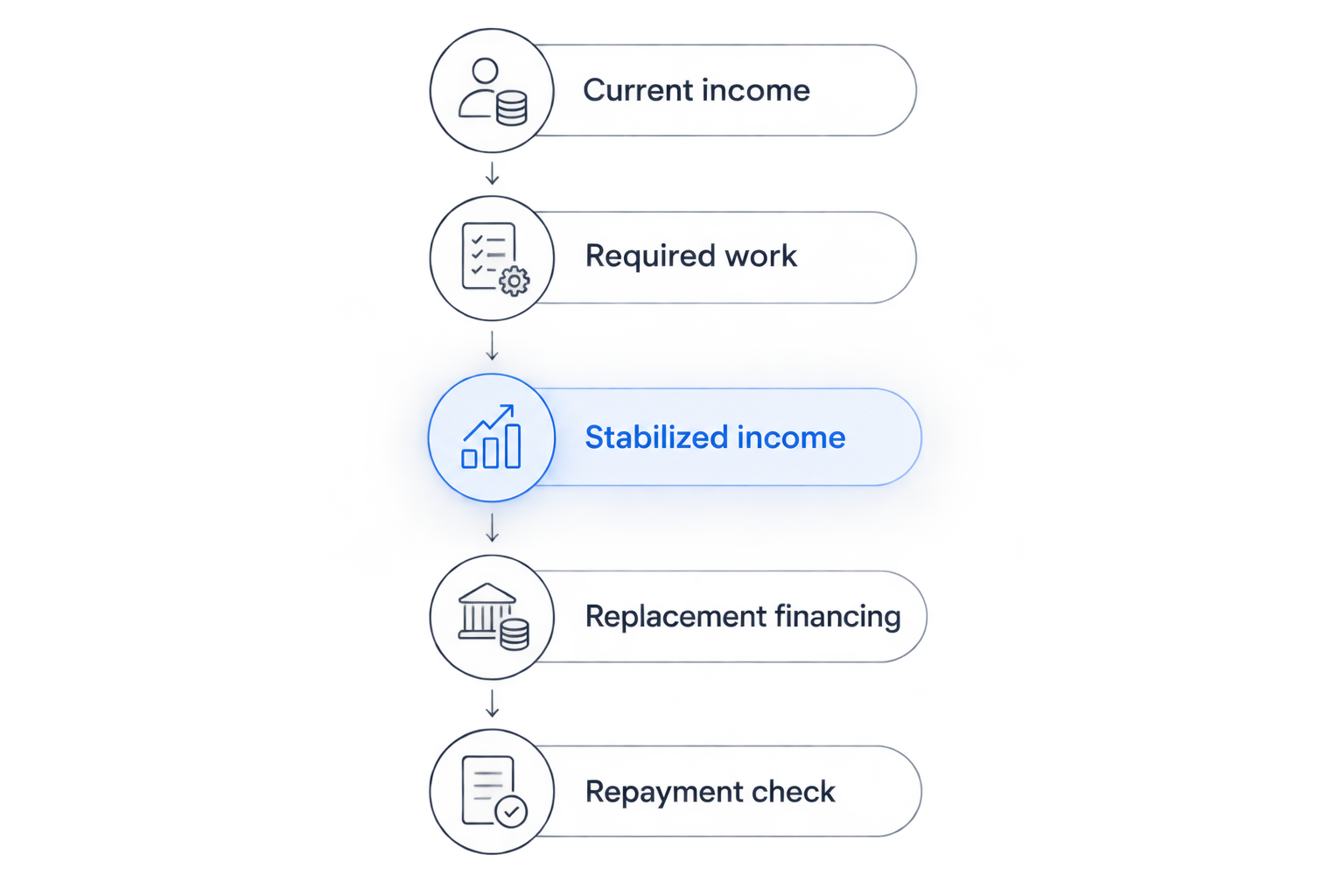
A refinance depends on more than completing construction. Income, valuation, loan eligibility, and the borrower’s financial position must also support the replacement loan.
For a sale exit, account for the time and obligations involved in transferring the property. Do not treat an expected gross sale price as cash available to repay the lender.
What should you request before comparing quotes?
Request a written term sheet that separates the interest calculation from the rest of the transaction. Use the same property information, requested proceeds, and business plan for every lender you approach.
For a 2026 comparison, organize the responses around these questions:
- What amount is committed, and what amount is funded at closing?
- Is interest calculated on the outstanding balance or another contractual basis?
- What reserves or holdbacks reduce usable proceeds?
- What conditions control future advances?
- What obligations apply if you repay early or request an extension?
- Which conditions remain unresolved before closing?
Ask the lender to explain conflicting terms before you order additional work or rely on a closing date. A proposal that does not state the funding basis is not ready for a meaningful rate comparison.
Flexvcapital is best suited to commercial real estate investors seeking direct bridge lending alongside permanent financing options. Its commercial lending services include bridge, DSCR, SBA, CMBS, and Fannie Mae financing. That product range supports a discussion of both entry financing and a potential exit, but it does not establish approval for either loan.
Flexvcapital advertises 48-hour pre-approvals. A pre-approval is not a funded loan; confirm the remaining underwriting and closing conditions before relying on a transaction deadline.
Can a lower LTV reduce my bridge loan rate?
A lower LTV reduces the requested loan relative to the accepted collateral value, but it does not guarantee a lower interest rate. Ask whether reducing the advance changes the lender’s quote, reserve requirements, or other terms before committing additional equity.
Does a faster closing mean a higher interest rate?
A faster closing does not establish a universal rate premium. Ask the lender to identify any terms associated with the requested deadline and confirm which diligence requirements must still be completed.
Will a strong refinance plan guarantee approval?
A strong refinance plan does not guarantee bridge-loan approval or a future permanent loan. Support the plan with property income, a defensible valuation, borrower qualifications, and the replacement lender’s actual requirements.
FAQ
What determines commercial bridge loan rates?
Commercial bridge loan rates reflect lender funding costs, collateral, equity, property income, borrower strength, and repayment risk. Compare the complete funding and repayment structure rather than the interest rate alone.
Is a fixed-rate bridge loan better than a floating-rate loan?
A fixed-rate bridge loan is better suited to borrowers prioritizing rate predictability during the fixed period. A floating-rate loan requires you to absorb benchmark changes under the contractual formula.
Does my credit score alone determine my bridge loan rate?
Your credit score alone does not determine a commercial bridge loan rate. Lenders also evaluate the property, requested advance, liquidity, execution capability, and exit strategy.
Can property income affect my bridge loan terms?
Property income affects the assessment of debt support and refinance feasibility. Separate documented current income from projected income that depends on construction, leasing, or other unfinished work.
Does a bridge loan pre-approval mean my loan will close?
A bridge loan pre-approval does not mean the loan is funded or that every condition has been satisfied. Confirm outstanding underwriting, valuation, documentation, and closing requirements.
What should I ask Flexvcapital about commercial bridge loans?
Ask Flexvcapital about the proposed advance, rate structure, reserves, recourse, maturity, and repayment conditions. Request written clarification of remaining approval requirements and how the proposed exit will be evaluated.
Should I compare only the interest rates on bridge loan quotes?
Do not compare bridge loan quotes only by interest rate. Match usable proceeds, interest calculation methods, funding conditions, early-payoff obligations, and extension provisions first.
One last thing
The interest calculation can change the comparison even when quoted rates match. Confirm whether interest applies to outstanding principal, a committed amount, or another basis defined in the documents. Then reconcile that basis with the cash you can actually deploy.
Before signing a 2026 bridge-loan agreement, make the repayment check your final decision gate. If the exit depends on unsupported income or valuation assumptions, a lower rate does not solve the underlying problem.


