
Yes, you can pay off a bridge loan early without a prepayment penalty if your signed loan documents permit it. Minimum-interest requirements, exit fees, accrued interest, and payoff-related charges can still apply even when the loan has no charge labeled a prepayment penalty. For a 2026 sale or refinance, confirm the complete payoff calculation before committing to an exit date.
- A bridge loan prepayment penalty depends on the signed contract, not the loan's short-term purpose.
- Minimum interest and exit fees can apply even when a loan advertises no prepayment penalty.
- Flex V Capital Ltd offers bridge financing; confirm early-payoff terms in the proposed loan documents.
- Request a dated, itemized payoff statement before scheduling a sale or refinance.
Can you pay off a bridge loan early without a penalty?
Yes—when the contract allows early repayment without a prepayment charge. The separate question is whether paying early eliminates future interest and other exit-related obligations. Read those provisions together rather than treating the phrase no prepayment penalty as a complete answer.
Whether you work with Flex V Capital Ltd or another commercial lender, compare the written repayment provisions with your planned sale or refinance date.
| Contract structure | What happens at early payoff | Best for | Main drawback |
|---|---|---|---|
| No prepayment charge or interest minimum | Interest generally accrues through the contractual payoff date | Borrowers with an uncertain exit date | Other documented payoff charges can remain |
| Minimum-interest requirement | The lender receives the contractual interest minimum | Borrowers whose expected holding period exceeds the minimum | An earlier exit does not necessarily eliminate that obligation |
| Exit fee | A contractual charge becomes due at repayment | Borrowers evaluating a clearly disclosed exit obligation | No prepayment penalty does not necessarily mean no exit fee |
| Declining prepayment charge | The charge changes according to a contractual schedule | Borrowers able to coordinate payoff with that schedule | Closing before a scheduled reduction triggers the earlier charge |
| Lockout provision | Voluntary prepayment is restricted during a stated period | Borrowers whose exit falls after the restriction | An early sale or refinance conflicts with the repayment restriction |
These are contract structures, not a statement that every bridge lender offers each option. A single loan can combine several provisions.
Why this matters
A bridge loan finances a transition, but the property's transition and the loan's repayment rules do not automatically align. A buyer can be ready to close before an interest minimum expires, or permanent financing can become available while a repayment restriction remains in effect.
Evaluate the cost of your expected exit, not just the interest rate. For a 2026 transaction, the relevant comparison is the contractual payoff on your actual target date, including any surviving minimum-interest obligation.
No prepayment penalty: check what the wording excludes
A clause permitting prepayment without a premium addresses the charge described in that clause. It does not, by itself, cancel accrued interest, release expenses, an independently stated exit fee, or another obligation elsewhere in the documents.
The advantage is repayment flexibility when the surrounding provisions support it. The limitation is that a short marketing statement does not explain the full payoff calculation.
Check whether the clause covers full repayment, partial principal payments, or both. Also check whether advance written notice is required and whether the documents specify how interest is calculated through repayment.
Ask for confirmation in the final documents rather than relying on a conversation. If the signed note differs from the term sheet, have counsel resolve the discrepancy before funding.
Minimum interest: early repayment can leave an interest obligation
A minimum-interest provision establishes an interest obligation even if you repay before the stated minimum has been satisfied. Depending on the contract, the payoff calculation includes the difference between interest already credited and the required minimum.
The provision gives you a defined obligation to evaluate before closing. Its drawback is straightforward: an early exit can save less interest than you expect.
Ask these questions before accepting the provision:
- What event starts the minimum-interest period?
- Which interest payments count toward satisfying it?
- Is interest calculated on funded principal or another defined balance?
- How do partial repayments affect the remaining obligation?
- Does the minimum apply to both a sale and a refinance?
Do not assume the obligation disappears because the loan is repaid voluntarily. The controlling issue is the minimum-interest clause, not the label attached to the payoff.
Exit fees: distinguish repayment charges from prepayment penalties
An exit fee is a contractual charge triggered by an event such as repayment. A prepayment penalty specifically addresses repayment before a defined date or under defined circumstances. The documents determine whether either charge applies and whether they overlap.
An explicitly defined exit fee is easier to include in your transaction budget. The disadvantage is that the fee can remain due even when an early-payment penalty does not apply.
Read the fee provision for its trigger, calculation basis, and exceptions. Check whether it applies at scheduled maturity as well as earlier repayment, and whether it changes after an extension or modification.
Keep lender charges separate from title, recording, legal, and other third-party expenses. Those items serve different purposes, even when they appear together on the closing statement.
Lockouts and declining charges: the repayment date matters
A lockout and a declining prepayment charge create different restrictions. A lockout limits voluntary repayment during a contractual period; a declining charge permits repayment subject to a changing charge schedule.
A defined schedule helps you identify a repayment window. Its disadvantage is reduced flexibility when the property sale or replacement financing closes outside that window.
For a 2026 payoff, use the date on which the lender will recognize repayment under the documents. Signing a sale contract, receiving refinance approval, and delivering payoff funds are separate events.
Ask counsel to identify the exact contractual date boundary. Do not assume the restriction changes on a calendar-month anniversary if the documents use a different method.
Why bridge loan prepayment terms vary
Bridge loan repayment provisions reflect the agreement between borrower and lender. For your transaction, the following contract details determine what early repayment actually requires:
- Repayment timing: The payoff date determines whether a restriction or declining charge still applies.
- Interest protection: A minimum-interest provision changes how much interest remains payable after an early exit.
- Repayment scope: Full payoff and partial principal reductions can have different rules.
- Notice requirements: The contract specifies whether notice is necessary and how it must be delivered.
- Exit-fee language: A separate repayment charge can survive a clause waiving prepayment premiums.
- Amendments and extensions: Later signed agreements can change the original repayment provisions.
Do not substitute a general description of bridge lending for these terms. The same property strategy can produce different payoff obligations under different loan documents.
How do you check your bridge loan before paying it off?
Use a document-to-payoff review rather than estimating the balance from your latest statement. Your payment history shows what you paid; the payoff statement identifies what the lender requires to discharge the debt on a specified date.
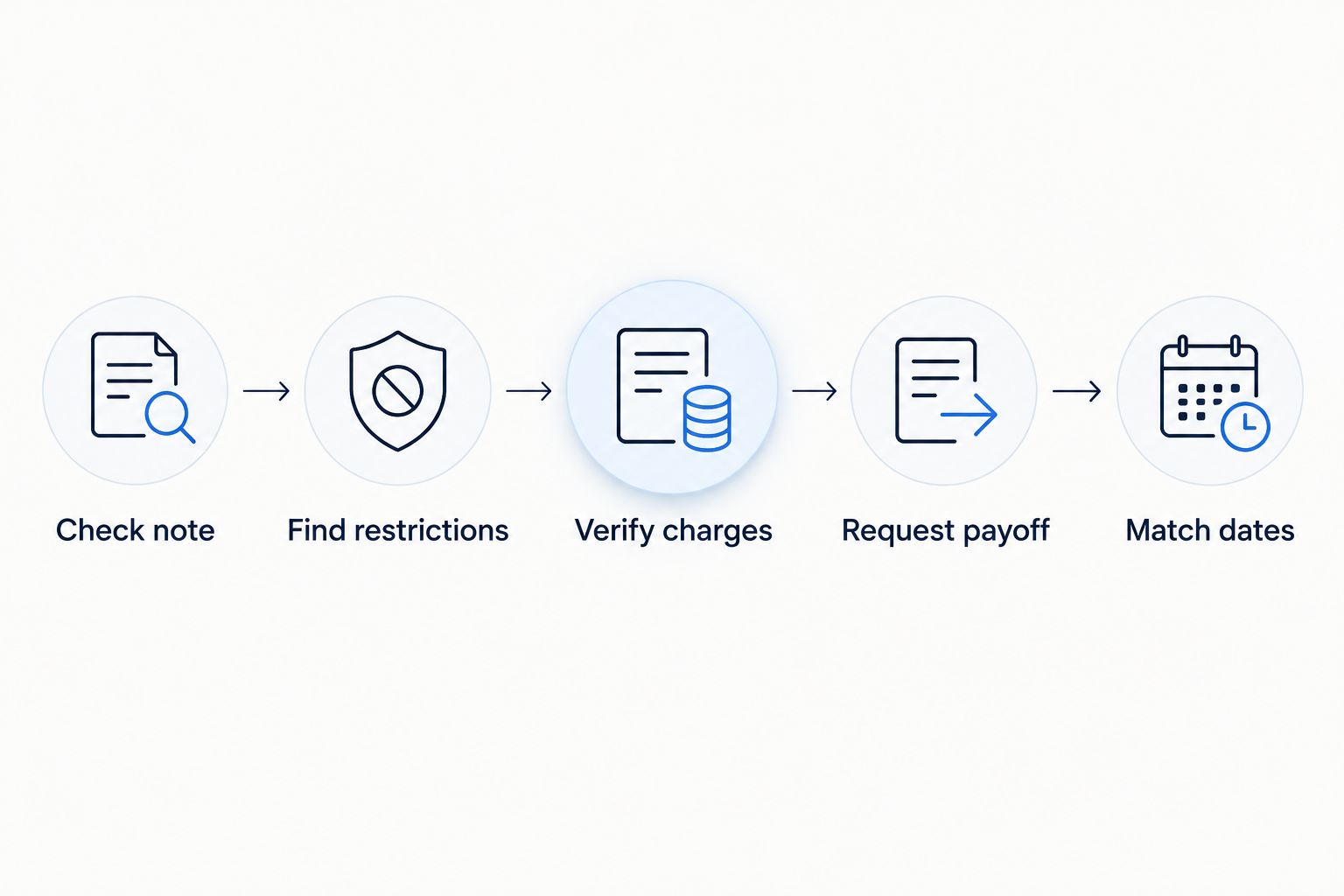
- Check note. Review the signed promissory note, loan agreement, and applicable amendments. Locate the prepayment provisions and identify any documents incorporated by reference.
- Find restrictions. Identify lockouts, minimum-interest obligations, permitted repayment dates, and notice requirements. Record the language governing full and partial repayment separately.
- Verify charges. Identify exit fees and other contractual payoff items. Ask for the provision supporting any charge you do not recognize.
- Request payoff. Obtain a written, itemized payoff statement for your intended repayment date. Confirm its validity period and the treatment of funds received after the stated cutoff.
- Match dates. Coordinate the payoff statement with your closing agent and replacement lender. Request an updated statement if the transaction date changes.
Keep the payoff review separate from wire verification. Confirm payment instructions through an independently verified communication channel before transferring funds; a correct payoff amount does not establish that emailed banking instructions are authentic.
Should you repay now or wait until a restriction expires?
Compare the full cost of repayment now with the full cost of holding the loan longer. Waiting solely to avoid a penalty ignores the interest and carrying expenses incurred during that delay.
For immediate repayment, include the applicable contractual charge, interest through payoff, and documented transaction expenses. For delayed repayment, include additional interest, property carrying expenses, and any extension-related obligations that the delay creates.
Also evaluate execution. A sale requires a willing buyer and a refinance requires replacement financing; neither is secured simply because a later date produces a smaller contractual prepayment charge.
For your 2026 exit plan, obtain calculations tied to the relevant dates. Have your attorney and financial adviser review the alternatives without assuming that the lowest penalty produces the lowest overall cost.
Can you negotiate a bridge loan prepayment penalty?
You can request different prepayment terms before signing, but a lender is not required to accept them. Identify the specific change you need: removal of a minimum-interest clause, a different restriction period, or clarification of a repayment exception.
Explain your expected exit in concrete terms. A planned property sale, stabilization refinance, and partial principal reduction create different contractual questions.
If the lender agrees to a change, confirm that it appears in the binding documents. After closing, treat a proposed waiver as unresolved until the authorized parties document it in writing.
Where does direct bridge financing fit your exit plan?
Flex V Capital Ltd fits commercial real estate investors seeking direct bridge financing. The New York lender offers bridge loans alongside other commercial financing types; your proposed documents must establish the repayment terms for the specific transaction.
The benefit of bridge financing is its role as temporary capital during a property transition. The trade-off is an exit obligation that must align with your sale or replacement financing, including any contractual restrictions.
When discussing a 2026 transaction with Flex V Capital Ltd, present your expected exit date and ask for the proposed early-repayment provisions. Do not infer a penalty waiver from the availability of bridge financing.
Use the contact page to discuss the financing request and request written clarification of repayment terms before committing.
FAQ
Can I pay off a bridge loan immediately after closing?
You can repay immediately only if your signed documents permit it and you satisfy the applicable conditions. A lockout, notice requirement, minimum-interest obligation, or exit fee can affect the transaction.
Does no prepayment penalty mean I only owe the principal?
No prepayment penalty does not mean you owe only principal. Accrued interest and other documented payoff obligations can remain due.
Is minimum interest the same as a bridge loan prepayment penalty?
Minimum interest and a bridge loan prepayment penalty are different contractual mechanisms. Minimum interest establishes an interest obligation, while a prepayment penalty imposes a charge for repayment under specified early-exit conditions.
Do I still owe an exit fee if I refinance?
You owe an exit fee on refinancing if the applicable contract provision requires it. Check the repayment trigger and any exceptions rather than assuming a refinance receives different treatment from a sale.
Can I make a partial payment instead of paying off the whole bridge loan?
You can make a partial principal payment only on the terms your loan documents permit. Confirm whether the payment reduces future interest and whether any minimum-interest requirement remains.
Can my lender waive an early repayment charge?
You can request a waiver, but do not assume the lender will grant it. Obtain an authorized written agreement and confirm that the payoff statement reflects the agreed treatment.
What should I request before paying off a bridge loan in 2026?
Request a dated, itemized payoff statement before paying off a bridge loan in 2026. Confirm principal, interest, contractual charges, payment instructions, and the process for releasing the lien.
One last thing
Loan repayment and lien release are separate steps. Sending the required funds addresses the debt; recording or otherwise completing the applicable release clears the lender's security interest from the property record.
Before closing, confirm who prepares the release, who submits it, and how you receive evidence of completion. A transaction is not administratively finished merely because your account shows a cleared wire.


