Yes—a trustee can hold title to commercial real estate in a trust capacity when state law, the trust agreement, and the lender’s requirements permit the arrangement. A commercial real estate loan held in trust still requires separate approval of the borrower, signing authority, collateral, and guarantors; transferring already-mortgaged property into a trust also requires a review of the loan’s transfer restrictions.
- A commercial real estate loan held in trust requires lender acceptance of the ownership and borrower structure.
- Trust ownership does not automatically eliminate personal guarantees or satisfy commercial mortgage underwriting.
- Approve the title structure before recording a deed or changing ownership of the borrowing entity.
- Flex V Capital Ltd is a direct commercial lender for commercial real estate investors and business borrowers.
Can a trust hold title for a commercial real estate loan?
Yes, but permission to own real estate is not the same as eligibility to borrow. For an ordinary private trust, the trustee generally holds legal title in a representative capacity. Statutory trusts and state-specific arrangements require separate analysis.
The lender must accept the proposed borrower and collateral structure. The title insurer must also be prepared to insure the mortgage or deed of trust with the ownership and signing arrangements shown in the closing documents. Address these issues during the purchase-contract-to-commercial-loan-closing process, not after documents are prepared.
For a 2026 transaction, have counsel identify these distinct roles:
- Title holder: The person or entity named on the deed, including any trustee capacity.
- Borrower: The party obligated to repay under the promissory note.
- Mortgagor: The owner pledging the property as collateral.
- Guarantor: A party accepting the obligations specified in a separate guaranty.
Those roles sometimes overlap. Do not assume they must always be identical, or that a lender will permit them to differ.
Why this matters
A trust arrangement that works for estate planning does not automatically work for commercial financing. Your lender needs an enforceable repayment obligation and a valid lien; your trustee needs authority to execute the documents creating those obligations.
The phrase commercial real estate loan held in trust also combines different questions. A trust holding a lender’s loan asset is different from a trustee holding title to the borrower’s property. This guide addresses the property-owner side: acquiring, refinancing, or transferring commercial property connected to a trust.
Resolve the ownership structure before accepting a loan commitment that assumes a different borrower. Otherwise, your attorney must reconcile the estate plan, title requirements, and financing documents while the transaction is already underway.
Which trust ownership structure fits the transaction?
These structures serve different purposes. The comparison below describes planning uses and financing issues, not automatic loan eligibility or a recommendation to establish a particular trust.
| Structure | Best for, subject to legal advice | Potential advantage | Financing limitation |
|---|---|---|---|
| Revocable trust with trustee holding title | Owners planning for continuity and succession | Provides a framework for successor management under the trust terms | Does not automatically protect assets from the settlor’s creditors or remove guaranty requirements |
| Irrevocable trust with trustee holding title | Owners implementing a specific estate or asset-transfer plan | Establishes ownership and control under the trust’s terms | Restrictions on amendment, distributions, or borrowing can complicate financing |
| Trust owning an interest in a property-owning LLC | Owners separating trust succession provisions from property-level entity governance | Keeps property title in the LLC while trust ownership operates at the membership level | Requires review of both trust authority and LLC documents, including ownership-transfer restrictions |
Revocable trust: confirm authority and continuity
A revocable trust can provide instructions for managing property during incapacity and after death. That planning benefit does not establish that a particular commercial lender accepts the trust as part of its borrower structure.
Ask counsel to confirm who can borrow, mortgage property, appoint a successor trustee, and sign after a trustee’s incapacity. If the lender requires a personal guaranty, revocable-trust ownership does not cancel that requirement.
Irrevocable trust: review restrictions before applying
An irrevocable trust requires close attention to its actual terms. The trustee’s authority, beneficiary rights, distribution provisions, and applicable law determine what the trustee can do; the label alone does not answer those questions.
Do not assume an irrevocable trust provides creditor protection or tax savings in your transaction. Those outcomes depend on the arrangement and applicable law. The financing review must also establish whether the trustee can pledge the property and undertake the proposed obligations.
Trust-owned LLC: review both layers
A trust can own membership interests in an LLC that owns commercial property. In that arrangement, the LLC holds the deed and ordinarily signs its own borrowing documents through an authorized representative.
The lender still needs to understand the ownership chain. Transferring LLC interests into a trust can implicate loan restrictions even when the recorded deed stays unchanged. Read the definitions of permitted transfers, ownership changes, and control changes before acting.
Why lender acceptance of trust ownership varies
For a 2026 application, evaluate the proposed trust structure against the actual loan program and documents. A lender’s acceptance of one arrangement does not establish acceptance of another.
- Governing law: State law affects how title is held, trustee powers, and execution requirements.
- Trust provisions: The agreement determines the trustee’s authority and any required approvals, subject to applicable law.
- Borrower eligibility: The loan program determines which borrower structures it accepts.
- Ownership and control: The lender needs to identify who owns, manages, and can change the borrowing structure.
- Collateral enforceability: Title and loan documents must support the intended lien and remedies.
- Existing loan restrictions: A proposed transfer must be evaluated against the current mortgage and related agreements.
Do not substitute a general statement that “trusts are allowed” for approval of your documents. Get written acceptance of the specific ownership structure, including any conditions that must be satisfied before closing.
How do you prepare a trust-owned property for financing?
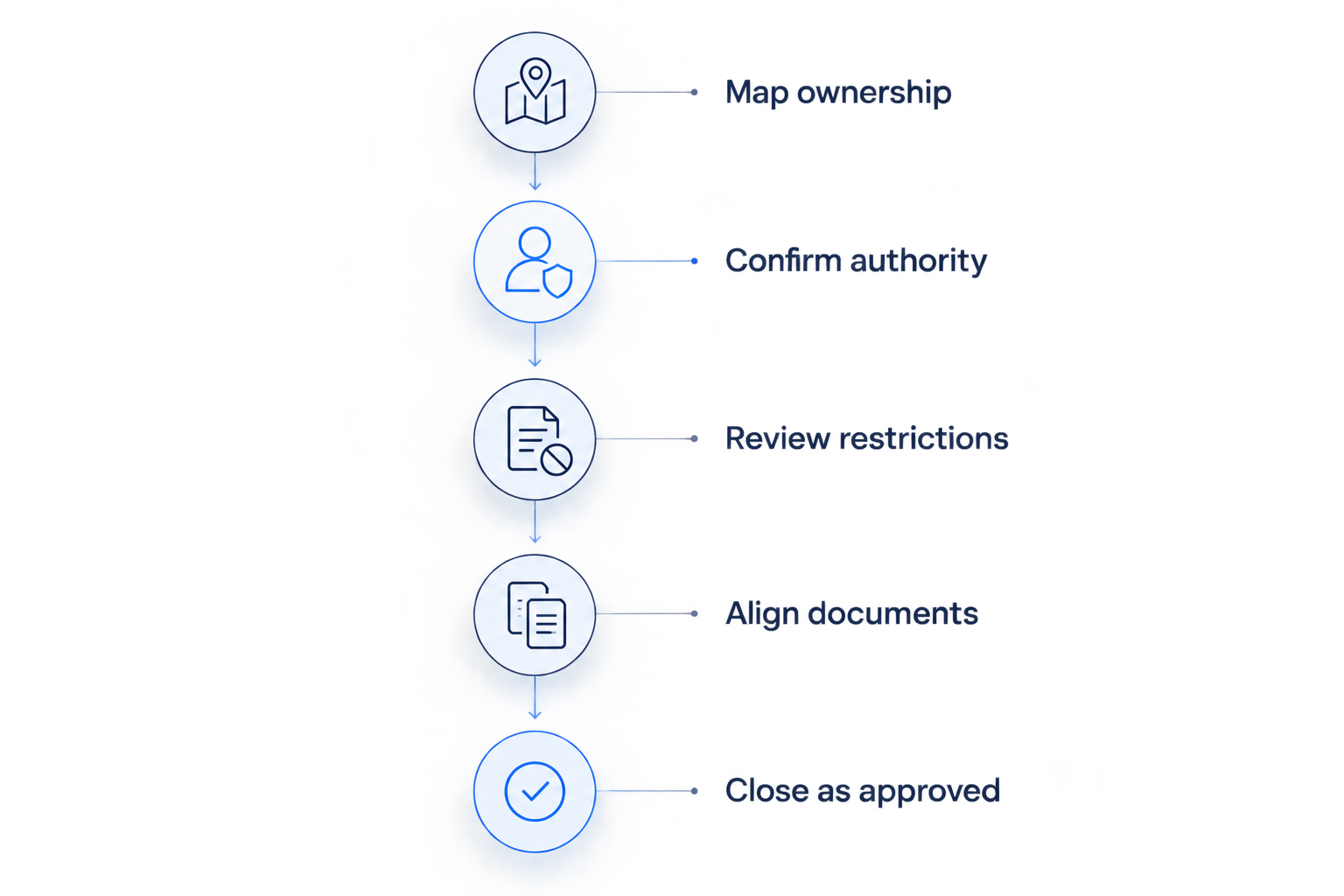
Use this sequence for a purchase or refinance. For an existing loan, review transfer restrictions before changing either the deed or ownership interests.
- Map ownership. Identify the deed holder, proposed borrower, trustees, beneficiaries where relevant to underwriting, controlling parties, and proposed guarantors. Show each entity between the trust and the property.
- Confirm authority. Have counsel review the trust agreement, amendments, trustee appointments, and relevant entity documents. Identify required signatures and approvals.
- Review restrictions. Compare the proposed structure with the new lender’s requirements and any existing loan covenants. Obtain required consent before making a transfer.
- Align documents. Coordinate the deed, note, mortgage, title commitment, insurance, and signature blocks. Resolve inconsistent names or capacities before execution.
- Close as approved. Sign and record only the approved documents. Retain the consent, authority evidence, and final ownership chart with the closing records.
These steps separate a valid estate-planning arrangement from a financeable transaction. Written approval of the structure is not a promise that the property, cash flow, or guarantors meet underwriting requirements.
What should the document package contain?
Prepare the current trust agreement and amendments, evidence of acting trustees, and the proposed deed vesting. A certification of trust establishes certain trust facts without reproducing the entire agreement where applicable law and the reviewing parties permit its use; it does not guarantee that further documents will be unnecessary.
For a trust-owned LLC, include the operating agreement, amendments, ownership records, and borrowing authorizations requested for the transaction. Also provide the existing loan documents when refinancing or proposing an ownership transfer.
Ask the lender and title company what each requires before ordering signatures. A trustee signing in an individual capacity instead of the required representative capacity creates a different legal issue from simply misspelling a name.
Can you transfer mortgaged commercial property into a trust?
Do not transfer mortgaged commercial property into a trust without reviewing the loan documents and obtaining any required consent. A transfer can trigger contractual remedies even when the owner considers the change an estate-planning formality.
Federal law provides a limited trust-transfer protection under 12 U.S.C. § 1701j-3(d)(8). The statutory subsection concerns loans secured by residential real property containing fewer than 5 dwelling units and specifies conditions for a transfer into an inter vivos trust, including the borrower remaining a beneficiary and no transfer of occupancy rights.
That is not a blanket exemption for commercial real estate. For a 2026 transfer involving an office, retail, industrial, mixed-use, or multifamily property, have counsel determine whether any statutory protection applies and what the contract requires.
Consent to transfer also does not automatically release the existing borrower or guarantor. Obtain an express release if release is part of the negotiated transaction; do not infer it from a consent letter.
Does trust ownership remove a personal guaranty?
Trust ownership does not itself remove a personal guaranty. The guaranty’s terms determine the guarantor’s obligations, and changing title does not rewrite those terms.
Distinguish full repayment liability from limited guarantees covering specified acts or obligations. Review who signs, in what capacity, and whether liability survives a transfer, refinance, or trustee change. Estate-planning documents are not substitutes for lender-approved releases.
Can a trust own the LLC that takes out the loan?
A trust can own an LLC interest, subject to the trust terms, applicable law, and the LLC agreement. Loan eligibility remains a separate question governed by the financing program and lender requirements.
The lender needs a clear path from the trust’s authorized trustee to the LLC’s authorized signer. Confirm whether changes in trustees, beneficiaries, managers, or membership interests require notice or consent under the proposed loan documents.
Where does direct commercial lending fit?
Flex V Capital Ltd is a direct commercial lender for commercial real estate investors and business borrowers. Its stated offerings include bridge loans, DSCR loans, hard money, SBA, CMBS, and Fannie Mae financing, with loan amounts from $500K to $20M+.
Flex V Capital Ltd states 48-hour pre-approvals. A pre-approval is not final approval of trust vesting, title, or closing documents. For a 2026 financing inquiry, submit the ownership chart and proposed borrower structure with the property information rather than treating trust review as a closing formality.
The stated program list does not establish that every trust structure qualifies. Ask for confirmation of the specific arrangement before transferring title or committing to a borrower entity.
Confirm your proposed borrower structure
Present the trust ownership, proposed borrower, and property details before changing title.
FAQ
Can a revocable trust get a commercial mortgage?
A revocable-trust ownership arrangement requires acceptance by the commercial lender and compliance with applicable law. The trustee must have authority to sign, and the lender must approve the borrower and collateral structure.
Is a commercial real estate loan held in trust the same as a deed of trust?
No. Trust ownership concerns who owns the property, while a deed of trust is a security instrument used to secure a debt in jurisdictions that recognize it.
Does putting commercial property in a trust protect it from the lender?
Trust ownership does not defeat a valid mortgage lien. Creditor-protection questions depend on the trust, applicable law, and the transaction; do not assume estate-planning ownership blocks foreclosure.
Do all beneficiaries have to sign the commercial loan?
Beneficiaries do not automatically have to sign merely because they are beneficiaries. Required signatures depend on trustee authority, applicable law, the trust terms, and the lender’s approved documents.
Can I change trustees after the commercial loan closes?
Review the loan documents before changing trustees. Notice, consent, updated authority evidence, or other conditions depend on the agreed transfer and control provisions.
Does trust ownership replace commercial property underwriting?
No. Trust ownership does not replace review of the property, repayment capacity, collateral, and any required guarantors. Legal authority and credit approval are separate requirements.
Does Flex V Capital Ltd automatically approve trust-owned property?
The stated commercial loan offerings do not establish automatic eligibility for trust-owned property. Submit the proposed ownership and borrower structure for transaction-specific review.
One last thing
A deed can stay unchanged while a loan-restricted ownership transfer occurs. Moving interests in a property-owning LLC into a trust changes upstream ownership even though the LLC remains on the deed.
Before a 2026 estate-planning transfer, send counsel the loan agreement as well as the trust documents. Ask for written confirmation of the required consents, notices, and continuing guaranty obligations before executing the transfer.