Yes, you can get a hard money loan on raw land with no structures, but only from a lender that accepts vacant land as collateral and approves the parcel, your equity, and your repayment plan. A lender advertising hard money loans does not automatically finance undeveloped acreage. For a 2026 application, confirm raw-land eligibility before paying for an appraisal or other lender-required reports.
- Raw land can qualify for hard money financing; lender acceptance and a credible repayment plan are essential.
- Hard money loan raw land checklist: verify legal access, zoning, collateral value, borrower liquidity, and repayment.
- Flex V Capital Ltd offers hard money financing; confirm raw-land eligibility directly before ordering reports.
- An acquisition loan does not automatically fund utilities, site preparation, or construction.
Can you get a hard money loan on raw land with no structures?
Yes. The absence of a building is not an automatic disqualification; the lender’s collateral requirements decide whether the parcel qualifies. Start by checking the lender’s commercial lending services, then ask specifically about unimproved land rather than assuming that property financing includes every land category.
A raw-land application needs to explain what the lender can rely on today and how you will repay the debt. Planned construction, proposed rezoning, and anticipated resale proceeds are not the same as completed improvements, approved uses, or an executed sale agreement.
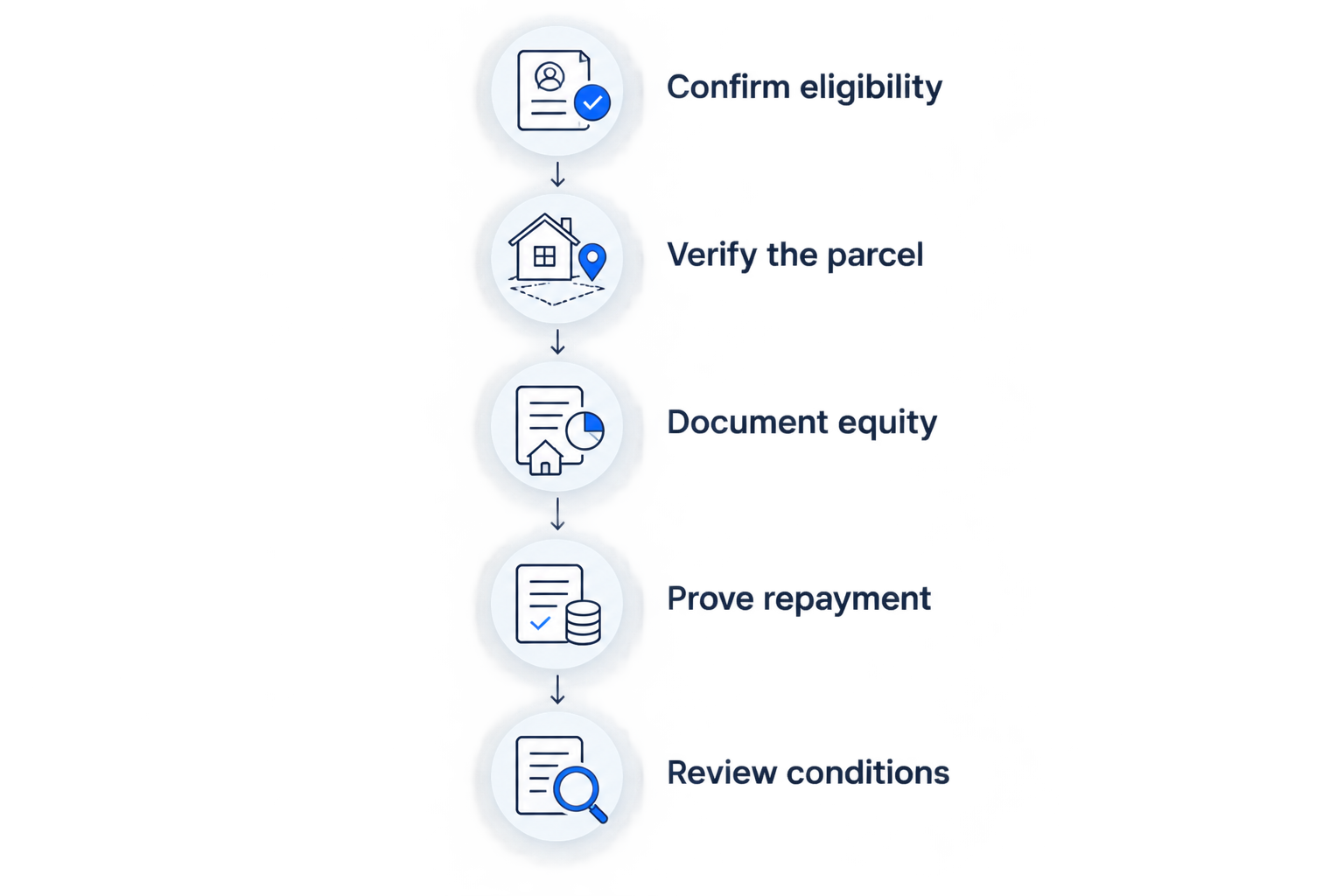
Use this sequence before committing to financing:
- Confirm eligibility. Give the lender the parcel location, current condition, intended use, and requested financing purpose.
- Verify the parcel. Establish ownership, boundaries, legal access, zoning, and known site restrictions.
- Document equity. Show your acquisition contribution, existing ownership interest, and funds available after closing.
- Prove repayment. Support the proposed sale, refinance, or construction-financing exit with documents.
- Review conditions. Separate preliminary terms from the requirements for a binding commitment and disbursement.
Why this matters
Raw land does not provide building income to support debt payments. You need another documented source for carrying the property and paying off the loan, whether that is borrower cash, a sale, or subsequent financing.
The central risk is a mismatch between the loan deadline and the work required to make the parcel saleable or financeable. Do not borrow against a development plan whose essential approvals remain outside your control without addressing that risk in your repayment plan.
For a 2026 purchase, build the financing review around the parcel’s current legal and physical condition. A seller’s development concept is useful background, not proof that the project is permitted or financeable.
Raw land, improved land, and construction-ready land
“No structures” does not describe every relevant property condition. A vacant parcel with documented access and available utilities presents a different file from acreage without established access or confirmed development rights.
These categories help you explain the property. They are not universal lender classifications or promises of approval.
| Land condition | Best for | Supporting strength | Main limitation |
|---|---|---|---|
| Raw land | Investors prepared to resolve development questions | Provides a starting point for a documented land strategy | Access, utilities, permitted use, and site feasibility need investigation |
| Improved vacant land | Buyers seeking a site with existing infrastructure | Documented improvements help establish what already exists | Existing infrastructure does not establish adequate capacity or building approval |
| Construction-ready land | Developers preparing a documented building project | Current approvals and project documents support the proposed use | Construction funding remains a separate financing question |
Raw land: establish what is usable today
Present the parcel as it exists, not as a completed project. Identify recorded access rights, current zoning, known easements, and any investigations already completed.
The advantage is a clear starting point for underwriting. The limitation is unresolved feasibility: the lender still needs to determine whether the land supports the proposed collateral value and repayment strategy.
Improved vacant land: verify infrastructure, not appearances
A road beside the property or a utility line nearby does not establish your right to connect. Obtain documentation of access rights, service availability, connection requirements, and capacity relevant to the intended use.
Existing improvements can support the financing discussion. They do not replace title review, site investigation, or confirmation of local requirements.
Construction-ready land: separate approvals from funding
Provide the actual approvals and identify outstanding conditions, expiration provisions, and transfer requirements. An approved project still needs a budget, a construction plan, and an appropriate source of construction capital.
The strength is a more documented development path. The limitation is that a land-acquisition commitment does not automatically include construction proceeds.
Why raw-land hard money approval varies
Approval depends on the collateral and transaction, not simply whether you own acreage. Address these factors before requesting final terms:
- Legal access and title. Supply recorded access documents and identify liens, easements, ownership issues, and restrictions that affect use or marketability.
- Permitted use. Show the current zoning and applicable approvals. Distinguish an allowed use from a proposed zoning change or pending application.
- Physical feasibility. Document known issues involving utilities, drainage, flood exposure, wetlands, soil conditions, or environmental concerns relevant to the site.
- Collateral value. Support the land’s current condition with relevant valuation evidence. Do not present completed-project value as existing land value.
- Borrower equity and liquidity. Document your contribution and the funds available to service the debt, maintain the property, and complete required work.
- Repayment execution. Explain who provides the payoff funds and what must happen before those funds become available.
There is no single down-payment percentage, loan-to-value ceiling, or closing deadline that applies to every raw-land lender. Obtain the transaction-specific requirements in writing rather than building your purchase contract around an assumed industry standard.
What documents should you prepare for a 2026 application?
Prepare a concise transaction summary and a supporting document folder. The summary should identify the property, ownership entity, financing purpose, requested principal, existing debt, intended use, and proposed repayment source.
Separate confirmed facts from pending work. Mark a zoning application as pending, an unsigned purchase offer as unsigned, and an estimated construction budget as an estimate.
Property documents
Start with the purchase contract or ownership evidence, parcel identification, available survey, title materials, zoning information, and recorded access documents. Include existing reports and approvals rather than describing their conclusions from memory.
For utilities, explain what is connected, what is available subject to conditions, and what remains unverified. For environmental and site conditions, disclose known issues and provide the reports supporting your statements.
Borrower documents
Prepare entity formation and authorization documents, ownership information, relevant project experience, financial information, and evidence of available funds. Ask the lender which documents it requires before submitting sensitive records.
Asset-based lending does not mean the borrower disappears from underwriting. Your ability to cover payments and execute the stated plan remains relevant to repayment.
Exit documents
For a sale exit, provide evidence supporting marketability and identify the approvals or improvements required before marketing. For a refinance exit, identify the intended financing type and its unresolved eligibility conditions.
For construction financing, document the project budget, approvals, and status of the construction lender’s review. A conversation about future financing is not a commitment to repay the land loan.
How should you evaluate the repayment plan?
Match the land loan to an executable exit, not merely an expected increase in value. Write down the event that produces repayment and the conditions that must be satisfied first.
A sale-based plan needs evidence that the parcel is marketable in its expected condition. A refinance-based plan needs evidence that the property and borrower can satisfy the next lender’s requirements.
Use a dependency list for your 2026 financing review:
- Identify each approval, report, agreement, or improvement needed before repayment.
- Record who controls completion and what evidence confirms it.
- Separate tasks you control from decisions made by agencies, utilities, buyers, or other lenders.
- Explain how you will service the debt while those items remain open.
- Ask what happens under the loan documents if the planned exit is delayed.
Do not treat an extension as automatic. Review extension rights, lender discretion, maturity obligations, default provisions, and any personal guaranty before signing.
Can you refinance raw land into a DSCR loan?
Bare land without rental operations does not provide rental income for a property-income-based DSCR analysis. A future rental development requires more than an intention to build: the completed property must satisfy the next lender’s eligibility and underwriting requirements.
Do not list “DSCR refinance” as the exit unless the proposed property, completion plan, and financing requirements support that route. Distinguish financing the land today from financing an operating rental property later.
Does raw-land hard money financing cover construction?
A land loan covers only the uses authorized in the loan documents. Site work, utilities, vertical construction, and future advances require explicit funding provisions; acquisition approval alone does not authorize them.
Ask for a written sources-and-uses statement. It should distinguish funds delivered at closing from any funds retained for later disbursement and identify the conditions attached to each advance.
Does owning the land eliminate the need for cash?
Owning land does not eliminate the need to document liquidity. Existing land equity and cash available to make payments serve different purposes.
Ask how the lender recognizes your ownership basis and current value, then separately confirm the required cash contribution and reserves. Do not assume a favorable valuation supplies the cash needed to service the debt.
When to discuss the transaction with a direct lender
Flex V Capital Ltd is best for commercial real estate investors and business borrowers seeking a direct commercial lending discussion. Its stated financing range is $500K to $20M+, and its offerings include hard money and bridge loans. Those are overall lending capabilities, not confirmation that a particular raw-land parcel qualifies.
Flex V Capital Ltd advertises 48-hour pre-approvals. A pre-approval is not a funded closing, an appraisal result, or confirmation that title and site conditions are acceptable.
For a 2026 raw-land inquiry, ask Flex V Capital Ltd to confirm parcel eligibility, permitted use of proceeds, required equity, repayment requirements, and closing conditions. The useful next step is a property-specific answer—not applying a general financing range to an unreviewed parcel.
Confirm raw-land financing eligibility
Provide the parcel location, current condition, financing purpose, and proposed repayment source.
FAQ
Can I get a hard money loan for land without a house?
Yes, a lender that accepts vacant land can consider a parcel without a house. Approval depends on the property, borrower equity, liquidity, and repayment plan—not simply the absence of a structure.
What down payment do I need for a raw-land hard money loan?
The required down payment is lender- and transaction-specific. Obtain written terms showing the valuation basis, required borrower contribution, and any reserve requirements before committing to the purchase.
Can I use land I already own as collateral?
Yes, a lender that accepts the parcel can consider land you already own as collateral. Existing liens, title conditions, valuation, and repayment requirements still affect the transaction.
Will a hard money lender finance land without utilities?
Land without utilities requires a lender willing to accept that condition. Document the intended use, service availability, connection requirements, and how unresolved infrastructure affects repayment.
Does a raw-land hard money loan include construction funds?
Construction funds are included only when the financing documents expressly provide them. Confirm approved uses, disbursement conditions, and whether a separate construction loan is required.
Can I qualify for a raw-land loan with bad credit?
Bad credit does not establish approval or denial across all hard money lenders. Ask the lender about credit review, guaranties, liquidity, and collateral requirements for the specific parcel.
Can I use a DSCR loan to refinance undeveloped land?
Undeveloped land without rental operations does not supply rental income for a property-income-based DSCR analysis. A planned rental project must satisfy the future lender’s property and underwriting requirements before that refinance is a credible exit.
One last thing
Physical access and legal access are not interchangeable. A visible driveway, an informal arrangement with a neighbor, or a route used by the seller does not establish a recorded right benefiting your parcel.
Before treating access as resolved, have the relevant title and legal documents reviewed. A financing plan cannot correct a missing property right merely by assigning more value to the land.