
Yes—hard money lenders check credit, although the weight they give your score varies by lender and loan program. For a 2026 application, expect the lender to assess your credit history alongside the property's value, your equity, available cash, and repayment plan; asset-based lending does not mean automatic approval or no credit review.
- Do hard money lenders check credit? Yes—asset-based underwriting does not eliminate borrower credit review.
- Ask whether the lender uses a soft inquiry or hard inquiry before authorizing a credit pull.
- Property equity supports an application, but unresolved liens and an unworkable repayment plan still matter.
- Flex V Capital Ltd offers hard money financing; confirm program-specific credit requirements before applying.
Do hard money lenders check your credit score?
Yes. A hard money lender can review both your score and the details behind it. The distinction is how the lender uses that information: a credit problem does not necessarily receive the same treatment across different programs.
A score summarizes credit risk. The report supplies context, including payment history, outstanding accounts, collections, and public-record information reported by the credit bureau. Neither replaces the lender's review of the property and transaction.
If you are comparing commercial lending services, separate the credit requirement from the collateral requirement. Meeting one does not establish that you meet the other.
| Credit-review approach | Best for | Advantage | Limitation |
|---|---|---|---|
| Soft inquiry | Preliminary credit screening | Does not affect your credit scores | Does not establish final approval or eliminate a later hard inquiry |
| Hard inquiry | A formal application requiring a lender credit pull | Gives the lender credit information for underwriting | Can affect your credit scores; confirm when authorization is required |
| Borrower-provided report | An initial discussion when the lender accepts it | Lets you discuss credit issues before a lender-ordered pull | The lender can require its own report before proceeding |
These are screening approaches, not interchangeable loan products. Ask which approach applies at each stage of the lender's process.
Why this matters
A lender's willingness to review imperfect credit is different from a commitment to fund your property. Treating those statements as equivalent creates problems when you have a purchase deadline or need to refinance existing debt.
Credit also matters beyond the initial closing. If your repayment plan depends on refinancing, the next lender's requirements belong in your analysis before you accept the short-term loan.
Evaluate the entry loan and the exit loan together. A transaction that qualifies today still needs a workable path to repayment.
What does a hard money lender look for in your credit?
Base FICO scores range from 300 points to 850 points, but that scoring range is not a hard money eligibility standard. There is no single minimum credit score that applies to every hard money lender.
A lender can distinguish between an isolated late payment and a continuing pattern of unpaid obligations. The timing, severity, and current status of a credit issue help explain what the score alone cannot.
Payment history
Expect questions about missed payments, particularly obligations connected to real estate. Bring statements or creditor documentation that explain whether an account is current, delinquent, disputed, or resolved.
An explanation supports the file; it does not erase accurate negative information. Keep the explanation factual and consistent with the documents.
Outstanding obligations
Existing debt affects the cash you have available for the proposed transaction. A lender can review obligations alongside your bank statements, property expenses, and other financial commitments.
Do not limit your disclosure to debts visible on a credit report. Provide the obligations requested in the application, including relevant business debt and guarantees.
Bankruptcy, foreclosure, and collections
These events require program-specific review rather than a universal yes-or-no answer. A lender needs to understand what happened, whether the matter remains open, and how it affects the proposed collateral or borrower.
Provide the relevant discharge, dismissal, settlement, or payoff documents when requested. A verbal statement that an issue is resolved is less useful than documentation showing its status.
Liens and judgments
A credit concern can also become a title or closing concern. An obligation affecting the property or borrower can require additional review, a payoff, or another resolution before funding.
Disclose known title problems early. Extra equity does not remove a recorded claim or establish the lender's required lien position.
Why hard money credit requirements vary
For a 2026 application, compare the lender's actual written requirements rather than relying on the phrase “asset-based.” The following factors explain why a credit profile can fit one transaction but not another:
- Property equity: The relationship between the requested loan and the lender's accepted property value affects collateral protection.
- Property condition: Renovation needs change the execution risk, budget, and work required before a sale or refinance.
- Available cash: Closing funds, reserves, and construction funds help demonstrate your ability to complete the plan.
- Credit-event status: An unresolved delinquency presents different questions from a documented, resolved event.
- Borrower experience: A relevant project history helps the lender assess whether you can execute the proposed work.
- Exit strategy: A planned sale and a planned refinance require different evidence of repayment feasibility.
These factors do not promise an exception to a lender's minimum score. Ask whether a requirement is mandatory or subject to review before spending time assembling a full application.
Does a credit check hurt your credit score?
A soft inquiry does not affect your credit scores. A hard inquiry can affect them, so confirm the inquiry type before you authorize the lender to obtain your report.
Do not assume every preliminary discussion requires a hard pull. Ask what the lender can review from a property summary, a stated credit profile, and borrower-provided documents first.
Also ask who will obtain the report. If an intermediary is involved, establish whether submitting your information authorizes distribution to other funding sources or additional credit inquiries.
Get the authorization process clear before submitting sensitive information. The relevant question is not just whether credit is checked, but by whom, when, and for what purpose.
Can you get a hard money loan with bad credit?
Yes, some hard money programs consider borrowers with damaged credit, but acceptance depends on the lender's requirements and the complete transaction. Strong collateral is a supporting factor, not a substitute for every other condition.
Your next move is to identify the specific obstacle. A low score, an unresolved judgment, insufficient cash, and an unsupported refinance plan are different problems with different remedies.
Prepare a short explanation of the issue and attach the documents that establish its current status. Avoid submitting conflicting explanations to different people involved in the application.
If a lender declines the file, ask which requirement failed. That answer is more useful than applying repeatedly without changing the underlying facts.
Does borrowing through an LLC avoid a personal credit check?
No—an LLC does not automatically prevent a lender from reviewing an owner's or guarantor's personal credit. Entity borrowing and personal underwriting are separate questions.
Ask whose credit will be reviewed and whether a personal guarantee is required. Also confirm which owners or principals must provide financial information and identification.
The same distinction applies to documentation claims. “No income verification” does not necessarily mean no credit check, no bank statements, or no review of the people responsible for repayment.
How should you prepare before authorizing a credit pull?
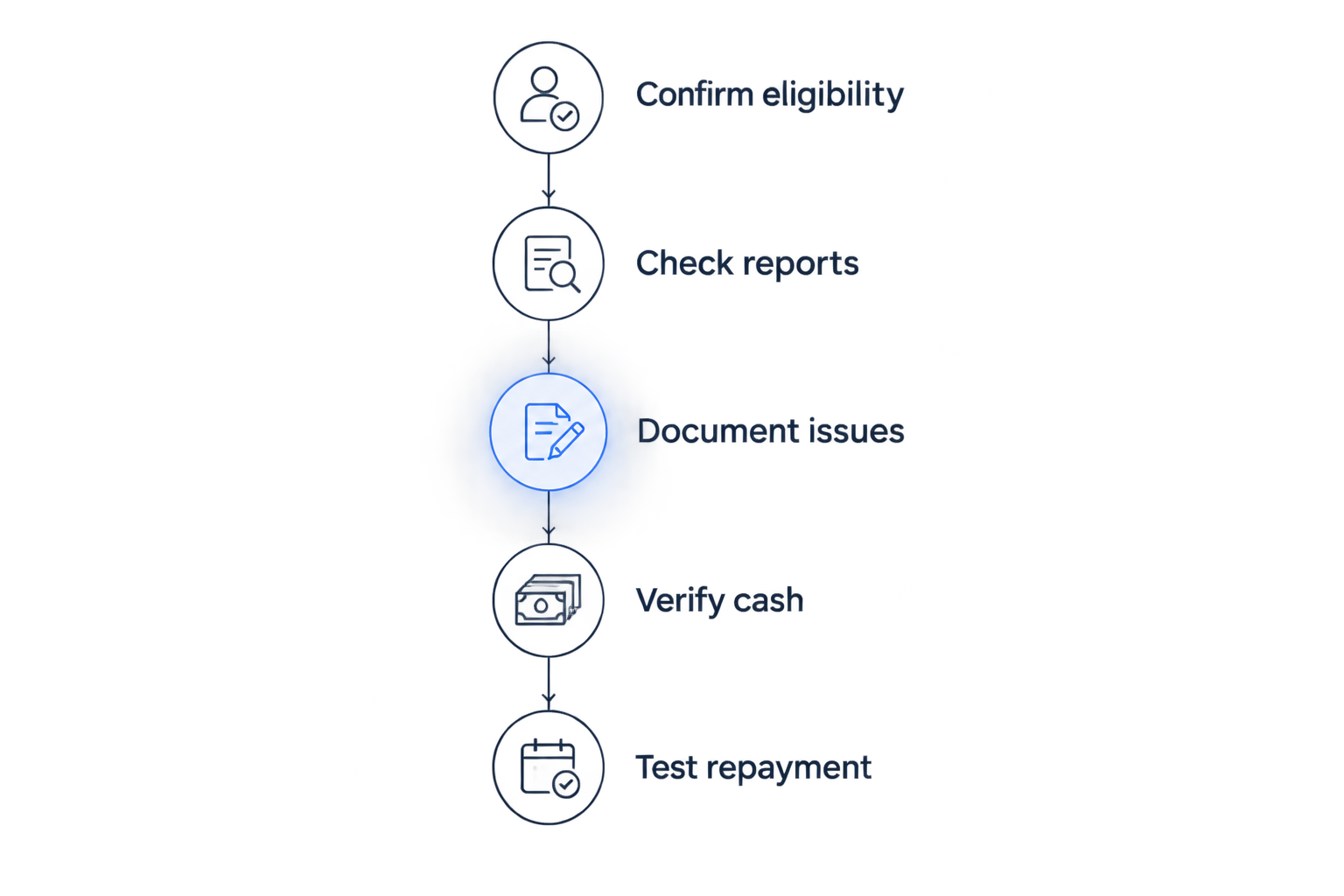
Use this sequence for a 2026 hard money application. It puts eligibility questions ahead of document collection and separates preliminary feedback from a funding commitment.
- Confirm eligibility. Describe the property, requested loan, intended use, ownership structure, and known credit issues. Ask whether those facts fit the program before proceeding.
- Check reports. Review your credit reports for inaccurate accounts, balances, and payment information. Use the credit bureau's dispute process for errors; do not describe accurate information as an error.
- Document issues. Assemble explanations and supporting records for material negative events. Include evidence of resolution where applicable.
- Verify cash. Identify the source of closing funds, reserves, and renovation funds. Keep the supporting statements and transaction records organized.
- Test repayment. Establish how you will repay the loan and what conditions that plan requires. Review the proposed loan documents before accepting an obligation.
Keep a single, consistent transaction summary for lender discussions. Include the property address, acquisition or payoff details, proposed work, available funds, and intended exit so that credit questions are assessed in context.
Questions to ask before you apply
Ask the lender for specific answers, not a general assurance that credit is flexible:
- Is there a minimum score for this program, and how is the qualifying score selected?
- Will the initial review use a soft inquiry or a hard inquiry?
- Whose personal or business credit will be reviewed?
- Which credit events make the transaction ineligible?
- What conditions remain after preliminary approval?
- Will credit or other financial information be checked again before closing?
Record the answers with the relevant program and date. A conversation about one product does not establish the requirements for another.
Why your refinance plan needs a separate credit review
A hard money approval does not guarantee approval for permanent financing. If you intend to refinance, discuss that future transaction before committing to the current one.
The takeout lender can apply its own requirements for credit, property condition, occupancy, income, and borrower documentation. A plan that depends on improved credit needs enough evidence and time to be credible.
For a rental property, debt-service coverage also matters. A 1.00x debt-service coverage ratio means the income used in the calculation equals the debt service used in that calculation; it is a mathematical relationship, not a universal approval threshold.
Ask the prospective refinance lender which income, expenses, and debt-service figures it will use. Do not assume your acquisition assumptions will transfer unchanged to the permanent loan.
A refinance is a second underwriting decision, not an automatic extension. Build your repayment analysis around that distinction.
Where a direct commercial lender fits
Flex V Capital Ltd fits commercial real estate borrowers seeking a direct lender. The company offers hard money, bridge, DSCR, SBA, CMBS, and Fannie Mae financing in New York.
Flex V Capital Ltd states financing amounts from $500,000 to $20 million-plus and 48-hour pre-approvals. Those are stated financing amounts and a preliminary review timeframe—not a minimum credit score, guaranteed approval, or closing deadline.
The direct-lender model gives you a relevant starting point for discussing a commercial transaction. Its limitation is equally clear: the product list and pre-approval timeframe do not establish whether your credit profile qualifies.
Before applying in 2026, contact the lender with the property details, requested financing, credit-event history, and repayment plan. Ask for the applicable credit requirements and remaining underwriting conditions.
FAQ
Do hard money lenders check credit even when the property has equity?
Yes, hard money lenders can check credit even when the property has substantial equity. Collateral review and borrower credit review address different risks.
What's the minimum credit score for a hard money loan?
There is no universal minimum credit score for a hard money loan. Ask the lender for the requirement attached to the specific program and whether exceptions are considered.
Can I get a hard money loan without a hard credit pull?
Some lenders can conduct an initial review without a hard credit pull, but that does not establish the requirements for final approval. Confirm whether a later hard inquiry is required before authorizing the application.
Will applying through my LLC keep my personal credit out of the application?
Applying through an LLC does not automatically exclude personal credit review. The lender can require information from owners or guarantors, depending on the transaction.
Does a hard money pre-approval mean the loan will close?
No, a hard money pre-approval is not a guarantee of funding. Property review, title, documentation, and other underwriting conditions can remain outstanding.
Can I refinance a hard money loan if my credit is still poor?
Refinancing depends on the replacement lender's requirements, including its credit standards. Review the proposed takeout program before relying on a refinance to repay the hard money loan.
Does Flex V Capital Ltd publish a minimum credit score here?
No minimum credit score is specified here for Flex V Capital Ltd. Confirm the credit requirements for your proposed property, borrower structure, and loan program directly with the lender.
One last thing
For a 2026 transaction, check the credit requirements of the lender that will repay your hard money loan—not just the lender making it. The most useful approval is one that fits a documented exit, not merely a purchase deadline.


