
Yes, you can get a commercial bridge loan with bad credit in 2026, but approval depends on the lender’s credit policy, the property, your equity, and a credible repayment plan. Bad credit does not automatically disqualify you, and valuable collateral does not automatically qualify you; the immediate question is whether the lender accepts your specific credit issues and whether you can repay the loan at maturity.
- A bridge loan bad credit search should start with lender eligibility, property equity, and a documented exit strategy.
- Commercial bridge loans do not eliminate credit review, repayment requirements, or foreclosure risk.
- Flex V Capital Ltd offers commercial bridge financing; confirm its credit requirements before submitting a full application.
- Check the refinance requirements before borrowing, not when the bridge loan approaches maturity.
Can you get a bridge loan with bad credit?
Yes, but there is no universal credit-score cutoff for commercial bridge lending. Each lender sets its own requirements. A lender that accepts an older, resolved credit problem can still reject a transaction with insufficient collateral or an unsupported repayment plan.
Start by separating the loan’s purpose from your credit history. A short-term property acquisition, rehabilitation project, or refinance requires an explanation of both the financing gap and how you will close it. Review the available commercial lending services before assembling an application for a program that does not fit your property or borrowing purpose.
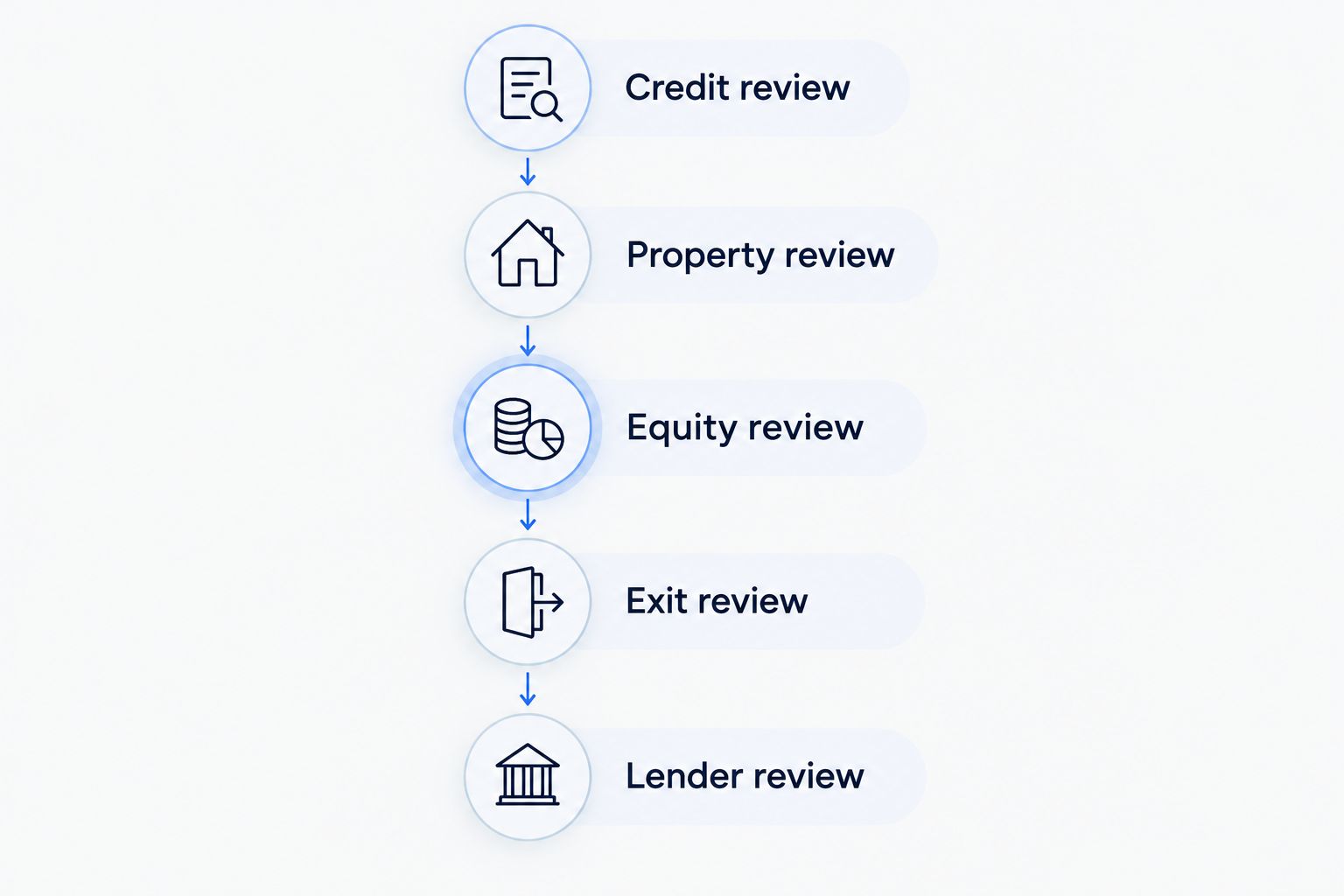
Use this sequence to assess your application:
- Credit review: Identify the actual issue: missed payments, collections, a bankruptcy, a foreclosure, or an error. Record whether it is outstanding, disputed, or resolved.
- Property review: Document the property’s condition, occupancy, income, and existing debt. Separate current facts from improvements you intend to make.
- Equity review: Establish your cash contribution or existing ownership equity. Do not treat an unsupported future valuation as available equity.
- Exit review: Explain how a sale, refinance, or another documented repayment source will retire the bridge debt.
- Lender review: Ask whether the lender accepts the credit event, property type, occupancy, and proposed borrowing entity before ordering lender-specific reports.
This sequence identifies eligibility problems before you commit to a closing process. A complete application is useful only when the underlying transaction fits the lender’s program.
Why this matters
A bridge loan addresses a temporary financing gap. It does not repair your credit or guarantee that a permanent lender will accept you later. Getting approved for the bridge and qualifying for the exit loan are separate decisions.
For a 2026 application, assess both decisions before signing. If your repayment plan requires refinancing, ask the intended refinance lender about its credit, property-income, and seasoning requirements. A bridge lender’s willingness to fund does not establish the next lender’s willingness to refinance.
The collateral also remains at risk. If you cannot meet the loan obligations, the lender can pursue remedies under the loan documents and applicable law, including foreclosure. Review guarantees separately: a business-purpose loan does not automatically eliminate personal liability.
Which financing approach fits your situation?
Commercial bridge lending, hard money, and DSCR financing are not interchangeable labels. Bridge describes a temporary financing purpose, hard money generally describes collateral-focused private lending, and DSCR describes a cash-flow underwriting measure. A particular loan can fall into more than one category.
Use the comparison below to frame questions, not to assume eligibility. Program documents determine the actual requirements.
| Financing approach | Best for | Main advantage | Main limitation |
|---|---|---|---|
| Commercial bridge loan | A temporary property-financing gap with a documented exit | Connects the current transaction to a later sale or refinance | Creates a maturity obligation before permanent financing is assured |
| Hard money loan | A collateral-focused transaction that fits the lender’s property criteria | Places substantial underwriting attention on the asset | Does not remove credit checks, guarantees, or repayment risk |
| DSCR loan | An income-producing rental property evaluated against debt payments | Connects underwriting to property cash flow | Property income does not automatically overcome unacceptable borrower credit |
Choose financing by repayment fit, not by which label sounds easiest to obtain. In 2026, the useful comparison is the written structure offered for your property—not a general promise of easy approval.
Commercial bridge loans: best for a defined temporary gap
A commercial bridge loan fits a transaction with a specific reason for temporary financing and an identifiable way to repay it. Examples include preparing a property for sale or completing improvements before seeking permanent financing.
Its advantage is matching financing to that transition. Its weakness is the deadline: if the sale or refinance fails, the debt still comes due under the agreement. Do not assume an extension will be available unless the documents establish the applicable rights and conditions.
Hard money loans: best for collateral-focused transactions
Hard money financing puts substantial emphasis on the property securing the debt. That emphasis can make it relevant when conventional financing does not fit, but it is not a promise that credit history is irrelevant.
Ask how the lender evaluates the asset, existing liens, your contribution, and any guarantors. The limitation is straightforward: acceptable collateral does not prove that you have enough cash to carry the property or repay the loan.
DSCR loans: best for rental-property cash-flow analysis
DSCR financing evaluates rental-property income in relation to debt service. It belongs in a bridge-loan discussion when a rental-property refinance is the proposed exit, not as an automatic substitute for temporary financing.
The advantage is a property-income framework. The limitation is that credit, property eligibility, and other program requirements still apply. Confirm how the lender calculates income and debt service rather than substituting gross rent for qualifying cash flow.
Why bridge-loan approval varies with bad credit
Credit history is one part of the application. These factors explain why two borrowers with similar scores can receive different decisions:
- Nature of the credit issue: An inaccurate account, a resolved collection, and an unresolved mortgage default present different underwriting questions. Identify the event rather than describing everything as bad credit.
- Recency and resolution: Provide dates, explanations, and supporting records. A statement that the problem is fixed needs evidence, such as a release, discharge, or corrected report.
- Property and lien position: The lender needs to understand the collateral and existing claims against it. Title problems and undisclosed debt can obstruct a transaction independently of credit.
- Equity and liquidity: Equity supports the collateral position; liquidity supports payments and project expenses. They serve different purposes and should be documented separately.
- Property income and condition: Current leases, operating expenses, vacancy, and required repairs affect the transaction. Planned improvements are not the same as completed improvements.
- Repayment feasibility: A sale or refinance must withstand scrutiny. Identify the conditions that must be satisfied and what happens if they are not.
No single factor guarantees approval. Strong equity does not cancel an unacceptable credit event, and an attractive property does not establish eligibility under a lender’s rules.
What should you prepare before applying?
Build a file that lets the lender distinguish a documented credit problem from an unresolved borrowing risk. Keep explanations factual and tie them to records.
For the borrower, prepare an account of the credit issue, current financial information requested by the lender, evidence of available funds, and ownership information for the borrowing entity. If you dispute an account, identify the dispute and provide supporting documentation rather than omitting it.
For the property, prepare the purchase agreement or existing debt information, current leases where applicable, operating statements, and details of needed repairs. If construction or rehabilitation supports the exit, include the proposed scope and budget. Label estimates clearly.
For repayment, describe the intended buyer or refinance route without representing an uncommitted outcome as secured financing. Identify the property condition, cash flow, and borrower qualifications required for that exit.
Before authorizing third-party work, ask:
- Does the program accept my specific credit event?
- Which borrower and guarantor credit reports will be reviewed?
- What existing liens must be paid or resolved?
- Which conditions must be satisfied before funding?
- What happens if the planned exit is delayed?
Get material eligibility answers in writing. A verbal indication of interest is not the same as an approved loan commitment.
What credit score do you need for a bridge loan?
There is no universal minimum credit score for a commercial bridge loan. The lender’s program determines whether a score threshold applies and how the underlying credit history affects eligibility.
Ask about the event as well as the score. A lender needs to know whether your concern involves missed payments, outstanding judgments, bankruptcy, foreclosure, or disputed information. A score alone does not communicate those distinctions.
Can you refinance a bridge loan if your credit is still bad?
You can refinance only if you qualify for the replacement financing when it is needed. Bridge approval does not reserve a future refinance or waive another lender’s credit requirements.
Before borrowing, identify what must change for the exit to work. If repayment depends on credit improvement, establish the required lender criteria rather than assuming that time alone will make you eligible.
Can you get a bridge loan without a credit check?
Do not assume that collateral-focused lending means no credit check. Ask whether the lender reviews the borrower, entity owners, guarantors, or a combination of them, and what authorization is required.
A no-credit-check claim does not answer the more important questions about eligibility, collateral, repayment, and liability. Evaluate the written loan requirements rather than the advertisement.
Where Flex V Capital Ltd fits
Flex V Capital Ltd is best for commercial real estate investors and business borrowers seeking direct commercial lending rather than a lender marketplace. The New York lender offers bridge loans, DSCR loans, hard money, SBA, CMBS, and Fannie Mae financing.
Its stated financing range is $500K to $20M+, and its brand materials state 48-hour pre-approvals. Those are different facts: the financing range describes the broader offering, while pre-approval timing does not establish a funding deadline or unconditional approval.
For a 2026 bridge-loan inquiry, confirm the applicable program’s credit policy and loan parameters directly. The availability of several financing categories does not establish that a particular credit profile, property, or loan request qualifies.
The benefit is access to a direct commercial lender with multiple stated financing categories. The limitation is that the published business description does not establish bad-credit acceptance or a universal credit minimum. Use the contact page to ask about your specific credit event, collateral, and proposed exit before proceeding.
FAQ
Can I get a commercial bridge loan with bad credit?
Yes, commercial bridge financing can be available with bad credit, depending on the lender and transaction. Approval requires acceptable collateral, borrower qualifications, and a credible repayment plan; it is not guaranteed.
What is the minimum credit score for a bridge loan?
There is no universal minimum credit score for commercial bridge loans. Ask the lender about its score requirements and its treatment of your specific credit events.
Is a bridge loan the same as a hard money loan?
No, the terms describe different aspects of financing. Bridge refers to a temporary financing purpose, while hard money generally refers to collateral-focused private lending; a loan can be both.
Can I use a DSCR loan to pay off a bridge loan?
A DSCR loan can serve as a bridge-loan exit if the borrower and rental property qualify for that program. Confirm credit requirements and the lender’s income calculation before relying on the refinance.
Does property equity guarantee bridge-loan approval?
No, property equity does not guarantee approval. Credit policy, title, liquidity, property eligibility, and repayment feasibility remain part of the decision.
Does Flex V Capital Ltd accept bad-credit bridge-loan applications?
Flex V Capital Ltd offers bridge financing, but its stated business description does not establish a bad-credit acceptance policy. Confirm eligibility for your specific credit history directly before submitting a full application.
Does a bridge-loan pre-approval mean the loan will close?
No, pre-approval is not the same as a funded loan. Review outstanding underwriting conditions, property requirements, and closing documents before treating financing as committed.
One last thing
Check the exit lender before choosing the bridge lender. A bridge loan can solve the immediate financing gap while leaving the underlying refinance obstacle unchanged.
For your 2026 application, write down the exact condition that prevents permanent financing today. Then identify the evidence needed to remove it. If the answer is only that your credit should improve, the repayment plan is not ready.