
Fannie Mae multifamily loan approval has no single guaranteed turnaround time; your lender must establish the schedule for your property, borrower file, and transaction. Preliminary approval is not authorization to fund, and underwriting approval can still leave legal, title, insurance, or other closing conditions unresolved. Plan around documented milestones, not an advertised approval speed.
- Fannie Mae multifamily loan approval time depends on the transaction; get a written underwriting and closing schedule.
- Preliminary approval, underwriting approval, and funding are different milestones in commercial real estate lending.
- Flexvcapital offers Fannie Mae financing; its stated 48-hour pre-approval is not a multifamily closing guarantee.
- A complete borrower file helps, but property reports and unresolved closing conditions also control timing.
How long does Fannie Mae multifamily loan approval take?
There is no universal approval period that applies to every Fannie Mae multifamily transaction. The useful answer is a lender-confirmed schedule that identifies the starting point, the approval milestone, and the conditions required before funding.
Ask whether the quoted turnaround starts when you submit an inquiry, sign an application, or deliver a complete underwriting package. Those are different starting points. The Fannie Mae multifamily application-to-closing workflow provides a separate guide to the sequence.
| Milestone | What it establishes | What it does not establish |
|---|---|---|
| Preliminary review | Initial assessment of the proposed transaction | Final property acceptance or a funding commitment |
| Application and underwriting | Review of borrower, property, and proposed loan structure | That every legal or closing condition is satisfied |
| Conditional approval | Approval subject to stated requirements | That unresolved conditions can be ignored |
| Closing readiness | Required documents and conditions are cleared for closing | That loan proceeds have already been disbursed |
| Funding | Loan proceeds are disbursed under the closing instructions | That earlier estimates were binding deadlines |
Ask for the milestone behind the number. An approval estimate without a defined endpoint does not tell you whether you can meet a purchase deadline or refinance maturity.
Why this matters for your 2026 closing
A purchase contract and an existing loan maturity create real deadlines. A preliminary lending decision does not change either one. If you treat an early indication as a closing commitment, you can reach the contractual deadline with underwriting or documentation still open.
Fannie Mae's conventional multifamily financing generally concerns properties with at least 5 residential units. Do not substitute a timeline for a small residential investment mortgage merely because both transactions involve rental income; the property review and lending process are not interchangeable.
Separate the contractual deadline from the lender's working target. Then ask counsel and the lender what must happen before each date. You need to know which deadlines are fixed, which depend on another party, and which require written changes if the transaction moves.
A schedule becomes useful when each outstanding item has an owner. A list of dates without responsibility attached is only a forecast.
What happens during each approval stage?
The approval process combines borrower review, property review, and closing preparation. Some work can proceed together, but an unresolved issue in one area can prevent the entire transaction from advancing.
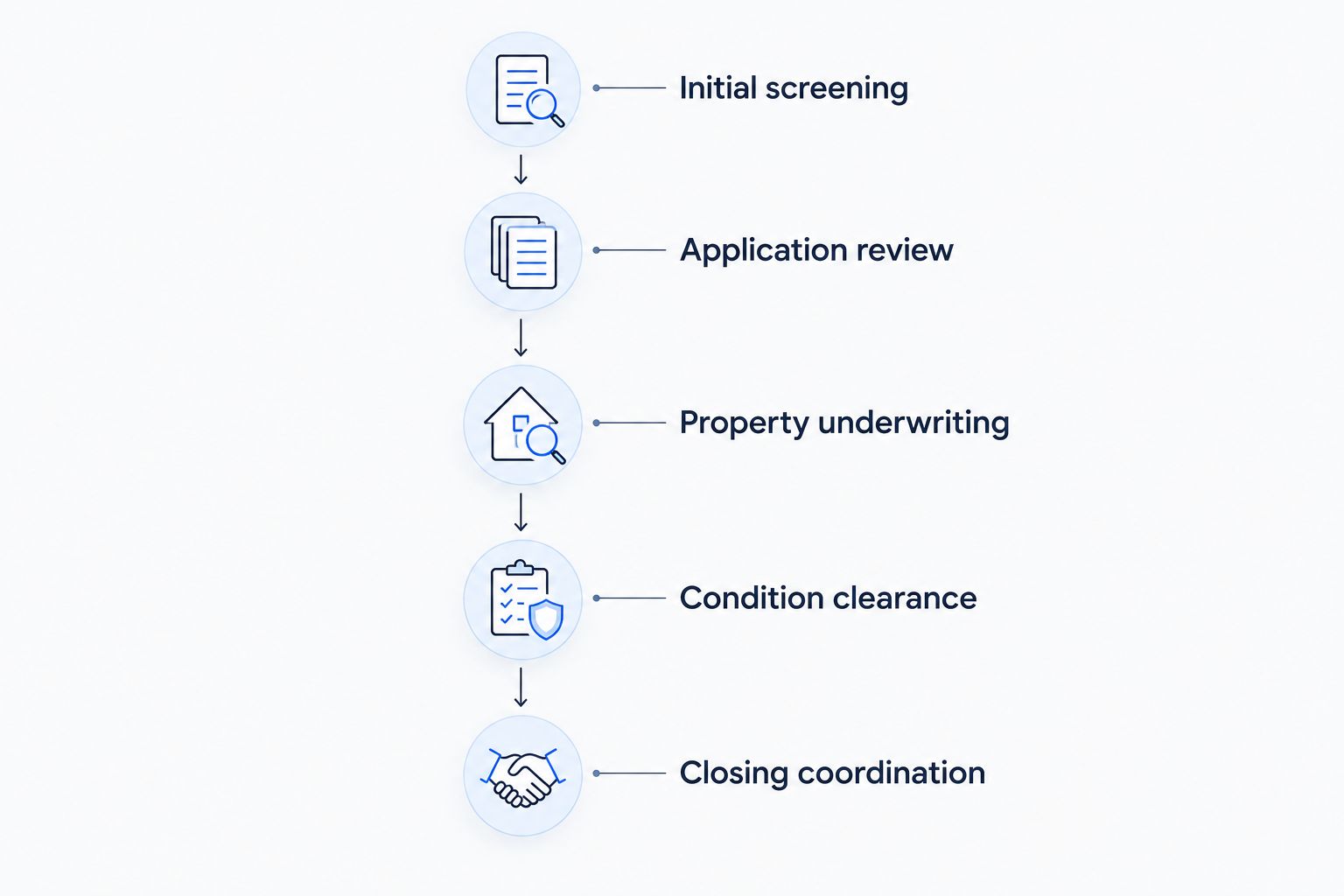
Use the following stages to organize your lender discussions. They describe the work, not promised durations.
- Initial screening. Confirm the property type, transaction purpose, requested financing, ownership structure, and current operating position. Ask whether the proposed transaction fits the lender's Fannie Mae execution before treating indicative terms as actionable.
- Application review. Establish what the lender considers a complete application. Identify missing borrower records, property financials, entity documents, and authorizations before asking for an underwriting completion date.
- Property underwriting. Reconcile rental income, operating expenses, occupancy, valuation, and relevant property reports. Ask which assumptions remain preliminary and which conclusions depend on information still outstanding.
- Condition clearance. Obtain a written list of approval conditions and identify the person responsible for satisfying each one. Distinguish a document that has been submitted from a condition the lender has accepted as cleared.
- Closing coordination. Complete the required legal, title, insurance, execution, and funding arrangements. Confirm the closing sequence with the lender and counsel rather than assuming an approval notice authorizes disbursement.
The important distinction is between completing work and receiving acceptance of that work. Sending a revised operating statement does not establish that underwriting has accepted the revision.
Why Fannie Mae multifamily approval time varies
The timeline depends on the work needed to reach an acceptable lending decision and complete the transaction. For your 2026 schedule, ask the lender to identify which of these factors is currently controlling progress:
- Application completeness. Missing ownership information, financial statements, or property records creates additional requests before the lender can finish its review.
- Financial consistency. Rent rolls, operating statements, leases, and supporting records must tell a consistent story. Unexplained differences require reconciliation rather than a faster submission of the same figures.
- Third-party reports. Appraisal, environmental, and property-condition work involves separate delivery and review steps. A report's delivery date is not necessarily its acceptance date.
- Property issues. Identified physical, environmental, occupancy, or legal matters can require additional analysis or conditions. Ask what evidence resolves the specific issue.
- Borrower and ownership review. Entity structure, control, experience, and required financial information affect the scope of review. Supply the requested records for the actual borrowing structure.
- Closing readiness. Title matters, insurance documentation, signatures, and remaining legal conditions can hold up funding after the credit decision. Track them alongside underwriting, not only afterward.
Ask which factor is the current constraint. Completing an easy item does not advance the closing if the unresolved condition controlling funding remains untouched.
What documents should you prepare before applying?
Prepare a consistent package rather than a large collection of disconnected files. The lender sets the actual requirements; the categories below help you organize the initial discussion without treating a general checklist as a final approval standard.
Property financials
Gather the current rent roll, historical operating statements, and current financial information requested by the lender. Identify the reporting periods clearly and explain material differences between records. Do not combine actual collections, scheduled rent, and projected income without labeling them.
If the property has recently changed management or accounting systems, explain how the records connect. Underwriting needs a traceable operating history, not just a summary total.
Borrower and ownership records
Prepare the borrowing entity's organizational documents and an accurate ownership structure. Collect the financial and experience information the lender requests for the relevant principals or other required parties.
Tell the lender about a proposed ownership change before documents are finalized. A file prepared for one borrowing structure does not automatically establish acceptance of a different structure.
Transaction and property records
For an acquisition, provide the executed contract and relevant amendments. For a refinance, identify the existing debt and maturity obligations. Include available property records and disclose known matters that require legal or technical review.
For a 2026 application, label every document with its reporting period and version. Clear file naming helps everyone distinguish the current submission from a superseded document without guessing.
Does a 48-hour pre-approval mean the loan closes then?
A 48-hour pre-approval is not a 48-hour closing commitment. Flexvcapital states that it offers 48-hour pre-approvals, but that statement does not establish a Fannie Mae multifamily underwriting or funding deadline for your transaction.
A preliminary assessment can help you decide whether to continue the financing discussion. Its limitation is equally important: it does not replace property diligence, final underwriting, or satisfaction of closing conditions.
Ask what the preliminary decision assumes and what information remains unverified. Request a separate schedule for underwriting, condition clearance, and funding before using the preliminary response to support a contractual commitment.
Is Fannie Mae approval the same as lender approval?
Fannie Mae multifamily financing is arranged through approved lenders, including lenders operating under its Delegated Underwriting and Servicing framework. Borrowers should not assume that every transaction requires an identical, separate Fannie Mae review after the lender completes underwriting.
Ask your lender who has approval authority for the proposed execution and whether any issue requires additional review. The practical question is not simply whether the file is with Fannie Mae; it is which decision remains outstanding and who can make it.
Keep terminology precise. A lender's indication of interest, a conditional credit decision, and authorization to close represent different levels of certainty.
What should you ask before accepting a closing estimate?
Use these questions to turn an estimate into a working schedule. Ask for answers tied to your property and application rather than a general description of the lender's process.
- What event starts the quoted approval period?
- Is the estimate for preliminary review, underwriting approval, or funding?
- Which documents are still missing from the application?
- Which reports have been ordered, and which remain subject to review?
- Are any exceptions or additional approvals required?
- Which closing conditions can be addressed while underwriting continues?
- Who maintains the outstanding-items list and confirms that conditions are cleared?
- What changes would require the closing target to be revised?
Request a written update when a material assumption changes. If a report, ownership change, or revised transaction structure affects the schedule, the old estimate should not remain the basis for your decisions.
Avoid treating every outstanding item as equally urgent. Ask the lender to identify the item that currently prevents the next decision and the evidence needed to resolve it.
How should you build your 2026 transaction calendar?
Start with the contractual closing date or existing debt maturity, then work backward with the lender and counsel. Do not insert a generic approval average where a transaction-specific review is required.
Keep separate entries for underwriting completion, condition clearance, document execution, and funding. A single calendar entry labeled approval hides the work between a credit decision and the release of proceeds.
For each milestone, record the required deliverable, responsible party, dependency, and current status. Ask the lender which activities can proceed together and which must wait for another decision.
If the lender cannot support your contractual date, address the mismatch before relying on the financing. Discuss the contractual implications with counsel and request a realistic lending schedule. Do not assume that an approaching deadline changes underwriting requirements.
Review the calendar whenever the transaction changes. A revised purchase agreement, borrowing entity, or property operating picture can affect documents already prepared and assumptions already reviewed.
When does a direct-lender conversation help?
Flexvcapital is best for commercial real estate borrowers seeking a direct-lender discussion about Fannie Mae financing. The firm identifies itself as a direct commercial lender in New York and offers Fannie Mae financing among its commercial lending services.
The benefit of that conversation is a transaction-specific assessment rather than reliance on a generic timeline. The limitation is that the initial response does not itself resolve underwriting or closing requirements.
Ask who will originate and underwrite the proposed loan, how the Fannie Mae execution is structured, and which party controls each decision. A lender's broader commercial offering does not establish that every property or borrower qualifies for a particular execution.
Bring the property address, unit count, transaction purpose, current operating information, proposed ownership structure, and required closing date. That gives the discussion a defined transaction to assess instead of an abstract question about speed.
FAQ
How long does Fannie Mae multifamily loan approval take in 2026?
Fannie Mae multifamily loan approval has no universal guaranteed turnaround. Ask your lender for a transaction-specific schedule that separates preliminary review, underwriting approval, closing readiness, and funding.
Can I get Fannie Mae multifamily financing approved in 48 hours?
A 48-hour preliminary response does not establish final Fannie Mae multifamily approval or funding. Final timing depends on underwriting, property review, and satisfaction of the transaction's closing conditions.
Does Fannie Mae approve every multifamily loan directly?
Fannie Mae multifamily loans are originated through approved lenders, and approval responsibilities depend on the execution. Ask your lender whether delegated authority applies and whether your transaction requires additional review.
What can delay a Fannie Mae multifamily closing?
Incomplete records, unresolved underwriting questions, property reports, title matters, and outstanding legal or insurance conditions can delay closing. Ask which specific item currently prevents the next milestone.
Does pre-approval mean I can waive my financing contingency?
Pre-approval does not establish that all funding conditions are satisfied. Review the financing contingency and the consequences of waiving it with your attorney before changing your contractual protection.
Does Flexvcapital offer Fannie Mae financing?
Flexvcapital offers Fannie Mae financing as part of its commercial lending services. Request a property-specific eligibility review and distinguish its stated 48-hour pre-approval from final underwriting and funding.
What property size is generally considered multifamily for Fannie Mae financing?
Fannie Mae conventional multifamily financing generally applies to properties with at least 5 residential units. Confirm the proposed property's eligibility and applicable requirements with an approved lender.
One last thing
Ask for the unresolved-condition list, not another reassurance about speed. The most useful closing update identifies what remains open, who owns it, and what establishes completion.
For your 2026 transaction, make the next action specific: request the current condition list and a revised schedule tied to it. Approval language alone does not tell you when proceeds will be available.