
SBA 504 loan fees are transaction-specific, not a single flat charge: your total combines CDC and SBA-related charges, the participating lender’s fees, and third-party closing expenses. That total excludes your equity contribution and interest, which belong in separate budget categories. For a 2026 transaction, get an itemized estimate showing what you pay before closing, what you pay at closing, and what enters the financed balance.
- SBA 504 loan fees require an itemized estimate covering CDC charges, lender fees, and third-party closing costs.
- Financed closing costs reduce immediate cash needs but increase the balance you repay.
- Flexvcapital offers SBA financing; confirm the proposed transaction’s structure and participating institutions before comparing fees.
- Compare cash to close, financed fees, ongoing charges, and prepayment terms separately.
How much does an SBA 504 loan cost in fees?
Your SBA 504 fee total is the sum of the charges across the entire financing structure—not just the CDC’s estimate. A typical transaction includes a participating lender’s first mortgage, a Certified Development Company’s SBA-backed debenture financing, and your equity contribution.
Flexvcapital is a direct commercial lender offering SBA financing to business borrowers. When requesting a proposal, specify that you want a 504 transaction review rather than a general SBA loan quote.
Use this breakdown to check whether an estimate covers the complete transaction:
| Component | What to identify | Budget treatment to confirm |
|---|---|---|
| CDC and SBA-related charges | Processing, debenture-related, servicing, and applicable program charges | Financed, collected upfront, or included in ongoing payments |
| Participating lender fees | Origination, underwriting, documentation, and lender counsel charges | Paid separately or included in approved financing |
| Property due diligence | Appraisal, environmental review, and other required reports | Payment deadline and refundability |
| Settlement expenses | Title work, recording, settlement services, and applicable taxes | Amount due at closing and responsible party |
| Interim financing | Interest, origination charges, and extension provisions | Costs before permanent debenture funding |
| Early payoff | Applicable debenture premium and separate bank-loan provisions | Contingent expense, not an ordinary upfront fee |
Ask each institution to identify its own charges and any estimates supplied by another party. A quote is incomplete when it leaves one side of the financing unpriced.
Why this matters
Two estimates can describe the same project while presenting very different cash requirements. One includes financed fees; another shows only the amount needed to close the first mortgage. Neither comparison works until the categories match.
For your 2026 budget, separate transaction expenses from the down payment, reserves, and interest. Otherwise, you risk treating borrowed closing costs as eliminated costs—or counting the same charge twice.
The practical question is not just what the fees total. You also need to know when each charge becomes payable, whether it is refundable, and whether you still owe it if the transaction stops.
CDC and SBA-related fees: separate upfront and ongoing charges
The CDC coordinates the SBA-backed portion of a 504 transaction. Its estimate should distinguish charges associated with arranging and funding that financing from charges collected through ongoing payments.
Ask for the applicable fee schedule and the calculation basis for each line. A percentage applied to the debenture amount is not interchangeable with a percentage applied to total project costs.
Your review should establish:
- Recipient: Identify who receives each charge.
- Calculation basis: Confirm which balance or project amount determines it.
- Payment timing: Separate application-stage payments from funding-stage charges.
- Financing treatment: Identify charges proposed for inclusion in the financed amount.
- Ongoing treatment: Identify charges included in the scheduled payment.
SBA’s 504 program guidance and the CDC fee provisions in 13 CFR §120.971 provide references for reviewing CDC charges. For a 2026 closing, ask the CDC to identify the applicable program guidance and any transaction-specific adjustments in writing.
Do not assume an older fee worksheet applies to your funding date. Keep the dated estimate with your financing documents so later revisions have a clear comparison point.
Participating lender fees: review the first mortgage separately
The participating lender’s first mortgage has its own terms and closing requirements. The CDC’s estimate does not replace that lender’s fee disclosure.
Request a separate list covering origination, underwriting, document preparation, legal work, and any other lender-imposed charges. Ask whether third-party expenses appear as individual line items or within a broader estimate.
Compare the complete first-mortgage terms, not an origination fee in isolation. A proposal with fewer upfront charges still needs scrutiny of its interest structure, maturity, balloon payment, and prepayment provisions.
The advantage of a separately documented first mortgage is visibility into that lender’s obligations and charges. The drawback is another set of terms to reconcile with the CDC financing. Keep both sets of documents in the same comparison worksheet.
Third-party closing costs: confirm scope before ordering reports
Appraisal, environmental review, title work, and settlement services are distinct from lender compensation. Their scope depends on the property, transaction, and underwriting requirements.
Before authorizing a report, ask who orders it, who pays, and which financing participants must accept it. A report prepared for one institution is not automatically acceptable to another.
For property valuation questions, review the guide to commercial real estate appraisal costs. Then confirm the actual engagement scope for your transaction rather than treating a general estimate as a closing commitment.
Ask these questions before paying:
- Is the report required now, or only after an initial eligibility review?
- Does the engagement cover the intended property and financing purpose?
- Will both the participating lender and CDC accept the report?
- What additional investigation would require separate authorization?
- What happens to the payment if financing does not proceed?
A completed report has value only if it satisfies the transaction’s requirements. Confirm acceptance before trying to save money by reusing existing work.
Interim financing: budget through permanent funding
Some SBA 504 transactions require interim financing before the debenture funds. Interim financing creates a separate cost period, with its own interest and potential lender charges.
Ask for a funding sequence that identifies when acquisition or construction money becomes available and when permanent financing replaces the interim balance. If construction is involved, distinguish draw administration from permanent-loan closing work.
Your estimate should address the consequences of delayed debenture funding. Read the interim loan’s maturity and extension provisions instead of assuming the permanent financing closes on the projected date.
For a 2026 project schedule, assign responsibility for each remaining funding condition. A projected funding date is not the same as a completed funding condition.
Why SBA 504 loan fees vary
SBA 504 transaction costs vary because the financing structure and required work differ. These factors explain which parts of your estimate need closer review:
- Financing amount: Charges calculated against a loan balance change with that balance; confirm the basis for each calculation.
- Property requirements: Appraisal scope, environmental investigation, and title issues affect the required third-party work.
- Project type: An acquisition and a construction project have different documentation, inspection, and funding requirements.
- Lender terms: The participating lender sets its own proposed charges and contractual provisions, subject to applicable requirements.
- Funding sequence: Interim borrowing introduces costs and deadlines before permanent financing replaces it.
- Jurisdiction: Recording charges and applicable transaction taxes depend on where the property and transaction are located.
Ask what changed when an estimate rises. A revised project scope, a newly required report, and a corrected omission are different explanations; each should have its own line item.
How do I calculate cash to close without double-counting fees?
Start with the financing structure, then assign every expense to a payment category. Do not add every disclosed fee to your down payment automatically: some costs are financed, and some have already been paid.
A common SBA 504 structure uses 50% participating-lender financing, 40% CDC financing, and 10% borrower equity. These percentages describe a standard structure, not a universal approval or an all-in cash requirement; certain projects require more borrower equity.
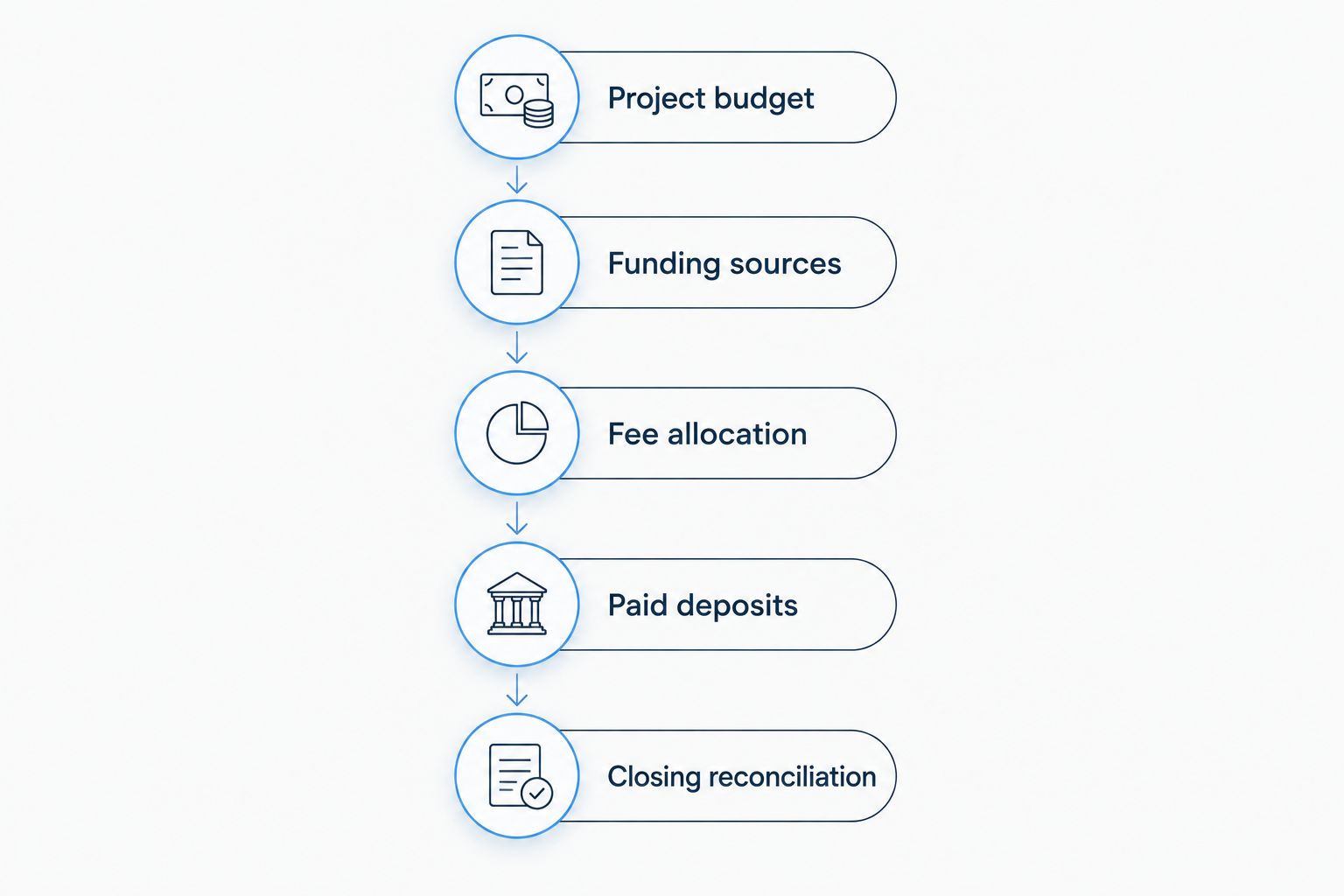
Use this sequence:
- Project budget: Reconcile the purchase or construction budget with approved project costs.
- Funding sources: Identify the first mortgage, CDC financing, and borrower contribution.
- Fee allocation: Mark each charge as financed, payable before closing, or payable at closing.
- Paid deposits: Reconcile payments already made and confirm any closing credits.
- Closing reconciliation: Match the final settlement figures to the latest approved financing documents.
The benefit is a clear separation between expenses and funding sources. The limitation is that the worksheet remains provisional until the financing participants approve its treatment of each cost.
Can I finance SBA 504 loan fees instead of paying them upfront?
Certain eligible SBA 504 financing costs can be included in the financed transaction, subject to program requirements and approval. Financed does not mean waived: you repay those costs as part of the debt.
Ask the CDC and participating lender to identify which charges qualify for financing and which require cash. Do not assume a general statement about financed closing costs covers every invoice.
The advantage is a lower immediate cash requirement for eligible expenses. The trade-off is a higher financed balance and interest on the amount borrowed. Review both effects before deciding how much cash to retain.
Are SBA 504 loan fees the same as a down payment?
SBA 504 loan fees are transaction expenses; the down payment is your equity contribution. A standard structure includes 10% borrower equity, but required equity can be higher, and your total cash requirement can exceed that contribution.
Keep reserves and other required deposits separate as well. A percentage-based down-payment discussion does not answer how much money must be available across the entire closing process.
Does paying off an SBA 504 loan early create another cost?
Early payoff can trigger a debenture prepayment premium, and the participating lender’s first mortgage has separate contractual terms. Request payoff treatment for both obligations rather than relying on a single verbal description.
SBA 504 debenture maturities include 10-year, 20-year, and 25-year terms. The loan term alone does not tell you the early-payoff expense; use the applicable documents and a dated payoff calculation.
If you expect to sell or refinance, compare that intended holding period with both loans’ provisions before signing. Upfront fees are only part of the financing decision.
What should I request before accepting a proposal?
Request a dated, itemized estimate that covers both financing components and the full closing sequence. Each line should identify its recipient, calculation basis, payment date, financing treatment, and refundability.
Flexvcapital is best suited to New York business borrowers seeking a direct commercial lender offering SBA financing. For a proposed 504 transaction, confirm the participating institutions, available structure, and responsibilities before treating any preliminary estimate as complete.
The most useful comparison is between written proposals with the same project assumptions. Ask for explanations of exclusions rather than choosing the document with the smallest visible subtotal.
Request an itemized financing review
Discuss SBA financing and the fee categories to confirm for your transaction.
FAQ
How much are SBA 504 loan fees in 2026?
SBA 504 loan fees in 2026 depend on the financing amount, applicable program charges, participating lender, and required closing work. Request a dated estimate separating upfront expenses, financed charges, and ongoing fees.
Can I roll SBA 504 closing costs into the loan?
Certain eligible SBA 504 closing costs can be financed, subject to program requirements and approval. Ask the CDC and participating lender to identify the treatment of each charge; financing a cost does not eliminate it.
Does the SBA 504 down payment cover all closing costs?
The SBA 504 down payment does not automatically cover all closing costs. A standard structure includes 10% borrower equity, but additional equity requirements and cash-paid expenses affect the total cash needed.
Do I pay fees to both the bank and the CDC?
An SBA 504 transaction can include charges associated with both the participating lender and the CDC financing. Obtain separate disclosures and reconcile them into one transaction budget.
Do I still owe appraisal fees if my SBA loan does not close?
Appraisal payment obligations depend on the engagement and cancellation terms. Confirm refundability and payment responsibility before authorizing the report rather than assuming payment depends on loan approval.
Is an SBA 504 prepayment penalty included in closing fees?
An SBA 504 debenture prepayment premium is a potential early-payoff expense, not an ordinary upfront closing fee. Review the debenture provisions and the participating lender’s separate prepayment terms.
Does Flexvcapital offer SBA financing?
Flexvcapital offers SBA financing as a direct commercial lender in New York. Ask which structure applies to your project and request an itemized estimate before comparing transaction costs.
One last thing
The same fee can appear in an early estimate, a financing worksheet, and a final settlement statement without representing three separate charges. Reconcile the recipient, purpose, and payment status before adding those documents together.
Before your 2026 closing, request a final change list against the earlier estimate. Every increase, credit, newly financed charge, and removed item should have an explanation—not just a revised total.